Short answer. Part-time work while studying abroad covers your living costs in most countries but rarely covers tuition. Monthly ranges are USD 800 to 1,400 in the US, CAD 1,200 to 1,800 in Canada, GBP 700 to 1,100 in the UK, AUD 1,800 to 2,400 in Australia, and EUR 600 to 900 in Germany.
Part-time work while studying abroad legally covers your living costs in most countries, but rarely covers tuition. The honest monthly range is USD 800 to 1,400 in the US, CAD 1,200 to 1,800 in Canada, GBP 700 to 1,100 in the UK, AUD 1,800 to 2,400 in Australia, and EUR 600 to 900 in Germany. Treat it as a rent and groceries buffer, not a tuition strategy.
Search “part time work while studying abroad for Indian students” and you will find dozens of posts claiming you can earn ₹7 to 12 lakh a year. Some push it higher. The headlines feel reassuring. The math behind them rarely holds up.
This post runs the actual numbers. Country by country. After tax. Measured against what those earnings cover in the city where you will actually live. The goal is not to discourage you from working part-time, it is to help you plan around what part-time income actually does, rather than what blog posts claim it does.
Faz's rulePart-time work funds your groceries and partially funds your rent. It does not fund your degree. Build your loan and savings to cover tuition entirely.
The ₹9-13L/year figures you see assume you work every permitted hour every week with no breaks, no illness, and no exam crunch. Net of tax, in the currencies you are spending, the number is real but it goes to living costs, not tuition repayment.
For the full guide, read Studying Abroad From India: Cost and Funding Guide.
The Variables That Determine What You Actually Take Home
Before the country breakdown, understand the four numbers that actually matter.
Weekly hours allowed during semester. Most countries cap student work at 20-24 hours per week while classes are in session. This is not negotiable, working beyond this limit risks your visa. During official university breaks, most countries allow unlimited work hours, but breaks account for roughly 16-20 weeks per year, not 52.
The wage rate. Minimum wage varies significantly. Australia sits at the high end. Germany sits at the middle. The UK and Canada fall in between. Many student jobs (retail, cafes, warehouses) pay at or just above minimum wage. Some campus jobs pay less. Skilled part-time work (research assistant, tutoring) can pay more but is not guaranteed.
Tax on low-income earners. Students are not exempt from income tax. Depending on the country and your annual income, you will pay somewhere between 0% and 25% of your earnings in income tax, plus possible social contributions. This is the number most Indian student income estimates ignore entirely. Gross figures and net figures can differ by 20-30%.
What those earnings cover. Taking home CAD 1,300 a month sounds meaningful until you see a one-bedroom room-share in Toronto listed at CAD 1,100. The purchasing power of your earnings depends entirely on the cost of living in your specific city.
Country-by-Country Income Reality
The figures below assume you work the full allowed hours during semester (20-24 hours/week depending on the country). In practice, most students work fewer hours during exam periods and thesis terms.
Faz's rulePart-time earnings cover 30-60% of monthly living costs, depending on city.
Sydney, London, and Toronto fall on the low end (around 30%). Adelaide, Manchester, and Halifax on the higher end (50-60%). The earnings-to-cost ratio is one of the most underestimated factors in study-abroad planning.
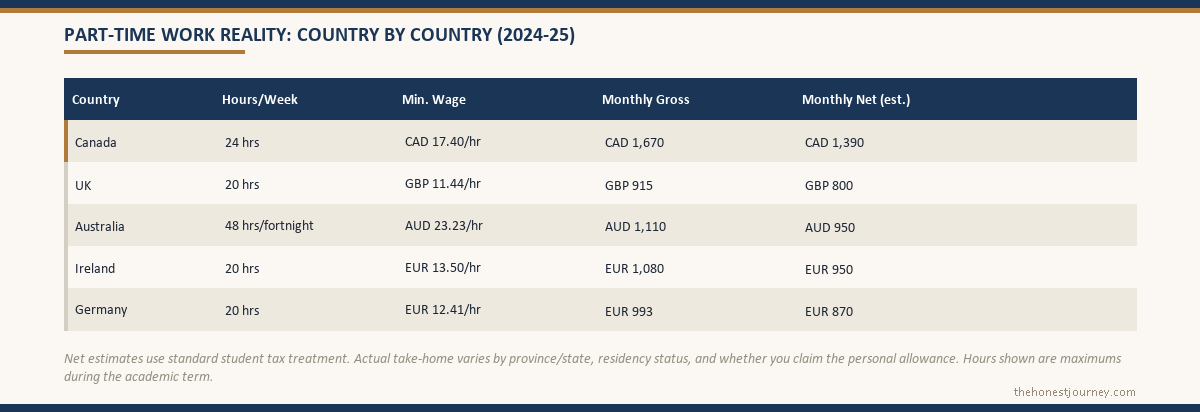
| Country | Hours Allowed (Semester) | Wage Rate | Monthly Net (After Tax) | Annual Net (INR Approx.) |
|---|---|---|---|---|
| Canada | 24 hrs/week | CAD 16-17/hr | ~CAD 1,300 | ~₹9.5L |
| Australia | 48 hrs/fortnight | AUD 23.23/hr | ~AUD 1,804 | ~₹13.2L |
| UK | 20 hrs/week | £11.44/hr | ~£793 | ~₹10.1L |
| Germany | ~20 hrs/week | €12.41/hr | ~€880 | ~₹9.6L |
Canada
Since 2024, international students in Canada can work up to 24 hours per week during semesters, with unlimited hours permitted during scheduled breaks. Minimum wage ranges from CAD 16 to 17 per hour depending on the province.
Working 24 hours at CAD 16.50/hr gives you a weekly gross of roughly CAD 396. After approximately 20% in federal and provincial income tax, your weekly net is around CAD 317. Monthly, that comes to approximately CAD 1,300.
At current exchange rates, that is roughly ₹79,000 per month, or ₹9.5 lakh annualised. It sounds like real money. Now compare it to Canadian costs. A shared room in Toronto or Vancouver runs CAD 1,200 to 2,000 per month. Groceries add CAD 300 to 400. You are at CAD 1,500 to 2,400 in basic expenses before transport, phone, or any personal spending.
In a lower-cost city (Winnipeg, Halifax, or a smaller Ontario town) the math improves. Rent can drop to CAD 700 to 900 for a shared room, and your CAD 1,300 monthly net covers a meaningful share of living costs. But tuition at a Canadian university for an international student runs CAD 25,000 to 45,000 per year. Part-time earnings do not touch that, which is why the honest guide to studying in Canada for Indian students treats the loan, not the part-time job, as the funding base.
Australia
Australia runs a fortnightly hours model, students are allowed 48 hours per fortnight, which works out to 24 hours per week. Australia’s minimum wage is the highest in this group at AUD 23.23 per hour.
At 24 hours per week, your weekly gross is AUD 557. Australia has a tax-free threshold of AUD 18,200 per year, which means students earning below this pay no income tax. If your part-time work keeps you below that threshold (which is possible if you are only working during semester) your effective tax rate could be close to zero. Working full hours year-round pushes you above the threshold, and you will pay around 19% on the portion above it.
At an effective tax rate of roughly 19%, your monthly net comes to approximately AUD 1,804, around ₹1.1 lakh per month, or ₹13.2 lakh per year. This is the highest figure in the group.
The catch is Australian living costs. In Sydney or Melbourne, a shared room costs AUD 1,200 to 2,000 per month. Groceries, transport, and utilities add AUD 600 to 800. You can spend more than you earn if you are in a major city. In a smaller city (Adelaide, Brisbane, or regional campuses) the math becomes genuinely workable. Your AUD 1,800 monthly net can cover rent, groceries, and leave a surplus. Tuition at an Australian university for international students runs AUD 30,000 to 50,000 per year, so the surplus does not come close to covering fees. The honest guide to studying in Australia goes deeper on what that funding gap looks like.
United Kingdom
The UK caps student work at 20 hours per week during term time. The National Living Wage for workers aged 21 and over is £11.44 per hour for 2024-25.
At 20 hours per week, your weekly gross is £228.80. After approximately 20% income tax, you take home around £183 per week. Monthly, that is roughly £793.
At current exchange rates, that converts to approximately ₹84,000 per month, or ₹10.1 lakh per year. Outside London, this covers groceries (roughly £200-250 per month) and contributes meaningfully toward student accommodation (£500-800 per month in most UK university cities). The math is tight but not impossible in cities like Coventry, Nottingham, or Sheffield.
In London, the numbers break down entirely. A room in a shared house in zones 3-4 costs £900 to 1,400 per month. Your £793 monthly net does not cover rent, let alone anything else. Students in London working part-time are generally reducing the deficit, not eliminating it. For more on studying in the UK relative to other destinations, the cheapest country to study abroad for Indian students comparison covers the full cost picture.
Germany
Germany sets student work limits at 120 full days or 240 half days per year. This averages to roughly 20 hours per week across the year. Germany’s national minimum wage is €12.41 per hour as of 2024.
At 20 hours per week, your weekly gross is approximately €248. Germany has generous low-income tax exemptions for students. If your annual earnings stay below the basic personal allowance (around €11,604 for 2024), you pay no income tax. Many students working 20 hours per week will be near or at this threshold. Assuming a minimal effective tax rate of around 10-15% when social contributions are included, your monthly net comes to approximately €880.
At current rates, that is around ₹80,000 per month, or ₹9.6 lakh per year. The reason Germany stands out is not the wage, it is the cost structure. In mid-size German university cities like Leipzig, Chemnitz, Magdeburg, or parts of Dresden, a room in a shared flat costs €350 to 600 per month. Groceries run €200 to 280. Your €880 monthly net can genuinely cover total living costs in these cities, leaving a small surplus. That makes Germany the one country in this group where part-time income most plausibly covers actual day-to-day expenses. Tuition, however, is a separate question, and public universities in Germany charge semester fees of €250 to 400, not tuition fees, so this is a structurally different cost model. If you’re considering Germany specifically, the honest guide to studying in Germany lays out how the loan requirements differ.
Faz's ruleAustralia pays the most per hour. Germany is where part-time earnings go the furthest because living costs are lower. The UK and Canada are in the middle.
If maximising part-time income is important to your plan, Australia has the highest minimum wage. But high Australian living costs, especially in Sydney and Melbourne, erode the advantage. Germany’s combination of €12.41/hr minimum wage and lower rental costs in mid-size cities makes the net impact on your budget relatively strong.
Where the ₹7-12 Lakh Figure Comes From, and Why It Misleads
The number is not fabricated. It is selectively constructed.
Most posts that quote ₹7-12 lakh per year are doing the following. They take the maximum allowed weekly hours (20-24). They multiply by the local minimum wage. They multiply by 52 weeks. They convert to rupees. They publish the result as “what students earn.”
Three problems with that method.
First, 52 weeks of full allowed hours assumes you work every single permitted hour, every week, for 52 weeks straight. In practice, students reduce hours during exam periods, dissertation terms, and over personal breaks. Most students working part-time through a master’s program work closer to 15-18 hours per week on average, not 24.
Second, the figure is gross. Income tax and, in some countries, social insurance contributions take 15-25% of it. Net take-home is consistently lower than the headline number.
Third, and most importantly, the figure is presented without context for what it covers. ₹9.5 lakh per year sounds like a significant contribution toward a degree that costs ₹25 to 50 lakh in tuition alone. It is not. It covers living expenses, partially. It does not reduce what you owe in tuition by a single rupee unless you are in Germany, where tuition as such does not exist.
The correct mental model is this: part-time work reduces how much money your family needs to transfer from India each month to cover your living costs. It does not fund your degree. The loan and savings you bring need to cover tuition entirely.
What Part-Time Work Actually Does Well
None of this means you should not work part-time. The case for working is real. It just needs to be framed correctly.
Part-time work during studies genuinely reduces your monthly family remittance by 30 to 60% in most countries, depending on city and hours worked. That is a meaningful reduction in ongoing financial pressure. It builds local work experience that is visible on a CV when you are applying for full-time graduate roles, employers in Canada, Australia, and the UK view local experience more favourably than internships done in India. It helps with language and professional integration, particularly in Germany and French-speaking Canada, where working alongside local colleagues accelerates language acquisition in ways that classrooms cannot. And it provides a partial hedge against exchange rate movements, if the rupee weakens during your degree, your local earnings in CAD, AUD, or GBP are worth relatively more.
These are the actual benefits. They are worth having. They are just not the same as “funding your degree.”
The Academic Cost Nobody Mentions
Twenty to twenty-four hours of work per week alongside a full-time master’s program is not a light commitment. A standard master’s program involves 15 to 20 hours of classroom time per week, plus readings, assignments, and group projects. Add 20-24 hours of paid work and you are looking at a 55 to 65-hour week as your normal operating mode.
Faz's rulePart-time work above 12 hours/week measurably impacts academic performance.
The published 20-hour weekly cap exists for a reason. Indian students who work close to the cap consistently report lower grades and slower thesis progress. Plan for 10-14 hours/week as the realistic limit if academic outcomes matter.
Students who sustain this through coursework semesters often manage. Students who continue at full working hours through their dissertation or thesis term frequently struggle. The thesis requires sustained focus over weeks and months. Splitting cognitive bandwidth between shift work and a 15,000-word research project is genuinely hard. Grade outcomes in thesis terms for students working full allowed hours tend to be lower than for students who reduce hours or stop working entirely during that period.
This matters for your return on investment. A master’s degree from a strong program delivers its financial payoff through where it places you in the job market. If working 24 hours a week through your dissertation produces a lower grade or a weaker thesis, the job you land on graduation may be lower than what the degree was capable of delivering. The income you earned during the degree does not offset a weaker graduate outcome over a multi-year career.
Plan to work during taught semesters. Plan to reduce significantly or stop during dissertation term. Build that into your financial model from the start, rather than counting on full income through the entire degree.
Faz's ruleIf you need part-time income to afford your monthly living costs, your loan is probably the right size. If you need it to make tuition payments, your loan is too small.
Part-time work as a living-cost buffer is a reasonable plan. Part-time work as a primary funding mechanism for a degree is a plan that fails whenever you have an exam week, a health issue, or a semester with a heavy workload. Size the loan for the full cost. Treat part-time income as upside.
The Honest Summary
Part-time income while studying abroad is real, it is meaningful, and it should be part of your financial plan. It typically nets ₹79,000 to ₹1.1 lakh per month depending on the country, assuming full allowed hours. After tax. In the local currency you are spending.
It covers a meaningful portion of your living costs in lower-cost cities. It covers almost nothing in London, Sydney, or Toronto if you are in a high-rent situation. It does not touch tuition. And it comes with an academic cost if you push it through thesis term.
Build your loan and family savings to cover your tuition entirely, and if you are still weighing how much to borrow, the education loan versus self-funding comparison is the right place to start. Model part-time income as a living-cost offset that reduces monthly remittance pressure. That is the version of this plan that actually works.
Your work rights are set by the visa, not the college, and the weekly hour caps vary more than people expect. The exact rules per country are in our student visa guides for Canada, Australia, the UK, Germany, Ireland and the Netherlands.
FAQ
How many hours can Indian students work while studying abroad?
It depends on the country and whether it is a semester or holiday period. In Canada, international students can work 24 hours per week during semesters and unlimited hours during official university breaks. In Australia, the limit is 48 hours per fortnight (equivalent to 24 hours per week) during semester. The UK allows 20 hours per week during term time. Germany permits 120 full days or 240 half days per year, which averages to roughly 20 hours per week. Exceeding these limits is a visa violation and can result in cancellation of your student visa.
How much can an Indian student realistically earn part-time in Canada?
At 24 hours per week on a CAD 16-17 per hour wage, your gross weekly earnings come to approximately CAD 384 to 408. After roughly 20% in combined federal and provincial income tax, your weekly take-home is around CAD 307 to 326, which translates to approximately CAD 1,300 per month. At current exchange rates, that is roughly ₹79,000 per month or ₹9.5 lakh annualised at full allowed hours. In practice, most students average fewer hours across the academic year, particularly during exam periods and dissertation term, so real annual earnings typically come in lower than the maximum figure.
Is part-time work enough to cover living costs while studying abroad?
In some cases, partially. In Germany’s mid-size university cities, part-time earnings of around €880 per month can cover most living costs where rent runs €350 to 600. In Australia’s smaller cities, AUD 1,804 per month can cover rent and groceries with a small surplus. In London or Sydney, part-time earnings fall significantly short of rent alone. In most cases, part-time work covers 30 to 60% of living costs, reducing how much you need to transfer from India each month rather than eliminating the need for outside funding. It does not cover tuition in any of these countries.
Can I work full-time during university holidays abroad?
In Canada, Australia, and the UK, yes, most student visa conditions allow unlimited work hours during official university break periods. Germany’s 120-full-day annual limit means unlimited hours in holidays come at the cost of fewer hours during semester, so the annual total is still capped. The key condition in all countries is that the break must be an officially scheduled university holiday, not a personal break you take between classes. Working full-time on a tourist break within your student visa period is generally not permitted and treating informal downtime as a “holiday” for work purposes is a visa risk.
Does working part-time while studying affect grades?
The evidence is fairly consistent: working 10 to 15 hours per week has a minimal effect on academic performance for most students. Working 20 to 24 hours per week during taught semesters is manageable for many students but demanding. The sharpest risk is in dissertation or thesis terms, where sustained focused work over weeks is required. Students working full allowed hours through dissertation term consistently report lower output quality and, in some cases, lower final grades. The practical recommendation is to work at or near full allowed hours during taught semesters, and to cut hours substantially (or stop entirely) during your dissertation or research project period. The grade you achieve on your thesis has a larger long-term income impact than the earnings you would have made during those 12 to 16 weeks.