Short answer. The Netherlands offers Indian students English-taught master’s at EUR 15K to 20K a year, a 1-year Orientation Year (Zoekjaar) visa, and starting salaries around EUR 40K to 55K gross. I find total annual costs land near ₹22L to 28L including living, meaningfully lower than the UK or US.
The trade-off is a competitive admissions bar at TU Delft, Eindhoven, and Erasmus, and a housing market you must lock down months before landing.
The Netherlands is one of the few European destinations where Indian students can study in English at globally ranked universities, fund the master’s with under ₹20L of debt for a 2-year program, and access a clear post-study work and residence permit pathway. It doesn’t get the attention Germany does (Germany still wins on tuition), or Ireland (Ireland wins on post-study work permit length), but for a specific kind of Indian student (engineering, business, computer science, or design with mid-tier credentials and a desire to stay in Europe long-term) the Netherlands math works better than the alternatives.
This post is the honest cost and outcome picture for a Netherlands master’s, written from the same angle as our Germany, Canada, Australia, and Ireland posts. Real numbers. Real trade-offs. Who fits, who doesn’t.
For the full guide, read Should I Study Abroad? The Honest Decision Guide.
Planning to bring a spouse? The Netherlands looks open on this and is effectively closed to students. The honest version is here.
The 60-second answer
The Netherlands offers 2,200+ English-taught master’s programs across 14 research universities (the WO category) and 36 universities of applied sciences (HBO). Annual tuition for non-EU students: €8,000-22,000 (₹7-19L) depending on the institution and program. Annual living costs: €11,000-15,000 (₹10-13L) depending on the city. Total 2-year master’s cost for Indian students: ₹14-22L per year all-in, or ₹28-44L total. Post-study work: the Orientation Year (Zoekjaar Hoogopgeleiden) provides a 12-month residence permit to find work after graduation. Long-term path to PR: 5 years of legal residence in the Netherlands qualifies for permanent residence. English-taught programs: strong in engineering, computer science, business, design, sustainability, agriculture, and water management. Best fit for: students with mid-tier Indian credentials targeting Europe-based careers in technical or design fields.
The cost picture in detail
Faz's ruleFree tuition for non-EU students ended in 2017. The honest cost today: ₹32-44L for a 2-year master's.
Tuition for non-EU students runs €8-22K per year at research universities, €8-13K at universities of applied sciences. Add €10-15K per year for living costs. Netherlands beats UK on cost but loses to Germany. The trade-off is English-medium program breadth.
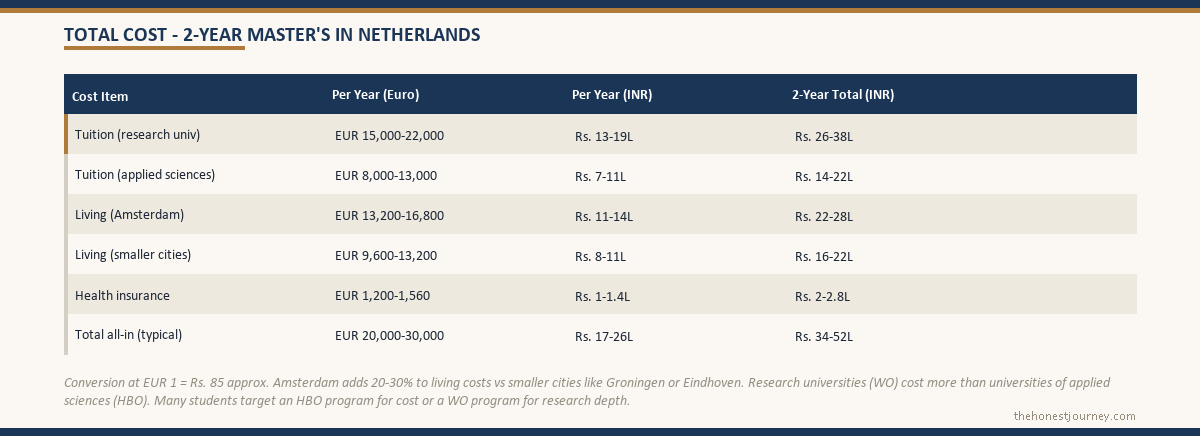
The Netherlands sits in a useful middle ground on cost between Germany (very low tuition) and the UK (high tuition). The numbers below are summarised here, and the full cost of studying in the Netherlands for Indian students breaks each one down further.
Tuition fees
For non-EU students (which includes Indian students), Dutch universities charge “institutional” tuition (higher than what EU students pay). The 2025-26 ranges:
Research universities (WO):
- Most programs: €15,000-22,000 per year
- Specialised technical programs: €18,000-25,000 per year
- Top-tier programs (TU Delft, Eindhoven, Erasmus, Wageningen): €16,000-20,000 per year
Universities of applied sciences (HBO):
- Most programs: €8,000-13,000 per year
- More practical, less research-oriented
- Often more directly tied to job market
For comparison: UK tuition (£14,000-25,000), Germany (mostly €0 + semester fee €500-800), Canada (CAD 20,000-30,000), Ireland (€10,000-25,000).
Living costs
By city, monthly expenses for a typical student (rent + food + transport + utilities + phone):
| City | Monthly cost | Annual equivalent |
|---|---|---|
| Amsterdam | €1,100-1,400 | €13,200-16,800 |
| Rotterdam | €900-1,200 | €10,800-14,400 |
| Utrecht | €1,000-1,300 | €12,000-15,600 |
| Eindhoven | €900-1,100 | €10,800-13,200 |
| Groningen | €850-1,050 | €10,200-12,600 |
| Wageningen | €800-1,000 | €9,600-12,000 |
| Maastricht | €900-1,100 | €10,800-13,200 |
Amsterdam is the most expensive, smaller cities like Groningen and Wageningen are 20-30% cheaper. Most Indian students target a balance: a strong university with a manageable cost of living.
Visa and pre-departure costs
Specific to Dutch visa requirements for Indian students:
- MVV (entry visa) + residence permit: €350 (paid by the university, deducted from tuition)
- Visa appointment costs: typically €60-100 in India
- Proof of funds: roughly €13,000 per year held in a Dutch or recognised Indian bank account before visa application
- Health insurance: €100-130/month after enrollment (mandatory)
- One-time setup: deposit on housing (typically 1-3 months rent), municipal registration, BSN (citizen service number) processes
Total pre-departure costs: typically €15,000-20,000 (₹14-18L) including proof of funds, tuition deposit, and first months of stay.
English-taught programs: where they cluster
Unlike Germany where you need to learn German for most programs, the Netherlands has the highest number of English-taught master’s programs in continental Europe.
Faz's ruleThe Netherlands has more English-taught master's programs than any other non-English European country.
Over 2,200 English-taught master’s across 14 research universities and 36 universities of applied sciences. For Indian students unwilling to learn German or French, this is the most accessible European destination by program breadth.
Strong English-taught fields
Engineering and Computer Science:
- TU Delft: among the top European technical universities
- TU Eindhoven: strong in industrial design, electrical engineering
- University of Twente: engineering, design, business
- Several HBO programs in software, mechatronics, mechanical engineering
Business and Economics:
- Erasmus University Rotterdam: globally ranked business school
- Tilburg University: economics, finance, marketing
- Amsterdam Business School (UvA): MSc Finance, MSc Management
- VU Amsterdam: International Business, Economics
Design and Architecture:
- Design Academy Eindhoven (Dutch design programs)
- TU Delft Architecture
- Various HBO programs in product design, fashion design
Agriculture, Water, Environment:
- Wageningen University: globally first in agriculture and forestry
- Delft on water management
- Utrecht on environmental science
Computer Science, AI, Data:
- Most major universities have English-taught MS programs in CS or AI
- Strong industry connections in Amsterdam, Eindhoven, Delft
Less common in English
Law: Most Dutch law programs are in Dutch. Limited English-taught LLM options.
Medicine: Mostly in Dutch. Internationally recognised but tough for Indian students without Dutch fluency.
Humanities: Mixed. Some English programs exist but less common than at Anglo universities.
The application timeline
Dutch application cycles are mostly January-April for September intake. Some programs have rolling admissions or January intakes.
September-October (Year 0): Identify target universities and programs. Prepare IELTS/TOEFL.
November-January: Application portal opens (typically Studielink + university-specific portal). Pay application fees (€60-100 per institution).
January-April: Application deadline window. Most TU Delft programs close in February for September intake.
April-June: Acceptance decisions. Provisional offers issued.
June-July: Pay tuition deposit (typically €5,000-10,000). Visa application started.
July-August: Visa decision, MVV issued.
September: Arrival, registration at municipality, university enrollment.
This timeline is similar to other European destinations. Visa processing for Indian students is reasonably efficient (4-6 weeks from MVV application).
The post-study residence pathway
The Dutch post-study pathway is one of the cleanest in Europe:
Step 1: Orientation Year (Zoekjaar)
After graduation, you qualify for a 1-year residence permit specifically to find work. No job offer required to obtain it. This permit allows full-time work in any sector during the 12 months. Cost: ~€220 application fee.
The orientation year must be applied for within 3 years of graduation. Most students apply immediately after.
Step 2: Knowledge Migrant (Highly Skilled Migrant) visa
After finding a job, you transition to a Knowledge Migrant residence permit. This requires:
- A job with a recognised sponsor (most major Dutch employers are recognised sponsors)
- A salary above the threshold: €2,801/month gross for graduates under 30 (2025 rate), €3,825/month gross for over 30 or non-recent graduates
- The salary threshold is achievable in most graduate jobs at Dutch companies (Philips, ASML, ING, Booking.com, etc.)
The Knowledge Migrant permit is renewable and converts the Orientation Year stay into long-term Dutch residence.
Step 3: Permanent residence
After 5 years of continuous legal residence, including the master’s degree years plus the orientation year and Knowledge Migrant period, you qualify for permanent residence (PR). PR allows unrestricted living and working in the Netherlands and is the gateway to Dutch citizenship.
Step 4: Citizenship (optional)
After 5 years of permanent residence (so 10 years total from arrival), citizenship is possible. The Netherlands requires renunciation of Indian citizenship if pursuing this (no dual citizenship for adults outside specific exemptions).
The full 5-year pathway from master’s start to PR is comparable to or slightly faster than Germany, similar to Ireland, faster than Australia.
Who Netherlands fits
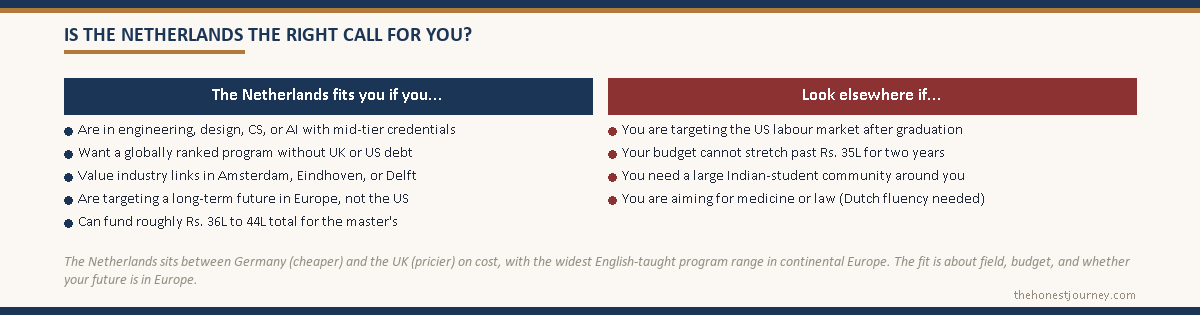
The Netherlands is a strong choice for:
- Engineering and design students with mid-tier Indian credentials targeting global tech/design careers
- Business students who want a globally-ranked program without UK/US debt
- Computer Science and AI students who want strong industry connections in Amsterdam, Eindhoven, or Delft
- Students targeting Europe long-term (not those primarily aiming for US/Canada)
- Students who can fund €18-22L per year all-in (so total ₹36-44L for the master’s)
Who it may not fit:
- Students targeting the US labour market post-graduation (US recruiters focus more on US institutions)
- Students whose budget can’t stretch to ₹35L+ for a 2-year master’s (Germany or Ireland may be cheaper)
- Students who need Hindi or regional-language networks (the Netherlands has a smaller Indian student community than UK, Canada, or US)
- Students targeting medicine or law (Dutch fluency required)
The honest comparison with similar destinations
For a typical Indian master’s-bound student:
| Country | Annual Cost (Total) | Course Length | Post-Study Work | PR Timeline |
|---|---|---|---|---|
| Netherlands | €18-24K (₹16-21L) | 2 years | 1 yr orientation | 5 years |
| Germany | €11-16K (₹10-14L) | 2 years | 18 months | 5 years (Blue Card path) |
| Ireland | €18-30K (₹16-26L) | 1-2 years | 2 years | 5 years to Stamp 4 |
| United Kingdom | £30-50K (₹31-52L) | 1-2 years | 2 years (Graduate Route) | 5 years |
| Australia | AUD 50-70K (₹26-36L) | 2 years | 18 months-4 years | Variable |
Netherlands beats Germany on language flexibility, beats UK on cost, beats Australia on PR pathway clarity, comparable to Ireland but with more program variety.
What’s not great
In the honest picture:
Housing crisis. Dutch student housing has been in shortage for several years, particularly in Amsterdam and Utrecht. Plan housing well in advance; some students arrive with no confirmed housing and live in temporary arrangements for weeks. Some universities (TU Delft, Eindhoven) have better student housing infrastructure.
Weather. Long winters, rainy, grey for much of October-March. For students from southern India, this can be an adjustment.
Cost of healthcare. Mandatory health insurance for international students is €100-130/month. This adds up over a 2-year stay.
Dutch language for everyday life. While university programs are in English, many cafes, government offices, and shops switch to Dutch. Learning basic Dutch helps but is not strictly required.
Smaller Indian community than UK/Canada/Australia. If a strong community network matters, the Netherlands has it in Amsterdam and Eindhoven but not at the scale of larger destinations.
Funding a Netherlands master’s from India
A Netherlands master’s lands in a comfortable middle of the cost range, but for most Indian families it is still a borrowed amount, so the loan math deserves the same honesty as the tuition tables above. A 2-year master’s at a research university, all-in, sits at roughly ₹32 lakh to ₹44 lakh. If you borrow ₹25 lakh of that, an education loan for the Netherlands at 11 percent over 10 years, after an 18-month moratorium where interest capitalises, leaves an EMI in the region of ₹36,000 to ₹40,000 per month. That is a meaningfully smaller monthly figure than a UK or Canada loan, which is the quiet financial advantage of the Netherlands.
The income side supports it. A new graduate on the Knowledge Migrant permit must earn at least the salary threshold to qualify, which is EUR 2,801 gross per month for recent graduates in 2025. In practice, graduate roles at recognised Dutch sponsors in engineering, tech, and business pay above that floor, often EUR 3,200 to EUR 4,000 gross per month. After Dutch income tax and the cost of living in a mid-size city, a disciplined graduate can route a real EMI home without the first-year squeeze that a Toronto-sized loan creates.
Two honest planning rules. First, choose the lender before you leave, because the rate gap between a nationalised bank and an NBFC compounds over a decade. The mechanics of that gap are laid out in the bank versus NBFC rate comparison. Second, decide deliberately between borrowing and self-funding rather than defaulting to a loan, a decision we work through in the loan versus self-funding guide. Because the Dutch total is lower than most English-speaking destinations, a partial self-fund plus a smaller loan is realistic for more families here than it would be for the UK or the US.
The student housing crunch and how to plan around it
The single most underestimated risk for an Indian student heading to the Netherlands is not tuition or visas. It is housing. The Dutch student housing shortage is structural and has run for years, and it is sharpest in Amsterdam, Utrecht, and Groningen. Every intake, a number of international students arrive with no confirmed room and spend their first weeks in hostels, short-term rentals, or a friend’s couch while they search.
The financial cost of this is real. Temporary accommodation in a Dutch city can run EUR 40 to EUR 80 a night, so three weeks of scrambling can quietly add EUR 1,000 to EUR 1,500 to your setup budget, money that was never in the original plan. There is also a deposit problem: most Dutch landlords ask for one to three months of rent upfront as a deposit, on top of the first month, so you may need EUR 3,000 to EUR 5,000 liquid the moment you sign a lease.
How to plan around it, honestly. Apply for university-managed housing the day the portal opens, because allocation is often first-come, and TU Delft and TU Eindhoven have stronger student housing infrastructure than the older city-centre universities. If you are targeting Amsterdam or Utrecht, treat a confirmed room as a precondition, not a detail to sort out after the visa. Budget a housing buffer of at least EUR 2,000 separate from your living costs. And be wary of housing scams aimed at international students, which the Dutch government and the official Study in NL portal both warn about: never transfer a deposit for a room you have not verified through the university or a recognised platform.
Part-time work and the return-to-India scenario
Indian students often ask whether part-time work can dent the cost. The honest answer in the Netherlands is: partly. Non-EU students can work up to 16 hours a week during term, or full-time during the summer holiday period, with the Dutch minimum wage for adults at EUR 13.27 an hour in 2025. At 16 hours a week through term plus a fuller summer, gross earnings land around EUR 7,000 to EUR 9,000 a year. After tax and the cost of getting set up, part-time work realistically covers 30 to 40 percent of your living costs. It does not touch tuition. Anyone telling you the degree “pays for itself” through a campus job is selling something. The realistic picture across destinations is in our part-time work while studying abroad guide.
The scenario almost nobody models is returning to India. Most Netherlands plans assume the Orientation Year leads to a Knowledge Migrant job, which leads to five years of residence, which leads to PR. For many students it does, and the Dutch pathway is genuinely cleaner than the UK or Canada. But a share of students return, by choice or because a job in the salary band did not materialise within the orientation year, and that branch deserves a number.
If you finish the master’s, work a year or two in the Netherlands, and then move back, you still carry the rupee EMI but now earn an Indian salary. A Netherlands-returned graduate in an Indian metro might earn ₹12 lakh to ₹20 lakh a year depending on field. An EMI of ₹38,000 a month is about ₹4.6 lakh a year, a heavy but survivable share of that income, and a much gentler return scenario than a UK-sized loan would produce. This is the quiet case for the Netherlands: the lower total cost means the worst-case branch is still manageable. Dutch master’s degrees are recognised in India under the equivalence frameworks overseen by the University Grants Commission, so a return is a setback rather than a disaster. The full financial model for staying versus returning is in our return to India after studying abroad guide.
Frequently asked questions
How much does it cost to study in Netherlands for Indian students?
Total cost for a 2-year master’s: typically €36,000-44,000 (₹32-44L) including tuition and living. Annual tuition for non-EU students: €8,000-22,000. Annual living costs: €10,000-15,000.
Is the Netherlands a good destination for Indian students?
Yes, for the right profile. Strong English-taught programs, decent cost (less than UK, more than Germany), clear post-study pathway, comparable PR timeline to Germany. Best fit for engineering, business, computer science, and design students.
Can I study in the Netherlands without learning Dutch?
Yes, for most master’s programs. 2,200+ English-taught programs are available across Dutch universities. Learning basic Dutch helps with everyday life but is not required for academic or post-study work purposes.
What is the Orientation Year visa in the Netherlands?
A 1-year residence permit after graduation allowing you to find work without restrictions. No job offer required to obtain it. Apply within 3 years of graduation. Cost: ~€220.
What is the salary threshold for Knowledge Migrant visa in Netherlands?
€2,801/month gross (2025 rate) for graduates under 30 and recent graduates. €3,825/month for others. Most graduate jobs at major Dutch companies meet this threshold.
How long is the path to PR in Netherlands for Indian students?
5 years of legal residence including master’s, orientation year, and Knowledge Migrant period. Cleaner than UK or Canada in terms of legislated certainty.
Are there scholarships for Indian students in Netherlands?
Several:
- Holland Scholarship: €5,000 one-time for non-EU students
- University-specific scholarships at most institutions (TU Delft, Erasmus, Wageningen, etc.)
- Orange Tulip Scholarships for Indian students specifically (across multiple universities)
We covered scholarship search strategies in the scholarships post.
Are Netherlands master’s recognised in India?
Yes. Dutch master’s degrees are recognised by the AICTE and UGC equivalence frameworks. Engineering and business degrees from Dutch research universities are widely accepted by Indian employers.
Can I work part-time during my studies in Netherlands?
Yes. International students can work up to 16 hours/week during the academic year and full-time during designated holiday periods (June-July-August). The minimum wage for adults is €13.27/hour (2025), so part-time work covers 30-40% of typical living costs.
Sorting the visa is the step most people underestimate. The full process, fees and funds proof for the Netherlands sit in the Netherlands student visa guide.
How does the Netherlands compare to Germany for Indian students?
Germany wins on tuition cost (almost free). Netherlands wins on English-taught program availability and language flexibility. Both have similar PR timelines (around 5 years). The choice depends on: language tolerance (German vs English-only), program field strength (Germany strong in engineering, Netherlands strong in business + tech), and city preferences.
For related decisions: the scholarships post covers the Holland Scholarship and other Netherlands-specific funding; the Germany post is the natural alternative European destination to compare; the Ireland post covers another English-taught EU destination with a different cost-benefit profile; and the part-time work post covers what students realistically earn in Netherlands and how that affects total cost.