Short answer. Studying in Germany as an Indian student costs roughly ₹12 to 18 lakh per year all-in, even though public university tuition is genuinely free, because living costs, blocked-account funding of EUR 11,904, and German language certification add up.
The free-tuition headline is real, the catch is B2 to C1 German, which takes 12 to 18 months and ₹1 to 3 lakh to certify and is the actual bottleneck for jobs outside English-medium tech roles.
Already graduated and want to job hunt in Germany instead? See the Opportunity Card points calculator.
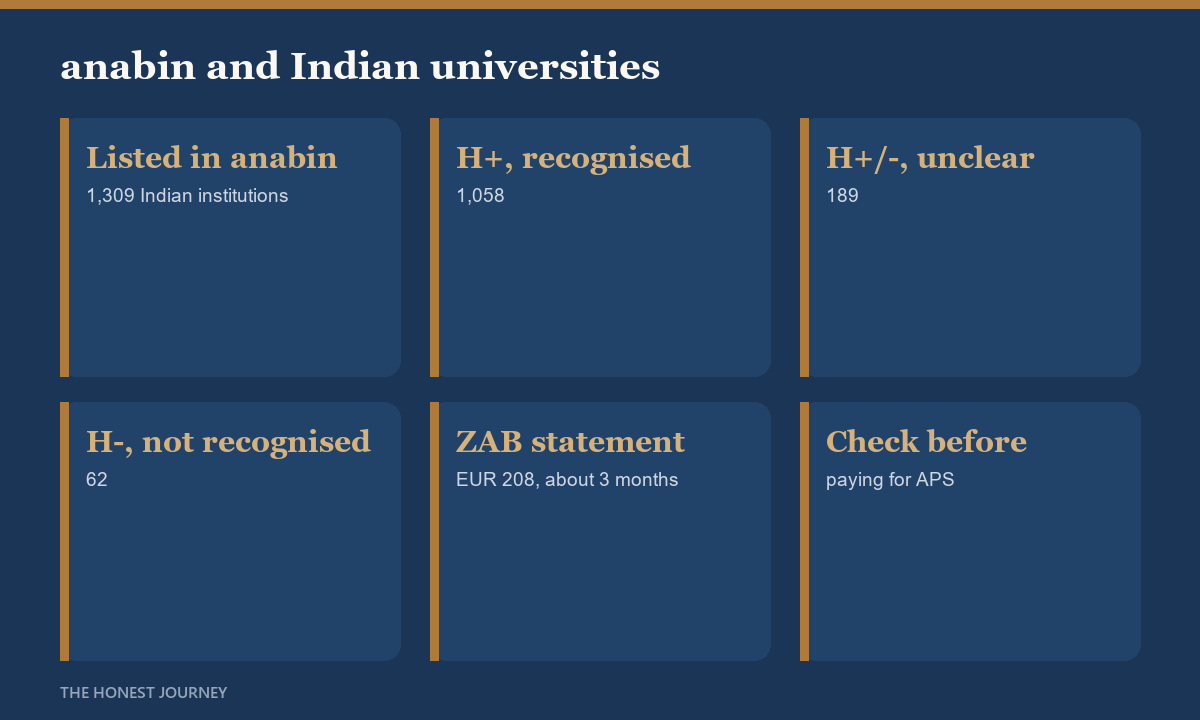
Before you apply, check that Germany recognises your university: anabin H+, H+/- and H- explained.
Before you apply, read how the APS certificate works: from the summer 2027 intake, some master’s applicants also need the dMAT test.
To see how your Indian grades convert, use the German grade calculator.
Budgeting for the blocked account? The blocked account calculator separates the deposit from what you actually lose.
Germany has a reputation that travels well: “free university education.” Indian parents forward the Wikipedia article, relatives mention it at weddings, and every education consultant has it on slide three of their pitch deck. The claim is real but incomplete, and the gap between “free tuition” and “free education” is where a lot of students get surprised.
This post breaks down what Germany actually costs, who it genuinely works for, and who is better off looking elsewhere.
For the full guide, read Studying Abroad From India: Cost and Funding Guide.
Many German programmes take no IELTS, but check the language of instruction first: a lot of them are taught in German and need TestDaF. See Germany without IELTS.
Planning for Germany? Winter is the real intake and Summer is thin, with fixed early deadlines. See intakes in Germany before you build your timeline.
The Tuition-Free Claim, Explained Correctly
Germany’s public universities do not charge tuition fees for undergraduate or most master’s programs. That part is true. Baden-Württemberg briefly introduced fees for non-EU students (around €1,500 per semester) but most states have rolled that back or kept it at zero.
Faz's ruleFree tuition is real at public universities, but the German language is the actual bottleneck.
B2-C1 German is required for most professional employment outside English-medium tech roles. The language certification takes 12-18 months and costs ₹1-3L. Factor this into the ‘cheap Germany’ calculation before treating it as the bargain destination.
What every student pays is a semester contribution (Semesterbeitrag) of roughly €250-400 per semester. This covers student union fees, administrative costs, and critically, a semester public transport pass (Semesterticket) that lets you ride buses and trains across your city or region for free. That transport pass alone is worth €400-600 a year in many cities, so the semester fee is not a raw cost, part of it replaces what you would have paid anyway.
The honest framing: you are not paying tuition, but you are absolutely paying to live, and Germany is not cheap.
Real Total Costs: What You Need to Budget
Faz's ruleTotal cost of a 2-year German master's: roughly EUR 11-16K per year all-in.
The cheapest serious European destination if the German language commitment is real. The blocked account requirement (EUR 11,904/year) is locked up in advance but returned in monthly instalments once you arrive.
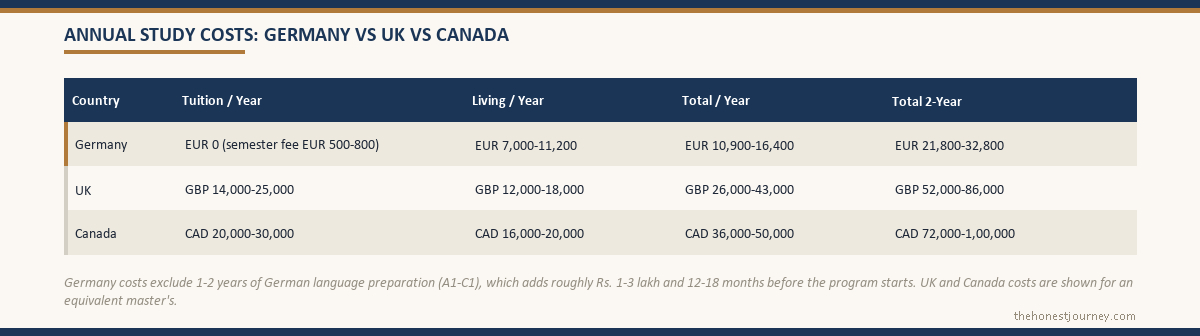
The German government requires international students to demonstrate they can support themselves before granting a student visa. The mechanism is a blocked account (Sperrkonto), and the required amount as of 2024-25 is €11,208 per year (€934/month). This is not a fee you pay to Germany, it is your own money, locked in a German bank account, released to you in monthly installments once you arrive.
You still need to fund this from somewhere, which means either personal savings or an education loan for Germany, and the loan interest clock runs from disbursement, not from graduation. That is the moratorium period interest problem, and it quietly inflates the real cost of a German degree.
Here is a realistic annual cost breakdown for a student in a mid-sized German city (not Munich, not Berlin). For a deeper line by line look, see the full breakdown of the cost of studying in Germany for Indian students.
| Expense Item | Annual Amount (€) | Notes |
|---|---|---|
| Rent (student dorm or shared flat) | €4,800 to €7,200 | €400-600/month; dorms cheaper but waitlists are long |
| Food and groceries | €2,400 to €3,600 | €200-300/month; cooking at home, mensa subsidised meals |
| Semester contribution | €500 to €800 | Twice a year; includes transport pass |
| Health insurance | €1,100 to €1,400 | Public statutory insurance; mandatory for students under 30 |
| Mobile, internet, misc | €600 to €900 | |
| Visa, travel, setup costs (Year 1) | €1,500 to €2,500 | One-time; visa fee, flights, initial deposits |
| Total (Year 1) | €10,900 to €16,400 |
Munich and Frankfurt push these numbers 20-30% higher. Cities like Leipzig, Dresden, or Dortmund are meaningfully cheaper. The blocked account minimum of €11,208 sits near the bottom of this range, it is designed to be a floor, not a comfortable budget.
Faz's ruleThe blocked account is your money, but you still have to fund it first.
When students say Germany is “free,” they mean tuition. They do not mean the €11,208 you need to lock up before you board the flight, money that typically comes from savings or a loan accruing interest from day one.
Language Reality: Which Programs Are Actually in English
This is where the Germany dream collides with reality for most Indian applicants.
At the undergraduate level, almost everything is in German. There is no realistic path to a bachelor’s degree at a public German university without B2 or C1 German, and in practice most programs want C1. If you are 17 and want to study engineering in Germany, plan 1-2 years of language preparation before you even apply.
At the master’s level, there are English-taught programs. The DAAD database of international programmes lists around 1,500+ English-medium master’s programs at German universities. Fields with reasonable English options include computer science, data science, electrical engineering, mechanical engineering, business informatics, and some programs in international relations or public policy.
The fields with thin English options include law, medicine, dentistry, psychology, social work, and most humanities programs. These are taught in German, require German-language entrance assessments, and lead to professions where German is the working language anyway.
Even in an English-taught master’s program, daily life and part-time work will require German. Groceries, housing contracts, bureaucratic appointments, part-time jobs at the university canteen or retail, all in German. If you are counting on it, read the honest numbers on part-time work while studying abroad before you build a budget around it. Students who arrive expecting to live in English are in for a difficult adjustment.
The Job Market After Graduation
This is the conversation that nobody has in the initial excitement phase.
Germany’s job market is predominantly German-language. Outside of two ecosystems (international tech roles in Berlin and Munich, and some multinational-heavy finance and consulting roles in Frankfurt), most professional jobs require conversational to fluent German. That means B2 minimum, C1 for anything senior.
The good news: Germany is actively trying to attract skilled immigration. The Skilled Immigration Act (Fachkräfteeinwanderungsgesetz) introduced in 2023 and expanded in 2024 makes it easier for Indian graduates to get work visas, and the government runs an official guide to it on the Make it in Germany portal. After graduating from a German university, you get an 18-month job-seeking visa automatically, not three or six months, eighteen months. This is a significant buffer.
The honest picture for Indian students: if you studied an English-taught CS or engineering master’s, speak at least conversational German (B1-B2), and are targeting Berlin or Munich tech, your post-graduation job prospects are genuinely good. Starting salaries for software engineers in Germany are typically €45,000-€60,000 gross. After German income tax and social contributions (which are high), take-home is lower than UK or US equivalents, but cost of living (outside Munich) is also lower.
If you are not in tech, do not plan to learn German to working proficiency, and expect to return to India in three years, the calculation changes significantly. You will spend 2-3 years building German language skills, pay German taxes as a resident, and then the degree’s value back in India depends heavily on your field. A German engineering or data science degree from TU Munich or RWTH Aachen is respected globally. A German degree in a field that has no Germany-specific premium offers less return on the time invested.
Faz's ruleGerman proficiency is not optional, it is the product you are actually buying.
The tuition savings versus UK or Canada look attractive on paper. But add the German language investment (1-2 years of courses, time, and opportunity cost) and the calculation is closer than the headlines suggest. Students who genuinely want to learn German and build a career in Europe come out ahead. Students who are minimising cost and planning to return to India in three years may find the maths does not work.
The Blocked Account: Mechanics and Loan Implications
To get a German student visa, you need to prove financial sufficiency. The primary way Indian students do this is a blocked account. The two most commonly used providers are Fintiba and Expatrio, both offer the account setup online before you arrive in Germany, charge a one-time setup fee (around €100-200), and release the monthly amount to your regular account once you are in Germany.
The process is: open a blocked account, transfer the required amount (€11,208 minimum per year), get a confirmation certificate, submit it with your visa application. Setup takes 1-3 weeks. You cannot access the funds until you land and activate the account with local identity verification.
For families using an education loan to fund the blocked account, the loan interest clock typically starts at disbursement. If your visa is delayed and you are waiting four months for the visa appointment, interest is accruing on €11,208 before you have set foot in Germany. Factor this into loan cost calculations. Most Indian banks offer education loans for Germany, secured loan interest rates (with collateral) run around 9-11% per annum; unsecured rates are higher. The gap is worth checking against the current education loan interest rate comparison for India.
One practical point: you need approximately €11,208 in the blocked account plus the first few months of other expenses (rent deposit, setup costs, flight) available separately. The blocked account is not a travel budget, it releases monthly, and the early months before the first release can be tight. Plan to arrive with at least €1,500-2,000 in accessible funds beyond the blocked account.
The Opportunity Card and Blue Card: Post-Study Pathways
Germany introduced the Chancenkarte (Opportunity Card) in 2024. This is a points-based visa that allows skilled workers (including those who want to test the German job market before having a job offer) to come to Germany for up to a year to look for work. You can work up to 20 hours a week during this period. It is not specifically a student visa, but it is relevant for graduates considering Germany as a destination after finishing studies elsewhere.
After graduating from a German university and finding qualifying employment, the standard route to long-term residence is the EU Blue Card. Requirements include a German university degree (or equivalent), a job offer with a salary of at least €45,300 gross per year in 2024 (lower threshold for shortage occupations: around €41,000), and an employment contract. The Blue Card leads to permanent residence (Niederlassungserlaubnis) after 21 months if you have B1 German, or 33 months without. Citizenship can follow in 5-8 years.
This pathway is real and functional. Germany is one of the few countries where the path from student to permanent resident to citizen is clearly legislated and relatively predictable. That is a significant advantage for students who want to settle in Europe long-term.
Faz's ruleGermany rewards settlers, not tourists. The system is built for people who plan to stay.
The 18-month post-study job search visa, the Blue Card, the relatively fast permanent residence route, these are all designed for people integrating into Germany, not passing through. If your five-year plan ends in Germany, these pathways are genuinely good. If your plan ends in Hyderabad or Toronto, you are optimising for the wrong thing.
Who Germany Is Genuinely Right For
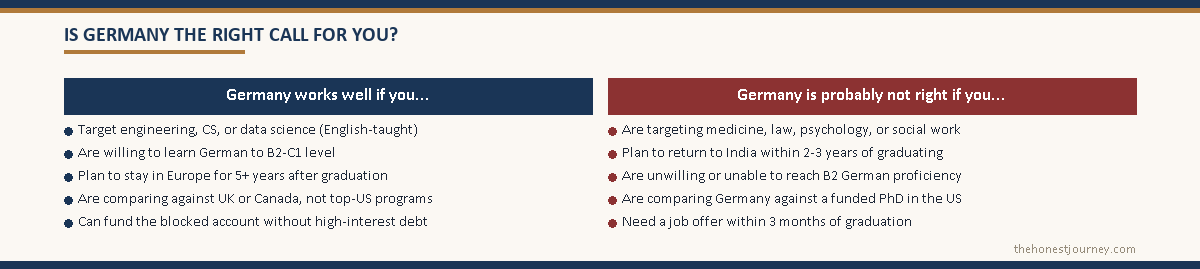
Germany works well if most of these apply to you:
- You are targeting engineering, computer science, data science, or a technical field with English-taught master’s programs at good universities (TU Munich, RWTH Aachen, KIT, TU Berlin, TU Dresden).
- You are willing to spend serious time learning German to at least B2, ideally C1, and you see this as an investment rather than a burden.
- Your five-year plan includes staying in Europe, not returning to India immediately after graduation.
- You are comparing Germany against the Canada study route or the UK (not the US), where total costs are significantly higher. If you like the low-cost European angle but want options beyond German-language hurdles, weigh it against our guides to studying in Italy for Indian students and studying in Sweden for Indian students, both affordable European routes with more English-taught programs.
- Your family can fund the blocked account without taking on high-interest unsecured debt, or you qualify for a secured education loan at reasonable rates.
Germany is probably not the right call if:
- Your target field is medicine, law, psychology, or any profession where Indian students need a German-language degree to have local value.
- You are planning to return to India in 2-3 years and your field does not specifically benefit from a German brand name.
- You are not willing or able to reach German language proficiency, the job market outside English-speaking tech corridors is essentially closed without it.
- You are comparing Germany against the US on the basis of research opportunities or specific university rankings at the top tier.
The “free tuition” headline is not wrong. Germany’s public universities genuinely do not charge tuition, and that is unusual in the world. But the honest total cost of studying in Germany for an Indian student is €10,000-16,000 per year, language preparation is a real investment of time and money, and the job market rewards people who commit to Germany rather than those who are optimising cost and planning to exit. Know what you are buying before you open that blocked account, and run your own return on investment math rather than trusting a brochure.
Health Insurance and the Hidden Setup Costs Nobody Quotes
Public health insurance is mandatory for students in Germany, and it is one of the costs that gets rounded down or skipped entirely in most “cheap Germany” pitches. As a student under 30 you pay the reduced student rate, which in 2024-25 sits at roughly EUR 120 to 135 a month once you add the statutory health and long-term care contributions. Over a two-year master’s that is around EUR 3,000, and it is not optional. The insurance certificate is a precondition for university enrolment, so you cannot defer it.
The first eight weeks in Germany are the most expensive of the entire degree, and the blocked account does not help here because it only releases EUR 934 a month. A typical arrival looks like this: a rent deposit of two to three months (Kaution) at EUR 800 to 1,500, the first month’s rent in advance, a furniture and kitchen starter spend of EUR 300 to 500 if the room is unfurnished, a city registration appointment, a SIM card, and a German bank account that often takes two to three weeks to activate. None of this waits for your monthly blocked-account release.
Plan to land with at least EUR 1,500 to 2,000 in accessible cash on top of the blocked account. Families who treat the blocked account as the whole budget end up borrowing from flatmates or putting setup costs on an Indian credit card at a poor exchange rate in the first month. If the funds are coming from a loan, those early forex charges and any TCS on the remittance are real money. The honest line: budget the first two months as if they cost double a normal month, because they do.
Public vs Private Universities and the Studienkolleg Detour
The free-tuition story applies to Germany’s public universities, and those are the ones worth targeting. Private universities exist, names like EU Business School or some of the international management schools, and they charge tuition that can run EUR 10,000 to 20,000 a year. They market hard to Indian students because that is their business model. A private German degree removes the single biggest reason to choose Germany in the first place, so unless there is a specific program you cannot get at a public university, the maths rarely works.
There is also a qualification gap that catches undergraduate applicants. A standard Indian Class 12 certificate is usually not accepted as direct entry to a German bachelor’s program. Most Indian students need either one to two years of completed study at a recognised Indian university first, or they have to clear a Studienkolleg, a one-year foundation course that ends in an assessment exam called the Feststellungsprüfung. The Studienkolleg itself is taught in German, which means you need B2 German before you even start the foundation year. Realistically that pushes a bachelor’s timeline in Germany to your Class 12 plus language preparation plus the foundation year plus the three-year degree.
This is why Germany is, in practice, a master’s destination for most Indian students rather than an undergraduate one. If you are 17 and set on Germany, the honest sequence is to do a year or two of a bachelor’s in India, build German to B1 or B2 in parallel, and then transfer or apply fresh. Trying to go straight from Class 12 into a German public bachelor’s is possible but slow, and the year of Studienkolleg is a real cost in time even when the tuition is zero.
A Realistic Two-Year Timeline and What It Costs Month by Month
The thing that surprises families most is not any single number, it is how long the runway is before the degree even starts. Here is an honest timeline for an Indian student targeting a Winter 2026 intake for an English-taught master’s.
Roughly 18 to 12 months out, you sit IELTS or TOEFL and, if you are committing properly, start German classes. A1 to B1 German through a structured course costs around ₹60,000 to 1,50,000 in India and takes eight to twelve months at a serious pace. Around 12 to 9 months out you shortlist programs and apply, often through uni-assist, which charges a per-application fee of EUR 75 for the first program and EUR 30 for each additional one. Plan for EUR 150 to 250 in application fees alone if you apply to four or five programs.
Around 6 to 4 months out, admission letters arrive and you open the blocked account, transferring roughly EUR 11,904 plus the EUR 100 to 200 setup fee. Then comes the visa appointment. This is the step that is hardest to control, because appointment slots at German consulates in India can be backed up by two to four months. The visa fee itself is modest at around EUR 75, but the waiting is where loan interest quietly accrues on money that is just sitting in a blocked account doing nothing.
Add it up and a student who starts seriously 18 months before intake spends real money the whole way through: language fees, English test fees, application fees, the blocked account, insurance prepayment, flights, and setup costs. None of it is tuition, and all of it is the actual cost of the “free” degree. The students who do well in Germany are the ones who saw this timeline clearly and funded it deliberately, rather than the ones who heard “free” and assumed the rest would sort itself out.
Sorting the visa is the step most people underestimate. The full process, fees and funds proof for Germany sit in the Germany student visa guide.
Deciding between destinations? Compare Germany vs Canada and Germany vs UK for Indian students.
Before you commit, weigh the payback: read is studying in Germany worth it for the honest ROI and years-to-repay math.
FAQ
Is studying in Germany really free for Indian students?
Public universities in Germany do not charge tuition fees, including for international students from India. You pay a semester contribution of €250-400 per semester, which covers administration and usually includes a public transport pass. However, you still need to fund your living costs (roughly €10,000-15,000 per year) and meet the blocked account requirement of €11,208 before your visa is approved. “Free” means no tuition bill, not no cost.
What is the blocked account requirement and how much do I need?
The blocked account (Sperrkonto) is a mandatory requirement for the German student visa. As of 2024-25, you need to deposit €11,208 per year (€934/month) into a German blocked account to demonstrate financial sufficiency. The money is your own, it is released to you monthly once you are in Germany. Providers like Fintiba and Expatrio let you open this account online before arriving. You will need this amount available in your savings or via an education loan before the visa application.
Can I study in Germany in English without learning German?
At the master’s level, yes, there are over 1,500 English-taught programs in fields like computer science, engineering, and business. At the bachelor’s level, almost all programs are in German, requiring B2-C1 proficiency. Even in an English-taught master’s, daily life and most part-time jobs require German. For long-term career prospects outside the international tech sector in Berlin or Munich, German language skills at B2 or above are effectively mandatory.
What are the job prospects after studying in Germany?
After graduating from a German university, you automatically receive an 18-month job-seeking visa. The tech sector in Berlin and Munich has a reasonable number of English-language roles, especially for engineers and data professionals. Outside tech, most professional roles in Germany require functional German (B2+). Starting salaries for engineers and tech professionals are typically €45,000-65,000 gross, with high tax and social security deductions. Graduates who invest in German language skills and target tech hubs have strong outcomes; those expecting to work in English across sectors will find the market limited.
How does an education loan work for Germany if there is no tuition to pay?
Indian education loans for Germany are structured around living costs rather than tuition fees. The loan typically covers the blocked account amount (€11,208), living expenses, travel, and setup costs. The total loan requirement for a two-year master’s is usually in the range of €25,000-35,000 (roughly ₹22-30 lakh at current rates), depending on city and lifestyle. Secured loans (with property as collateral) run at approximately 9-11% per annum. Interest begins from disbursement, so delays between loan disbursal and visa approval add to the cost.
Is Germany better than the UK or Canada for Indian students?
It depends heavily on your field and post-graduation plans. Germany’s total annual cost (€10,000-16,000) is lower than the UK’s (£25,000-40,000 including tuition) or Canada’s comparable range. Germany also offers a stronger long-term settlement pathway for those willing to stay. However, the UK and Canada have larger established Indian professional communities, more English-language job markets, and historically clearer post-study work routes. Germany wins on cost and European settlement pathway; UK and Canada win on English-language career flexibility and Indian professional networks.