Short answer. Studying in Canada as an Indian student in 2025-26 still makes sense if you target a designated learning institution, budget CAD 35,000 to 50,000 a year all-in, and accept that PR routes have tightened.
Federal caps cut new study permits by roughly 50 percent from the 2023 peak, and the post-graduate work permit now requires programs aligned to in-demand occupations. The math works for skilled-trade and STEM grads, less so for generic business diplomas at private colleges.
Canada used to be the obvious answer for Indian students who wanted a top-ranked university, a clear post-study work path, and a realistic shot at permanent residency. From 2018 to 2023, Indian students were the single largest international group at Canadian institutions, and the numbers kept climbing. Then 2024 happened.
The federal government introduced a 35% cap on new international student permits in 2024, then tightened it further, total international student approvals dropped by roughly 50% compared to the 2023 peak. Enrollment at smaller colleges collapsed. Some institutions lost majority of their international intake overnight. The signal was clear: Canada is still open, but it is being a lot more selective about who gets in and under what conditions.
This post is not about whether Canada is “good” or “bad.” It is about whether Canada is the right call for you, given where things actually stand in 2025-26. Real numbers. Honest tradeoffs. No consultant pitch at the end.
For the full guide, read Studying Abroad From India: Cost and Funding Guide.
The money side of Canada is split across companion pages: the cost of studying in Canada breakdown.
Timing a move to Canada? Winter is a genuine second intake, but the study-permit cap now gates when you can go. See intakes in Canada.
Why Canada became the top destination for Indians, and what changed
The appeal was always the combination: internationally respected universities, relatively affordable tuition compared to the US, a post-study work permit that was genuinely generous, and an Express Entry immigration system that actively valued Canadian study and work experience. For a middle-class Indian family willing to take on significant debt, it felt like a structured bet with a clear return path.
Faz's ruleCanada in 2024-2026 is mid-cycle policy change.
PGWP rules tightened, study permit caps introduced, post-study work pathways shifted. The data on what ‘Canadian study abroad’ looks like for Indians is changing every 6 months. Verify current rules at the IRCC portal before applying.
What changed is that the Canadian government decided the international student pipeline had grown too fast. The permit cap was introduced formally in January 2024, with provinces given quotas. The PGWP (Post-Graduate Work Permit) rules also changed: graduates from most college diploma programs that are not clearly linked to labor market needs no longer qualify for the full three-year PGWP. This is a significant shift from the old rules, where almost any graduating international student could get a PGWP matching the length of their program.
The result is a sharper divide between university degrees and college diplomas in terms of immigration outcomes. This matters enormously if your goal is permanent residency, not just the degree itself.
Faz's ruleResearch the institution, not just the country.
Canada’s immigration outcomes now depend heavily on whether you chose a university degree or a college diploma program. The country-level reputation does not override that distinction.
The real cost breakdown for Indian students
There are four cost buckets you need to plan for: tuition, living expenses, the GIC, and miscellaneous setup costs. The numbers below are in Canadian dollars unless noted, because that is how the billing works.
Faz's ruleToronto and Vancouver cost 20-30% more than Halifax, Saskatoon, or Winnipeg.
Same Canadian institutions, very different cashflow. A 2-year master’s in Toronto runs ₹50-60L all-in; the same program in a smaller city runs ₹35-42L. The city choice is a financial decision, not just a lifestyle one.
Tuition
| Program type | Annual tuition (CAD) | Approx. in INR (at 61 CAD/INR) |
|---|---|---|
| College diploma (2-year) | CAD 15,000 to 20,000 | ₹9.1 lakh to ₹12.2 lakh |
| Undergraduate degree (3-4 years) | CAD 25,000 to 35,000 | ₹15.3 lakh to ₹21.4 lakh |
| MBA / professional master’s | CAD 35,000 to 55,000 | ₹21.4 lakh to ₹33.6 lakh |
| STEM master’s (public university) | CAD 20,000 to 30,000 | ₹12.2 lakh to ₹18.3 lakh |
University of Toronto, UBC, McGill, and McMaster sit at the higher end. Smaller public universities in Saskatchewan, Manitoba, or New Brunswick tend to be CAD 18,000 to 25,000 per year for most programs. The prestige-to-cost ratio matters if you are financing through a loan.
Living costs
Toronto and Vancouver have had aggressive rent inflation since 2022. A one-bedroom apartment in Toronto near a university campus will cost CAD 2,000 to 2,600 per month. Shared accommodation drops this to CAD 900 to 1,400 per person. Smaller cities like Halifax, Waterloo, or Saskatoon run CAD 700 to 1,100 per month for a shared room.
Total annual living expenses (rent, groceries, transit, phone, health insurance) range from CAD 12,000 in a smaller city to CAD 20,000 in Toronto or Vancouver. Budget the higher number if you are applying to Toronto or Vancouver institutions. Indian students who have already been through the transition report that food costs can be managed (Indian groceries are widely available), but rent is the number that will decide your monthly pressure.
The GIC requirement
Canada requires international students to show proof of funds. The Guaranteed Investment Certificate (GIC) requirement as of 2024 is CAD 10,200 for the first year. We break this down fully in the Canada GIC guide. This is not a fee, it is a blocked deposit with a Canadian bank or approved financial institution that gets released to you in installments once you arrive. The money is yours, but it is locked until you land and complete the formalities.
In rupees, that is roughly ₹6.2 lakh that has to sit ready before your visa is processed. It earns a small amount of interest. The main cost here is the foreign exchange conversion and the fact that your family has to have this liquidity available before you even receive your visa.
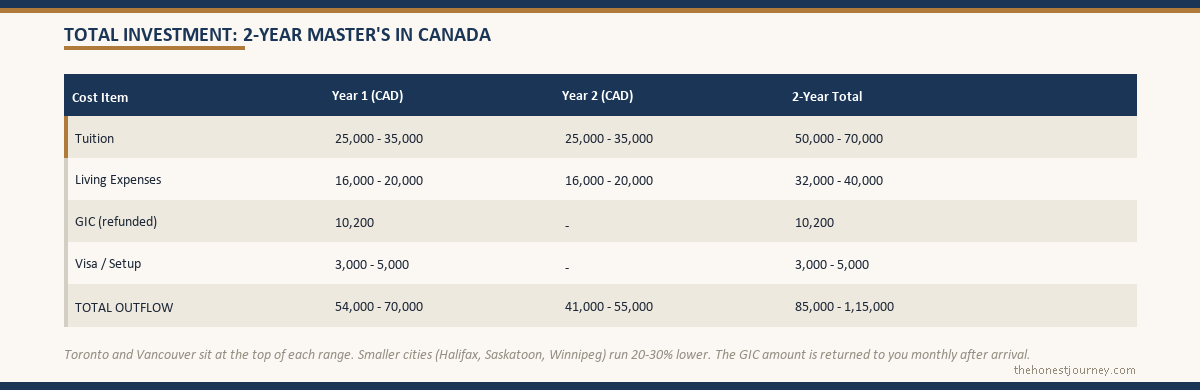
Total investment for a 2-year master’s program in Toronto
| Cost head | Amount (CAD) | Amount (INR approx.) |
|---|---|---|
| Tuition (2 years) | CAD 50,000 to 70,000 | ₹30.5 lakh to ₹42.7 lakh |
| Living expenses (2 years) | CAD 32,000 to 40,000 | ₹19.5 lakh to ₹24.4 lakh |
| GIC (refunded to you) | CAD 10,200 | ₹6.2 lakh |
| Visa, insurance, travel, setup | CAD 3,000 to 5,000 | ₹1.8 lakh to ₹3 lakh |
| Total outflow (ex-GIC return) | CAD 85,000 to 1,15,000 | ₹51.9 lakh to ₹70.2 lakh |
These are real numbers, not optimistic projections. Run them against any education loan you are considering, and check the bank versus NBFC interest rate comparison before you commit. The EMI math has to close on a realistic Canadian salary, not a best-case scenario.
Part-time work during your studies: 24 hours per week
Indian students often ask about earning during the course to offset costs. Canada allows international students to work up to 24 hours per week during the academic semester (the limit was 20 hours before 2023, then temporarily raised to unlimited, and has since settled at 24). During official breaks, you can work full-time.
Entry-level part-time work in Canada pays CAD 15 to 18 per hour in most provinces (minimum wage varies by province). At 20 hours per week for 40 weeks a year, that is roughly CAD 12,000 to 14,000 gross before tax. After income tax and assuming you are a student with limited deductions, take-home is around CAD 10,000 to 12,000 annually.
This does not come close to covering tuition, but it can cover a meaningful part of your living expenses if you are disciplined. The realistic picture across destinations is in our part-time work while studying abroad guide. The risk Indian students report is that finding on-campus or flexible employer jobs takes 2-3 months after arrival, and off-campus minimum wage jobs can interfere with coursework in demanding programs.
Faz's rulePart-time earnings cover rent, not tuition.
At 24 hours per week, you might net ₹6-7 lakh per year. That covers a shared apartment in a mid-size city. It does not put a dent in a ₹35 lakh tuition bill.
Post-study work permit and the immigration pathway
This is the section that determines whether Canada makes financial sense for you. The Post-Graduate Work Permit (PGWP) allows you to work in Canada after graduation for a period tied to your program length, up to 3 years for programs of 2 years or more.
What changed in PGWP rules in 2024
The key change: college diploma graduates now need to be in a program on the official approved list (linked to specific labor market needs) to qualify for PGWP. University degree graduates at public universities are still broadly eligible. Private college graduates face the most restrictions.
If you are doing a master’s or bachelor’s degree at a Designated Learning Institution (DLI) that is a public university, PGWP eligibility is largely unchanged. If you enrolled in a 2-year college diploma in business administration, hospitality, or a general field, verify explicitly whether your specific program at your specific institution still qualifies before you apply.
Express Entry and CRS points
Canada’s Express Entry system uses a Comprehensive Ranking System (CRS) score. Canadian study experience and Canadian work experience both add points. A master’s degree from a Canadian institution adds 30 CRS points. Working in Canada on PGWP in an NOC category 0, A, or B occupation adds further points. The Provincial Nominee Programs in Atlantic Canada and Manitoba actively target international graduates from their institutions.
The pathway still exists and is still functional. The honest caveat is that Express Entry CRS cut-offs have fluctuated significantly (from 481 to 520+ in different draw cycles in 2024), and a PGWP alone does not guarantee you will get an ITA. Language scores, job offer letters, and provincial nomination all become more important as the CRS floor rises.
Faz's rulePGWP is a head start, not a guarantee.
Three years of Canadian work experience and a master’s degree puts you in a strong position for PR. It is not automatic, and the CRS cut-off is a real variable you cannot control.
Who Canada works for in 2025-26, and who should reconsider
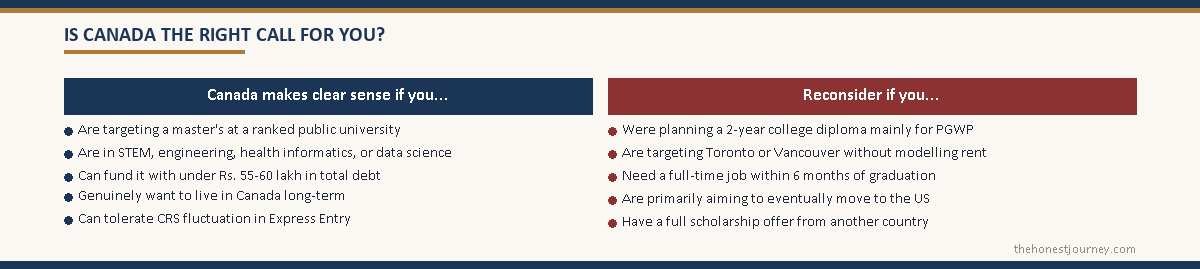
Canada makes clear sense if you
- Are targeting a master’s or bachelor’s degree at a ranked public university (not a private college)
- Are in a STEM, engineering, health informatics, or data-focused field where Canadian labor market demand is real
- Can fund the education without taking on more than ₹50-60 lakh in total debt, given realistic Canadian salary projections
- Have a genuine interest in living in Canada long-term, not just using it as a transit point to the US
- Can tolerate the uncertainty of CRS fluctuations in the immigration system
Canada deserves a harder look if you
- Were planning a 2-year college diploma primarily for PGWP access, the rules have tightened significantly here
- Are targeting Toronto or Vancouver and have not modeled the rent costs honestly
- Are carrying education loan pressure that requires landing a full-time job within 6 months of graduation
- Are primarily interested in eventually moving to the US, Canada is not an efficient stepping stone for US work authorization
- Are comparing Canada to a full scholarship at a strong institution in another country, perhaps Germany or the Netherlands
The honest version: Canada is a high-quality destination with a functioning immigration pathway. It is also more expensive and more competitive than it was three years ago, and the rules around post-study work and immigration have tightened. Go in with real numbers and clear expectations, not recruitment brochure assumptions. If you are still choosing between countries, see how Canada stacks up in our USA vs Canada, UK vs Canada and Canada vs Australia comparisons for Indian students.
Funding a Canada degree from India: the loan reality
Most Indian families do not write a ₹60 lakh cheque for a Canada master’s. They borrow. So the honest planning question is not “can I get into a Canadian university,” it is “does the loan math close on a realistic Canadian salary.”
Start with the total. A 2-year master’s in Toronto runs ₹52 lakh to ₹70 lakh all-in. If you borrow ₹45 lakh of that, an education loan at 11 percent over 10 years, after an 18-month moratorium where interest capitalises, leaves you with an EMI in the region of ₹65,000 to ₹72,000 per month. That is the number to test against your post-study income, not the headline tuition figure. Before you lock in a lender, our rundown of the best education loans for Canada shows which banks offer the rates and limits that make this math close.
Now the income side. A new graduate in Canada on a PGWP, in a skilled role, typically earns CAD 55,000 to 75,000 per year gross. After Canadian income tax, provincial tax, and basic living costs in a mid-size city, the disposable amount you can realistically send home toward an EMI is often CAD 1,200 to 1,800 per month, which is roughly ₹73,000 to ₹1.1 lakh at current exchange rates. The math can work, but it is tight in the first year, especially if it takes you two or three months to find that first job.
Three honest planning rules. First, decide your lender before you fly out, because rates differ sharply between a nationalised bank and an NBFC, and the gap compounds over a decade. Second, prefer a lender that lets you pay simple interest during the study period if your family can manage it, because that stops the moratorium interest from capitalising into the principal. Third, do not borrow the maximum just because it is sanctioned. A smaller loan in a cheaper Canadian city is a far calmer financial position than a large loan in Toronto. The deeper version of this decision sits in our loan versus self-funding comparison.
City choice is a financial decision, not a lifestyle one
Indian students tend to pick a Canadian city the way they pick a holiday destination, by reputation and vibe. That is the wrong lens when a loan is involved. The city you choose can swing your total cost by ₹15 lakh to ₹20 lakh over a two-year program.
Here is the spread in plain terms. A shared room in Toronto or Vancouver costs CAD 1,100 to 1,500 a month. The same shared room in Saskatoon, Winnipeg, or Halifax costs CAD 700 to 1,000. Over 24 months, that single line item differs by CAD 9,600 to 12,000, which is ₹5.9 lakh to ₹7.3 lakh. Add the higher cost of transit, groceries, and everyday spending in the big metros, and the realistic gap is closer to ₹15 lakh across the full program.
There is a second, less obvious financial angle. Atlantic Canada and the Prairie provinces run Provincial Nominee streams that specifically favour graduates from local institutions. A degree from a public university in Nova Scotia or Manitoba can give you a more direct provincial nomination route than the same degree in crowded Ontario, where the applicant pool is enormous. So the smaller city is sometimes both cheaper to live in and a faster immigration path.
The honest trade-off is the job market. Toronto and Vancouver have deeper tech, finance, and consulting markets. A smaller city has fewer roles, and for some fields, almost none. The right call is field-specific. If you are in a niche where employers cluster in two cities, the metro premium may be worth it. If your field has demand spread across the country, the smaller city wins on every financial measure. Either way, model the rent honestly before you accept an offer, the same discipline we apply in the cheapest country to study abroad breakdown.
The return-to-India scenario nobody plans for
Every Canada plan assumes the PGWP leads to a job, the job leads to Express Entry, and Express Entry leads to PR. For many students it does. But a meaningful share of students return to India, by choice or because the immigration math did not work out, and almost nobody runs that scenario before they borrow.
So run it now. If you complete the degree, work two years in Canada, and then return to India, what does the loan look like? You will still owe a large rupee-denominated EMI, but you will now be earning an Indian salary. A Canada-returned graduate in a metro Indian city might earn ₹12 lakh to ₹22 lakh per year depending on field and employer. An EMI of ₹65,000 a month is ₹7.8 lakh a year. On a ₹14 lakh salary, that is more than half your gross income going to one loan. It is survivable but heavy.
This is not an argument against Canada. It is an argument for borrowing an amount that does not become a crisis if the immigration pathway stalls. The CRS cut-off is genuinely outside your control, and treating PR as guaranteed is the single most expensive assumption an Indian student can make. The financial model for staying versus returning is laid out in detail in our return to India after studying abroad guide.
A practical hedge: pick a field and a university where the degree carries weight in India too, not only in Canada. A master’s that an Indian employer recognises and values means the return scenario is a setback, not a disaster. The recognition framework in India is governed by the University Grants Commission, and a degree from a ranked Canadian public university generally maps cleanly onto Indian equivalence norms. The point of honest planning is that both branches of the tree, stay and return, leave you standing.
Sorting the visa is the step most people underestimate. The full process, fees and funds proof for Canada sit in the Canada student visa guide.
Before you commit, weigh the payback: read is studying in Canada worth it for the honest ROI and years-to-repay math.
FAQ
Is it harder to get a student visa for Canada after the 2024 cap?
Yes, in practice. The cap reduced the total permits available, which means acceptance rates at many colleges dropped sharply. University programs at ranked public institutions were less affected than college diploma programs. Your institution’s DLI status and whether they have been allocated permits in your intake year both matter. Apply early and verify that your institution is still actively accepting international students for the semester you are targeting.
What is the GIC and do I get the money back?
The Guaranteed Investment Certificate (GIC) is a CAD 10,200 deposit required to demonstrate you have funds for your first year. You deposit it with an approved financial institution before your visa is processed. Once you arrive in Canada and complete the GIC setup with your bank, it is released to you in scheduled installments, typically monthly over 12 months. The money is yours. The cost to you is the foreign exchange conversion and the fact that it has to be liquid before your visa approval.
Can I work 24 hours a week throughout my degree?
Yes, during academic sessions. During official semester breaks (typically December-January and April-August depending on your institution), you can work full-time with no hour restriction. The 24-hour limit applies when classes are in session. You need a valid study permit and must be actively enrolled to maintain this work authorization.
Which Canadian cities are cheaper for Indian students?
Halifax (Nova Scotia), Saskatoon (Saskatchewan), Winnipeg (Manitoba), and St. John’s (Newfoundland) are consistently cheaper than Toronto and Vancouver. Rent in Halifax for a shared room runs CAD 700 to 950 per month compared to CAD 1,100 to 1,500 in shared Toronto accommodation. Atlantic Canada also has specific immigration programs like the Atlantic Immigration Program that favor graduates from institutions in that region. The tradeoff is a smaller job market, especially in tech and finance.
Does a Canadian degree help for US jobs or immigration?
Not directly. A Canadian degree does not give you any advantage in the US H-1B lottery, which is the main bottleneck for Indian students aiming for US work authorization. Some Canadian universities have strong alumni networks and recruiting pipelines with US employers, but this is program-specific and employer-specific. If your end goal is the US, a Canadian degree is not a reliable shortcut.
What is the realistic timeline from landing in Canada to getting PR?
A typical path: 2-year master’s program, followed by up to 3 years on PGWP working in a skilled occupation, followed by Express Entry application. Total: 4-5 years from landing to potential PR invitation. This assumes you maintain employment in an eligible NOC category, maintain language score requirements (IELTS 7+ or CLB 9+), and that the CRS cut-off in the draw cycles you are eligible for is within range of your score. It works for many people. It is not guaranteed for everyone.