Short answer. The GIC for a Canadian student visa is a mandatory CAD 20,635 (about ₹12.7 lakh in 2025) you deposit with a Canadian bank before your visa is processed, and most Indian education loans do cover it as part of the sanctioned amount.
The money is yours, returned in monthly installments of roughly CAD 1,720 over your first year in Canada. The trap is timing, the deposit is locked before you fly, but loan disbursement and interest start the moment it leaves your account.
If you are applying for a Canadian student visa, you will run into something called the GIC requirement. Many students assume it is some bureaucratic formality or an optional deposit. It is neither. The GIC is a mandatory financial proof requirement that costs real money, and if you are taking an education loan to study in Canada, you need to understand exactly how the GIC fits into your total funding picture before you apply.
This post covers what GIC actually is, how much it costs in rupees, whether your education loan can cover it, and the specific cash-flow trap that catches unprepared students.
For the full guide, read Studying Abroad From India: Cost and Funding Guide.
For the rest of the Canada picture: the USA vs Canada comparison, the UK vs Canada comparison, and the cost of studying in Canada breakdown.
What is GIC and why Canada requires it
GIC stands for Guaranteed Investment Certificate. For the purposes of the Canadian student visa (Study Permit), Immigration, Refugees and Citizenship Canada (IRCC) requires most international students from designated countries, including India, to purchase a GIC from a participating Canadian financial institution.
The GIC requirement exists because Canada wants proof that you can cover living expenses during your studies, not just tuition. The government essentially mandates that you lock a fixed amount into a Canadian bank account before arriving. Once you land and set up your account, the bank releases that money to you in monthly installments over the first year.
It is not a fee you lose. It is not a scam. The money comes back to you. But you have to have it upfront, in Canadian dollars, before your visa is processed.
Faz's ruleGIC money is yours, but it is locked until you land in Canada.
The GIC is not a visa fee or a government charge. You are parking your own money in a Canadian bank before arriving. The bank releases it to you monthly once you are there. The catch is you need to fund it before your visa is approved.
How much does the GIC cost in 2024
As of 2024, the IRCC proof of financial support guidance requires a GIC of CAD 10,200 for most students. This breaks down as follows:
| Component | Amount (CAD) | Purpose |
|---|---|---|
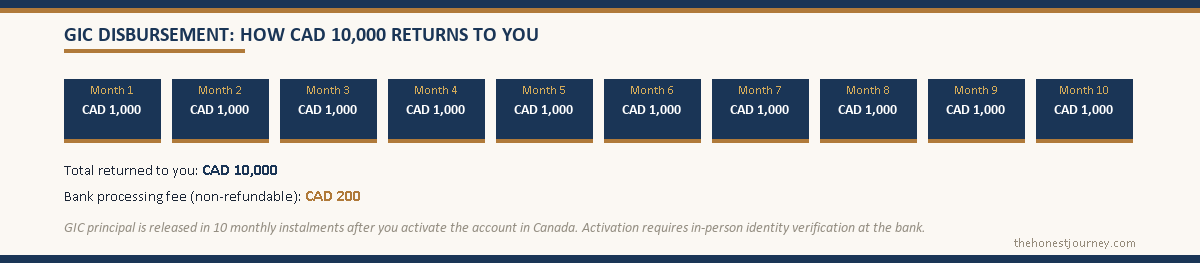
| GIC principal | 10,000 | Released to you monthly as living allowance |
| Bank processing fee | 200 | One-time fee kept by the bank, non-refundable |
| Total required | 10,200 |
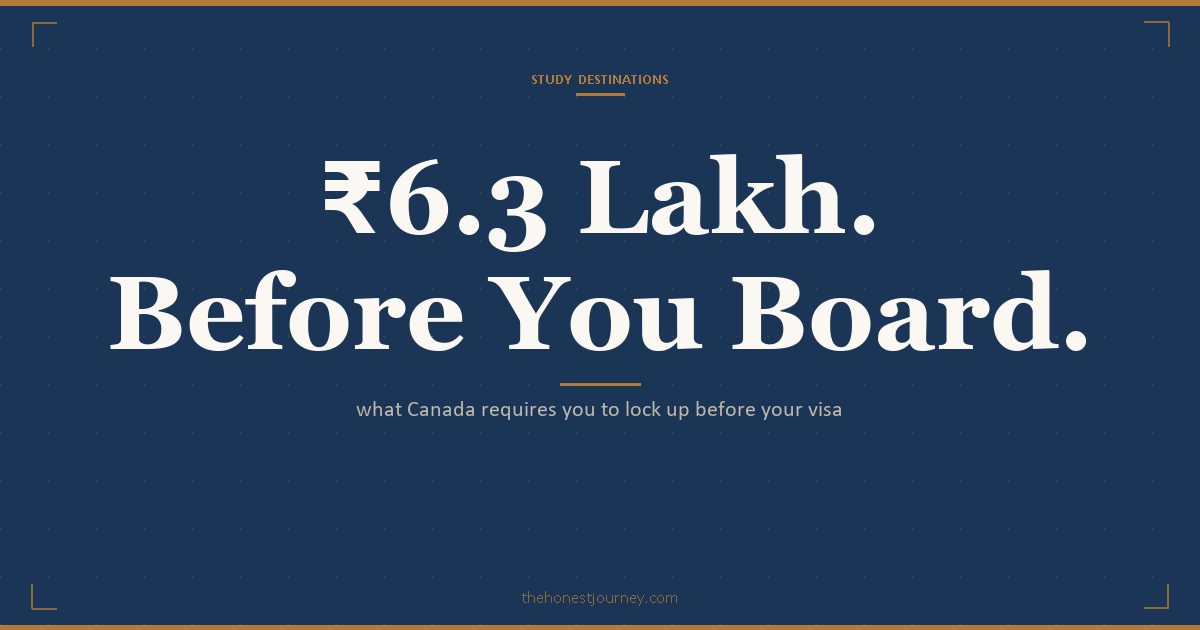
At an exchange rate of approximately ₹62 per CAD (mid-2024 rates), the total outflow is roughly ₹6.3 lakh. The exchange rate fluctuates, so the actual rupee figure at the time you send the wire will differ. Budget for ₹6.5 to 7 lakh to be safe.
Once in Canada, the CAD 10,000 principal is disbursed to you over approximately 10 months at around CAD 1,000 per month. The CAD 200 processing fee is non-refundable under any circumstances.
Which students are required to purchase a GIC
The GIC requirement applies to students who are citizens or residents of countries on IRCC’s designated list. India is on the list. If you are applying for a Canadian Study Permit from India, you will almost certainly need to submit GIC proof as part of your application.
There are limited exemptions, including students enrolled in programs of six months or less, and certain exchange students. For the vast majority of Indian students pursuing a one or two year postgraduate program or a four year undergraduate degree, the GIC is mandatory.
Check the IRCC website directly for the current list, because the IRCC study permit document checklist was updated in late 2023 and the requirement was extended to additional applicant categories.
Does an education loan cover the GIC
This is the question most students get wrong. The short answer: sometimes yes, but not automatically, and many banks exclude it by default.
Faz's ruleMost education loans cover the GIC, but you have to ask for it specifically.
PSU banks default to tuition-only disbursement and treat the GIC as a separate visa-funds tranche. NBFCs are more flexible. Confirm at sanction stage that the GIC is included; do not assume.
Indian education loans from nationalized banks (SBI, Bank of Baroda, Canara Bank, etc.) and NBFCs are structured around specific allowable expenses, and it helps to know in advance exactly what an education loan covers. The standard list includes tuition, living expenses, travel, and study materials. GIC does not fit neatly into any of these categories because technically it is not an expense, it is a refundable deposit in a foreign bank account.
Here is the practical reality by lender type:
| Lender type | GIC coverage | Condition |
|---|---|---|
| Public sector banks | Often excluded by default | Must be explicitly requested and shown in the university’s cost sheet |
| Private banks | Varies by product | Some include it under “pre-departure expenses” if documented |
| NBFCs | More flexible | Will include if GIC amount is in the sanction letter scope |
The only way to confirm is to ask your loan officer directly, in writing: “Is the GIC amount of CAD 10,200 included in my sanctioned loan amount?” Do not assume. Do not guess.
Faz's ruleAlways get GIC coverage confirmed in writing before counting on your loan for it.
Ask your bank officer specifically whether the GIC is covered in your sanctioned amount. Get it in writing. Many students discover on disbursement day that the GIC is excluded, leaving them scrambling for ₹6 lakh from their own pocket.
Self-funded GIC vs loan-funded GIC
If your education loan does not cover the GIC, you have to fund it from your own savings or family funds. This is not rare, a large portion of students end up funding the GIC separately.
Faz's rule₹6.3 lakh upfront for the GIC, returned over 10 months once in Canada.
Plan for both the cashflow lockup before arrival and the non-refundable bank processing fee (CAD 200) that comes out of the principal. The net inconvenience is cashflow timing, not absolute rupees lost.
The sequencing matters here. You need to submit the GIC purchase confirmation to IRCC as part of your Study Permit application. That means the money has to leave your Indian bank account and reach the Canadian bank before your visa is approved, which happens before you travel, and well before your first loan disbursement covers tuition in Canada.
If you are planning to self-fund the GIC:
- Confirm you have ₹6.5 to 7 lakh in liquid savings available to send abroad before your visa application
- Factor in the time for wire transfer processing (typically 2 to 5 business days through your Indian bank)
- Keep documentation of the transfer for both your visa application and your income tax records in India, since the remittance may attract TCS on foreign remittance
- Understand that this money is tied up for up to 10 months after you arrive in Canada before it is fully returned to you
The double-cost trap: total funding you actually need
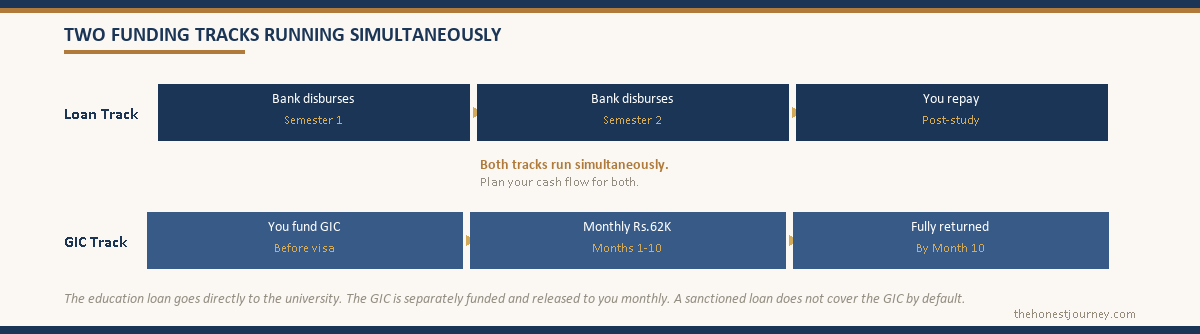
Here is where most students underestimate their total requirement. When you plan a Canadian education budget, you have two parallel funding tracks running at the same time:
Track 1, Education loan disbursal track: Your Indian lender releases money directly to the Canadian university for tuition. This typically happens in one or two tranches aligned with the academic calendar. If you are still deciding which lender to approach, our guide on the best education loan options for Canada compares what the major banks actually sanction.
Track 2, GIC track: You (or your loan, if it covers it) fund the GIC account before you arrive. This money is then released back to you monthly for living costs once you are in Canada.
These two tracks do not cancel each other out. You need enough to fund both at the same time. A student with a ₹50 lakh education loan covering tuition, often an unsecured loan without collateral, still needs ₹6.5 to 7 lakh for the GIC sitting in their bank account before the visa is approved.
Faz's ruleBudget for GIC separately from your loan, even if your loan is fully sanctioned.
A sanctioned loan does not mean the GIC is covered. Most loan disbursements go directly to the university. Your GIC funding is a separate liquidity requirement that has to be met before your visa is even approved. Plan for it as a distinct cash outflow.
What happens to the GIC money if you do not go
If your visa is refused or you choose not to travel, what happens to the GIC deposit depends on the bank and the stage of the process.
Before you purchase the GIC (that is, before you wire the money to the Canadian bank), nothing happens, you simply do not send the money. After you purchase the GIC but before you activate it in Canada, most participating banks will refund the CAD 10,000 principal, minus administrative fees. The CAD 200 processing fee is almost always non-refundable.
The refund process typically takes 6 to 8 weeks and the money returns as a wire in Canadian dollars back to the Indian bank account you sent it from. Exchange rate fluctuations during the holding period mean you may receive slightly more or less in rupees than you sent.
Read the specific terms of the Canadian bank’s GIC product before purchasing. Refund policies differ between institutions.
Practical checklist before you apply
- Confirm whether your education loan sanction letter explicitly includes the GIC amount
- If not included, confirm you have ₹6.5 to 7 lakh in liquid funds available before your visa application date
- Check the current IRCC GIC requirement amount directly on the IRCC website, the CAD 10,200 figure is current as of 2024 but may change
- Purchase the GIC only from a bank on IRCC’s approved participating financial institution list
- Keep the GIC confirmation letter from the bank, this is a required visa document
- Factor the GIC timeline into your overall application schedule, wire transfers and GIC issuance can take 1 to 2 weeks
GIC vs proof of funds: the SDS route changes the math
The GIC does not exist in isolation. It is the centrepiece of what used to be called the Student Direct Stream, the faster study permit processing route, and even after IRCC retired the formal SDS program in late 2024, the GIC plus upfront tuition payment remains the strongest financial profile you can present.
Under the standard route, you can in principle show proof of funds through bank statements, fixed deposits, or a loan sanction letter rather than a GIC. In practice, for Indian applicants, a fully funded GIC is treated by visa officers as the cleanest, least ambiguous evidence that living costs are covered. A pile of bank statements invites questions about the source of funds and how long the money has been held. A GIC answers those questions before they are asked.
This is why I would not think of the GIC as an optional cost to minimise. Even if your education loan technically lets you show proof of funds another way, the GIC route reduces the chance of a refusal, and a refusal costs you a full application cycle plus the fee. The roughly ₹6.3 lakh is not just a deposit. It is also buying you a lower-friction visa decision. If Canada is one of several countries you are weighing, the broader cost picture is laid out in the cheapest country to study abroad comparison.
How the GIC interacts with your education loan margin money
Here is a connection most students miss entirely. Indian education loans, especially secured loans from public sector banks, almost always carry a margin money requirement. Margin money is the share of the total cost the bank expects your family to fund directly, typically 10 percent for studies abroad. On a ₹40 lakh total cost, that is ₹4 lakh the family puts in from its own pocket.
If your loan does not cover the GIC, the GIC funding and the margin money requirement land at almost the same time, before you travel, and both come from family savings. A family that budgeted ₹4 lakh for margin money can be blindsided when the GIC adds another ₹6.3 lakh of upfront liquidity demand on top. That is over ₹10 lakh in cash needed before a single loan rupee is disbursed.
The cleaner play, where possible, is to negotiate the GIC into the sanctioned loan amount so it counts toward the financed portion rather than sitting outside it. Some lenders will treat the GIC as part of living expenses if the university cost sheet lists it. Read the margin money explained post before your sanction meeting so you can map the full upfront cash requirement, GIC plus margin plus visa fees, in one go rather than discovering it piecemeal.
A realistic GIC timeline, week by week
Students underestimate how long the GIC step takes and end up compressing it dangerously close to the visa deadline. Here is a realistic sequence.
Week 1. Choose a participating Canadian bank and open the GIC application online. The application itself is quick, but document verification of your passport and acceptance letter can take a few business days.
Weeks 2 to 3. Arrange the wire transfer from your Indian bank. This is the step that runs long. Your Indian bank needs the remittance paperwork under the Liberalised Remittance Scheme, the funds clear in 2 to 5 business days, and the Canadian bank then needs time to confirm receipt and issue the GIC certificate. Currency conversion happens at the rate on the transfer date, which is why budgeting a buffer above the headline figure matters.
Week 4. Receive the GIC confirmation letter. Only now can you submit a complete study permit application, because the GIC letter is a required document.
From the date you decide to buy the GIC to the date you hold the certificate, plan for three to four weeks, not three to four days. If your loan is funding the GIC, add the lender’s own disbursement timeline on top, because the bank has to release that tranche before the wire can go out. A delay here cascades into a delayed visa application and potentially a missed intake. If you are still comparing destinations on processing speed and cost, the wider guide to studying in Canada covers how the GIC fits the overall application calendar.
FAQ
Is the GIC a mandatory requirement for all Indian students applying for a Canadian Study Permit?
For most Indian students applying for a Study Permit to pursue a full-time program of more than six months in Canada, yes. India is on IRCC’s designated country list. There are narrow exemptions for short programs, certain exchange arrangements, and applicants who already have a close family member with permanent residency in Canada. Check the current IRCC policy directly because the list of exemptions has been updated recently.
Can I use my education loan to fund the GIC?
Only if your loan sanction explicitly includes the GIC amount. Most public sector bank education loans do not include it by default because the GIC is technically a refundable deposit, not an academic expense. You need to ask your loan officer directly and confirm in writing. Some private banks and NBFCs are more flexible about including it if you document it properly in the loan application stage.
How much is the GIC in Indian rupees in 2024?
The required amount is CAD 10,200 (CAD 10,000 principal plus a CAD 200 non-refundable processing fee). At mid-2024 exchange rates of approximately ₹62 per CAD, this works out to roughly ₹6.3 lakh. Budget ₹6.5 to 7 lakh to account for exchange rate movement and wire transfer fees from your Indian bank.
When do I get the GIC money back after I arrive in Canada?
After you arrive in Canada and activate your GIC account at the participating bank, the CAD 10,000 principal is released to you in monthly installments, typically around CAD 1,000 per month over 10 months. The CAD 200 processing fee paid at purchase is not returned. You do not get the full amount in one go, it is structured as a monthly living allowance for your first year.
What if my visa gets rejected after I have already purchased the GIC?
Most Canadian banks on the IRCC-approved list will refund the CAD 10,000 principal if you have not yet activated the GIC account in Canada. The CAD 200 processing fee is typically non-refundable. The refund usually takes 6 to 8 weeks and comes back as a wire transfer to your Indian bank account. Check the specific refund terms before purchasing, as they vary between institutions.
Does having a large education loan sanctioned mean I have enough proof of funds for the visa?
Not automatically. The GIC itself is the proof of funds for living expenses. IRCC also expects you to show proof of tuition payment or a confirmed letter of acceptance with tuition details. A sanctioned loan letter from an Indian bank is generally accepted as evidence that tuition will be covered, but the GIC is a separate, specific requirement that a loan sanction letter does not replace. Both are needed.