Short answer. An SOP for a student visa is a short, honest statement that proves you are a genuine student with a real plan, real funding, and a real reason to study this course in this country.
Visa officers read it to test intent and financial logic, and some loan files ask for a similar purpose note that must say the same things without contradicting it. A visa SOP runs around 800 to 1,200 words, stays factual, and never reuses the same emotional script that thousands of other applicants paste in.
The first SOP I ever wrote was 2,400 words of feeling. It opened with “Since childhood I have been fascinated by technology” and it got quietly torn apart by a friend who actually read visa files for a living. He told me the officer would reach paragraph two, recognise the template, and stop reading. That stung, because I had spent a weekend on it.
What I learned after rewriting it three times is that an SOP is not an essay competition. It is a credibility document. The officer is not grading your prose. They are deciding whether you are a real student who will study, pay, and follow the rules, or someone using a study route for something else. This post is the honest version of how to write one, why a visa SOP and a university SOP are not the same document, and where your loan file quietly asks for a matching purpose note.
This page covers the visa document. The one your university reads is a different thing with a different reader and a different goal, and we cover it separately in the statement of purpose. Your recommenders are covered in the letter of recommendation.
What an SOP for a student visa actually has to do
Strip away the advice industry and an SOP for a student visa has four jobs. It has to prove genuine intent to study. It has to show academic fit, that this course makes sense given what you have already done. It has to show financial logic, that you and your funding can cover the cost without working illegally. And depending on the country, it has to address ties and return intent, the question of what you do after the course ends.
That is the whole brief. Everything you write should serve one of those four. The officer is human and overworked, and they read hundreds of these. They are pattern-matching for two things: the genuine file and the manufactured one. A manufactured file over-explains feelings and under-explains money. A genuine file is specific, calm, and internally consistent with the rest of the application.
The official portals are blunt about this. The US guidance at travel.state.gov centres the nonimmigrant intent test, meaning you must show you plan to return. The UK rules at gov.uk student visa run a genuine student assessment. Canada’s pages at canada.ca immigration weigh study plan and ties heavily, and Australia at immi.homeaffairs.gov.au uses the Genuine Student requirement. Different names, same underlying question: are you real.
The difference between a visa SOP and a university SOP
This trips up almost everyone, because both are called an SOP and students assume one file does both jobs. It does not.
A university SOP is an admissions document. Its reader is a faculty admissions committee. Its job is to argue that you belong in that academic program: your research interests, your alignment with specific professors or labs, your intellectual trajectory, what you will contribute to the cohort. It can be longer, more reflective, more about ideas. It is allowed to be ambitious about your future in the field.
A visa SOP is an immigration document. Its reader is a visa officer with no interest in your research questions. Its job is to prove you are a genuine, funded student who will comply with visa conditions and, in most countries, leave when the course ends. It is shorter, drier, and far more focused on logistics: the offer, the funding, the timeline, the plan after graduation.
| Dimension | University SOP | Visa SOP |
|---|---|---|
| Reader | Admissions committee, faculty | Visa officer |
| Core question | Do you belong in this program | Are you a genuine, funded student |
| Length | 800 to 1,500 words, program-dependent | 800 to 1,200 words |
| Tone | Reflective, intellectual | Factual, logistical |
| Funding detail | Light or absent | Specific and central |
| Return intent | Not required | Often essential |
If you submit your university SOP to a visa officer, it reads as off-target. It spends paragraphs on research curiosity and barely mentions how you will pay. If you submit your visa SOP to an admissions committee, it reads as thin and transactional. Write two documents. They can share facts, never wording.
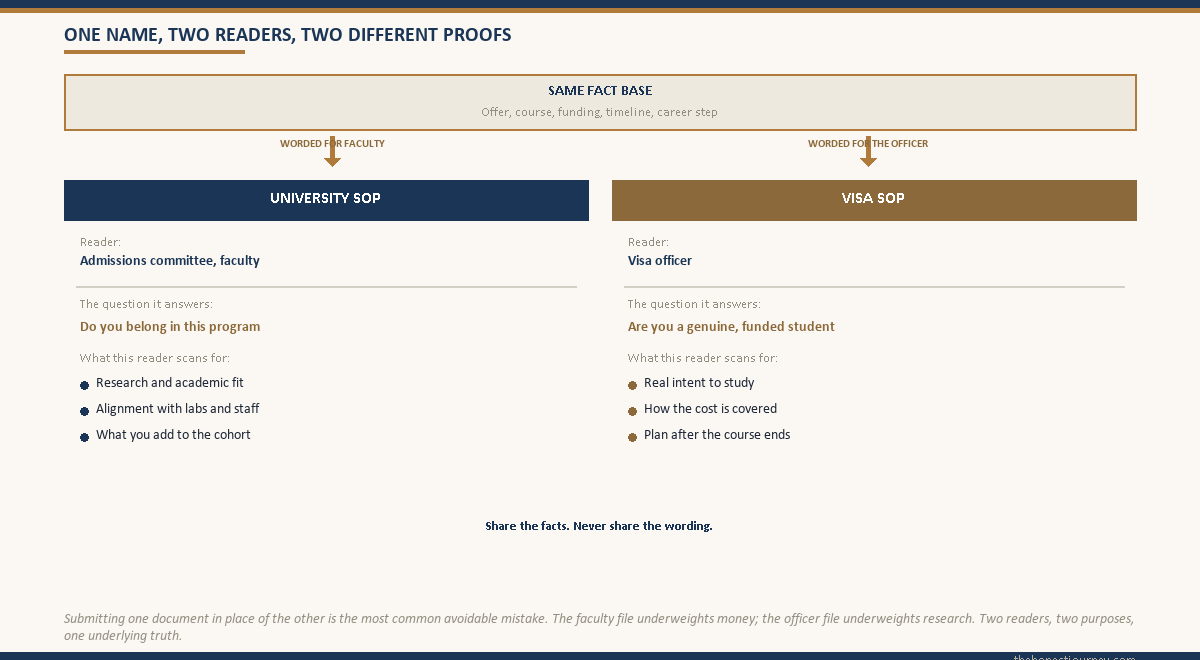
Faz's ruleA visa SOP and a university SOP are two different documents with two different readers. Share the facts, never the wording. Submitting one in place of the other is one of the most common avoidable mistakes.
I made this exact error. I had a strong university SOP, so I lightly edited it and used it for the visa file. It was full of research talk and almost silent on money and timelines. A friend who reviewed visa applications flagged it in thirty seconds. The fix was not to write more, it was to write a separate, shorter, money-and-plan document. They serve different people who want different proof.
The structure that actually works
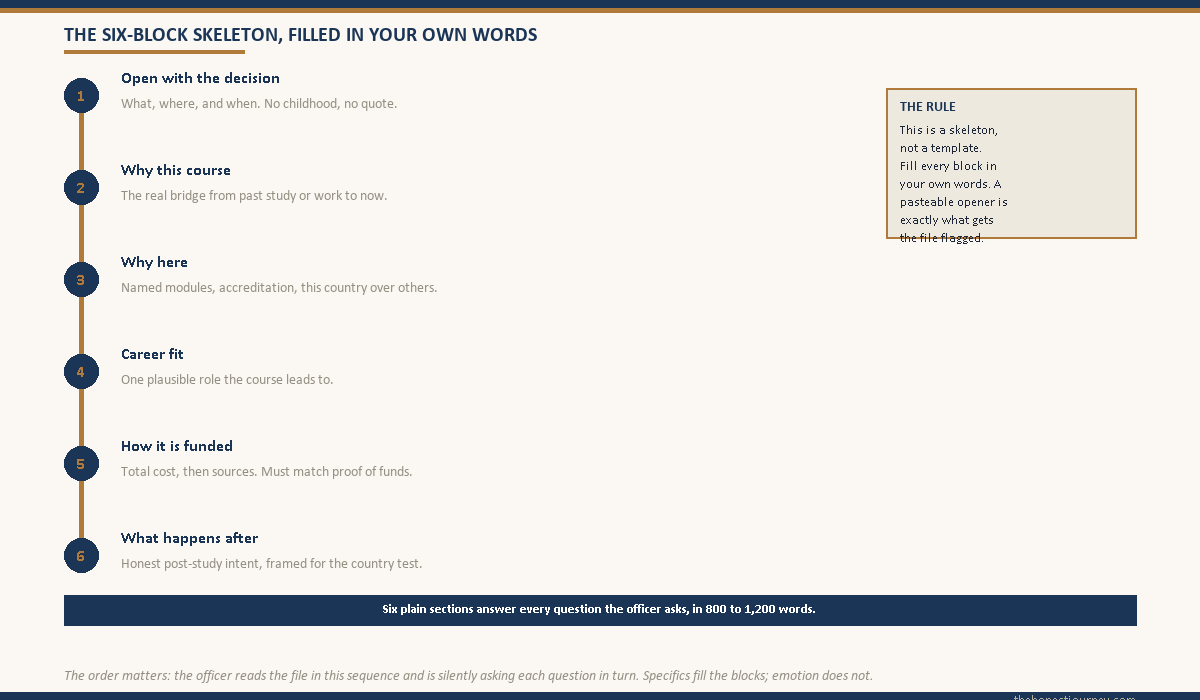
I am not giving you a template to paste, because a pasteable template is exactly what gets caught. What I can give you is the logical skeleton that serves the four jobs above. Fill it with your own specifics in your own words, and it holds up.
Open with the decision, not your childhood. One or two sentences stating what you are going to study, where, and starting when. The officer knows the basics from your file. Confirm them and move on. No “since childhood”, no quote, no fascination.
Why this course. Connect it to what you have already done. If you studied commerce and want a data analytics Master’s, name the bridge: the statistics papers, the project, the job task that pointed you here. Specificity is the proof of genuineness. Vague ambition is the tell of a template.
Why this university and this country. Name the actual program, two or three concrete reasons it fits (modules, accreditation, a specific specialisation), and why this country over the obvious alternatives. “Quality education” is not a reason. A named module or a professional accreditation body is.
How it fits your career. A short, plausible line from the course to a role. Not a grand mission. A realistic next step that someone could check against the job market.
How it is funded. This is the section most students underwrite and officers most want. State the total cost honestly, then the sources: family savings, an education loan with the sanctioned amount, any scholarship. The numbers here must match your proof of funds for a student visa exactly. A mismatch between your SOP and your bank statements is a fast rejection.
What happens after. Where required (the US is strict, the UK and Canada weigh it, Australia tests it), state your intent clearly. For most countries this is your plan to return or your honest read of the post-study work route and then your longer arc. Do not invent ties you do not have, and do not promise things the visa does not allow.
That sequence answers every question the officer is silently asking, in the order they ask it. The whole thing fits in 800 to 1,200 words.
The honest dos and donts
This is the part the advice mills skip, because the donts cut against the products they sell. I will be direct.
Do not paste a template. Officers and admissions staff have read the same opening lines thousands of times. “I have always been passionate about”, “In today’s competitive world”, “It gives me immense pleasure”. The moment one appears, your credibility drops, because it signals you did not write your own file. A template is the single fastest way to look manufactured.
Do not exaggerate. Inflated grades, invented achievements, a fabricated work role, a scholarship you did not get. Visa files are cross-checked against documents, and a single provable lie can sink the application and stain future ones. The genuine version of your story, told plainly, beats a polished fiction every time.
Do not fill space with emotion. An SOP is not a place to perform feeling. “It is my lifelong dream” tells the officer nothing checkable. Replace every emotional sentence with a factual one: a number, a date, a named module, a real funding source. If a line cannot be verified or does not advance one of the four jobs, cut it.
Do keep it internally consistent. The course in your SOP must be the course on your offer letter. The funding figure must match your loan sanction and bank statements. The timeline must match your admission dates. Officers read the SOP against the rest of the file specifically to catch contradictions.
Do write plainly. Short sentences, no thesaurus showing off, no jargon you cannot explain. A clear file reads as an honest file.
Do tailor per country. The same facts, framed for the right test. A US SOP leans into nonimmigrant intent and your plan to return. A UK or Canadian SOP leans into the genuine-student logic and a realistic funding and study plan. An Australian SOP addresses the Genuine Student requirement directly. One base of facts, country-specific framing on top.
Faz's ruleEvery sentence in an SOP should be checkable. If a line cannot be verified against a document or does not prove intent, fit, or funding, delete it. Emotion is not evidence.
Here is the test I use. Read each sentence and ask: could the officer verify this, and does it answer why I am genuine. If a sentence fails both, it is filler. When I applied that test to my first draft, half the document vanished, and what remained was stronger. The officer does not want to feel your passion. They want to confirm your file is real.
Length, format, and the small things that matter
A visa SOP that runs to four pages signals nervousness, not thoroughness. Aim for 800 to 1,200 words, one to one-and-a-half pages. Some countries cap it or provide a structured online form instead of a free document, so always check the specific portal: travel.state.gov for the US, gov.uk for the UK, canada.ca for Canada, and immi.homeaffairs.gov.au for Australia. Several of these now use a guided questionnaire that effectively becomes your SOP, so the principles above apply even when there is no free-text essay.
Plain formatting. Your name and the date at the top, addressed to the visa officer where a free document is required. Standard font, no decorative flourishes, no images. If the consulate gives a word or character limit, respect it exactly, because going over is its own small signal of not following instructions.
Spelling and grammar matter more than students think, not for style but for care. A file riddled with errors reads as rushed, and a rushed file invites a closer look. Read it aloud once. Anything that sounds like a brochure, rewrite into a plain sentence.
Where the loan file asks for a purpose note
Most Indian education loan files do not demand a full SOP, but many ask for a short purpose note or a statement explaining the course, the institution, and how the loan will be used. PSU banks following the IBA model scheme assess employability and the reasonableness of the cost, so a brief, factual note that mirrors your visa SOP helps the credit officer understand the file. For abroad study, the bank wants the same logic the visa officer wants: a real course, a real cost, and a plausible repayment path.
The crucial rule is alignment. The course, the institution, the total cost, and the funding mix in your loan purpose note must match your visa SOP and your bank statements. A loan note that says one figure and a visa SOP that says another creates exactly the kind of inconsistency both readers are trained to catch. The numbers travel together through the disbursement chain, which I walk through in the education loan disbursement process post.
Keep the loan purpose note shorter than the visa SOP, often half a page. Name the course and institution, state the total cost, state the sanctioned loan amount and the margin you are covering, and add one plain line on the career outcome that explains how you intend to repay. No emotion, no template. The bank is doing a credit assessment, not reading an essay. Treat it as a factual summary of the same truth your visa SOP tells.
For destination-specific cost logic that feeds both the visa SOP funding section and the loan note, the per-country guides help. The cost of studying in USA for Indian students breakdown and the study in New Zealand for Indian students guide give the real numbers you should be quoting, not rounded guesses.
The honest closing take
An SOP is not where you sell yourself. It is where you prove you are real. The students who struggle are the ones who treat it as a creative writing test and load it with feeling, big words, and a template opener. The students who clear it cleanly are the ones who treat it as a credibility document: four jobs, six plain sections, every sentence checkable, every number matching the rest of the file.
Write the visa SOP and the university SOP as two separate documents, because they answer to two different readers. Keep the loan purpose note aligned to the visa SOP so the credit officer and the visa officer are looking at the same truth. And resist the entire industry that wants to sell you a fill-in-the-blanks template, because the template is precisely what gets your file flagged. The honest, specific, plainly written file is not just the ethical option. It is the one that works.
For the wider funding picture that your SOP and loan note both rest on, I cover proof of funds for a student visa in detail, and the official UGC pages at ugc.gov.in are useful for confirming recognition of Indian qualifications when you describe your academic background.
What the SOP has to prove changes with the visa you are applying under. The surrounding process per country is in our student visa guides for Canada, the UK, Australia and the USA.
FAQ
What is an SOP for a student visa?
An SOP for a student visa is a short written statement explaining why you want to study a specific course in a specific country and how you will fund it. The visa officer reads it to assess whether you are a genuine student with real intent, sound finances, and, in most countries, a plan after the course ends. It is not an admissions essay and should stay factual rather than emotional. The official US, UK, Canadian, and Australian portals each run a genuine-student or intent test that the SOP directly addresses.
How long should an SOP be?
A visa SOP should run roughly 800 to 1,200 words, which is about one to one-and-a-half pages. Longer than that signals nervousness rather than thoroughness, and officers read hundreds of files. Some consulates cap the length or replace the free document with a guided online questionnaire, so always check the specific country portal before writing. If a word or character limit is given, respect it exactly, because exceeding it reads as a failure to follow instructions, which is its own quiet negative signal.
Is the SOP different for the visa and the university?
Yes, they are two distinct documents. A university SOP is an admissions file read by faculty, focused on academic fit, research interest, and what you will contribute to the program. A visa SOP is an immigration file read by a visa officer, focused on genuine intent, funding, and return plans. They can share underlying facts but never wording. Submitting a university SOP to a visa officer reads as off-target because it underweights money and timelines, the things the officer most wants confirmed.
Do banks ask for an SOP for an education loan?
Most Indian banks do not demand a full SOP, but many ask for a short purpose note explaining the course, the institution, and how the loan will be used. PSU banks following the IBA model scheme assess employability and cost reasonableness, so a brief factual note helps. The key rule is alignment: the course, total cost, and funding figures in the loan note must match your visa SOP and your bank statements exactly, because any mismatch is the kind of inconsistency both readers are trained to catch.
What should an SOP not contain?
An SOP should not contain a pasted template, an exaggerated or fabricated claim, or emotional filler that cannot be verified. Opening lines like “since childhood I have been passionate” signal a copied file and drop your credibility immediately. Inflated grades, invented work roles, or a scholarship you did not receive can sink the application when cross-checked against documents. Replace every feeling sentence with a checkable fact: a number, a date, a named module, or a real funding source. If a line is not verifiable and does not prove intent, fit, or funding, cut it.
How do I start an SOP?
Start with the decision, not your childhood. Open with one or two sentences stating what you will study, where, and starting when, then move straight into why this course connects to what you have already done. Skip the quote, the fascination story, and the grand mission statement, because officers have read those thousands of times. The strongest openings are specific and calm. Name the program and the concrete bridge from your past study or work to this course, and let specificity do the work that emotion cannot.
Does an SOP need to show return intent?
It depends on the country. The US weighs nonimmigrant intent heavily, so a US SOP should clearly address your plan to return and your ties to home. The UK and Canada weigh genuine-student logic and a realistic funding and study plan, with return intent considered but less central. Australia tests the Genuine Student requirement directly. Never invent ties you do not have, and never promise something the visa does not permit. State your honest post-study intent, framed for the specific country test, and keep it consistent with the rest of the file.
Can I use the same SOP for multiple countries?
You can reuse the same base of facts but not the same document. Each country runs a slightly different test, so the framing must change even when the underlying course, funding, and timeline stay identical. A US version leans into return intent, a UK or Canadian version into the genuine-student and funding logic, and an Australian version into the Genuine Student requirement. Rewriting the framing per country, while keeping every fact and number consistent across versions and with your bank statements, is the safe approach. One truth, country-specific presentation.
Faz · The Honest Journey · 2026