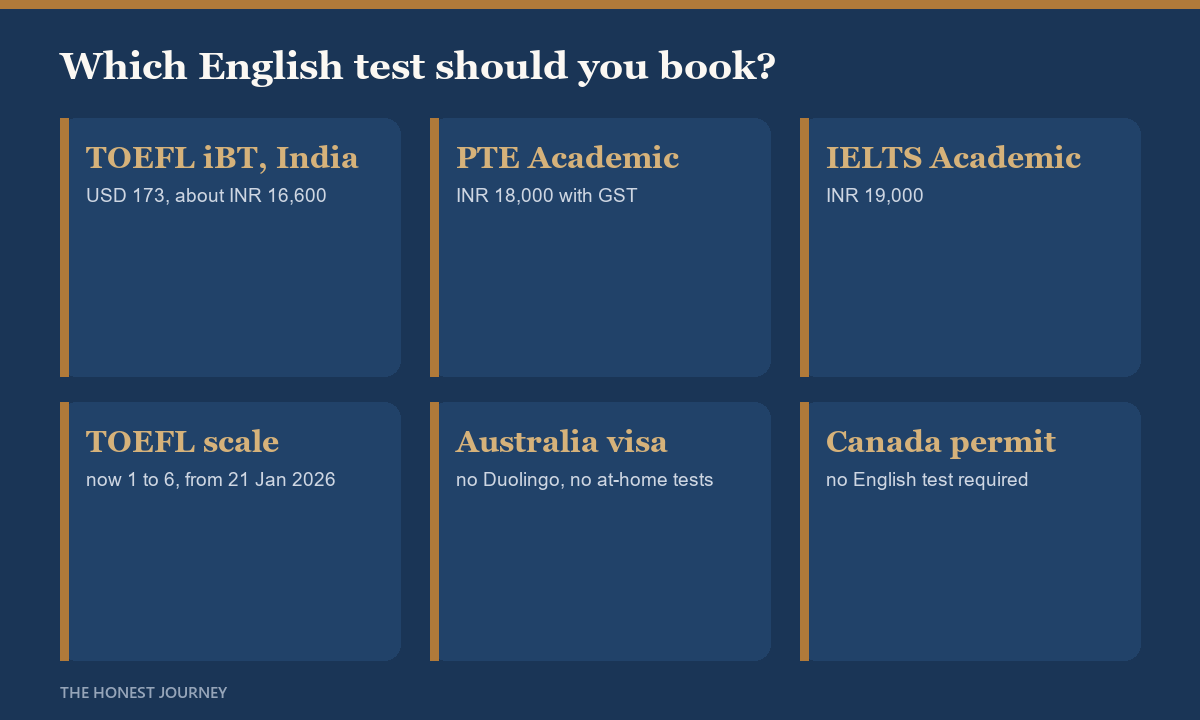
Short answer. For an Indian student, the route to Australia is the Subclass 500 student visa. As of the 2026 intake the application charge sits at roughly AUD 2,000 (confirm the current figure on the Department of Home Affairs portal), and you must show financial capacity of about AUD 29,710 for twelve months of living costs, plus tuition, plus travel.
At ₹56 per AUD that funds figure is around ₹16.6 lakh, and the Genuine Student requirement now decides most outcomes.
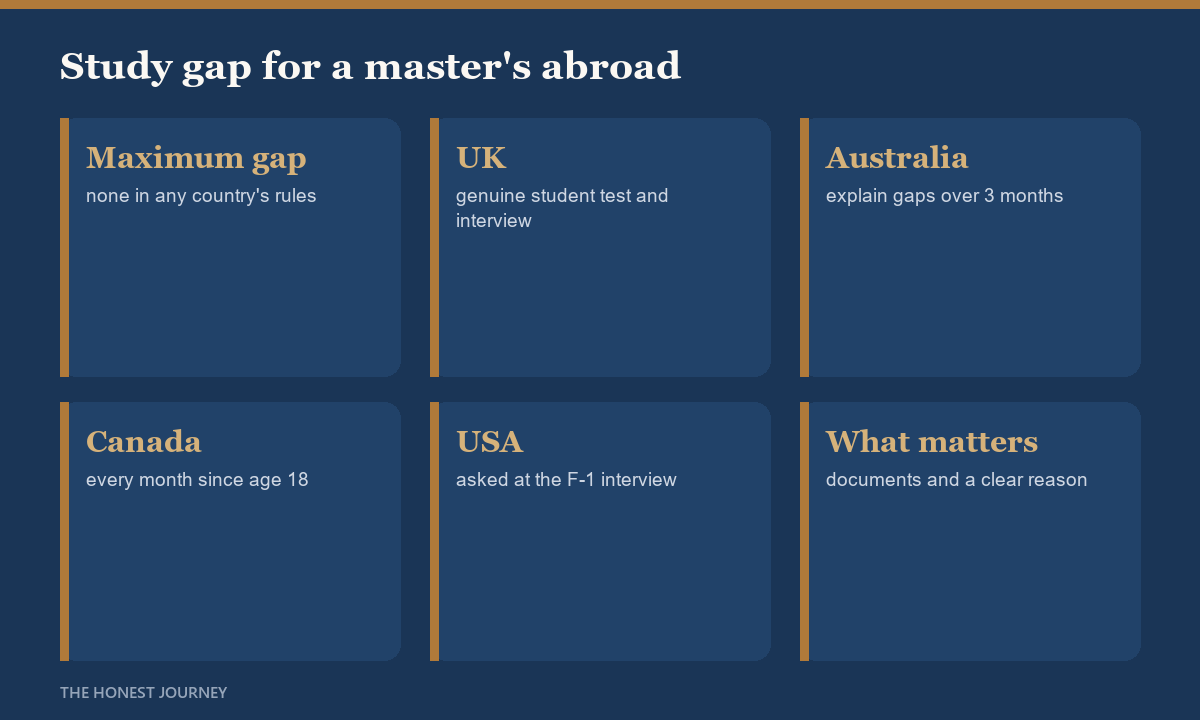
Worried about a gap in your studies? See how the Genuine Student check treats a study gap.
A cousin of a friend applied for his Subclass 500 in early 2025, after the rules had tightened. His offer letter and bank statements were fine on paper. What nearly sank him was the statement he wrote about why this course, in this city, made sense for someone with his work history. He had treated it as a formality and pasted something generic. The case officer read it as a weak Genuine Student answer, asked for more, and held the file for weeks. He got the visa, but the lesson stuck with me: in Australia today the money is necessary but the story is what gets judged.
This post stays strictly in the visa lane. It is the Subclass 500 route, the charge, the funds-proof rule, the Genuine Student requirement, OSHC, work rights, processing, and the honest refusal reality. If you want admissions and university choice, that lives in the study in Australia for Indian students guide. The rupee budget for tuition and city living sits in the cost of studying in Australia post. Here we only talk visa.
What the Subclass 500 actually is
The Subclass 500 is the single student visa for Australia. There is no separate category by course type the way some countries split things. Whether you are doing a Bachelor’s, a Master’s by coursework, a research degree, an ELICOS English course or a VET qualification, you apply for the same Subclass 500. It lets you stay for the duration of your course, usually with a few months of buffer on either side, and it carries study, work and health-cover conditions attached to the grant.
The two things that define your application are your Confirmation of Enrolment (the CoE, issued by the university or college once you accept and pay your deposit) and your answers to the Genuine Student requirement. Everything else, the charge, the funds proof, OSHC, biometrics, sits around those two. The official rules and the current numbers are published by the Department of Home Affairs on immi.homeaffairs.gov.au, and the student-facing overview is on studyaustralia.gov.au. Read both before you start, because the figures in this post are a planning snapshot, not a permanent rulebook.
The Subclass 500 fees, in INR
Let me put the money on the table first. The planning rate through this article is ₹56 per AUD. It moves, so re-check it the week you pay. These are the visa-side costs, not your tuition or living budget, which belong on the cost page.
| Visa-side cost | AUD | INR (at 56) |
|---|---|---|
| Subclass 500 application charge (primary applicant) | ~2,000 | ~1,12,000 |
| OSHC (single, per year, typical) | ~600 to 750 | ~33,600 to 42,000 |
| Health examination / medical | ~350 to 500 | ~19,600 to 28,000 |
| Biometrics | ~50 | ~2,800 |
| Police / document costs | ~variable | ~variable |
| Visa-side total (excluding tuition and living) | ~3,000 to 3,300 | ~1,68,000 to 1,85,000 |
The line that shocks people is the application charge itself. It used to be AUD 710. It was lifted to AUD 1,600 from July 2024, then raised again to roughly AUD 2,000 as part of the integrity push. That is not a typo and it is not refundable if you are refused, so it is real money at risk. Treat the AUD 2,000 as a planning number and confirm the exact charge for your lodgement date on the Home Affairs portal, because this is one of the figures most likely to change between intakes.
Faz's ruleThe application charge is gone the moment you lodge, refusal or not. So you are effectively paying about ₹1.1 lakh to be judged. Make the file worth judging before you click submit.
People rush to lodge to “hold a spot” and pay the AUD 2,000 with a half-built Genuine Student answer. There is no spot to hold, and the charge does not come back if you are refused. Spend the extra two weeks getting the funds and the statement right, then lodge once.
The financial capacity requirement
This is the proof-of-funds heart of the visa. Australia does not just want to see you can pay tuition. It wants evidence you can cover yourself for the first year of living too. As of the 2026 intake the living-cost benchmark is around AUD 29,710 for twelve months for the student. At ₹56 per AUD that is roughly ₹16.6 lakh of living funds alone, and that sits on top of your first-year tuition and your return travel cost.
So the financial picture a case officer wants to see is three layers stacked: the AUD 29,710 living figure, plus your course fees for the first year, plus travel. Depending on your tuition that combined number can run well past AUD 60,000. The funds can be shown through savings, an education loan sanction, or evidence of a sponsor’s genuine capacity, but the money has to look credible and consistent with where your family says it came from. Unexplained lump sums that appear days before lodgement are exactly what triggers scrutiny now.
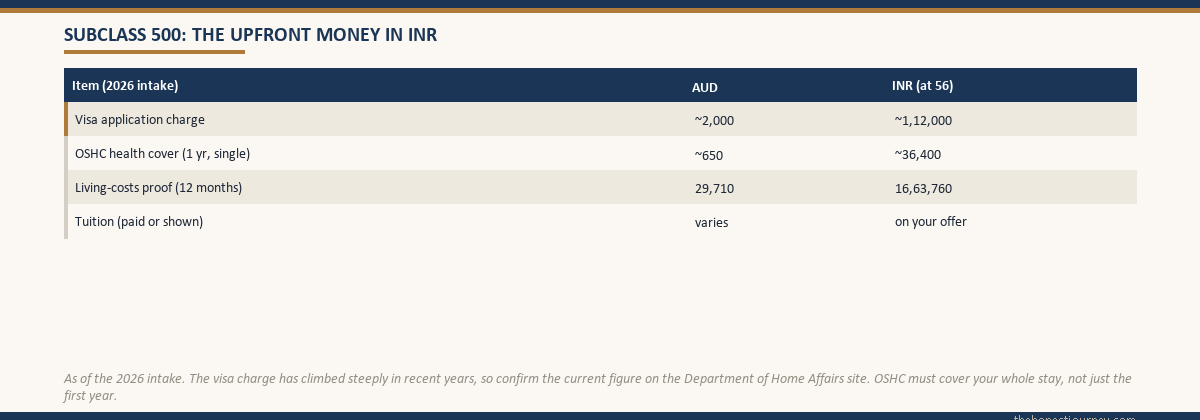
How those funds are assembled, the secured and unsecured loan bands for Australia, and what banks certify is covered in the education loan for Australia post. The general mechanics of what counts as acceptable evidence, how long money should be seasoned, and the documents that satisfy a case officer are in the proof of funds for student visa guide. The exact living-cost figure changes by intake, so confirm the current AUD amount on the Home Affairs portal before you build your file.
The Genuine Student requirement
This is the change that matters most, and it is why an Australia application in 2026 feels different from one in 2023. In 2024 the old Genuine Temporary Entrant (GTE) requirement was replaced by the Genuine Student (GS) requirement. The shift is not just a name. The old GTE leaned on whether you intended to leave Australia at the end. The new GS asks, more directly, whether you are a genuine student making a coherent education decision, while still allowing that you may later seek post-study work through legitimate pathways.
In practice you answer a set of targeted questions about your circumstances: your ties and situation in India, why you chose this specific course and provider, how the course fits your past study and work, and how it serves your future plans. There is no single right answer. What the case officer is testing is whether the whole file hangs together. A 28-year-old with five years in marketing applying for an entry-level diploma in an unrelated field, funded by a sudden deposit, with a thin statement, is the profile that gets refused. A coherent progression with credible money rarely does.
Faz's ruleThe Genuine Student answer is not a form to fill, it is the case for your own application. If you cannot explain in plain words why this course in this city makes sense for you, the case officer will not be able to either.
Write it yourself, in your own voice, tied to your actual history. Agents who paste a template into this section are the single biggest cause of avoidable refusals I see. The money can be perfect and a weak GS answer still sinks the file.
OSHC: the health cover you cannot skip
Overseas Student Health Cover is mandatory for the entire duration of your stay, and you must hold it before the visa is granted. You buy a policy from an approved provider, usually for the full length of your course in one payment, and the policy start date has to cover your arrival. A single student policy typically runs around AUD 600 to AUD 750 a year, roughly ₹33,600 to ₹42,000 at ₹56 per AUD, though family cover costs more.
Two honest notes. First, OSHC is a visa condition, not an optional add-on, so build it into your pre-departure money, not your in-country budget. Second, the policy your university suggests at enrolment is usually the simplest to align with your CoE dates, which removes a small but real risk of a date mismatch holding up your grant. Confirm the current minimum OSHC requirement on the Home Affairs portal, because the rules on duration and coverage are periodically reviewed.
The application process, step by step
The Subclass 500 is lodged online through your ImmiAccount. The sequence is fairly fixed, and doing it in order saves you the most grief.
- Accept your offer and get the CoE. You accept the university’s offer, pay the required deposit, and they issue your Confirmation of Enrolment. The CoE is the spine of the application, you cannot lodge a complete file without it.
- Arrange OSHC. Buy your health cover for the full course duration, with a start date that matches your arrival, so the policy is in place before the grant.
- Assemble your financial capacity evidence. Pull together the funds proof for the living benchmark plus tuition plus travel, seasoned and explainable, before you lodge.
- Prepare your Genuine Student answers. Write the GS responses in your own words, tied to your real study and work history and your specific course choice.
- Lodge online and complete biometrics and health. Create or use your ImmiAccount, upload everything, pay the application charge, then complete biometrics and the health examination when prompted.
After lodgement the case officer may grant, may request more information, or may refuse. If they ask for more, respond fully and quickly, because a thin or late response is itself a signal. The exact document checklist and the current online steps are maintained on immi.homeaffairs.gov.au, and the broader student journey is laid out on studyaustralia.gov.au.
Work rights on the Subclass 500
Once your course has started, the Subclass 500 lets you work up to 48 hours per fortnight during term, and unlimited hours during scheduled course breaks. The fortnight framing matters: it is measured over any two-week period, so you cannot bank hours by working a heavy week and a light one in a way that breaks the cap. Breaching the work condition is a visa problem, not a minor one, so treat the 48-hours rule as a hard line.
The honest framing is the same as everywhere. Term-time work is a living-cost supplement, real money toward groceries, transport and rent, but it does not fund tuition and you should never present it to a bank or to yourself as the thing that closes your funding gap. The realistic mechanics of how much student work actually offsets are in the part-time work while studying abroad post. After you finish, the Temporary Graduate visa (Subclass 485) is the post-study work pathway, but that is a separate visa and a separate decision, so I will not retell it here.
The honest take on refusals and the 2024 to 2025 tightening
Australia spent 2024 and 2025 deliberately tightening student-visa integrity, and you should plan as if that environment is the new normal, not a temporary phase. The application charge tripled. The Genuine Student requirement replaced GTE. Financial-capacity scrutiny went up. None of this means a genuine, well-funded student is at risk. It means a borderline file that would have squeaked through in 2022 now gets refused.
Refusals today cluster around two things, and they are linked. The first is financial credibility: funds that are too low, too recently arrived, or that do not match the family’s stated income. The second is a weak Genuine Student answer: a course that does not fit the applicant’s history, a generic statement, or an obvious mismatch between the stated plan and the choices on the file. Almost every refusal I have seen up close traces back to one or both. The synthesised view below contrasts what a strong file shows against what tends to trigger a refusal, so you can audit your own application before you lodge.
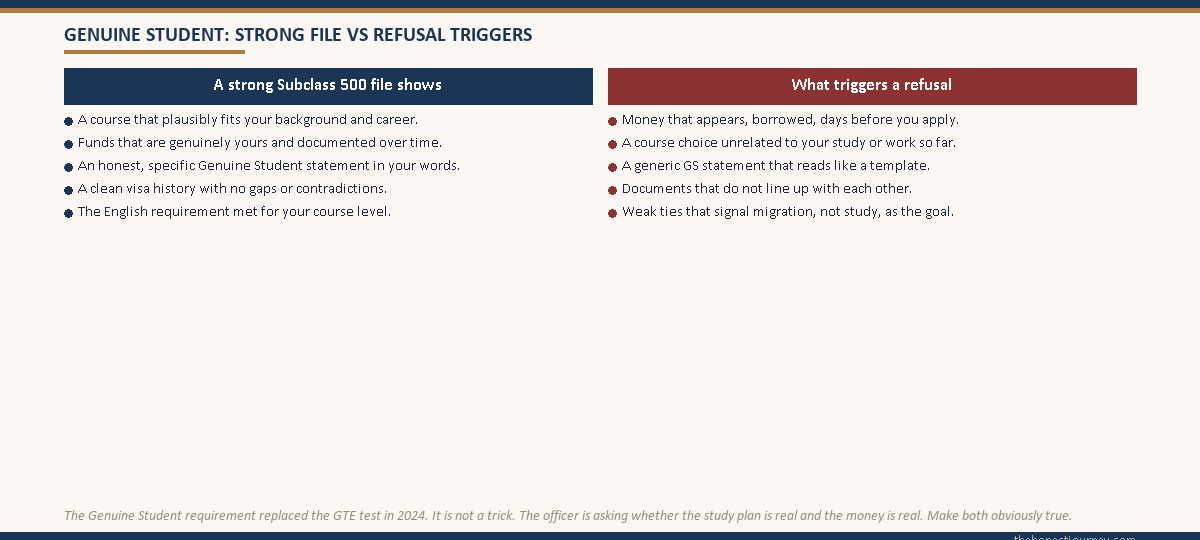
So the practical advice is unglamorous. Get the money right and explainable, well above the bare benchmark if you can, and seasoned in the account. Write the Genuine Student answers yourself, honestly, tied to a course that actually fits your path. Do those two things and the rest of the Subclass 500 is administrative. Skip either and the AUD 2,000 charge is money you may not see again.
Australia still allows dependants, with partner work capped at 48 hours a fortnight unless you are a research student. Full detail on the student dependent visa page.
For a lower-cost Asian alternative to Australia, the Student Pass route is worth a look. The steps and fees are covered in the Malaysia student visa as well.
FAQ
How much is the Australia student visa application charge in 2026?
As of the 2026 intake the Subclass 500 application charge is approximately AUD 2,000 for the primary applicant, roughly ₹1.12 lakh at ₹56 per AUD. It rose from AUD 710 to AUD 1,600 in July 2024, then to about AUD 2,000 as part of the integrity changes. The charge is not refundable if you are refused. Confirm the exact current figure for your lodgement date on the Department of Home Affairs portal before you apply.
How much money do I need to show for the Subclass 500 visa?
You must show financial capacity for one year of living costs at about AUD 29,710 as of the 2026 intake, roughly ₹16.6 lakh at ₹56 per AUD, plus your first-year tuition and your travel cost. The funds can come from savings, a loan sanction or a genuine sponsor, but they must be credible and explainable. Sudden lump sums before lodgement trigger scrutiny. Confirm the current living-cost figure on the Home Affairs portal.
What is the Genuine Student requirement for Australia?
The Genuine Student (GS) requirement replaced the Genuine Temporary Entrant (GTE) requirement in 2024. You answer targeted questions about your circumstances, why you chose the specific course and provider, how it fits your study and work history, and your future plans. The case officer assesses whether you are a genuine student making a coherent decision. A course that does not match your background, or a generic templated answer, is a common reason for refusal.
How long does the Subclass 500 take to process?
Processing times vary by provider level, course type and how complete your file is, and they shifted through the 2024 to 2025 tightening. A clean, well-documented application generally moves faster, while any request for more information adds weeks. Because the published times change regularly, check the current processing estimate for your visa stream on the Department of Home Affairs portal rather than relying on what a friend experienced in an earlier intake.
Can I work 48 hours per fortnight on a student visa in Australia?
Yes. Once your course has started the Subclass 500 lets you work up to 48 hours per fortnight during term, and unlimited hours during scheduled course breaks. The fortnight is any rolling two-week period, so you cannot exceed the cap by working an uneven pattern. Breaching the work condition is a serious visa issue. Treat term-time work as a living-cost supplement, not a way to fund tuition or close a funding gap.
Is OSHC mandatory for an Australian student visa?
Yes. Overseas Student Health Cover is mandatory for the entire duration of your stay and must be in place before the visa is granted. You buy it from an approved provider, usually for the full course length, with a start date matching your arrival. A single policy typically costs around AUD 600 to AUD 750 a year, roughly ₹33,600 to ₹42,000. Confirm the current OSHC requirement on the Home Affairs portal.
Why are Australian student visas getting refused?
Refusals in 2026 cluster around two linked issues. The first is financial credibility: funds that are too low, too recently deposited, or inconsistent with the family’s stated income. The second is a weak Genuine Student answer: a course that does not fit the applicant, a generic statement, or a plan that contradicts the file. The 2024 to 2025 integrity tightening means borderline applications that once passed are now refused, so credibility on both fronts matters.
What is the success rate for the Australia student visa?
There is no single fixed success rate, and it varies by provider, course and applicant profile, especially after the integrity changes. The honest framing is that a genuine, well-funded student with a coherent course choice and a self-written Genuine Student answer has a strong chance, while borderline files now fail more often than before. Rather than chase a headline percentage, build the two things case officers actually test: explainable funds and a credible student story.
Faz · The Honest Journey · 2026