Short answer. Opening a bank account abroad is circular: the account often needs an address, the address sometimes needs an account, and both can need a local phone number. The way out is order. Get a local SIM first, use your university or temporary accommodation as the address, then pick a bank that lets students open with a passport.
Opening a bank account abroad is one of the first things you must do and one of the most circular, because the account often needs an address, the address sometimes needs an account, and both can need a local phone number you do not have yet. The way out is order: get a local SIM first, use your university or temporary accommodation as your address, and pick a bank or app that lets students open an account with a passport, admission letter and visa rather than a permanent lease. In Germany the blocked account is your first account and is arranged before you fly; in the UK, Canada and the US you open a student account in your first week, often at a bank branch near campus or through a student-friendly digital bank. Do the SIM, then the bank, then everything else. The account is not hard, the order is what trips people up.
Almost every student hits the same wall in week one: they try to open a bank account and are asked for a proof of address they do not yet have, or a local number to receive a verification code. Then they try to rent a place and are asked for a local bank account. It feels like a trap, but it is just a sequence problem, and the sequence is well known. This guide walks through the order that works and the realistic path in the main destination countries, so you are not stuck moving money on a forex card longer than you need to.
If you are still setting up how money leaves India, read the A2 form, LRS and forex guide and how much money to carry abroad first, and keep a forex card as your bridge until the local account is live.
The order that breaks the circular trap
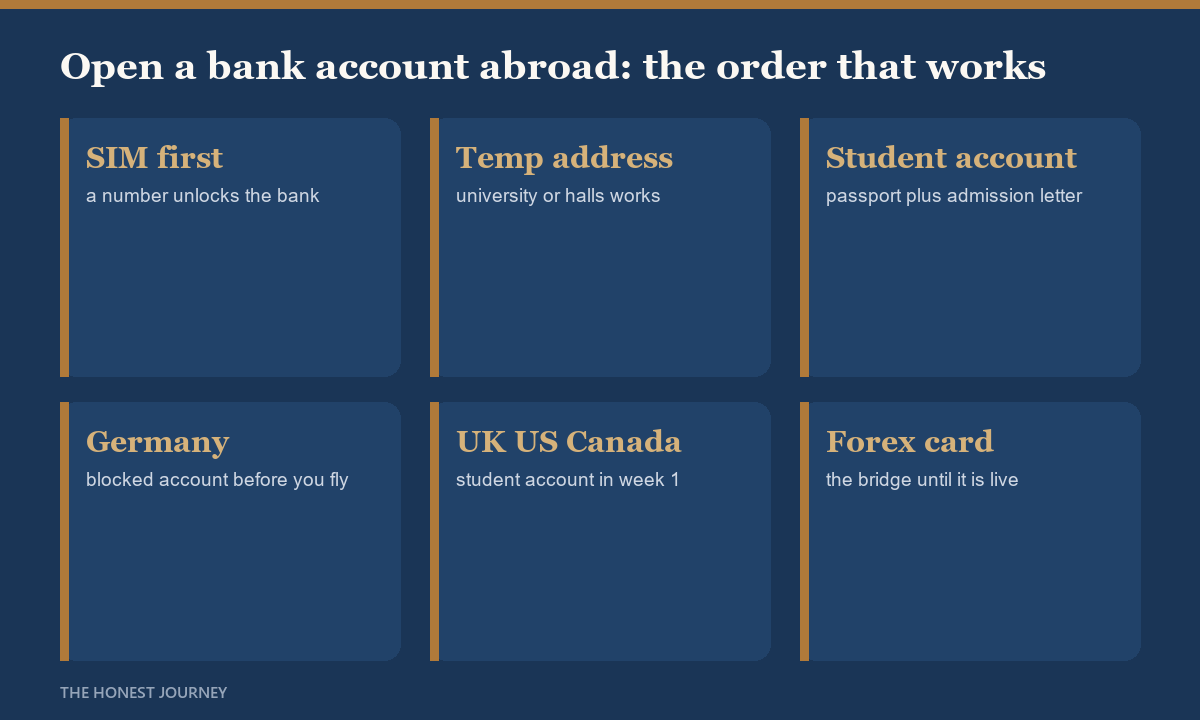
The single most useful thing to understand is the sequence. Do these in order and the circularity disappears:
- Get a local SIM or activate an eSIM first. A local number is needed for bank verification codes, app logins and appointments. It is the key that unlocks everything else, covered in the SIM abroad guide.
- Use a valid temporary address. Your university address, student halls, or verified temporary accommodation usually works for opening an account. You do not need a permanent lease first.
- Open a student account with your core documents. Passport, visa, admission or enrolment letter, and proof of address are the usual set. Student accounts are designed for exactly your situation.
Follow that order and you avoid the loop where each step seems to demand the next.
Germany: the blocked account comes first
Germany is the exception, because your first German account is the blocked account (Sperrkonto), and you open it before you fly as proof of funds for the visa. It holds a fixed sum and releases a set monthly amount to you after you activate it locally on arrival. That activation, plus city registration, then lets you open a normal current account (Girokonto) for daily use. So the German order is: blocked account before departure, activate on arrival, register your address, then open a regular account. The blocked account guide covers how to fund it, including via an education loan.
United Kingdom: student account in week one
In the UK you open a student bank account after you arrive, typically in your first week or two. High-street banks offer student accounts, and you will usually need your passport, visa or BRP, a university enrolment or bank letter confirming your address and student status, and proof of your UK address. Many students also open a digital or app-based account quickly as a bridge while the traditional account is set up, since app banks often verify faster. Ask your university, most have a bank letter process specifically to help international students open accounts.
Canada: newcomer and student accounts
Canadian banks actively court international students with newcomer and student account packages, so this is relatively smooth. You can often start the process before arrival with some banks and complete it in a branch in your first week with your passport, study permit or introduction letter, proof of enrolment and a local address. Your GIC, if you bought one for the visa, is held at a specific bank and its account becomes part of your setup, releasing your living-cost funds in instalments, explained in the GIC guide.
United States: a branch visit in the first week
In the US you generally open a student checking account in person at a bank branch near campus in your first week, with your passport, visa, I-20, proof of your US address and often your university enrolment. Some banks ask for a local phone number, which is why the SIM comes first. Many campuses have partner banks with branches on or near campus that are used to student paperwork, so start there. A Social Security Number is not usually required to open a basic student account, though it helps for some products later.
What every country asks for
Wherever you go, assemble this core set before your appointment and the process is quick:
- Passport with visa and your study permit, BRP or I-20 as applicable.
- University enrolment or admission letter, ideally a bank-specific letter if your university offers one.
- Proof of local address, which a university address or temporary accommodation often satisfies.
- A local phone number for verification.
Use a forex card as the bridge
Until your local account is active, a forex card loaded before you flew handles daily spending without carrying cash, and a small amount of local currency covers the very first day. Do not feel pressure to open the account on day one, a few days on the forex card is normal and safe while you get the SIM, address and paperwork lined up. Once the account is live, move your everyday balance across and keep the forex card for backup.
The honest closing take
Opening a bank account abroad feels harder than it is because students attempt it out of order and hit the address-and-phone loop. Get the SIM first, use your university or temporary address, bring the standard document set, and pick a student or newcomer account built for your situation. Germany runs on its own track with the blocked account before you fly. Everywhere else it is a first-week branch visit or app signup, bridged by a forex card until it is done. Solve the sequence and the account solves itself.
FAQ
Can I open a bank account abroad without a permanent address?
Usually yes. A university address, student halls, or verified temporary accommodation typically works to open a student account. You do not need a permanent lease first. Getting a local SIM before you try is the key, since banks need a local number for verification.
What is the right order to set things up in the first week?
Get a local SIM or activate an eSIM first, then open the bank account using a temporary address, then handle everything else. The SIM unlocks bank verification, and a temporary address satisfies most account openings, which breaks the circular trap where each step seems to need the others.
How is opening a bank account in Germany different?
In Germany your first account is the blocked account, opened before you fly as proof of funds. You activate it on arrival to release a set monthly sum, register your city address, then open a regular current account for daily use. The other major countries open a student account in your first week instead.
What documents do I need to open a student bank account?
Typically your passport with visa, your study permit, BRP or I-20, a university enrolment or admission letter, proof of a local address, and a local phone number. Many universities provide a bank-specific letter to help international students open accounts.
How do I manage money before my local account is open?
Use a forex card loaded before you flew for daily spending and a small amount of local cash for the first day. A few days on the forex card while you sort the SIM, address and paperwork is normal, then move your balance to the local account once it is active.