Short answer. Carry roughly USD 2,000 to 3,000 in physical cash for your first few days, keep the bulk of your living money on a forex card, and wire tuition straight to the university. You can legally move funds under the LRS limit of USD 250,000 a year, but you must declare cash above USD 5,000 at customs.
Forex cards cost around 1 to 2 percent, far less than bank cash rates.
Heading out soon? See the pre-departure checklist and how to open a bank account abroad.
The week before my cousin flew to Toronto, his father went to the bank and converted nearly half the first semester’s living budget into a thick wad of Canadian dollars. The logic was the old one: cash is safe, cash is king, what if the card does not work on day one. He landed with the equivalent of USD 6,000 in his backpack, sweated through customs because he had no idea about the declaration rule, and then spent the next two weeks terrified of losing the envelope in his hostel room.
He did not need most of it. Almost nobody does. This post is the honest answer to how much money to carry abroad for students, where it should sit, and what the rules and the costs actually are so you do not repeat his mistake.
I will give you a split that works, the legal limits in plain language, and a straight cost comparison so you can decide with your eyes open.
For most students the honest answer is roughly USD 2,000 to 3,000 in physical cash for the first few days, the bulk of your living money on a forex card, and your tuition wired directly to the university or local account. You can legally carry foreign exchange under the LRS limit of USD 250,000 per financial year, but you must declare cash above USD 5,000 (or USD 10,000 including traveller’s cheques) at customs.
For the full guide, read Studying Abroad From India: Cost and Funding Guide.
How much money to carry abroad as a student: the honest split
The mistake almost everyone makes is treating “money to carry” as one lump that has to travel with you physically. It does not. Your money should sit in three places, and only a small slice of it should ever be cash in your pocket.
Here is the split I give every student who asks. It assumes a typical first-semester need, but the proportions hold whether your budget is small or large.
| Where the money sits | Rough amount | What it is for |
|---|---|---|
| Physical cash | USD 2,000 to 3,000 | Airport transfer, first meals, SIM card, the deposit a landlord wants before your account opens |
| Forex card | USD 3,000 to 6,000 | Daily spending for the first month or two until your local bank account is live |
| Bank transfer or local account | The rest | Tuition, hostel fees, large rent deposits, the bulk of the year’s living cost |
Notice that physical cash is the smallest slice, not the largest. The reason is simple. Cash that is lost or stolen is gone with no recourse. A forex card can be blocked and reissued. A bank transfer leaves a record and reaches the recipient directly. Carrying USD 6,000 in notes the way my cousin did is not “safe”, it is the single most exposed way to move money.
The USD 2,000 to 3,000 cash figure is not a rule, it is a practical floor and ceiling. You want enough to survive a few days if your card or account hits a snag, and not so much that losing it ruins your semester. For most countries that range covers your taxi, a local SIM, groceries for a couple of weeks, and a security deposit if a landlord insists on cash before your account is open.
Faz's ruleCash is the riskiest place your money can sit, so it should be the smallest slice.
Carry enough cash to land safely and survive a few days, nothing more. The bulk belongs on a forex card you can block and replace, or wired to an account that leaves a record. Lost cash is simply gone.
The LRS limit: how much you are legally allowed to carry
Under the Reserve Bank of India’s Liberalised Remittance Scheme, a resident individual can send out or carry up to USD 250,000 per financial year for permitted purposes, and overseas education is one of them. That ceiling covers everything together: your tuition wired to the university, the money loaded on your forex card, the cash you carry, and any maintenance money sent during the year. It is a combined annual cap, not a separate allowance for each channel.
For an undergraduate or master’s student this limit is rarely a problem. Even an expensive year in the US or UK, tuition plus living, usually lands well under USD 250,000. The students who do brush against it are typically funding a full multi-year programme upfront or moving large family transfers in the same year. If that is you, check the official scheme details on the Reserve Bank of India site before you plan, because the LRS is the rule that governs every rupee that leaves the country for your education.
One detail worth knowing: when education is funded by a loan from a recognised financial institution, the remittance can be made under the education head, and the tax treatment is gentler than for self-funded transfers. I will come back to that in the TCS section, because it is the part most families get wrong.
The customs declaration rule, in plain language
This is the rule my cousin tripped over because nobody told him. When you carry foreign currency out of India, you do not have to declare small amounts, but above a threshold you must fill out a Currency Declaration Form. The thresholds, per the Central Board of Indirect Taxes and Customs, are:
| What you are carrying | Declaration needed? |
|---|---|
| Foreign currency notes up to USD 5,000 (or equivalent) | No declaration required |
| Foreign currency notes above USD 5,000 (or equivalent) | Must declare on the Currency Declaration Form |
| Total foreign exchange (notes plus traveller’s cheques) up to USD 10,000 | No declaration required |
| Total foreign exchange above USD 10,000 (or equivalent) | Must declare |
Read that carefully. The line for plain cash notes is USD 5,000. The higher USD 10,000 line is for total foreign exchange when part of it is held as traveller’s cheques. A forex card balance does not count as currency you are physically carrying, so it sits outside this rule entirely. That is one more reason the card is the cleaner way to move the bulk of your money.
The destination country has its own rule too, and it usually mirrors this. Most countries require a declaration when you bring in cash above the equivalent of USD 10,000. So if you stay within the USD 2,000 to 3,000 cash slice I recommended, you are comfortably below every declaration threshold on both ends and you walk through customs without a second look.
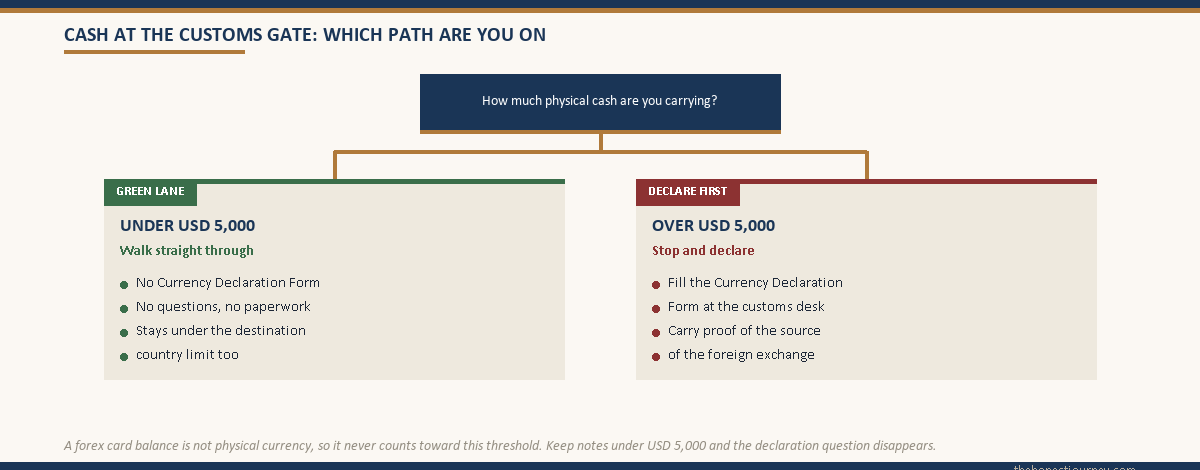
Faz's ruleKeep physical cash under USD 5,000 and you never have to think about the declaration form.
The forex card balance is not physical currency, so it does not count toward the customs threshold. Stay inside the cash floor and the whole declaration question disappears on both the Indian and the destination side.
Cash vs forex card vs bank transfer: the plain cost comparison
Every channel for moving money abroad has a cost. The cost is rarely a single visible fee. It is usually buried in the exchange rate markup, the withdrawal charges, and the convenience tradeoffs. Here is the honest comparison so you can see where your money actually leaks.
| Channel | Typical cost | Best use | The catch |
|---|---|---|---|
| Physical cash (money changer) | 1 to 3 percent markup on the rate, plus a small commission | First few days, small immediate needs | No recourse if lost or stolen, exposed at customs above the threshold |
| Forex card | Issuance fee around ₹150 to 500, FX markup near zero on the loaded currency, ATM withdrawal charge of roughly USD 2 to 3 per withdrawal abroad | First one to two months of daily spending | Cross-currency markup of 3 to 3.5 percent if you spend in a currency the card is not loaded in |
| Bank wire transfer | Bank fee of roughly ₹500 to 1,500 per transfer, plus the bank’s FX markup, sometimes a correspondent bank fee on the receiving side | Tuition, large rent deposits, the bulk of the year’s money | Markup varies a lot between banks, so compare the all-in rate, not just the headline fee |
The pattern is clear once you see it. Cash carries the highest hidden cost because the money changer’s rate is rarely the best one, and the risk of loss is total. A forex card loaded in the right currency carries almost no exchange markup and gives you something the cash cannot: it can be frozen and reissued if your wallet vanishes. A bank wire is the cheapest way per dollar to move large sums for tuition, but only if you compare the all-in rate, since the markup hides in the exchange rate rather than the visible fee.
The single biggest mistake here is loading a forex card in the wrong currency. If you load US dollars but study in Canada and spend Canadian dollars, every swipe gets hit with a cross-currency conversion of 3 to 3.5 percent. Load the card in the currency of the country you are going to. For a deeper look at issuance fees, reload charges, and which features actually matter, see the breakdown in the best forex card for students post.
The TCS angle: loan-funded vs self-funded
This is the part that quietly changes the maths for a lot of families, and almost nobody mentions it until the bank does it for you. Tax Collected at Source, or TCS, applies to money sent abroad under the LRS, including the amount you load on a forex card and the tuition you wire. How much gets collected depends on whether your education is loan-funded or self-funded.
| Source of funds | TCS rate (on amounts above the annual threshold) | What it means for you |
|---|---|---|
| Education funded by a loan from a recognised financial institution | 0.5 percent above the threshold for the year | Lowest rate, designed to ease the burden on students borrowing to study |
| Education self-funded (family savings, own money) | 5 percent above the threshold for the year | Higher rate, applies to remittances for education not backed by a loan |
The threshold and rates are set under the Income Tax rules and have been revised more than once, so confirm the current figures on the Income Tax Department site before you remit. The principle, though, has held: a loan-funded education attracts a much lower TCS rate than self-funded remittances. That gap is the reason it matters which bucket your money comes from.
The crucial thing students miss is that TCS is not a tax you lose. It is collected in advance and credited against your final tax liability. You can adjust it when you file your return, and if your co-applicant (usually a parent) has tax to pay, the TCS already collected offsets it. So the real cost is the cash-flow hit of having the money parked with the tax department until you file, not a permanent loss. For how this interacts with the loan itself, see the detailed walk-through in the TCS on education loan post.
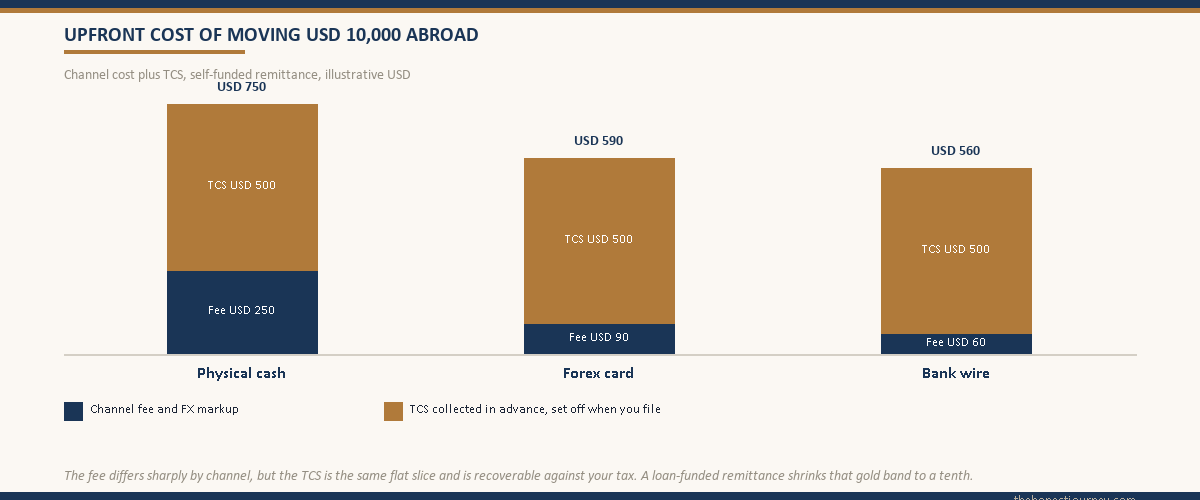
Faz's ruleA loan-funded remittance is taxed at a fraction of a self-funded one, and the TCS is recoverable either way.
TCS is collected in advance, not lost. You set it off against your tax when you file. The real cost is the cash sitting with the tax department for a few months, so plan your remittance timing around it.
How much for the actual first month
Strip away the rules and here is the practical question every student is really asking: how much do I need for the first month on the ground before the routine settles? My honest estimate, across the common destinations, is the equivalent of USD 2,000 to 4,000 for the first month, depending heavily on whether your accommodation deposit is due immediately.
That month usually includes a security deposit and first month’s rent (the single largest item), a local SIM, groceries, basic kitchen and bedding if your housing is unfurnished, public transport, and a buffer for the things you forget. If your university hostel or homestay is prepaid before you fly, the first month is far cheaper, often under USD 1,500, because the big-ticket housing deposit is already handled.
This is why the split matters so much. The deposit and rent should ideally go by bank transfer or off the forex card, not from your cash envelope. Keep the cash for the small, immediate, card-might-not-work-yet moments, and let the card and the transfer carry the weight. If you are still assembling your visa file and need to show this money formally, the rules on what counts and what does not are in the proof of funds for a student visa post, and if you are heading to Canada specifically, the GIC requirement is its own thing, covered in the GIC for Canada post.
The honest closing take
The instinct to carry a thick stack of cash comes from a real fear, the fear of landing in a strange country and having nothing work. That fear is valid. The answer to it is not more cash, it is the right cash plus backups that cannot be lost. A modest cash float, a forex card loaded in the right currency, and a bank transfer for the big sums covers every scenario the cash-stack approach was trying to cover, at lower cost and far lower risk.
If you remember three things, remember these. Keep physical cash under USD 5,000 so the customs form never enters your life. Load your forex card in the currency you will actually spend. And know whether your remittance is loan-funded or self-funded before you load a single dollar, because that one fact decides your TCS rate and changes the upfront cost more than any fee a money changer will quote you.
Carry less than you think you need in cash. Plan more carefully than you think you need to for everything else. That is the honest version of getting your money abroad.
FAQ
How much cash can I carry abroad as a student?
You can legally carry foreign exchange under the LRS limit of USD 250,000 per financial year, but for practical purposes most students should carry only USD 2,000 to 3,000 in physical cash. That covers the first few days for transport, a SIM, groceries, and a possible deposit. Anything beyond that is better held on a forex card or wired to a local account, because lost cash has no recourse and large cash amounts trigger a customs declaration.
What is the LRS limit for students?
Under the Reserve Bank of India’s Liberalised Remittance Scheme, a resident individual can send or carry up to USD 250,000 per financial year for permitted purposes including overseas education. This is a combined annual cap covering tuition transfers, forex card loads, cash carried, and maintenance money. Most undergraduate and master’s students stay well under it. Only those funding a full multi-year programme upfront or moving large family transfers in the same year tend to approach the ceiling.
Do I need to declare currency at the airport?
You must declare on the Currency Declaration Form if you carry foreign currency notes above USD 5,000, or total foreign exchange (notes plus traveller’s cheques) above USD 10,000. Below those thresholds no declaration is needed. A forex card balance is not physical currency, so it does not count toward the limit. If you keep your cash under USD 5,000, you avoid the declaration entirely on the Indian side, and most destination countries use a similar USD 10,000 limit on arrival.
Forex card or cash, which is better?
For the bulk of your money, the forex card wins. It carries almost no exchange markup when loaded in the right currency, it can be blocked and reissued if lost, and it does not count toward the customs cash threshold. Cash is only better for the very first days, when you may need it before any card or account is confirmed working. Keep cash to a small float and put the rest on the card or wire it.
How much money should I take for the first month abroad?
Plan for the equivalent of USD 2,000 to 4,000 for the first month, driven mainly by whether your accommodation deposit is due on arrival. That covers a security deposit and first rent, a local SIM, groceries, basics for unfurnished housing, transport, and a buffer. If your hostel or homestay is prepaid before you fly, the first month can cost under USD 1,500. Route the deposit and rent through a transfer or the forex card, not your cash envelope.
Is there TCS on money I carry abroad?
Yes. Tax Collected at Source applies to remittances under the LRS above the annual threshold, including forex card loads and tuition wires. If your education is funded by a loan from a recognised institution, the rate is much lower than for self-funded remittances. TCS is collected in advance, not lost, and you set it off against your tax liability when you file your return. Confirm the current rates and threshold on the Income Tax Department site before you remit.
Does a forex card balance count toward the customs declaration limit?
No. The customs declaration thresholds apply to physical foreign currency notes and traveller’s cheques you are carrying, not to a forex card balance or money already wired abroad. This is one of the practical reasons to keep cash low and load the bulk of your money on the card. You can carry a large card balance through customs without any declaration, while the same amount in notes would require the Currency Declaration Form.
What is the cheapest way to send tuition abroad?
For large amounts like tuition, a bank wire transfer is usually the cheapest per dollar, but only if you compare the all-in rate rather than the headline fee, because the real cost hides in the exchange rate markup. Forex cards are best for daily spending, not big lump sums. Cash is the most expensive and riskiest channel for any sizeable amount. Always ask the bank for the total cost including the FX markup and any correspondent bank fee before you confirm.
Faz · The Honest Journey · 2026