Short answer. Studying in Italy as an Indian student is genuinely cheap on tuition, roughly 900 to 4,000 euro per year at a public university, and the all-in cost lands around 12 to 18 lakh INR per year once you add living costs of 700 to 1,100 euro a month.
The honest catch is not the money, it is the paperwork and the language. The three steps agents charge a fortune for, the Universitaly pre-enrolment, the ISEE income certification, and the visa proof of funds, are things you can do yourself. The other quiet trap is the post-study permit, which is a job-search permit, not a work permit, and life off-campus runs in Italian.
The regional grant that covers tuition and living costs is explained in full in the DSU scholarship guide for Indian students.
Italy is one of the few European destinations where the headline cost actually holds up. Public university tuition really is low, the cities are beautiful, and there are real English-taught master’s programmes in engineering, design, and economics. So when a student writes to me asking whether Italy is “too good to be true,” my answer is no, the cheap tuition is real. But the search results for “study in Italy for Indian students” are wall to wall agents, and agents earn their fee by making three free government processes sound terrifying. This post is the opposite. It shows the real all-in cost in INR with the math, walks through the paperwork you can do without paying anyone, and is honest about the downsides nobody puts on slide three.
I do not earn anything whether you go to Italy or not. For the broader picture before you commit to any country, read Studying Abroad From India: Cost and Funding Guide and the honest comparison of the best country to study abroad for Indian students.
The tuition story, told correctly
Here is the part that is genuinely good news. At Italy’s public universities, which are the ones worth targeting, tuition runs roughly 900 to 4,000 euro per year. That is per the European Commission’s official Study in Europe country profile for Italy, not a brochure. Private universities and the international management schools are a different world, 6,000 to 20,000 euro or more per year, and they market hard to Indian families because that is their business model. A private Italian degree removes the single biggest reason to choose Italy, so unless there is one specific programme you cannot get at a public university, the maths rarely works.
The cleverer part of the Italian system is that public tuition is not a flat fee. It is scaled to family income through a mechanism called the ISEE, the indicator of equivalent economic situation. Lower-income students pay a reduced fee, and many universities set a low statutory minimum for the poorest brackets. I will not quote you a single “everyone pays 156 euro” figure, because that minimum is set per university and per region, and treating it as a blanket fact is exactly the kind of half-truth agents trade on. What is true: if your family income is modest by Italian standards and you complete the income certification correctly, your tuition can fall well below the 900 euro floor. That certification is one of the three steps I cover below, and it is worth real money.
Faz's ruleTarget public universities, and treat the ISEE as homework worth thousands of euro, not a formality.
The low tuition headline is real only at public universities, and the income-tested ISEE can cut it further. The catch is that as a non-EU student you need an ISEE Parificato, certified at a CAF centre in Italy using translated income documents. Agents charge for it. It is paperwork, not magic, and doing it yourself is the single highest-return hour of admin in this whole process.
The real all-in cost in INR, with the math shown
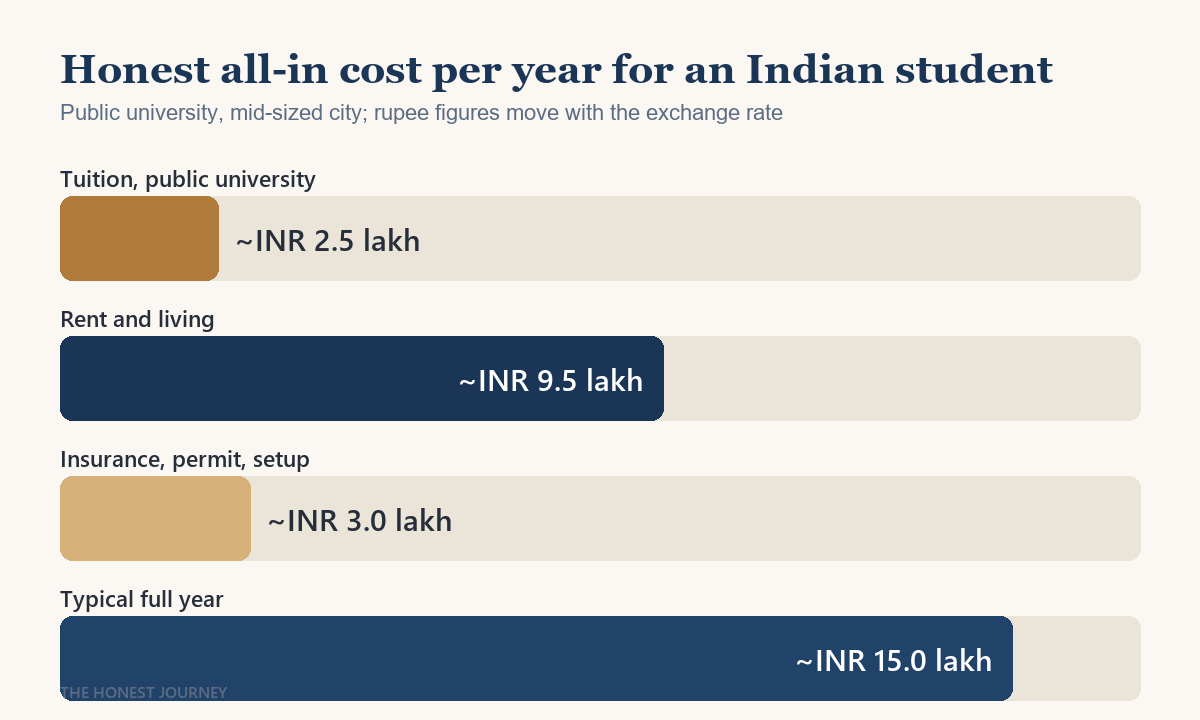
This is the number the agent-written pages bury, so let me build it from the ground up. The two big buckets are tuition and living. Tuition at a public university is 900 to 4,000 euro per year. Living costs, again from the EU country profile, are 700 to 1,100 euro per month depending on city, with Milan and Rome at the top and Bologna, Pisa, Padua, or Turin meaningfully cheaper. Take a realistic mid-case: 1,500 euro tuition plus 850 euro a month living, which is 10,200 euro a year of living. Add health insurance, the residence permit, books, a SIM, and setup, and you are around 13,000 to 14,000 euro for a full year.
Convert that honestly. At roughly 90 INR to the euro, 13,500 euro is about 12.15 lakh INR. A higher-cost year in Milan, say 4,000 euro tuition plus 1,100 euro a month living, lands closer to 19,000 euro, which is about 17 lakh INR. So the honest all-in range is 12 to 18 lakh INR per year, with the cheaper end being a non-EU student at a mid-sized public university and the expensive end being a private-leaning programme in an expensive city.
| Cost item | Per year (euro) | Per year (INR, approx) | Notes |
|---|---|---|---|
| Public university tuition | 900 to 4,000 | 81,000 to 3,60,000 | Income-scaled via ISEE; lower brackets pay less |
| Rent and living | 8,400 to 13,200 | 7,56,000 to 11,88,000 | 700 to 1,100 euro per month by city |
| Health insurance | 150 to 600 | 13,500 to 54,000 | SSN voluntary registration or private cover |
| Residence permit and stamps | 100 to 200 | 9,000 to 18,000 | Permesso di soggiorno; paid on arrival |
| Visa, flights, setup (Year 1) | 1,200 to 2,000 | 1,08,000 to 1,80,000 | One-time; flights, deposit, initial spend |
| Typical full year | 13,000 to 19,000 | ~12 to 18 lakh | Mid-sized public uni at the low end |
Two honest caveats on this table. The INR figures move with the exchange rate, so treat them as a snapshot, not a promise, and run your own conversion at the rate on the day you remit. And the proof-of-funds figure the visa demands, which I cover next, is a separate floor that sits near the bottom of the living range. It is designed to prove you can survive, not to fund a comfortable year.
The student visa and the proof of funds
For a study stay longer than 90 days, Indian students need a national type D study visa. The single number that matters for the financial-means test, per the official Italian consulate study-visa checklists under esteri.it, including the consulates serving India, is 6,079.45 euro for one academic year, which works out to about 506.62 euro per month. You prove it with a bank letter showing your balance, a parent’s notarised affidavit of support with their bank letter, or a financial-aid or loan sanction letter stating the amount granted.
This is the third of the three steps agents oversell. There is nothing exotic about it. You are showing the consulate that you, or your funder, have at least 6,079.45 euro available. If you are funding through an education loan, the sanction letter itself is usually accepted as proof, which is one practical reason a loan can simplify the visa, not just pay for it. For the deeper mechanics of arranging and documenting this, read how proof of funds for a student visa actually works.
One process point that trips people up before the visa even starts: as a non-EU student you must complete a mandatory pre-enrolment on the Universitaly portal run by Italy’s Ministry of University and Research. Your visa application is tied to that pre-enrolment record. The deadlines reset every year, so do not trust any date you read on a blog, including a date I might write here. Open the live current-year calendar on the official portal and work backwards from it.
The three steps agents charge a fortune for
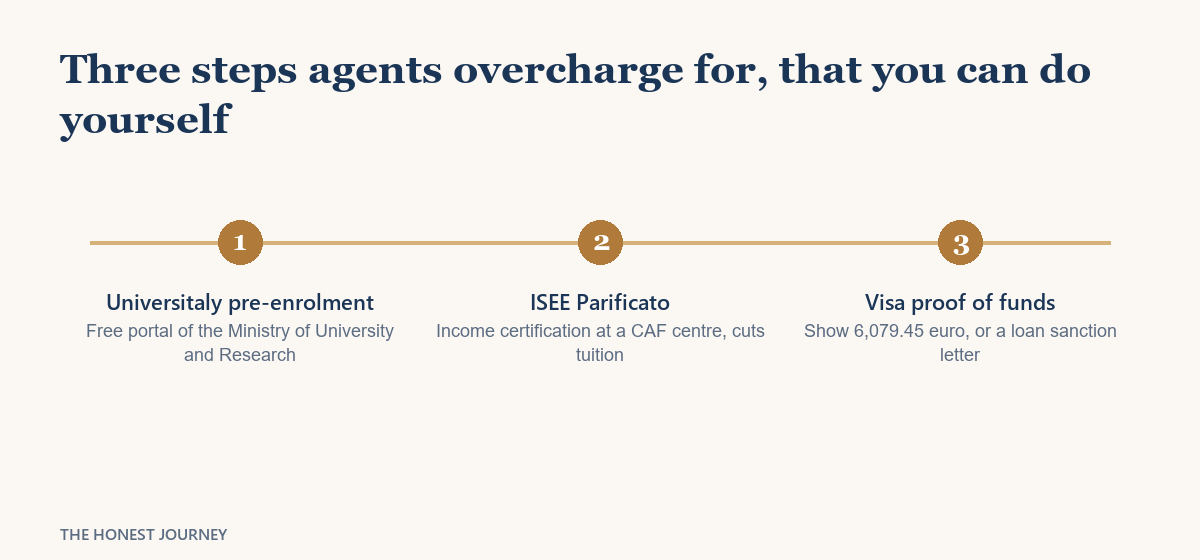
This is the section that owns the honest hook, so here it is plainly. There are three pieces of paperwork that consultancies wrap in mystery and a four-figure fee. None of them is beyond a careful student.
First, the Universitaly pre-enrolment. You create an account on the Ministry’s portal, select your university and course, upload your documents, and the system routes your pre-enrolment to your chosen Italian university and the relevant Italian diplomatic mission. It is the official gateway, and it is free. The only real skill it demands is starting early and matching your documents exactly to what the university listed.
Second, the ISEE Parificato, the income certification that unlocks lower tuition and the regional right-to-study grants. As a non-EU student whose family income is earned in India, you cannot use the standard Italian ISEE. You need the ISEE Parificato, which is produced at a CAF centre in Italy using your family’s income and asset documents, certified and translated. It is fiddly and it happens after you arrive, which is why agents love charging for it, but the payoff is direct: a correct ISEE Parificato can cut your tuition and qualify you for income-tested grants worth far more than any agent fee.
Third, the visa proof of funds, the 6,079.45 euro evidence covered above. Assembling a bank letter or attaching a loan sanction letter is administrative work, not specialist work.
I am not saying never use help. If your English is shaky or your family documents are genuinely complicated, paid help can be worth it. I am saying go in knowing these are three free or low-cost government processes, so you can judge whether the fee matches the value, rather than paying out of fear that the system is a black box. It is not.
After you land: the eight-day clock
Italy has one bureaucratic rule that catches Indian students off guard, and missing it causes real problems. Within eight days of arriving, you must register with the local police, the Questura, and apply for your residence permit, the permesso di soggiorno. This is per the EU Immigration Portal, and the eight-day window is not a suggestion. You apply through a kit usually available at a post office, submit your documents, pay the fees, and receive an appointment. The card itself can take weeks to be issued, but starting within eight days is what keeps your stay legal.
Build this into your arrival plan the same way you would build in finding accommodation. The first two weeks in Italy are administratively dense: police registration, residence permit kit, a tax code, opening a bank account, the ISEE Parificato appointment, and university enrolment. None of it is impossible, but Italian bureaucracy is slow and patience is the real requirement. Treat the first month as a part-time job in paperwork and you will be fine.
Working during study, and the stay-back reality
Non-EU students in Italy may work up to 20 hours per week, capped at 1,040 working hours within 52 weeks, per the EU Immigration Portal. That is enough to offset some living costs, especially in a cheaper city, but it is not enough to fund a degree, and you should never build your budget on the assumption of finding work quickly. Part-time work in Italy off-campus very often requires functional Italian, which I will come back to, so the English-only student’s earning options are narrower than the 20-hour allowance suggests.
Now the part that matters most and is most often misrepresented. After you graduate, your study permit can be converted into a job-search or employment permit valid for up to one year. Read that carefully. The study permit does not itself authorise you to take up regular employment, and the post-study permit is a permit to look for work and to convert once you have a qualifying job, not a green light to work from day one. This is per the EU Immigration Portal. Agents who pitch Italy as “study then a one-year work visa” are blurring a real distinction. You get a year to find a job and convert, which is genuinely useful, but it is a search window, not a work authorisation handed to you at graduation.
Faz's ruleThe post-study permit is a job-search permit, not a work permit. The clock is one year to find a job and convert.
Italy gives graduates up to one year to look for work and convert the study permit into an employment permit. That is a real opportunity, but it is conditional, and without functional Italian the job search is hard outside a handful of international roles. Plan for the conversion, do not assume it.
Scholarships and funding that actually exist
Italy has real scholarship routes, and they are worth knowing because they can change the all-in maths substantially. The two that matter most for Indian students are the national MAECI scholarship called Invest Your Talent in Italy, and the regional right-to-study grants.
Invest Your Talent in Italy, run by the Italian Foreign Ministry, supports English-taught master’s programmes in three fields: Engineering and Advanced Technologies, Architecture and Design, and Economics and Management. It bundles the master’s with on-the-job training at Italian companies and an Italian language course, which directly addresses the language and employability gaps that otherwise undercut the Italy case. Sources disagree on the exact stipend, so I will not quote a figure. Confirm the amount, the eligible universities, and the deadline on the official IYT call for the year you are applying, because all three change annually.
Regional right-to-study grants, known as Diritto allo Studio Universitario or DSU, are income-tested grants administered by each region and university. They can cover fee waivers, a cash grant, subsidised accommodation, and meal support. The catch, again, is the ISEE Parificato, because eligibility is assessed on that certified income figure, and the thresholds vary by region. Do not trust a single national number. Check the specific right-to-study page for the university you are targeting, for example the official right-to-study pages published by individual public universities, and read the income threshold for that region directly.
For the wider menu of options, including portable scholarships and how to stack funding sources, read the guide to scholarships for Indian students to study abroad.
Funding from India: the LRS, TCS, and the loan angle
However you cover the cost, the money leaving India runs through the Liberalised Remittance Scheme. Under the RBI’s LRS, a resident individual can remit up to 250,000 US dollars per financial year, and education is an eligible purpose. That ceiling is far above a typical Italian year, so the scheme itself is rarely the constraint. The mechanics of remitting, the bank forms, and the documentation are covered in the explainer on the A2 form, LRS, and forex for students.
The tax piece changed meaningfully with the Finance Act 2025, and this is one place I will be precise about the source rather than the percentage. As of changes effective 1 April 2025, the threshold above which TCS, tax collected at source, applies on LRS remittances was raised to 10 lakh INR, and crucially, TCS was removed on education remittances funded by a loan from a specified financial institution. Verify the exact rates and the definition of a specified institution against the Finance Act 2025 and the Income Tax Department or PIB notifications before you rely on a number, because the news coverage of this was noisy and not always accurate. The practical takeaway for most families is that funding Italian education through a recognised education loan can remove the TCS friction entirely, which is a genuine reason to consider the loan route. The detail sits in the post on TCS on education loans in India.
On the loan itself, Italy is one of the cheaper destinations, so the loan you need is smaller than for the UK or the US, which widens your options. If you have no property to pledge, weigh the collateral-free route carefully in the guide to education loans for abroad studies without collateral, and for the full landscape of lenders, rates, and the moratorium trap, the complete education loan India guide is the place to start. The honest reminder I give every borrower applies here too: interest usually runs from disbursement, not from graduation, so a smaller Italian loan still has a real cost clock attached.
The honest downsides
If the rest of this post made Italy sound easy, this section corrects the balance. There are three real downsides, and none of them appear on an agent’s slide.
First, the language barrier off campus. You can absolutely complete an English-taught master’s in English. But the moment you step off campus, Italy runs in Italian: the Questura, the CAF centre for your ISEE, the lease, the part-time job, the doctor, the landlord. English is far less widely spoken in daily Italian administration than in, say, the Netherlands or the Nordics. Students who arrive with zero Italian survive, but they spend the first year frustrated, and their job prospects on the one-year search permit are narrower because most Italian employers want Italian. Learning to at least A2 or B1 before or during the degree is not optional if you are serious about staying.
Second, the bureaucracy is slow. The eight-day permit clock, the weeks-long wait for the actual permit card, the CAF appointments, the document translations, the post-office kits. It works, but it works at its own pace, and an impatient student reads the slowness as dysfunction. Build buffer time into everything and keep certified copies of every document.
Third, the job-search permit is not a work permit, as covered above. The one-year window after graduation is a real opportunity, but it is conditional and language-gated, and the Italian graduate job market for non-Italian speakers is thin outside specific international and technical roles. If your entire plan rests on staying and working in Italy, go in with realistic expectations and a serious Italian-language commitment, not a brochure’s optimism.
Who Italy is genuinely right for
Being honest about fit is the whole point of this site, so here it is plainly. Italy works well if most of these are true for you:
- You are targeting an English-taught master’s in engineering, advanced technology, architecture, design, or economics and management, where the programmes and the Invest Your Talent route are strongest.
- Cost matters to you, and you are comparing Italy against the UK, the US, or even Germany on an all-in basis, where Italy’s low public tuition is a real advantage.
- You are willing to do the paperwork yourself, or at least understand it, so the ISEE Parificato and the Universitaly pre-enrolment become a saving rather than a fear-driven fee.
- You are open to learning Italian to at least a working basic level, because it transforms both daily life and your job-search prospects.
- You value the experience of living in Italy and Europe, not only the degree, because that quality-of-life dividend is part of what you are buying.
Italy is probably not the right call if:
- Your plan rests entirely on a guaranteed, immediate work visa after graduation, because the post-study permit is a search window, not a work authorisation.
- You refuse to learn any Italian and expect to live and work entirely in English long-term, because off-campus life and most local jobs require Italian.
- Your field has thin English-taught options, in which case you would need strong Italian just to study, let alone work.
- You need a large international Indian professional network and a high-volume English job market on graduation, where Canada, the UK, or the US currently offer more.
- You are impatient with bureaucracy and would treat the slow, document-heavy admin as a dealbreaker rather than a known cost.
The honest summary: Italy’s cheap-tuition headline is real, the all-in cost of 12 to 18 lakh INR a year is among the most reasonable in Europe, and the three scary-sounding paperwork steps are free or low-cost government processes you can run yourself. The price you actually pay is in language and patience, and the post-study permit is a job-search year, not a work permit. Know exactly what you are buying, do the paperwork yourself where you can, and run your own numbers at the exchange rate on the day, not a brochure’s.
Once you have settled on Italy, the visa is the step most people underestimate. The permit route, fees and funds proof for Italy sit in the Italy student visa guide.
FAQ
How much does it really cost an Indian student to study in Italy per year?
Roughly 12 to 18 lakh INR per year all-in. Public university tuition is low, about 900 to 4,000 euro per year, and the bigger cost is living, at 700 to 1,100 euro per month depending on city, with Milan and Rome highest. A realistic mid-case at a mid-sized public university lands near 13,000 to 14,000 euro a year, which is about 12 lakh INR at roughly 90 INR to the euro. Run your own conversion at the live rate, because the INR figure moves with the exchange rate.
Can I study in Italy in English without learning Italian?
Yes for the degree, with real caveats for life. There are genuine English-taught master’s programmes, especially in engineering, advanced technology, architecture, design, and economics and management. But everything off campus runs in Italian: the residence permit office, the CAF centre for your income certification, leases, doctors, and most part-time and graduate jobs. You can complete the degree in English, but learning Italian to at least a basic working level is close to essential if you want a comfortable daily life and a realistic job search after graduation.
What is the minimum money I need to show for the Italy student visa?
The financial-means figure on the official Italian consulate study-visa checklists is 6,079.45 euro for one academic year, which works out to about 506.62 euro per month. You can prove it with a bank letter showing your balance, a parent’s notarised affidavit of support with their bank letter, or an education loan sanction letter stating the amount granted. This is a floor to show you can support yourself, not a realistic full-year budget, so do not confuse it with your actual cost of living.
Is the Universitaly pre-enrolment something I have to pay an agent for?
No. The Universitaly pre-enrolment is a free process on the official portal run by Italy’s Ministry of University and Research, and as a non-EU student it is mandatory before your visa. You create an account, select your university and course, and upload your documents, and the portal routes your pre-enrolment to the university and the Italian diplomatic mission. Agents often charge to handle it, which can be worth it if your documents are complicated, but it is a government form you are capable of completing yourself. Deadlines reset every year, so always check the live current-year calendar on the official portal.
What is the ISEE Parificato and why does it matter?
The ISEE Parificato is the income certification non-EU students use in Italy, because the standard Italian ISEE assumes Italian-earned income. It is produced at a CAF centre in Italy using your family’s income and asset documents, certified and translated. It matters because Italian public tuition is scaled to income and the regional right-to-study grants are income-tested, so a correct ISEE Parificato can lower your tuition and unlock grants worth far more than the cost of preparing it. It is fiddly and happens after you arrive, which is why it is worth doing carefully rather than ignoring.
Can I work during and after my studies in Italy?
During studies, non-EU students may work up to 20 hours per week, capped at 1,040 hours within 52 weeks. That helps with costs but will not fund a degree, and off-campus work usually needs functional Italian. After graduation, the study permit can be converted into a job-search or employment permit valid for up to one year. Be clear on this: it is a window to find a job and convert, not a work permit handed to you at graduation, and the study permit itself does not authorise regular employment until converted.
Does funding Italian education through a loan affect the TCS I pay?
It can remove it. As of changes effective 1 April 2025, the threshold above which TCS applies on LRS remittances was raised to 10 lakh INR, and TCS was removed on education remittances funded by a loan from a specified financial institution. Verify the exact rates and which institutions qualify against the Finance Act 2025 and the Income Tax Department or PIB notifications, because the news coverage was inconsistent. The practical effect for many families is that funding through a recognised education loan removes the TCS friction on the remittance.
Faz · The Honest Journey · 2026