Short answer. For Indian students, Italy issues a National Type D long-stay study visa, and the real gate before it is a mandatory pre-enrolment on the Universitaly portal. As of the 2026 intake the visa fee is around EUR 50, and you must show financial proof of roughly EUR 6,000 per year, about EUR 460 per month.
After you land, you apply for the permesso di soggiorno within 8 working days.
A girl I mentored, sharp and admitted to a good university in Milan, nearly lost her intake over a step she did not know existed. She had her offer, her funds, her documents, and she went straight to book a consular appointment. The consulate turned her away because she had not completed her pre-enrolment on Universitaly first. She had never heard the word. Nobody in her circle had done Italy, so there was no senior to warn her. She lost three weeks scrambling and only just made her window. The visa was never the hard part. The gate before it was.
This post stays strictly in the visa lane: the visa type, the Universitaly gate, the real step-by-step, the fees, the funds proof, the permesso, work rights, and the honest timing reality. If you want the wider picture, the universities, the cities, the tuition and living budget, and whether Italy is the right call for you, that lives in the study in Italy for Indian students guide. Here we only talk about getting the visa.
First, it is a National Type D long-stay study visa
People say “Italy student visa” loosely, but the document you actually apply for has a precise name. For a course longer than 90 days, which any degree is, you need a National visa, called a Type D or long-stay visa, in the study category. This is different from a Schengen Type C short-stay visa, which is for tourism and stays under 90 days and cannot be used to study a full programme. If a form or an officer asks, the answer is National Type D, study purpose.
The visa is issued by the Italian consulate or embassy, and the official portal for the whole visa process is vistoperitalia.esteri.it, run by the Italian Ministry of Foreign Affairs. Treat that as one of your two sources of truth. Every fee and requirement in this post is a planning figure. As of the 2026 intake, confirm the current number on the official portal the week you apply, because consular figures move between intakes.
The Universitaly pre-enrolment gate: do this first
This is the single step that catches Indian students who are otherwise fully prepared, so I am putting it before the fees. Before you can apply for the visa, you must complete a pre-enrolment on the Universitaly portal at universitaly.it. This is mandatory for all non-EU applicants, and no consulate will process a study visa application that has not first been validated through Universitaly. It is not paperwork you do later. It is the gate.
Here is how it works in practice. Once you have your offer, you register on Universitaly, select your university and course, upload your documents, and submit the pre-enrolment. Your chosen university then confirms it on their side. Only after that confirmation does the consulate accept your visa application. The timing matters, because both your university and the portal move on their own schedule, and a late pre-enrolment cascades into a late visa. Start it the moment you have your admission, not the week you want to fly.
Faz's ruleUniversitaly comes before the visa, not with it. No pre-enrolment, no consular appointment, full stop. Treat it as your very first move the day your offer lands.
The most painful thing I see with Italy is fully qualified students who assumed the visa was step one. It is not. Universitaly is step one, and it depends on your university confirming their side, which takes time you have to plan for. Do it early, chase your university, and only then look at the consulate.
The visa fees, in INR
Let me put the money on the table. These are the government and administrative fees tied to the visa and residence permit, not your tuition or living costs, which live in the study-in guide. The planning rate through this article is ₹90 per euro. It moves, so re-check it the week you pay.
| Fee | EUR | INR (at 90) | When |
|---|---|---|---|
| National Type D study visa fee | ~50 | ~4,500 | One-time, at application |
| Permesso di soggiorno (postal kit, stamp, permit) | ~100 to 150 | ~9,000 to 13,500 | One-time, after arrival |
| Health insurance (annual) | ~150 to 300 | ~13,500 to 27,000 | Recurring, per year |
| Visa plus first-permit administrative total | ~300 to 500 | ~27,000 to 45,000 | First year |
The honest read of this table: the visa fee itself is small, roughly ₹4,500. The permesso di soggiorno is a bundle of costs, the postal application kit, a revenue stamp, and the electronic permit fee, that together run more than the visa. Health insurance is recurring, one of the few genuinely annual line items here. The body image below breaks the visa, permesso, and insurance apart so you see what is one-time versus what repeats every year.
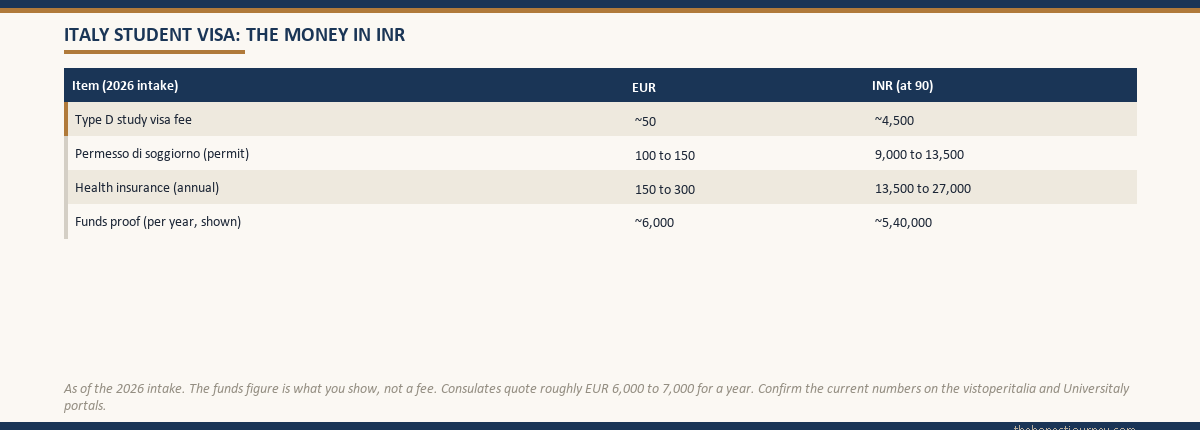
Note what is not here. Your tuition, which for Italian public universities is often modest, and your city living costs sit in the study in Italy guide, not on this page. On this visa page, money appears only as the funds you must prove to get the visa, which is the section that follows.
Financial proof: the figure that decides your file
After Universitaly, the most common reason an Italy student file wobbles is money, specifically whether you can show you can support yourself for the year without working illegally. So this is the section to get right.
As of the 2026 intake, the consular requirement lands around EUR 6,000 for one academic year, which works out to roughly EUR 460 per month across the year. At ₹90 per euro that is about ₹5.4 lakh for the year. Some Italian consulates in India quote a figure closer to EUR 6,000 to EUR 7,000, tied to the annual social allowance, so treat EUR 6,000 as a floor and confirm the exact figure your consulate asks for on the official portal, because this is the number that varies and gets revised.
You can show these funds through a bank statement in your name or a sponsor’s, a fixed deposit, a scholarship letter, or an education loan sanction letter from a recognised Indian bank. What the consulate wants is not just a balance on paper but money that reads as genuinely available to you. A loan sanction that ties clearly to your tuition and living costs, or seasoned savings with a clear source, carries more weight than a sum that appeared last week. The broader principles of presenting funds proof cleanly are in the proof of funds for a student visa guide, and if you are financing with a loan, the statement of purpose that ties it together is covered in the SOP for a student visa and education loan post.
Faz's ruleShow funds that make sense, not just funds that are enough. A loan letter tied to your course reads better than a balance that landed last week with no story behind it.
I have seen Italy files with plenty of money get questioned because the funds looked arranged for the appointment. Seasoned savings, a clear source, or a loan sanction that maps to your tuition tell a coherent story. Build that story before you build the balance.
The four-step process, end to end
Here is how the Italy student visa actually runs, in the order it happens. The step flow below maps the same four stages at a glance.
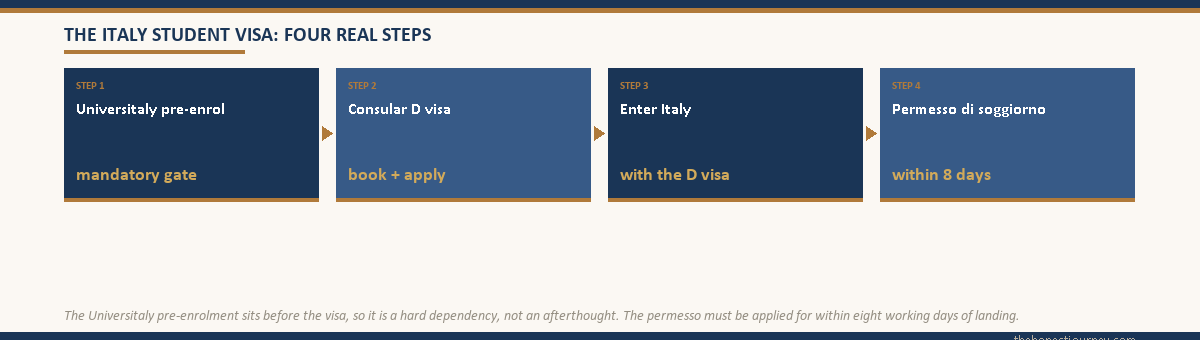
Step one: Universitaly pre-enrolment. Once you accept your offer, register on the Universitaly portal, select your university and course, upload your documents, and submit the pre-enrolment. Your university confirms it on their side. This is the hard gate, so treat it as a dependency you clear before anything else, not a form you file alongside the visa.
Step two: the consular Type D visa application. Book your appointment at the Italian consulate or the appointed visa centre, then submit your National Type D study visa application with your Universitaly confirmation, admission letter, financial proof, accommodation proof, health insurance, and passport. Pay the visa fee, around EUR 50. This is where the funds and documents are judged.
Step three: enter Italy. With the visa in your passport, you travel to Italy in time for your course. Keep your admission letter, Universitaly confirmation, financial proof, and insurance in your hand luggage, because you may be asked at the border and you will need them again for the permesso.
Step four: apply for the permesso di soggiorno within 8 working days. Once you land, you have 8 working days to begin your permesso di soggiorno, the residence permit that lets you legally stay for the year. You collect the postal application kit, submit it, and attend a police appointment for fingerprints. Miss this window and your legal status is at risk, so it is the first thing you sort after you arrive, before you settle in.
The permesso di soggiorno, health insurance, and documents
Two things trip students who think the visa is the finish line. First, the permesso di soggiorno. The visa gets you into Italy, but the permesso is what makes your stay legal beyond the first days, and the 8-working-day clock starts when you arrive. You pick up the postal kit, usually from a post office with a Sportello Amico counter, fill it, pay the fees, and get a police headquarters appointment for biometrics. It takes weeks to be issued, but starting it on time is what matters.
Second, health insurance. You need valid health coverage for your whole stay, shown at the visa stage and again for the permesso. Many students take an Italian policy or register with the national health service once enrolled, but you must have coverage in place from day one, not arranged later. Beyond those, the documents that carry weight are your admission letter, Universitaly pre-enrolment confirmation, financial proof, proof of accommodation, and passport. Follow the exact checklist your consulate publishes on the official portal, because it updates between intakes and consulates vary.
Processing time and the honest timing reality
The Italy student visa itself is usually not slow to decide once your file is complete. The consular processing generally runs a few weeks, though it stretches in the busy pre-intake months. The real timing risk is not the visa decision. It is the two things around it: getting a consular appointment slot, and getting Universitaly confirmed in time.
Now the part most guides skip. Consular appointment availability is the quiet bottleneck. In the peak season before an autumn intake, appointment slots at Italian consulates in India fill up, and a student ready on paper can still wait weeks for a date. Combine that with a Universitaly pre-enrolment that depends on your university, and you have two independent queues that both have to clear before you fly. Neither is hard, but both punish lateness. Students who miss their intake almost never miss it on the visa decision. They miss it because they started the appointment hunt and Universitaly too late.
So the move is simple. Complete Universitaly the day your offer lands, book your appointment the moment slots open, and keep your funds and documents ready so that when the date comes, you walk in complete. Done that way, the Italy visa is a process you execute rather than a scramble you survive.
Work rights while you study
Your Italy student visa and permesso let you work, within a limit. You may work up to 20 hours per week during the academic term, and the cap is generous enough during official university holidays that many students take on more in the breaks. Read the conditions tied to your own permesso, because they govern, and confirm the current limit on the official portal, as work rules can be revised.
The honest framing on work is the same everywhere I write it. Twenty hours of part-time work is a living-cost supplement, not a tuition fund. It buys breathing room and useful local experience, but it does not close a funding gap, and you should never present it to the consulate as how you will pay. If your plan only works because you are counting on part-time earnings, the plan is too thin. The realities of balancing work with a full course load are in the part-time work while studying abroad guide.
Arrival: the first things to register
One last thing students miss. Arriving in Italy is not the end of the paperwork, it is the start of a short, time-boxed list. The permesso di soggiorno within 8 working days is the headline, but you also settle health coverage and complete your university registration in person once enrolled. Keep all your visa documents in your hand luggage, because you will need them within days of landing. Treat the first two weeks as an administrative sprint, and the rest of the year runs smoothly.
The honest take on the Italy student visa
The Italy student visa is not a hard visa for a genuine, well-prepared student. The visa fee is low, the funds bar is one of the more reasonable in Europe, and the decision itself is usually not the obstacle. What makes Italy trip people is sequencing. The Universitaly gate comes first and depends on your university, the consular appointment is a queue that fills, and the permesso has an 8-working-day clock the moment you land. None of these is difficult. All of them punish a student who treats the visa as a single event rather than a chain of dependencies.
So the move is to respect the order. Clear Universitaly early, secure your appointment the moment slots open, keep your funds credible and your documents ready, and start the permesso the day you arrive. Confirm every fee and figure on the official portal, because consular numbers shift between intakes. Do that, and Italy becomes one of the more manageable routes into a European degree. If you are still weighing where the money stretches furthest, the cheapest country to study abroad guide puts Italy alongside the other affordable options.
Weighing Italy against another warm, lower-cost European base? The application, fees and funds proof for the Spain student visa sit close to Italy’s, so it is worth reading both.
FAQ
How much is the Italy student visa fee for Indian students?
As of the 2026 intake, the National Type D long-stay study visa fee is around EUR 50, roughly ₹4,500 at ₹90 per euro, paid when you submit your application at the consulate or visa centre. On top of that you later pay for the permesso di soggiorno after arrival, which is a separate bundle of costs. Confirm the current visa fee on the official portal before you pay, as consular figures are revised between intakes.
How much financial proof do I need for an Italy student visa?
As of the 2026 intake you must show roughly EUR 6,000 for the academic year, about EUR 460 per month, which is around ₹5.4 lakh at ₹90 per euro. Some Italian consulates in India quote closer to EUR 6,000 to EUR 7,000, tied to the annual social allowance. Treat EUR 6,000 as a floor and confirm the exact figure your consulate asks for on the official portal, because this number varies.
What is Universitaly and why does it matter for the visa?
Universitaly is the official Italian portal where non-EU students complete a mandatory pre-enrolment before applying for the study visa. No consulate will process your visa without a validated Universitaly pre-enrolment first, so it is the true first step, not later paperwork. It also depends on your university confirming their side, which takes time, so start it the day your offer lands rather than the week you want to fly.
What is the permesso di soggiorno and when do I apply?
The permesso di soggiorno is the residence permit that makes your stay in Italy legal beyond the first days. Once you land, you have 8 working days to begin the application, usually by collecting a postal kit from a post office, submitting it, and attending a police appointment for fingerprints. It takes weeks to be issued, but starting it within the window is what protects your status, so it is the first thing you sort after arrival.
How long does an Italy student visa take to process?
The visa decision itself usually takes a few weeks once your file is complete, though it stretches in the busy months before an autumn intake. The bigger timing risk is getting a consular appointment slot and getting Universitaly confirmed in time, as both are queues that fill up in peak season. Apply early on all fronts, because students who miss their intake almost always miss it on timing, not on the visa decision.
Can I work on an Italy student visa?
Yes. Your student visa and permesso di soggiorno let you work up to 20 hours per week during the academic term, with more room during official university holidays. Read the conditions on your own permesso, because they govern, and confirm the current limit on the official portal, as work rules can change. Treat part-time work as a living-cost supplement and useful experience, never as a tuition fund or as how you tell the consulate you will pay.
Do I need health insurance for an Italy student visa?
Yes. You must have valid health coverage for your whole stay, and you show it both at the visa stage and again for the permesso di soggiorno. Many students take an Italian policy or register with the national health service once enrolled, but you need coverage in place from day one, not arranged after arrival. Budget roughly EUR 150 to EUR 300 a year, and confirm the accepted forms of insurance with your consulate.
Is the Italy student visa hard to get for Indian students?
Not for a genuine, well-prepared student. The visa fee is low, the funds bar is reasonable by European standards, and the decision itself is rarely the obstacle. What trips Indian students is sequencing: the Universitaly gate, the consular appointment queue, and the 8-working-day permesso clock. None is difficult, but all punish lateness. Respect the order, start early, and Italy becomes one of the more manageable European routes.
Faz · The Honest Journey · 2026