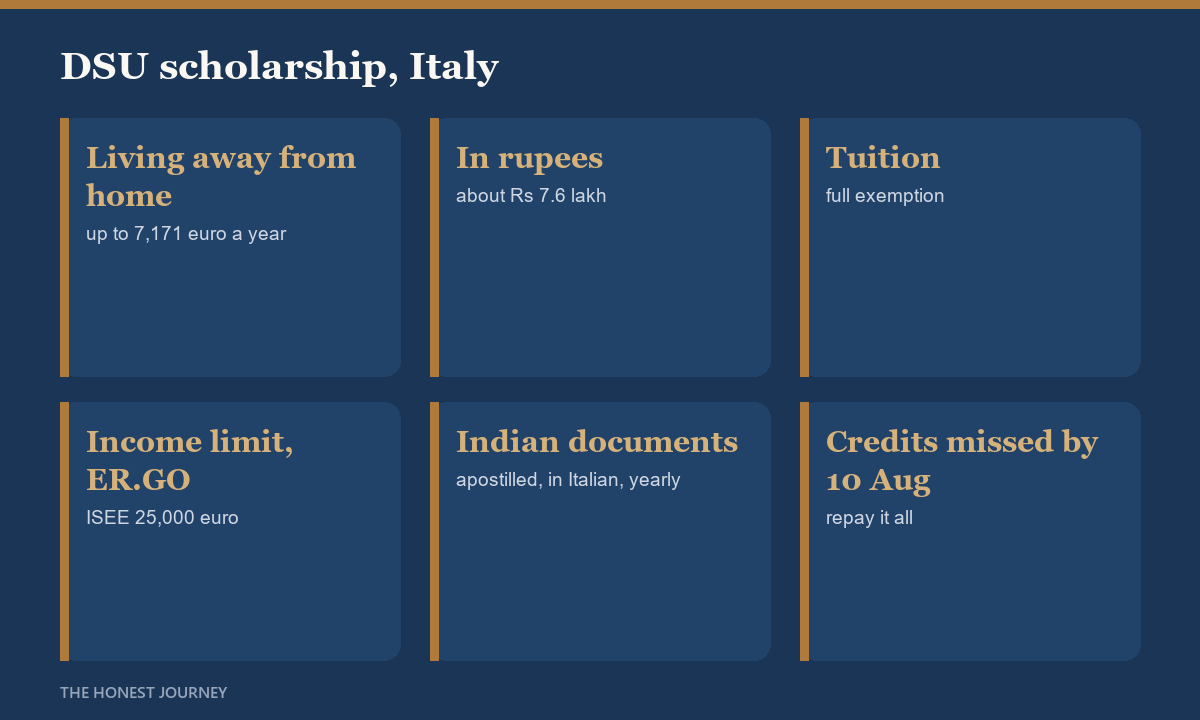
Short answer. The DSU scholarship is Italy’s regional, income based grant, open to Indian students. In Emilia-Romagna it pays up to 7,171 euro a year, about ₹7.6 lakh, plus a full tuition waiver. You need apostilled, translated Indian income documents every year, and if you miss your credit target, you repay everything.
Italy’s public universities are cheap, and the DSU scholarship is the reason many Indian students end up paying close to nothing in tuition. DSU stands for diritto allo studio universitario, the right to university study. It is not a single national scholarship. Each Italian region runs its own call through its own agency, with its own deadlines, documents and amounts, inside limits set by the national government.
This guide uses ER.GO, the agency for universities in Emilia-Romagna such as Bologna, Parma, Modena and Reggio Emilia, and Ferrara, because its 2026 to 27 rules are published in full. The structure is similar in other regions, but always read the call for your own university’s region. For the wider picture of costs and paperwork, start with our guide to studying in Italy as an Indian student.
What DSU pays in 2026 to 27
| Your status | Maximum a year | In rupees, approx. |
|---|---|---|
| Non resident, living away from home in the university city | 7,171.11 euro | ₹7.64 lakh |
| Commuter | 4,190.71 euro | ₹4.46 lakh |
| Resident, living at home | 2,890.16 euro | ₹3.08 lakh |
An Indian student who moves to Italy is normally a non resident student, the top band, but only if you document a domicile in the university city, such as a rental contract. Amounts are scaled down as family income rises, and two increases apply in Emilia-Romagna: 15 percent if your family’s ISEE is 12,500 euro or less, and 20 percent for women enrolled in science, technology, engineering or mathematics.
The cash is only part of it. Students who qualify get a full exemption from university tuition and a refund of the 140 euro regional tax, can convert part of the grant into meal vouchers, and can apply for a place in ER.GO’s residences, which charge a monthly fee and are allocated by ranking.
The income test, for a family in India
Eligibility depends on your family’s economic indicator, which must fall below the region’s threshold. ER.GO kept that threshold at an ISEE of 25,000 euro for 2026 to 27. Because your family’s income and assets are in India, you cannot get a normal Italian ISEE. Instead you submit Indian documents and ER.GO works out an equivalent figure from them.
- Issued by Indian authorities: the documents must come from the public authority competent for your family’s area, in the original language, issued in the year you apply.
- Last year’s income, this year’s snapshot of assets: they must show your family’s income for the previous year and its assets as of 31 December of the previous year.
- Apostilled: the signature of the issuing official must be legalised or apostilled. India is a party to the Hague Apostille Convention, so apostille is the route.
- Translated into Italian: every document, in full.
- Every year: new documents for each year you apply, even if nothing changed.
This is the slow part. Getting income and property certificates issued, apostilled and translated can take weeks, and ER.GO’s 2026 to 27 deadline for scholarship applications was 24 August 2026, before most Indian students had even landed. Start the paperwork in India as soon as you accept an offer, and upload it through your ER.GO user dossier by the deadline in the call.
Faz's ruleDSU is a scholarship you can end up owing. Plan your first year as if the second half of the money might not come.
ER.GO says it plainly: the scholarship is not a non repayable grant. If you do not earn the minimum credits set in the merit tables by 10 August, the award is revoked and you must return all the money and services you received, including accommodation and meals. For a first year master’s student, half the money arrives by 31 December and 40 percent only from June, after you have proved your credits. That timing also means DSU cannot be your proof of funds for the visa; our Italy student visa guide covers what the consulate wants to see.
How the money is paid
| Student | First | Second | Third | Fourth |
|---|---|---|---|---|
| First year of a master’s | 50% by 31 December | 10% from March, if credits are met by 28 February | 40% from June, if credits are met by 10 August | |
| First year of a bachelor’s | 20% by 10 November | 30% by 31 December | 10% from March, if credits are met by 28 February | 40% from June, if credits are met by 10 August |
Being listed as eligible in the provisional ranking does not guarantee the money; the award is confirmed later, and your position is suspended until your university marks your enrolment as active. ER.GO also receives your exam results from the university in periodic batches, not in real time, so there can be a gap between passing an exam and the next payment.
Steps for an Indian applicant
- Get your admission and pre enrolment done through Universitaly, as described in our Italy guide.
- Find your region’s DSU agency and read this year’s call, especially the income threshold, deadlines and the list of foreign documents.
- Get your family’s Indian income and asset documents issued, apostilled and translated into Italian.
- Get an Italian tax code, the codice fiscale, which ER.GO’s application needs.
- Apply online by the deadline and upload the foreign income documents through your user dossier.
- Enrol at the university on time, document your domicile, and track your credits against the merit table from your first semester.
ER.GO warns that you never need an agency or intermediary to collect or submit these documents, and that it checks what students submit and reports false declarations. Paying someone to arrange your ISEE paperwork buys you nothing the agency requires.
The honest closing take
For a student from an ordinary Indian family at an Italian public university, DSU can be worth more than most named scholarships: up to about ₹7.6 lakh a year plus free tuition, renewed every year you keep your grades up. It is also more work than any of them, because it is an income test run on Indian paperwork, repeated annually, with the money paid in arrears.
Treat it as a strong probability, not a certainty, while you plan. Show your full first year funds for the visa, get the apostilled documents moving early, and choose courses you can pass on schedule in the first year. If you also need a loan for the gap, the cost of studying abroad calculator shows how much DSU changes the amount you need.
FAQ
Can Indian students get the DSU scholarship in Italy?
Yes. DSU is open to students of any nationality enrolled at a university in the region, provided they meet the income and merit requirements and submit the foreign income documents the call asks for.
How much is the DSU scholarship for international students?
In Emilia-Romagna for 2026 to 27, up to 7,171.11 euro a year for a student living away from home, 4,190.71 euro for a commuter and 2,890.16 euro for a student living at home, plus a full tuition exemption. Other regions set their own amounts.
What is the ISEE limit for the DSU scholarship?
ER.GO set it at 25,000 euro for 2026 to 27. For a family in India, ER.GO calculates an equivalent figure from the Indian income and asset documents you submit.
Do I have to repay the DSU scholarship?
Only if you do not meet the merit requirement. If you miss the minimum credits by 10 August, the award is revoked and you must return the money and the value of services received, such as housing and meals.
Which Indian documents do I need for the DSU application?
The documents your region’s call lists for your family’s composition, income and assets, issued by the competent Indian authority in the year you apply, apostilled and translated into Italian. Check the exact list in the call each year.
Where these figures come from
- Regione Emilia-Romagna, the ER.GO 2026 to 27 call in summary
- ER.GO, documents for students with income or assets abroad
- ER.GO, payments and revocations
- Hague Conference, Apostille Convention status table
- European Central Bank, euro reference exchange rates
Checked against the sources above in October 2026. Each region publishes a new call every summer with its own amounts and deadlines.