Short answer. For Indian students, Spain issues a national long-stay student visa (estancia por estudios), and as of the 2026 intake the visa fee is about EUR 80. You must prove financial means of 100% of the IPREM, roughly EUR 600 per month, which works out to about EUR 7,200 for a year.
For stays over six months you then apply for the TIE foreigner ID card within 30 days of landing, and private health insurance is mandatory throughout.
A girl I helped from Pune had her admission to a Madrid master’s locked by March and assumed the visa was a formality she could book “sometime in June”. By the time she tried, the consular appointment slots for her jurisdiction were gone until August, and her intake started in September. She was not short on money or documents. She simply did not know that in India the appointment itself is the bottleneck, and that apostilling and translating her degree would eat another three weeks. She made it, but only because she panicked early enough. Most people panic too late.
This post stays strictly in the visa lane: the visa type, the consular route, the fee, the funds proof, the TIE, health insurance, processing reality, and work rights. It does not cover tuition or city living costs, because that is a different conversation. Spain does not have a dedicated study-in guide on this site yet, so for the money-proof mechanics that apply across every country, lean on the proof of funds for a student visa guide. Here we only talk about getting the Spanish visa.
First, the visa: the national long-stay student visa
People search “Spain student visa” and imagine one uniform thing, but the document that matters for a full degree is the national long-stay visa for study, which Spaniards call the estancia por estudios. It is a type D national visa, not the short Schengen tourist visa, and it is what you apply for at the Spanish consulate when your course runs longer than 90 days. The short-stay Schengen visa is for language courses or programmes under three months, and it is a different animal. If you are coming for a degree or a full master’s, you want the national long-stay student visa.
The whole system sits under Spain’s Ministry of Foreign Affairs for the consular visa stage and the Ministry of Inclusion for the in-country residence side. The official visa information lives at exteriores.gob.es, and the residence and foreigner rules live at inclusion.gob.es. Treat those two as your only source of truth. Rules and figures shift between intakes, so as of the 2026 intake every number in this post is a planning figure you should confirm on the official portal the week you apply.
The consular application and the apostille trap
Here is the shape of it. You apply for the visa in person at the Spanish consulate that covers your Indian state. Spain runs consulates in New Delhi and Mumbai with defined jurisdictions, so you cannot pick the shorter queue. You apply where your address falls.
The part that catches Indian applicants is document legalisation. Spain requires your key documents, your degree certificate and often your birth certificate and any police clearance, to be apostilled in India through the designated authority and then officially translated into Spanish by a sworn translator Spain accepts. Neither is instant. Between the apostille, the translation, and gathering the acceptance letter, insurance, and funds proof, the document pack alone can take a month. Build that month in before you even look at appointment dates.
Faz's ruleIn India the consular appointment is the real deadline, not the visa decision. Book the appointment and start apostilling the day your admission is confirmed, not the month before you fly.
I have watched confirmed, well-funded students miss an intake purely because the New Delhi or Mumbai slot they needed was booked out for weeks and their apostille was still in a queue. The paperwork is winnable. The calendar is not, if you start late. Treat March, not July, as your visa month.
The visa fee, in INR
Let me put the money on the table. These are the fees tied to the visa and your arrival, not your tuition or living costs, which belong to a different page. The planning rate through this article is ₹90 per euro. It moves, so re-check it the week you actually pay.
| Item | EUR | INR (at 90) |
|---|---|---|
| National long-stay student visa fee | ~80 | ~7,200 |
| TIE foreigner ID card (tasa, after arrival) | ~16 to 21 | ~1,440 to 1,890 |
| Private health insurance (annual, typical) | ~400 to 700 | ~36,000 to 63,000 |
| Apostille and sworn translation (India side, typical) | ~50 to 150 | ~4,500 to 13,500 |
| Visa-related outlay (excl. funds proof) | ~546 to 951 | ~49,140 to 85,590 |
The honest read of this table: the visa fee itself is small, around ₹7,200, and the TIE tasa is smaller still. The item that actually costs money is the private health insurance, which is mandatory and which you pay before you get the visa. Indian nationals pay the standard EUR 80 band, while a handful of countries pay reciprocity rates, so confirm your exact figure on the official portal. The body image below breaks the outlay apart.
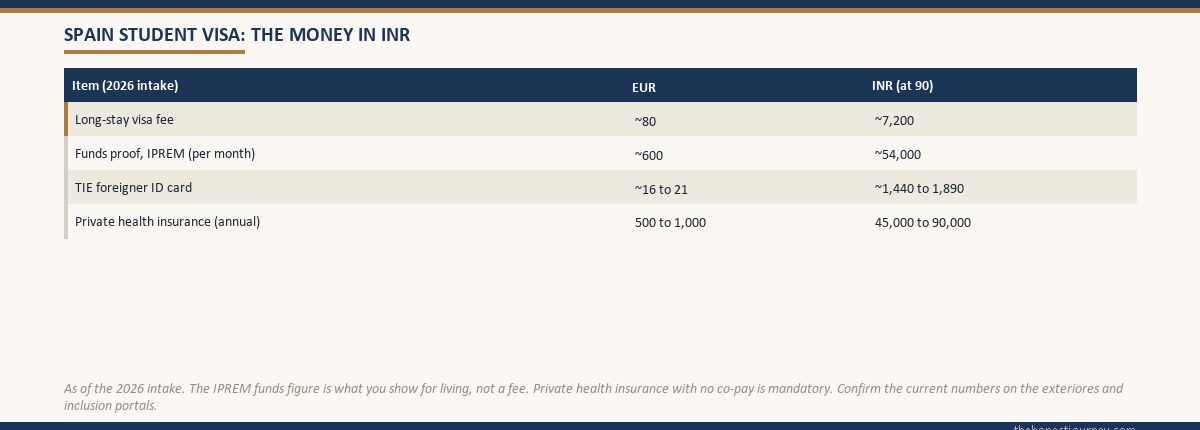
Note what is not here. Your tuition is paid to the university, and your monthly living cost in Madrid or Barcelona is a separate budget. On this page, money appears only twice: as the fees above, and as the funds you must prove to be granted the visa.
Proof of funds: 100% of the IPREM
This is the section that decides borderline cases, and Spain states its bar in a specific way. You must show financial means of 100% of the IPREM, which is Spain’s public income index. As of the 2026 intake the IPREM is about EUR 600 per month, so for a one-year stay you are proving roughly EUR 7,200, about ₹6.48 lakh at ₹90 per euro. For a longer course you multiply that monthly figure across the months of your intended stay. Confirm the current IPREM on the official portal, because it is revised and consulates in high-volume countries, India included, read it strictly.
You can prove this with your own bank statements, or, very commonly for Indian families, with a sponsor. A parent or guardian provides their bank statements plus a notarised declaration of financial support that ties them to you. What the consulate wants is not a single fat balance that appeared last week, but funds that look real: a steady account, a clear source, and a loan sanction letter if you are financing through an education loan. The broader principles of presenting funds proof cleanly are in the proof of funds for a student visa guide, and if you are carrying cash and cards for the first weeks, the how much money to carry abroad guide covers the arrival end.
One thing worth saying plainly. Because your visa file leans on a coherent funding story, a well-written statement of purpose that explains your course choice and how it is funded genuinely helps. If a loan sits behind your funds, tie the two together in your narrative rather than leaving the officer to guess. The SOP for a student visa and education loan guide walks through how to write that so the money and the motive read as one story.
Faz's ruleSpain sizes the funds proof against the IPREM and multiplies it by your months of stay, so a two-year course needs roughly double a one-year course. Do the multiplication before you assume EUR 7,200 is enough.
The mistake I see is students proving one year of IPREM for a two-year programme and being surprised when the consulate asks for more. The rule is per month of intended stay, not per year of visa. Read your admission length, multiply, then add a margin.
The four-step process, end to end
Here is how the Spanish student route actually runs, in the order it happens. The step flow below maps the same four stages at a glance.
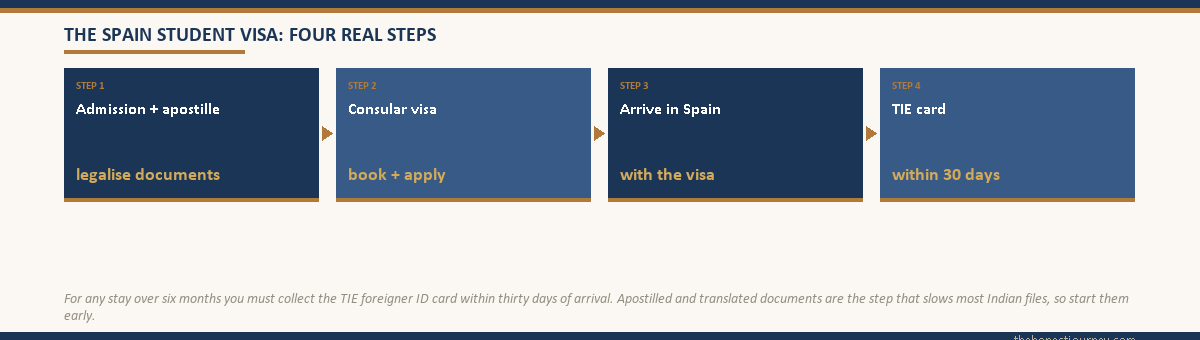
Step one: secure admission and apostille your documents. Accept your offer from the Spanish institution and get your official acceptance letter. In parallel, apostille your degree and any other required certificates in India and arrange the sworn Spanish translations. This is the stage that quietly takes the longest, so start it the day your admission is confirmed.
Step two: book the consular appointment and apply. Book your slot at the Spanish consulate that covers your state, and this is the real deadline, because slots in New Delhi and Mumbai fill weeks ahead. Attend in person with your visa form, acceptance letter, funds proof, private health insurance certificate, apostilled documents, and passport, and pay the roughly EUR 80 fee.
Step three: arrive in Spain. Once granted, the visa lets you enter Spain to begin your course, but do not treat landing as the finish line. The clock on the next step starts the moment you arrive.
Step four: apply for the TIE within 30 days. If your stay is longer than six months, you must apply for the TIE, the foreigner identity card, within 30 days of arrival. You book an appointment, submit your fingerprints and documents, pay the tasa, and later collect the card. This is the step most people underestimate, and appointments can be scarce, so book it early, even before you land.
The TIE, health insurance, and the documents that carry weight
Two obligations trip people who think the visa is the end of it. The first is the TIE. For any stay over six months your visa is only the entry document, and the TIE is your actual residence card in Spain. You apply within 30 days of arrival, and missing that window creates avoidable problems. Book the TIE appointment as early as you can, because in the big cities the slots vanish quickly.
The second is private health insurance, and it is not optional. Spain requires a full private policy from an insurer authorised to operate in Spain, with full coverage and no co-payments, for the duration of your stay, and you must show the certificate at the visa stage. This is a common reason a file stalls, because students buy a thin travel policy that does not meet the requirement. Buy a compliant student health policy and keep the certificate with your visa pack. Beyond those, the documents that carry weight are your acceptance letter, funds proof, apostilled and translated certificates, and passport. Follow the official checklist on the consulate page, because it updates between intakes.
Processing time and the honest appointment reality
Spanish student visa processing is usually reasonable once your file is in, often a few weeks, though it varies by consulate and season. The official estimate for study visas is published per consulate, so check the one covering your jurisdiction rather than a forum number. The takeaway is the same as always: apply early.
Now the part most guides skip. For Indian applicants the pain is rarely the decision, it is getting to the counter. Consular appointment slots in New Delhi and Mumbai fill weeks in advance around the September intake, and there is no fast lane. On top of that, consulates in high-volume countries read the funds and document requirements strictly, so a thin insurance policy or an unseasoned bank balance gets more scrutiny here than a casual reading of the rules would suggest. These are not character judgments. They are process realities you defeat by starting in March, apostilling early, buying compliant insurance, and presenting funds that hold together. If something is missing, the consulate will usually ask for it rather than refuse outright, but that costs you time you may not have before your intake. So the winning move is a complete, credible file the first time, submitted with weeks to spare.
Work rights on a Spanish student visa
Your student status lets you work, within limits, and this improved recently. Under Spain’s 2022 immigration reform, students on a study visa may work up to 30 hours per week, up from the older and stricter arrangement that required a separate work authorisation for very limited hours. This is a genuine advantage over several other European destinations, but read the current conditions on the official portal, because the practical implementation and any employer paperwork can vary, and this figure was revised in the last few years.
The honest framing on work is the same as everywhere. Thirty hours sounds generous, but it is a living-cost supplement, not a tuition fund, and it should never be the plan that closes a funding gap you presented to the consulate. Treat it as breathing room and experience. If you want to understand how student work rights compare across countries and what the money actually looks like, the part-time work while studying abroad guide lays it out honestly.
After studies, and where Spain sits
After you finish, Spain has a route that lets graduates stay to look for work or start a business, and the study time itself counts toward longer-term residence, which makes the country more than a one-degree stop. Those post-study routes have their own evolving rules and belong to a wider decision conversation, so I will only flag it here. Just know the runway after graduation is a real part of why the Spanish ticket can repay.
And if the question on your mind is whether Spain is the affordable choice at all, that is a budgeting decision, not a visa one. Spain sits in the moderate band of Europe, cheaper than the Nordics or Switzerland, dearer than parts of Eastern Europe. Where it lands for your budget is covered in the cheapest country to study abroad guide, which weighs destinations on total cost rather than headline tuition.
The honest take on the Spain student visa
The Spanish national long-stay student visa is not a hard visa to win on its merits. The funds bar, at 100% of the IPREM, is one of the gentler ones in Europe, and the work rights at 30 hours a week are generous. What makes people fail is not the rules, it is the timeline and the document work. The apostille takes weeks, the sworn translation takes weeks, the consular appointment fills weeks ahead, and the TIE has to be done within 30 days of a landing you are still excited about.
So the move is simple. Start the day your admission is confirmed. Apostille and translate early, book the consular slot the moment you can, buy compliant private insurance rather than a thin travel policy, prove your IPREM funds cleanly across the full length of your course, and book the TIE appointment before you fly. Confirm every fee and figure on the official portal, because they shift between intakes. Do that, and Spain becomes a process you execute calmly rather than a scramble you barely survive.
If Spain’s budget appeals, Poland is often even lighter on the wallet. The fees, funds proof and permit steps sit in the Poland student visa as well.
FAQ
How much is the Spain student visa fee for Indian students?
As of the 2026 intake, the national long-stay student visa fee is about EUR 80, roughly ₹7,200 at ₹90 per euro, paid at the Spanish consulate when you apply. Indian nationals pay the standard band, while a few countries pay reciprocity rates. Confirm the exact figure on the official portal at exteriores.gob.es before your appointment, as fees are revised between intakes and can differ slightly by consulate.
How much proof of funds do I need for a Spain student visa?
As of the 2026 intake you must show financial means of 100% of the IPREM, about EUR 600 per month, which is roughly EUR 7,200 for a one-year stay, about ₹6.48 lakh at ₹90 per euro. For longer courses you multiply the monthly figure across your months of stay. You can use your own funds or a sponsor with bank statements and a notarised declaration. Confirm the current IPREM on the official portal.
What is the TIE and when must I apply for it?
The TIE is the foreigner identity card, your actual residence card in Spain for stays over six months. Your visa is only the entry document, and you must apply for the TIE within 30 days of arriving in Spain. You book an appointment, submit fingerprints and documents, pay a small tasa of roughly EUR 16 to 21, and collect the card later. Appointments in the big cities are scarce, so book yours early, even before you land.
Is health insurance mandatory for a Spain student visa?
Yes. Spain requires full private health insurance from an insurer authorised to operate in Spain, with full coverage and no co-payments, for the length of your stay, and you must show the certificate at the visa stage. A thin travel policy usually does not meet the requirement and is a common reason a file stalls. Buy a compliant student health policy, confirm its wording matches the consulate’s requirement, and keep the certificate with your visa documents.
How long does a Spain student visa take to process?
Once your complete file is submitted, processing is usually a few weeks, though it varies by consulate and season, and each consulate publishes its own estimate. For Indian applicants the real bottleneck is not the decision but securing a consular appointment, as slots in New Delhi and Mumbai fill weeks ahead around the September intake. Apply early, and check the processing estimate for the consulate covering your state on the official portal.
How many hours can I work on a Spain student visa?
Under Spain’s 2022 immigration reform, students on a study visa may work up to 30 hours per week, which is generous compared with several other European destinations. Read the current conditions on the official portal, as the practical implementation and any employer paperwork can vary and this figure was revised recently. Treat work as a living-cost supplement and experience, never as a tuition fund or as something you present to the consulate as how you will pay.
Do I need to apostille my documents for a Spain student visa?
Yes, for most applicants. Spain requires key documents such as your degree certificate, and often your birth certificate and police clearance, to be apostilled in India and then officially translated into Spanish by a sworn translator Spain accepts. Neither is instant, and together they can take several weeks. Start the apostille and translation the day your admission is confirmed, because leaving it late is a common reason students miss their intake even with a clean file.
What is the difference between the Spain student visa and the estancia por estudios?
They are two stages of one journey. The national long-stay student visa is what you apply for at the consulate in India, and it is your document to enter Spain. The estancia por estudios is the student residence status you then hold in Spain, formalised through the TIE card for stays over six months. In short, the visa gets you in, and the residence authorisation and TIE let you stay legally for the length of your course.
Faz · The Honest Journey · 2026