Short answer. For Indian students, Poland issues a National D long-stay visa for study, applied for at the Polish consulate through VFS. As of the 2026 intake the visa fee is EUR 80, and you must show roughly PLN 776 per month for living plus accommodation and around PLN 2,500 return travel, proved for the year.
As of the 2026 intake the visa fee is EUR 80, and you must show funds of roughly PLN 776 per month for living, plus accommodation and a return travel amount of around PLN 2,500, proved for the year. If you stay over one year you then apply for a karta pobytu. Confirm every figure on the official portal.
A girl from my extended family messaged me last winter in a small panic. She had her admission letter from a Polish university and had assumed the student visa was a quick embassy stamp like a tourist visa. Then someone told her about VFS slots, document legalisation, and a residence card she would need after landing, and the whole thing suddenly felt like a maze. It was not a maze. It was just a sequence nobody had laid out in order. That is what this post does.
This post stays strictly in the visa lane: the D visa type, the consular route through VFS, the fee, the funds you must prove, health insurance, the karta pobytu after arrival, processing reality, and work rights. Poland does not yet have a dedicated study-in overview on this site, so for the wider question of how to arrange and present your money, lean on the proof of funds for a student visa guide. Here we only talk about getting the visa and the residence card.
First, it is a National D visa, then a residence card
People search “Poland student visa” and picture one document. In practice there are two stages, and understanding the split saves a lot of confusion. The entry document is the National D visa, a long-stay visa issued by the Polish consulate before you travel that lets you come to Poland and begin studying. Then, if your studies run longer than one year, you apply in Poland for a temporary residence permit, the karta pobytu, at the voivodeship office. The D visa gets you in. The karta pobytu keeps you legal for the long haul.
Everything official for the entry visa lives on the Polish government portals. Treat the consular pages under gov.pl and the study information at study.gov.pl as your only source of truth. As of the 2026 intake every number in this post is a planning figure you should confirm on the official portal the week you apply.
The consular application through VFS
Indian applicants apply for the Polish National D visa through the consulate, and in India the paperwork and appointments run via VFS Global, the visa application centre for Poland. You register the application, book a slot, submit your documents and biometrics at VFS, and the consulate makes the decision. The practical bottleneck is the appointment slot itself, which quietly derails timelines.
The core documents the consulate expects are your acceptance letter, a completed application form, your passport, proof of funds, proof of paid tuition or the first instalment, health insurance, proof of accommodation, and a return travel amount. Some documents may need to be legalised or apostilled, which takes its own time. Follow the live checklist on the official portal, because it updates between intakes and the exact list can vary by consulate.
The visa and residence-card fees, in INR
Let me put the money on the table first. These are the government and official fees, not your tuition or living costs. The planning rates through this article are ₹90 per euro for the visa fee and ₹21 per Polish zloty for the zloty amounts. Both rates move, so re-check them the week you transfer money.
| Fee | Local currency | INR (planning) |
|---|---|---|
| National D visa fee | EUR 80 | ~7,200 |
| VFS service fee (typical, varies) | varies | ~1,500 to 3,000 |
| Karta pobytu, residence permit fee | PLN 340 | ~7,140 |
| Karta pobytu card issue fee | PLN 100 | ~2,100 |
| Official fees only (visa plus later card) | EUR 80 plus PLN 440 | ~16,440 plus VFS |
The honest read of this table: the visa fee itself is small, about ₹7,200, and the VFS service charge on top is modest. The karta pobytu fees come later, only if you stay over a year, and are separate from the entry visa. None of these are your big spend. The big number is the funds you have to prove, and that is not a fee at all. The body image below shows the fees against the funds you merely demonstrate.
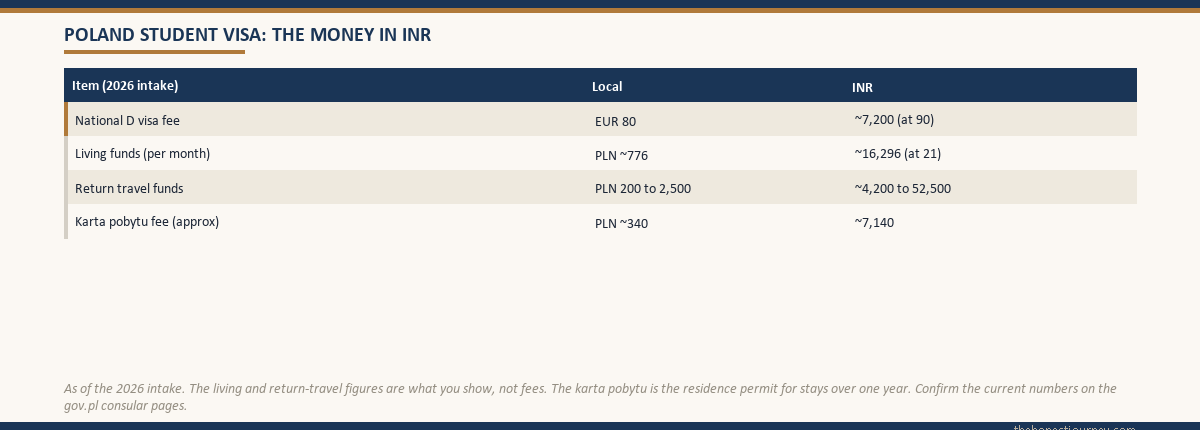
Note what is not here. Your tuition and city living costs are a separate conversation from the visa. For the wider picture of how much cash to physically carry and arrange for the move, see the how much money to carry abroad guide. On this page, money appears only as the funds you must prove to get the visa.
Proof of funds: the part that decides your case
If a Polish student visa is refused, money is the most common reason, specifically whether the consulate believes you can genuinely support yourself. So this is the section to get right.
As of the 2026 intake you must show funds to cover your stay, framed as roughly PLN 776 per month for living, plus accommodation, plus a return travel amount around PLN 2,500, demonstrated for the length of your stay, typically the year. At ₹21 per zloty, PLN 776 is about ₹16,300 a month, so across a ten to twelve month year the living portion alone runs to roughly ₹1.6 to 2 lakh before accommodation and travel. Many families sensibly show a cushioned balance of around ₹6 to 8 lakh, seasoned over three to six months. Confirm the exact figure on the official portal, because it is tied to Polish social-support rates that get revised.
What the consulate actually wants is not just a big balance, but money that makes sense. A lump sum that appeared last week, with no story of where it came from, reads as arranged-for-show and weakens you. Seasoned savings, a clear source, and a loan sanction letter if you are financing part of it build credibility.
Faz's ruleThe consulate judges whether your money is credible, not just whether it clears the PLN 776 line. A balance that landed last week looks worse than a steady, well-sourced fund with a loan sanction behind it.
I have watched files with plenty of money get held up because the funds appeared overnight and had no story. Seasoned savings, a clear source, and a loan letter that ties to your tuition tell a coherent tale. Confirm the current monthly figure on the official portal, because it moves with Polish social rates.
Document legalisation and health insurance
Two things catch people who assume the application is only about money. First, legalisation. Certain documents, depending on the consulate and your paperwork, may need to be apostilled or legalised before they are accepted, and this is not something you arrange overnight. Build a buffer of a few weeks for it, and check the official checklist for which documents need it, because forcing it at the last minute is a classic cause of a missed intake.
Second, health insurance is required. You must show valid health cover for your stay, either a policy that meets the consular requirement or, once enrolled, coverage through the Polish system if that applies to you. It is a document the consulate expects in the file, and a missing or non-compliant policy can stall an otherwise clean application.
The four-step process, end to end
Here is how the Poland student route runs, in the order it happens. The step flow below maps the four stages at a glance.
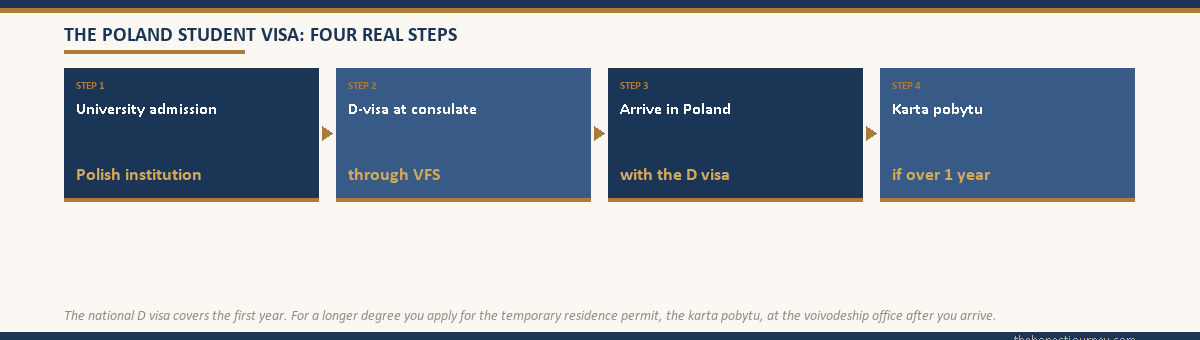
Step one: secure admission. You accept an offer from a Polish university, pay any tuition deposit they require, and receive your acceptance letter. This letter is the anchor document for the whole visa application, so nothing else moves until it is in hand.
Step two: apply for the D visa through VFS. Register the National D visa application, gather your documents including proof of funds, accommodation, insurance and any legalised papers, book your VFS appointment, and submit with biometrics. Pay the EUR 80 visa fee and the VFS service charge. Then the consulate decides. The slot itself is often the slowest link, so book as early as you can.
Step three: arrive in Poland and settle. With the D visa you travel to Poland, begin your course, and sort out the practicalities of living there. If your studies are one year or shorter, the D visa may carry you through and you are largely done.
Step four: apply for the karta pobytu if you are staying over a year. For studies longer than one year, you apply in Poland for the temporary residence permit at the voivodeship office covering where you live. This keeps you legal for the rest of the degree. Start it early, for reasons I explain below.
The karta pobytu at the voivodeship office
This is the part Indian students most often misunderstand, so let me be plain. The D visa is your entry and early stay. If your programme runs longer than one year, you do not keep renewing the visa. Instead you apply, from inside Poland, for the temporary residence permit, the karta pobytu, at the voivodeship office (urząd wojewódzki) for the region where you study. You submit your study document, proof of funds, health insurance and accommodation, give fingerprints, and pay the permit fee of PLN 340 plus PLN 100 for the card.
The honest catch is timing. Processing for a karta pobytu can take many months, and in some voivodeships it has stretched well beyond half a year depending on the region and caseload. The practical move is to lodge the application well before your D visa expires, so you are covered by the pending-application status rather than caught in a gap. Treat the karta pobytu as a task you begin early in your stay, not a formality you rush at the end.
Processing time and the honest reality
For the entry visa itself, plan for consular processing of roughly two to four weeks in the normal case, though it varies with season and volume. The real constraint for Indian applicants is not the decision time, it is getting the VFS appointment slot. In peak season before an autumn intake, slots for Poland can be scarce, and students who wait for every document to be perfect before booking find the calendar has moved against them. Book the slot early, then complete the file.
Now the part most guides skip. Polish student visa refusals for Indian applicants do happen, and they cluster around two issues: funds and intent. Funds refusals come when the money is short of the required proof, unseasoned, or unclear in source. Intent questions arise when the consulate is not satisfied the study plan is genuine or the profile reads as migration-first rather than study-first. Neither is a character judgment. They are credibility judgments you address with a clean funds trail and a coherent study rationale, not a more expensive agent.
Work rights on the student visa
Here is a genuine advantage of studying in Poland. Students holding the right study status may work without needing a separate work permit, a simpler position than several other European countries where students must apply for permission or are capped tightly. That said, the exact conditions attach to your specific status, so read what applies to your permit and confirm the current rules on the official portal, because employment rules for students do get revised.
The honest framing on work is the same as everywhere. It is a living-cost supplement, not a tuition fund. Treat part-time earnings as breathing room, never as how you tell the consulate you will pay. If you want a realistic sense of what student work abroad does and does not cover, the part-time work while studying abroad guide is grounded rather than rosy.
Faz's rulePoland letting students work without a separate permit is a real plus, but it is still supplement money, not tuition money. Never present part-time work as how you will fund the degree.
The right to work without a separate permit removes a hurdle that trips students elsewhere, and it genuinely helps with living costs. But I have seen families quietly bank on that income to cover fees, and that is where budgets crack. Fund the degree from savings and loan, and let the job be the cushion.
After studies, and the honest cost comparison
Poland sits in the group of European destinations Indian students increasingly consider because the numbers are gentler than the West and student work rights are relatively open. That value case belongs partly to the decision conversation rather than this visa page. If you are weighing Poland on pure affordability, the cheapest country to study abroad guide puts it in context, and if funding is tight, the scholarships for Indian students guide is worth reading before you finalise your budget.
Once you have your karta pobytu you are settled for the length of your studies, and the residence-card status generally allows you to continue working. The route beyond graduation is its own topic, a separate decision from getting the student visa.
The honest take on the Poland student visa
The Poland student route is not hard for a genuine, reasonably funded student with a clean file, and the fees are among the friendlier ones in Europe. The two things that trip people are the funds proof and the calendar. Show the PLN 776 per month living amount plus accommodation and return travel, seasoned and clearly sourced, and get your VFS slot booked early rather than perfecting documents while the appointments vanish.
So the move is simple. Lock your admission, build credible funds with a clear paper trail, sort health insurance and any legalisation early, book the VFS appointment the moment you can, and once in Poland begin the karta pobytu well before your visa runs out. Confirm every fee and figure on the official portal, because they shift between intakes. Do that, and the Poland student visa becomes a sequence you execute rather than a maze you fear.
Poland is one of Europe’s cheaper routes, and others sit in the same bracket. Compare the fees, funds proof and permit steps in the Spain student visa and the Austria student visa before you decide.
FAQ
How much is the Poland student visa fee for Indian students?
As of the 2026 intake, the Polish National D long-stay study visa fee is EUR 80, about ₹7,200 at ₹90 per euro, paid when you apply through the consulate. On top of that VFS Global charges a service fee, typically a few thousand rupees, for handling your application in India. Confirm the current fee on the official portal before you pay, as these are revised between intakes.
How much proof of funds do I need for a Poland student visa?
As of the 2026 intake you must show funds covering your stay, framed as roughly PLN 776 per month for living, about ₹16,300, plus accommodation and a return travel amount near PLN 2,500, demonstrated for the year. Many Indian families show a seasoned balance of around ₹6 to 8 lakh to cover this comfortably. Verify the current monthly figure on the official portal, as it tracks Polish social-support rates.
What is the karta pobytu and when do I apply for it?
The karta pobytu is Poland’s temporary residence permit, the document that keeps you legal when your studies run longer than one year. You apply for it inside Poland at the voivodeship office covering where you live, submitting your study document, funds proof, insurance and accommodation, and paying PLN 340 plus PLN 100 for the card. Start it early in your stay, because processing can take many months.
How long does a Poland student visa take to process?
The National D visa decision at the consulate typically takes around two to four weeks, though it varies by season and volume. In practice the bigger delay for Indian applicants is securing a VFS appointment slot, which can be scarce before an autumn intake. Apply and book early, two to three months before your course starts, rather than perfecting documents while the calendar slips. Check current timelines on the official portal.
Can I work in Poland on a student visa?
Yes. Students holding the right study status in Poland may work without needing a separate work permit, which is more open than several other European countries. The exact conditions attach to your specific status, so read what applies to your permit and confirm the current rules on the official portal, as employment rules get revised. Treat any earnings as a living-cost supplement, never as your tuition fund.
Do I need health insurance for a Poland student visa?
Yes. Valid health insurance covering your stay is a required document in the visa file, either a policy meeting the consular requirement or, once enrolled, coverage through the Polish system where it applies. A missing or non-compliant policy can stall an otherwise clean application, so arrange it early rather than at the last minute. Confirm the exact insurance requirement on the official portal, because the accepted forms can vary by consulate.
Why are Poland student visas refused for Indian students?
Refusals cluster around two issues: funds and intent. Funds refusals happen when the money is short of the required proof, appeared too recently to look genuine, or has an unclear source. Intent questions arise when the consulate is not satisfied the study plan is genuine or the course looks like a poor fit. Both are credibility judgments you address with a seasoned, well-sourced funds trail and a coherent study rationale.
How do I get a VFS appointment for the Poland student visa?
Indian applicants apply through VFS Global, which handles Polish visa applications and biometrics in India. You register the application, book an appointment slot, and submit your documents and biometrics in person. The slot is often the slowest link, especially before an autumn intake, so book as early as you can rather than waiting for every document to be perfect. Check current slot availability and requirements on the official portal.
Faz · The Honest Journey · 2026