Short answer. For Indian students, Austria does not issue a classic student visa. For a stay over 6 months you apply for the residence permit for students (Aufenthaltsbewilligung Studierender) at the Austrian embassy.
The combined permit fees run about EUR 160, and as of the 2026 intake you must show secured funds of roughly EUR 739 per month if you are under 24, or EUR 1,334 per month if you are 24 or over, for 12 months. Confirm every figure on the official portal.
A girl I have been mentoring set her heart on Vienna after a cousin talked up the low tuition at Austrian public universities. She budgeted carefully for fees and rent, then almost came undone at the one number she had not planned for: the secured-funds proof the embassy wanted parked in a bank account before it would even look at her file. She had treated Austria like a cheap option and forgotten it borrows Germany’s funds discipline. Once she saw it as a Germany-style case with a smaller tuition bill, it clicked.
This post stays strictly in the visa lane: the permit type and its real name, applying at the embassy, the fees, the age-split funds proof, address registration after arrival, processing reality, and work rights. Austria does not yet have a study-in overview on this site, so for the funds-proof mechanics, which are almost identical, I will point you to the Germany student visa for Indian students guide. If Germany’s blocked account made sense to you, Austria will too. Here we only talk about getting the permit.
First, it is a residence permit for students, not a visa
People type “Austria student visa” out of habit, and I use the phrase too because that is what everyone searches. But the document you actually apply for, if your course runs longer than 6 months, is a residence permit for students, in German the Aufenthaltsbewilligung Studierender. It is not a sticker in your passport that you renew at a consulate. It is a residence title issued under Austrian settlement law, and it is the real thing that lets you live and study in Austria.
For very short stays under 6 months a visa route can apply, but that is not the case for a degree. For a bachelor’s or master’s you are firmly in residence-permit territory. The official rules, the forms, the fee breakdown and the current funds figures all live on the government portal at migration.gv.at, and the OeAD, Austria’s agency for education and mobility, publishes a clear student walk-through at oead.at. Treat those two as your only source of truth. Austrian figures shift each year, so as of the 2026 intake, every number in this post is a planning figure you should confirm on the official portal the week you apply.
Applying at the Austrian embassy
You lodge the application in person. Indian students apply at the Austrian embassy in New Delhi, and the file is then forwarded to the relevant Austrian authority for a decision. This is not an online submission you complete from your bedroom. You book an appointment, appear in person, hand over your documents, give your fingerprints, and pay the fee.
The single hardest thing to understand about the Austrian route is that the decision is not made at the counter. The embassy collects your file and passes it to the Austrian immigration authority, which assesses it and decides. The embassy is the door, not the judge. That explains the processing time, and why a complete, well-ordered file with the funds proof done properly is worth so much.
The permit fees, in INR
Let me put the money on the table first. These are the government permit fees, not your tuition or living costs. The planning rate through this article is ₹90 per euro. It moves, so re-check it the week you transfer money.
| Permit fee component | EUR | INR (at 90) |
|---|---|---|
| Application submission fee | 120 | ~10,800 |
| Fee on grant of the permit | 20 | ~1,800 |
| Collection of biometric data | 20 | ~1,800 |
| Combined permit fees | ~160 | ~14,400 |
| Student health insurance (monthly, typical) | ~80 | ~7,200 |
The honest read of this table: the permit fees are modest, about ₹14,400 all in, split across submission, grant, and the biometric data step. That is genuinely cheap compared with several Western routes. Health insurance is a separate, recurring cost, not a one-off fee, and you must have cover in place. But notice what actually decides your case: the secured-funds proof. That is not a fee. It is money you must show you already hold, and it dwarfs everything above.
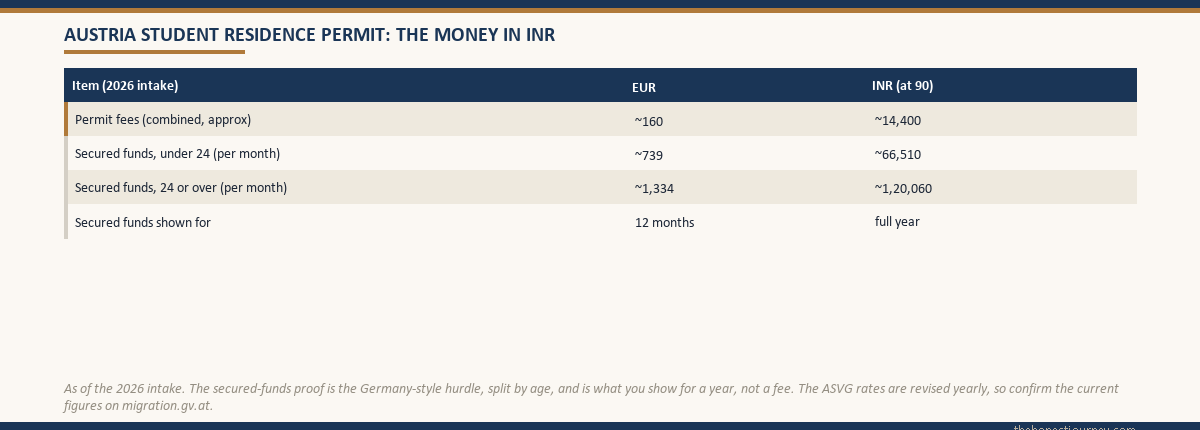
The full rupee picture for tuition and city living does not belong here, because this page is only about the permit. On this page, money appears in just two forms: the small fees above, and the funds you must prove below.
The secured-funds proof: the part that decides your case
This is the Germany-style hurdle, and it is where most Austrian student files live or die. As of the 2026 intake you must show secured funds of roughly EUR 739 per month if you are under 24, or EUR 1,334 per month if you are 24 or over, held for 12 months in advance. The age split is real and it is unusual, so read it twice. The older applicant must prove nearly double.
Do the arithmetic in rupees so it lands. For an under-24 applicant, EUR 739 a month across 12 months is about EUR 8,868, which at ₹90 per euro is roughly ₹7.98 lakh. For an applicant 24 or over, EUR 1,334 a month across 12 months is about EUR 16,008, which is roughly ₹14.4 lakh. That is the sum you must show sitting in an account, seasoned and yours, before the authority will approve you. These 2026 ASVG-linked figures nudge upward most years, so confirm the exact monthly amount on the official portal, because this is the number that decides everything.
You typically prove this through a bank statement or savings, and Austria also accepts a blocked account or a declaration of guarantee from someone resident in the EU. If you have followed the German blocked-account model, this will feel familiar, because it is the same logic: the state wants to know you can live without working illegally or dropping out broke. The mechanics of arranging and presenting this kind of proof, which carry across both countries, are laid out in the Germany student visa guide, and the general principles of a credible funds file are in the proof of funds for a student visa guide.
Faz's ruleAustria is cheap on fees and strict on funds. The EUR 160 permit is nothing; the age-split secured funds are the make-or-break, so build that account first and treat everything else as paperwork.
I watch Indian families budget beautifully for Vienna’s low tuition and then freeze at the funds proof. Under 24 you show around EUR 739 a month, at 24 or over around EUR 1,334 a month, both for a full year, both parked and seasoned. Sort that account before you book a single appointment.
One honest word on how much cash to physically carry versus what to show on paper. The funds proof is a bank record, not a suitcase of euros. What you actually travel with on the day is a separate, much smaller question, and I have written that out in the how much money to carry abroad guide. Do not confuse the two.
The four-step process, end to end
Here is how the Austrian residence permit actually runs, in the order it happens. The step flow below maps the same four stages at a glance.
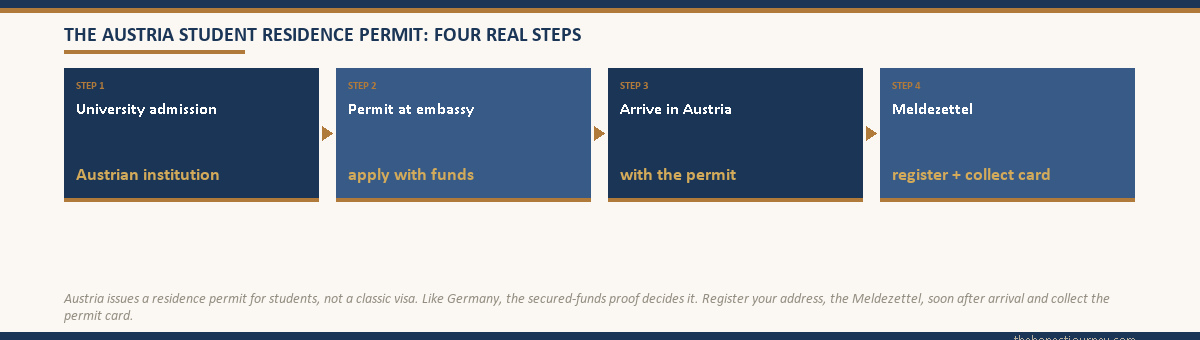
Step one: get your university admission. You secure a place, or at least conditional admission, at an Austrian university. A firm acceptance is the anchor of the whole file. Without proof that a recognised institution has taken you, there is nothing for the permit to attach to.
Step two: lodge the permit application at the embassy. Book your appointment at the Austrian embassy in New Delhi, appear in person, hand over your admission letter, passport, health insurance evidence, and the all-important secured-funds proof, give your biometric data, and pay the fee. This is the stage that carries the case, because the file is then forwarded for a decision you cannot influence in person.
Step three: arrive in Austria. Once the permit is approved, you enter Austria. The permit card itself is usually issued and collected in-country, so your entry document gets you in, and the physical residence title follows.
Step four: register your address and collect the card. Within a few days of finding accommodation you complete the Meldezettel, the mandatory address registration, at the local registration office. You then collect your residence permit card. Both are covered next.
Meldezettel, health insurance, and the documents that matter
Two things trip up students who assume approval is the finish line. The first is the Meldezettel. Austria requires you to register your residential address with the local authority within three working days of moving in. It is a simple form, but it is legally mandatory, and much of your later admin, including collecting your card and opening accounts, keys off it. Do it immediately, not eventually.
The second is health insurance, which is not optional and is checked at application. You must have adequate cover for your stay. Many students use the Austrian student self-insurance, which as of the 2026 intake costs in the region of EUR 80 a month, but confirm the current premium and that your specific cover is accepted on the official portal.
Beyond those, the documents that carry weight are your letter of admission, your passport, your health insurance evidence, and above all your secured-funds proof. Follow the official document checklist on migration.gv.at and via the OeAD, because the list is precise and it updates between intakes. A missing or weak funds document is the single most common reason an otherwise fine file stalls.
Processing time and the honest reality
Be patient, and apply early. Because the embassy forwards your file to the Austrian authority for a decision, processing is not quick. As of the 2026 intake, applicants should plan for a wait that commonly runs several weeks and can stretch longer depending on the season and how complete the file is. Do not build your travel plans around a fast turnaround, and never book flights before you have the decision in hand.
Now the part most guides skip. Austrian student permits are rarely refused on a whim, because the decision is made on documents, not on a consular officer’s read of you across a desk. That is both good and unforgiving. Good, because a complete, well-funded file with genuine admission tends to clear. Unforgiving, because you cannot talk your way past a gap. If the funds proof is short, unseasoned, or unclear in its source, the file weakens, and there is no counter conversation to save it. The paper is the case.
So the practical move is boring and it works: get admission early, build and season the funds account well ahead, insure yourself properly, and lodge a complete file at the first appointment you can get. The applicants who struggle are almost always the ones who left the funds proof to the last month.
Faz's ruleThe file is the case, because the decision is made on paper, not across a desk. You cannot talk your way past a gap, so close every gap before you lodge.
Austria decides your permit on documents forwarded from the embassy, not on how you come across in the room. That cuts both ways. A clean, well-funded file clears quietly, but a short or unseasoned funds proof sinks with no conversation to save it. Perfect the paper first.
Work rights and what comes after
Your residence permit for students lets you work, within limits. As of the 2026 intake, students may work up to 20 hours per week, but with an important catch that separates Austria from some neighbours: you need an employment permit for the specific job, which the employer applies for. It is not an automatic right you switch on. Confirm the current hour limit and the employment-permit process on the official portal, because these rules are revised.
The honest framing on work is the same as everywhere I write. It is a living-cost supplement, not a tuition fund, and certainly not something you present to the authority as how you will pay. The whole point of the secured-funds proof is that your studies are covered before you earn a cent in Austria. If you want the realistic picture of what part-time work abroad actually pays and covers, I have set it out in the part-time work while studying abroad guide.
After your studies, Austria offers routes to stay and work for graduates of Austrian institutions, tied to finding qualified employment. Those rules have their own evolving detail and belong to a wider decision conversation, not this permit page, so I will only flag that the runway exists.
The honest take on the Austria student route
Austria is one of the most misread destinations for Indian students. People hear about low public-university tuition and assume the whole thing is easy and cheap. The permit fees genuinely are small, about ₹14,400. But the funds proof is pure Germany: an age-split secured amount, held for a year, checked hard. That is the real bar, and pretending otherwise sets students up for a nasty surprise.
The comparison with Germany is the honest lens. Both run on the same principle, that you prove you can support yourself before you arrive, and in both the funds proof is make-or-break. Austria’s tuition is often lower and its under-24 figure is a touch gentler, which is exactly why it deserves a serious look. If you are weighing where the numbers work best, the wider affordability comparison sits in the cheapest country to study abroad guide.
So the move is simple. Treat Austria as a Germany-style funds case with a smaller tuition bill. Build and season the funds account first, get firm admission, insure yourself, lodge a complete file early at the New Delhi embassy, and register your Meldezettel the moment you land. Confirm every figure on migration.gv.at, because they shift between intakes. Do that, and the permit becomes a process you execute rather than a lottery you enter.
Studying in the German-speaking heart of Europe? Austria’s closest alternatives are covered in the Switzerland student visa and the Poland student visa if you want to compare the funds proof and permit steps.
FAQ
How much is the Austria student residence permit fee for Indian students?
As of the 2026 intake, the combined permit fees are roughly EUR 160, about ₹14,400 at ₹90 per euro. That breaks down into around EUR 120 on submission, EUR 20 when the permit is granted, and EUR 20 for the biometric data step. Health insurance is a separate, recurring cost, not part of this fee. Confirm the current amounts on the official migration.gv.at portal before you pay, as they are revised.
How much financial proof do I need for an Austria student permit?
As of the 2026 intake you must show secured funds of roughly EUR 739 per month if you are under 24, or EUR 1,334 per month if you are 24 or over, held for 12 months. That is about ₹7.98 lakh or ₹14.4 lakh respectively at ₹90 per euro. These ASVG-linked figures rise most years, so verify the exact monthly amount on the official portal, because this is the requirement that decides your case.
Why does Austria have an age split in the funds proof?
Austria’s secured-funds figures are tied to national social-insurance reference rates, which set a higher expected living standard for applicants aged 24 and over. So an under-24 student shows the lower monthly amount, around EUR 739, while a student 24 or over shows nearly double, around EUR 1,334. It is not a penalty, just how the reference rate works. Both must prove the amount for 12 months in advance, and both figures move each intake.
What is the Meldezettel and when do I do it?
The Meldezettel is Austria’s mandatory address registration. Within three working days of moving into your accommodation, you register your residential address at the local registration office. It is a short form, but it is legally required, and later steps like collecting your residence card and opening a bank account depend on it. Do it immediately after you find housing, not weeks later, and keep the confirmation slip safe for your other admin.
How long does the Austria student permit take to process?
As of the 2026 intake, plan for a wait that commonly runs several weeks and can stretch longer. Because you lodge at the embassy but the decision is made by the Austrian authority the file is forwarded to, it is not a fast route. Apply as early as you can and never book flights before the decision is in hand. A complete, well-funded file processes more smoothly, so the funds proof done properly saves you time.
How many hours can I work on an Austria student permit?
As of the 2026 intake, students may work up to 20 hours per week, but with a catch: you need an employment permit for the specific job, which your employer applies for. It is not an automatic right. Confirm the current hour limit and the permit process on the official portal, as these rules change. Treat work as a living-cost supplement, never as a tuition fund or as something you present as how you will pay.
Is an Austria student permit a visa or a residence permit?
For a stay over 6 months, which any degree is, it is a residence permit for students, the Aufenthaltsbewilligung Studierender, not a classic visa. It is a residence title under Austrian settlement law, applied for at the embassy and issued after the Austrian authority decides. People search “Austria student visa” out of habit, and the phrase is fine, but knowing it is really a residence permit changes how you approach the funds proof and arrival registration.
Is Austria easier than Germany for the funds proof?
They run on the same principle: prove you can support yourself before you arrive, with the funds proof as the make-or-break. Austria’s tuition is often lower and its under-24 monthly figure is a touch gentler than Germany’s blocked-account amount, so for younger applicants it can feel slightly easier. But the discipline is identical. If Germany’s blocked account made sense to you, treat Austria the same way and build the account first.
Faz · The Honest Journey · 2026