Short answer. For an Indian student, the route into Germany is the National (D) visa for study, and four things gate it: a mandatory APS certificate (Akademische Pruefstelle) before you apply, a blocked account (Sperrkonto) holding about EUR 11,904 for the year, roughly EUR 992 a month, German health insurance, and a visa fee of about EUR 75.
As of the 2026 intake, confirm every figure on the German Missions in India site, india.diplo.de.
Got your admit? Next, plan the move with our pre-departure checklist and what to carry to Germany.
A cousin of a friend applied for the German student visa two intakes ago, admission letter in hand, blocked account funded, feeling sorted. Then the appointment desk asked for his APS certificate and he did not have one. He had never heard of it. That one missing document cost him a full semester, because the APS process itself takes weeks and his intake closed while he waited. Nobody had told him that for Indian applicants the APS is now the first gate, not an optional extra you sort out later.
This post stays strictly in the visa lane. It is the visa type, the documents, the blocked account, the application steps, processing time and work rights. If you want tuition, semester contribution and city living costs, those live in the cost of studying in Germany for Indian students guide, and the admissions and university-choice side sits in the study in Germany for Indian students guide. Here we only talk visa.
The visa: National (D) visa for study
Germany does not have a single “student visa” product the way some countries do. What you apply for at the German mission in India is a National (D) visa, the long-stay category, issued for the purpose of study. It lets you enter Germany and, once you arrive, convert into a residence permit for study purposes (the Aufenthaltstitel) at the local foreigners’ authority. The D visa is the entry ticket. The residence permit is the thing that actually keeps you legal for the length of your degree.
There is also a National (D) visa for applicants who have admission but still need to clear a few steps, sometimes called a study-applicant visa, but for most Indian students with a confirmed admission letter the straightforward route is the study visa itself. The application fee for the National (D) visa is about EUR 75, which at ₹90 per euro is roughly ₹6,750. That planning rate of ₹90 per euro runs through this whole post, and it moves, so re-check it the week you pay.
The APS certificate: the gate Indian applicants miss
This is the single most important paragraph in the post, so read it twice. For Indian students, the APS certificate from the Akademische Pruefstelle (the Academic Evaluation Centre at the German embassy’s purview) is now mandatory before you can apply for the study visa. It is a verification of your academic documents, confirming your degrees and marksheets are genuine and that you meet the entry standard for German higher education. Without it, the visa application does not proceed.
The reason people get caught is timing. The APS is not a same-week document. You submit your academic records, pay the APS fee, and the verification takes time, often several weeks. If you discover the requirement only when you go to book your visa appointment, you have already lost weeks you do not have. Start the APS the moment you decide on Germany, in parallel with your university applications, not after. The current APS procedure, fee and turnaround are published through the German Missions in India on india.diplo.de, so confirm the exact process for your case there before anything else.
Faz's ruleStart the APS certificate the day you decide on Germany, not the day you book the visa appointment. It is the gate, and it runs on weeks, not days.
Almost every avoidable German visa delay I have seen traces back to a late APS. People treat it as paperwork to sort out after admission, then lose a semester waiting for verification. Run it in parallel with your university applications so it is done and in your file before you ever touch the visa booking.
Proof of funds: the blocked account (Sperrkonto)
The blocked account is the heart of the German student visa, and it is where most of your money and attention go. A Sperrkonto is a special German bank account into which you deposit a full year’s living funds in advance. The account is “blocked” in the sense that you can only withdraw a fixed monthly amount once you arrive, which is the mechanism Germany uses to prove you can support yourself without working illegally.
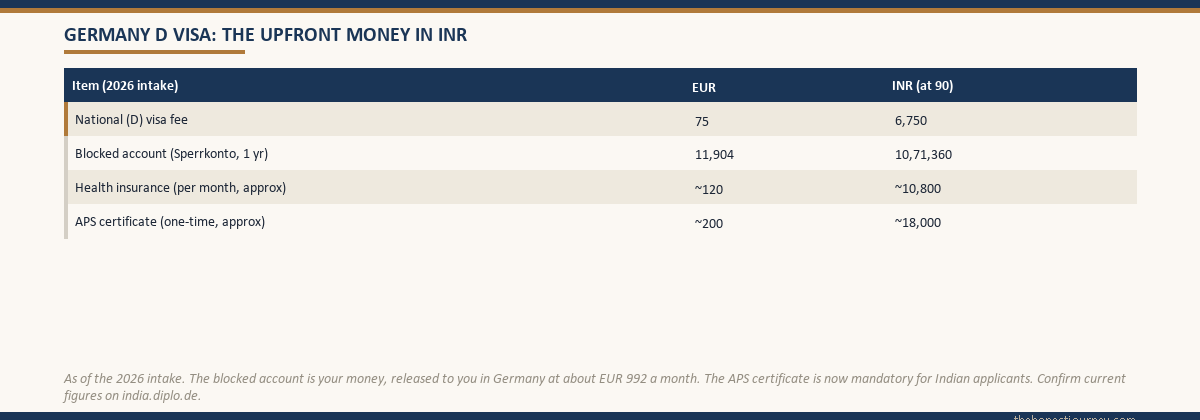
As of the 2026 intake, the standard figure is about EUR 11,904 for one year, which works out to roughly EUR 992 a month that you are allowed to draw. At ₹90 per euro that headline deposit is about ₹10,71,360, call it ₹10.7 lakh, sitting blocked before you even fly. This number is set by the German authorities and is revised periodically, so treat it as the 2026 figure and confirm the current amount on india.diplo.de before you fund the account.
The blocked account is not the only accepted proof of funds, but it is by far the most common route for Indian students. The financing for this is exactly what the education loan for Germany blocked account post covers, and the wider mechanics of how funds-proof works across destinations are in the proof of funds for student visa guide. The fees table below puts the visa-side numbers in rupees so the picture is auditable.
| Visa-side cost | EUR | INR (at 90) |
|---|---|---|
| National (D) visa application fee | ~75 | ~6,750 |
| Blocked account (Sperrkonto), one year | ~11,904 | ~10,71,360 |
| Blocked account opening / handling fee (typical) | ~50 to 150 | ~4,500 to 13,500 |
| German health insurance (annual, public-rate range) | ~1,300 to 1,500 | ~1,17,000 to 1,35,000 |
| APS certificate fee (Indian applicants) | ~confirm current | ~confirm current |
So the blocked account dwarfs every other line. The visa fee is small, the insurance is a real but modest annual cost, and the APS fee is comparatively minor. The deposit is the mountain, and it is the number your loan or family funding has to clear in full before the visa file is even complete.
Health insurance: a hard requirement
German health insurance is mandatory for the visa and for enrolment. You cannot register at a German university or hold the residence permit without valid health cover, so this is not a line you can defer. Most students take public statutory health insurance once enrolled, which for students runs in the region of EUR 110 to EUR 130 a month, roughly EUR 1,300 to EUR 1,500 a year, about ₹1.17 lakh to ₹1.35 lakh at ₹90 per euro.
For the visa application itself, before you are enrolled, you typically show travel or incoming health insurance covering the gap between arrival and the start of your statutory cover. The mission will tell you exactly what it accepts. The practical point is that insurance is a documented requirement at two stages, the visa and enrolment, and a missing or wrong-type policy is one of the routine reasons a file stalls. The official guidance on insurance and the wider study route is laid out on make-it-in-germany.com, the German government’s own portal for international students and workers.
The application steps, in order
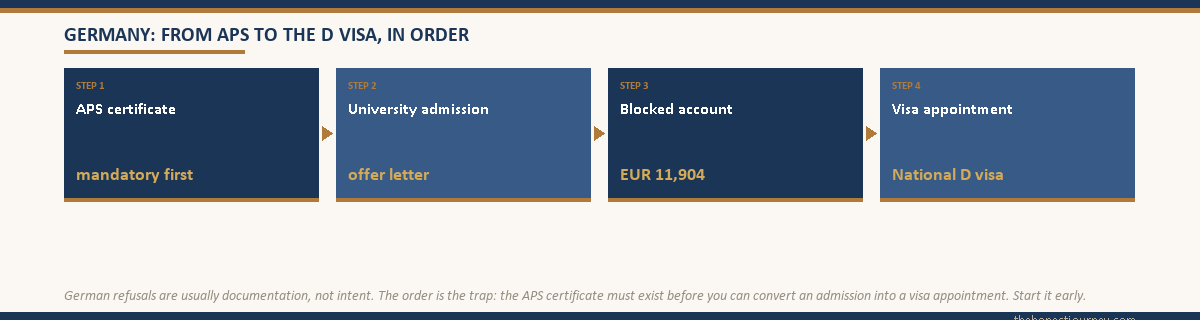
The German student visa is less about persuasion and more about assembling a complete, correct file in the right sequence. Get the order wrong and you lose time at the appointment stage. Here is the realistic order.
- Get your APS certificate. Start this first, in parallel with applications. It must be done before you apply for the visa.
- Secure university admission. You need the admission letter (Zulassungsbescheid) from a recognised German university for the study visa.
- Open and fund the blocked account. Deposit the full year’s funds, about EUR 11,904 as of 2026, and obtain the confirmation document.
- Arrange health insurance. Get the appropriate cover for the visa stage and have proof ready.
- Book the visa appointment and submit. Complete the application, pay the EUR 75 fee, give biometrics, and submit the full file at the German mission.
The flow below shows the four document gates that actually decide whether your appointment goes smoothly, from the APS through admission and the blocked account to the visa appointment itself.
Faz's ruleGerman refusals are usually a documentation gap, not a judgement on you. The process rewards a meticulous file, so the cure is paperwork, not persuasion.
Unlike interview-heavy destinations, Germany is not weighing whether it believes your intentions on the spot. It is checking that the APS, the blocked account, the insurance and the admission all line up. Fix the gap, and most refusals are recoverable. That is genuinely good news if you are organised.
Biometrics, processing time and the appointment crunch
At the appointment you submit documents and give biometrics. The honest part is the waiting. Two separate clocks run against you. First, the appointment slot itself: demand at the German missions in India is high around peak intake, and getting a slot can take weeks. Second, the processing after submission: a National (D) visa decision can take from a few weeks to a couple of months, sometimes longer in peak season.
This is why timing discipline matters more for Germany than for almost any other destination. Add the APS weeks, the appointment wait, and the processing weeks together, and you can easily be looking at a multi-month runway from “I decided on Germany” to “I have the visa in my passport.” Plan backwards from your enrolment date and start everything early. The current appointment and processing situation is posted on india.diplo.de, so check it for your specific mission before you assume a timeline.
Work rights on the student visa
Germany gives students a real, defined work allowance. On the study residence permit you may work 140 full days or 280 half days per year without needing additional permission. That is a genuine living-cost supplement, and many students use it across term and holidays. Working on campus as a student assistant (HiWi) is common and often does not count against the limit in the same way, but confirm the local rule.
The honest framing is the same as everywhere: this allowance helps with living costs, it does not pay your tuition or replace the blocked account. The blocked account exists precisely so that you are not dependent on work to survive. Treat the 140 days as breathing room, not as the plan. The general mechanics of how much student work actually offsets sit in the cost of studying in Germany for Indian students guide, and the financing structure is in the education loan for Germany post.
The honest take on the German student visa
Germany is one of the more process-driven, less subjective student visa routes for Indian students, and that is a feature, not a bug. There is no make-or-break interview where an officer decides whether to believe you. There is a checklist, and if your APS, blocked account, insurance and admission are all in order, the file goes through. The refusals I have seen are overwhelmingly documentation gaps: a late APS, a blocked account funded short or at the wrong amount, an insurance policy of the wrong type. These are fixable, which is the genuinely reassuring part.
The trap is treating it casually because it is “just paperwork.” The paperwork is exactly the thing, and it runs on long clocks. The APS takes weeks, the appointment takes weeks, the processing takes weeks. The blocked account ties up more than ₹10 lakh before you fly. Start early, fund the account in full at the current figure, and have every document of the right type. Do that, and Germany is one of the most predictable visas to win. Leave it late, and the calendar, not the embassy, is what beats you.
Germany is the most generous destination for spouses, who get full work rights on family reunion. See the family reunion page.
If Germany does not work out, its neighbours run parallel routes worth comparing. The permit steps, fees and funds proof for the Austria student visa, the Switzerland student visa and the Poland student visa can each be the cheaper or faster option for your course.
FAQ
What is the visa fee for a German student visa from India?
The National (D) visa for study carries an application fee of about EUR 75, which at ₹90 per euro is roughly ₹6,750. This is paid when you submit the application at the German mission. It is a small line compared with the blocked account, but it is non-refundable, so make sure your file is complete before you pay. As of the 2026 intake, confirm the current fee on the German Missions in India site, india.diplo.de, since fees are revised periodically.
How much money do I need in the blocked account for Germany?
As of the 2026 intake, the standard blocked account (Sperrkonto) figure is about EUR 11,904 for one year, roughly EUR 992 a month that you can withdraw once you arrive. At ₹90 per euro that is about ₹10.7 lakh deposited before you fly. This amount is set by the German authorities and revised from time to time, so treat it as the 2026 number and confirm the current requirement on india.diplo.de before you fund your account.
Is the APS certificate mandatory for Indian students?
Yes. For Indian applicants the APS certificate from the Akademische Pruefstelle is now mandatory before you apply for the study visa. It verifies that your academic documents are genuine and meet German entry standards. Without it, the visa application does not proceed. The process takes several weeks, so start it early, in parallel with your university applications. Confirm the current APS procedure, fee and turnaround through the German Missions in India on india.diplo.de.
Do I need health insurance for the German student visa?
Yes, German health insurance is mandatory for both the visa and university enrolment. For the visa stage, before you enrol, you typically show travel or incoming health cover. Once enrolled, most students take public statutory insurance, which for students runs around EUR 110 to EUR 130 a month, about EUR 1,300 to EUR 1,500 a year. A missing or wrong-type policy is a common reason files stall, so confirm exactly what your mission accepts on make-it-in-germany.com.
How long does the German student visa take to process?
Two clocks run. Getting a visa appointment slot can itself take weeks during peak intake, and after you submit, a National (D) visa decision typically takes from a few weeks to a couple of months, sometimes longer in busy season. Add the APS weeks beforehand and you can face a multi-month runway from decision to visa in hand. Plan backwards from your enrolment date and start early. Check the current situation for your mission on india.diplo.de.
How many days can I work on a German student visa?
On the study residence permit you may work 140 full days or 280 half days per year without extra permission. On-campus student assistant (HiWi) roles are common and may be treated differently, so confirm the local rule. This is a genuine living-cost supplement, but it does not pay tuition or replace the blocked account, which exists so you are not dependent on work to survive. Treat the allowance as breathing room, not as your funding plan.
Why do German student visas get refused?
German refusals are usually documentation gaps rather than judgements on your intent. The common causes are a missing or late APS certificate, a blocked account funded short or at the wrong amount, the wrong type of health insurance, or an incomplete admission document. Because the process is checklist-driven, most refusals are fixable once you correct the gap. This is the reassuring part: there is no subjective interview to fail, so a meticulous, correctly assembled file is what gets you through.
How long does it take to get a German visa appointment?
Appointment availability at the German missions in India varies a lot by season and city, and around peak intake it can take several weeks to secure a slot. Because the appointment is a separate wait before processing even begins, it is one of the biggest reasons students miss their intake. Book as early as your documents allow, and have the APS and blocked account ready so you are not delayed once a slot opens. Check current slot availability on india.diplo.de.
Faz · The Honest Journey · 2026