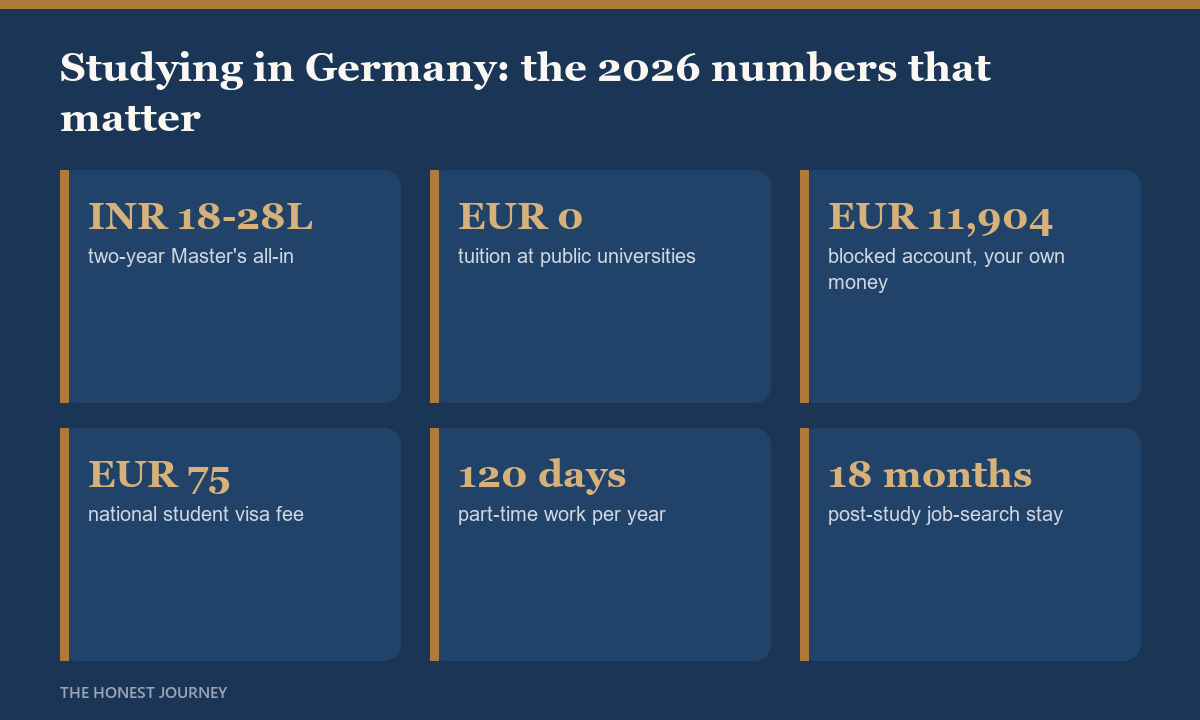
Short answer. The all-in cost of studying in Germany for Indian students in 2026 runs roughly ₹18 lakh to ₹28 lakh for a two-year Master’s, which makes it the cheapest serious study destination for Indians.
Public universities charge almost no tuition, so the real cost is two years of living plus the one big upfront cheque: a €11,904 blocked account the visa demands as proof you can support yourself. At ₹92 to the euro, that blocked account alone is about ₹11 lakh, and it stays your money.
Got your admit? Next, plan the move with our pre-departure checklist and what to carry to Germany.
Every intake season a parent messages me sounding almost suspicious. “They are saying Germany is free, there must be a catch.” There is no catch on tuition. A public German university genuinely charges an Indian Master’s student close to zero in tuition. The catch, if you want to call it that, is that Germany makes you prove you can fund yourself before you land, and it does that through a blocked account. The cost of studying in Germany for Indian students is not a tuition number. It is a living-cost number plus one large deposit that you get back a month at a time.
This post walks through why German public tuition is near zero, how the blocked account actually works, what living costs look like city by city, what the pre-arrival fees add up to, and what the honest two-year rupee total is in 2026. If you are still mapping the bigger picture, the full guide on studying in Germany for Indian students covers admissions, the APS and timelines end to end.
Germany is also the answer to a bigger question a lot of families ask first: the cheapest country to study abroad for Indian students.
Why Germany breaks the cost rulebook: near-zero tuition
In most study destinations tuition is the single largest line item. In Germany it is close to the smallest. Public universities, which include almost every well-known name (TU Munich, RWTH Aachen, Heidelberg, TU Berlin), charge no tuition fee for most Master’s programs, for German and international students alike. What you pay each semester is an administrative contribution called the semester fee.
| Cost item | Public university (typical) | What it covers |
|---|---|---|
| Tuition per semester | €0 for most Master’s | No tuition at public universities in most states. |
| Semester fee | €150 to €350 | Administration, student union, and often a public transport pass. |
| Baden-Württemberg surcharge | €1,500 per semester | The one state that charges non-EU students tuition. Applies in Stuttgart, Heidelberg, Karlsruhe. |
| Private university tuition | €5,000 to €20,000 per year | Only if you pick a private institution. Most Indian students do not. |
The semester ticket bundled into that fee is quietly valuable. In many cities it covers unlimited local public transport for the whole semester, which removes a cost that runs €60 to €90 a month in most other countries. The one number to watch is Baden-Württemberg. If your admit is in Stuttgart, Heidelberg or Karlsruhe, budget an extra €1,500 a semester, because that state reintroduced tuition for non-EU students.
Faz's ruleIn Germany the visa officer does not care about your tuition, because there usually is none. The number they care about is the blocked account. Treat €11,904 as the real price of admission, not the semester fee.
Families anchored on “free tuition” sometimes arrive at the visa stage without the blocked account funded and are stunned. The tuition being free does not reduce what you have to show. It shifts the entire proof-of-funds burden onto the blocked account, and that money has to be sitting there before you apply.
The blocked account: your single biggest cheque
The blocked account (Sperrkonto) is Germany’s version of proof of funds. Before the consulate issues your national student visa, you deposit a fixed sum into a special account that you cannot fully withdraw at once. Once you arrive, the bank releases a set amount each month, which is how Germany satisfies itself that you can live for a year without running out of money or working illegally.
For 2026 the required amount is €11,904 for the year, released at €992 per month. Providers like Fintiba, Expatrio and Coracle are the ones most Indian students use, and they charge a small setup and monthly maintenance fee on top.
| Blocked account line | Amount | Rupees (at ₹92 per euro) |
|---|---|---|
| Annual deposit | €11,904 | ₹10.95 lakh |
| Monthly release once in Germany | €992 | ₹91,300 |
| Provider setup fee | €49 to €89 | ₹4,500 to ₹8,200 |
| Provider monthly maintenance | €5 to €10 | ₹460 to ₹920 |
The important thing to understand is that the blocked account is not a fee. It is your own living-expense money, held in escrow and handed back to you month by month. So while it is the largest single cheque you write before leaving India, roughly ₹11 lakh, it is not a sunk cost. It becomes your rent and groceries for year one. The only true cost is the provider’s small setup and maintenance charge and the forex spread on sending it across.
Living costs, city by city
The €992 a month the blocked account assumes is a realistic national average, but the spread between cities is wide. Munich is the most expensive student city in Germany by a distance. The former East German cities and mid-sized university towns are dramatically cheaper.
| City tier | Rent (shared room) | Total monthly living | Rupees per month |
|---|---|---|---|
| Munich, Frankfurt (expensive) | €600 to €800 | €1,100 to €1,400 | ₹1.01 lakh to ₹1.29 lakh |
| Berlin, Hamburg, Cologne (mid) | €450 to €650 | €900 to €1,150 | ₹82,800 to ₹1.06 lakh |
| Leipzig, Dresden, Aachen (affordable) | €300 to €450 | €700 to €950 | ₹64,400 to ₹87,400 |
This single choice, the city, moves the two-year total more than anything else on the page. A Master’s in Leipzig or Dresden can cost ₹8 lakh to ₹10 lakh less over two years than the same degree in Munich, purely on rent and daily living. The academic quality gap between a strong public university in a cheap city and one in an expensive city is often negligible, so this is the lever worth pulling.
Faz's rulePick the city as carefully as you pick the university. A degree in Dresden and a degree in Munich open the same doors in the German job market, but one leaves you ₹10 lakh lighter in debt.
Indian students over-index on the city’s brand name and under-index on its rent. Munich feels safer to name-drop, but the German engineering employer looks at the university and the degree, not the postcode. The cheaper city is very often the smarter financial decision with no career penalty.
Pre-arrival fees: APS, visa, insurance
Beyond the blocked account, there are a handful of mandatory costs every Indian applicant pays before landing. None is large, but together they cross ₹60,000 to ₹80,000, and the APS is one you cannot skip.
| Fee | Amount | What it is |
|---|---|---|
| APS certificate | €165 (about ₹18,000) | Mandatory academic verification for Indian students through the APS India office, needed before you apply to universities. |
| National student visa fee | €75 | The Type D long-stay visa fee, paid in INR at the VFS appointment. |
| Health insurance (public) | €120 to €130 per month | Statutory public health insurance is mandatory for enrolment. Roughly €1,450 a year. |
| Blocked account provider setup | €49 to €89 | One-time charge from Fintiba, Expatrio or similar. |
The APS (Akademische Prüfstelle) certificate is the one that trips up first-time applicants. It is a verification of your academic documents that Indian students must obtain before universities will even process an application, and it takes six to ten weeks. Start it early. Public health insurance at roughly €120 a month is also non-negotiable for enrolment, and it is genuinely good coverage. The full picture on cover is in the health insurance for study abroad guide.
Part-time work and the post-study stay
Germany is generous on both working during study and staying afterwards, which is a large part of why the low cost is not the whole story. Indian students can work 120 full days or 240 half days per year without a separate permit. With the minimum wage now around €13.90 an hour, a student working roughly 15 to 20 hours a week earns €800 to €1,000 a month, which can cover most of one month’s living. For the rules and the realistic earnings, see part-time work while studying abroad.
After graduation, Germany grants an 18-month residence permit to look for a job related to your degree. Because tuition was near zero and living was modest, a graduate who lands even an average German engineering or IT salary (€45,000 to €60,000 gross) clears the entire two-year cost within the first year of work. This is the quiet reason Germany is the best cost-to-outcome ratio in this whole cluster.
A worked rupee total: two-year public-university Master’s in 2026
The cleanest way to make it concrete is a specific case. A Master’s in Mechanical Engineering or Computer Science at a public university in a mid-cost city like Berlin or Aachen, no tuition, blocked account for year one, modest part-time work from semester two.
| Line item | Euro | Rupees (at ₹92 per euro) |
|---|---|---|
| Tuition (4 semester fees at €250) | €1,000 | ₹92,000 |
| Year 1 living (via blocked account) | €11,904 | ₹10.95 lakh |
| Year 2 living (offset by part-time work) | €9,500 | ₹8.74 lakh |
| Health insurance (2 years) | €2,900 | ₹2.67 lakh |
| APS + national visa fee | €240 | ₹22,000 |
| Round-trip flights (2 trips home) | €1,100 | ₹1.01 lakh |
| Initial settlement (deposit, registration, setup) | €1,300 | ₹1.20 lakh |
| Forex spread + remittance | €450 | ₹41,400 |
| Two-year all-in total | €28,394 | ₹26.1 lakh |
A two-year public-university Master’s in a mid-cost city lands around ₹24 lakh to ₹27 lakh all-in in 2026. Choose an affordable city like Leipzig or Dresden and it drops toward ₹18 lakh to ₹20 lakh. Choose Munich and it climbs to ₹28 lakh to ₹30 lakh. The number scales with your city and your part-time work, not with tuition, which stays near zero throughout. Forex is small per transfer but consistent across two years, so understand the A2 form and LRS rules for sending money abroad and pick an efficient route. The best forex card for students post covers the options.
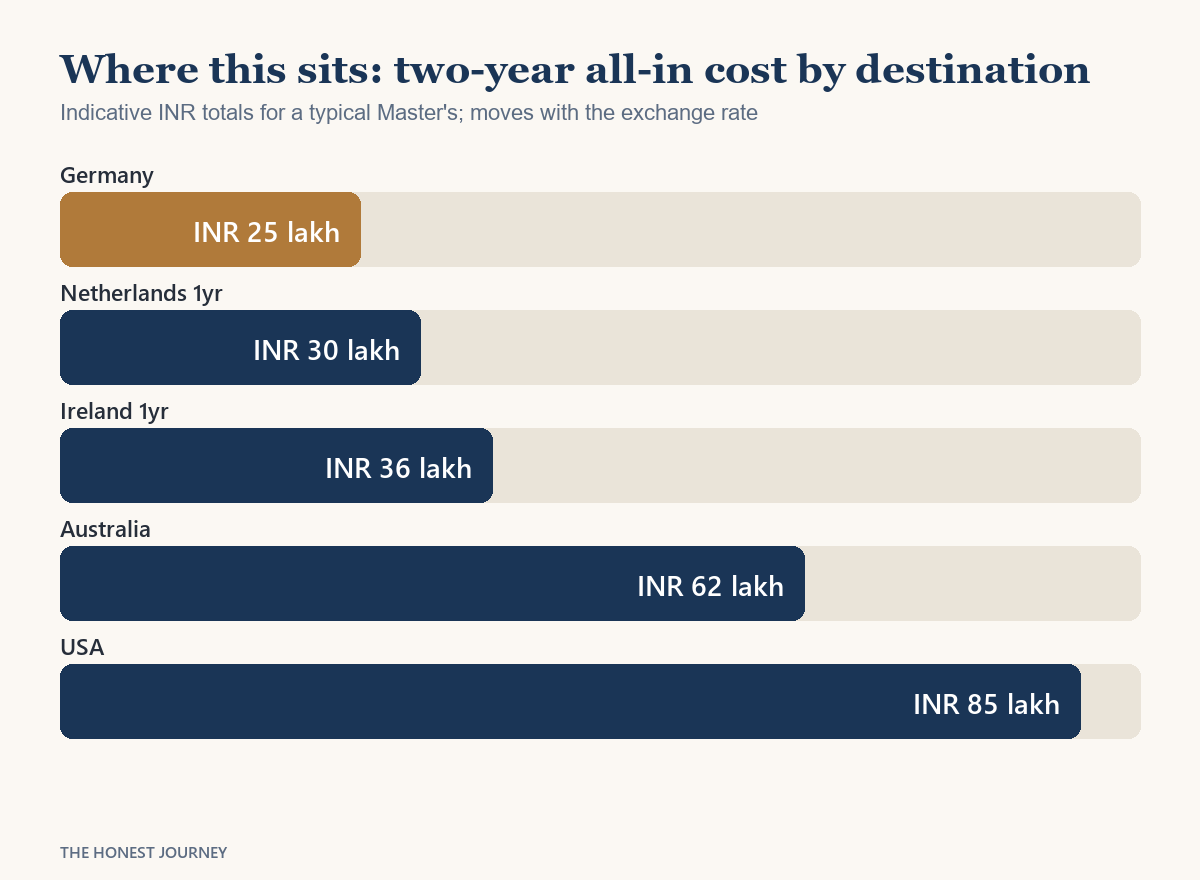
Faz's ruleThe honest number for a public-university Master's in Germany in 2026 is around ₹25 lakh all-in for two years, most of which is your own living money coming back to you a month at a time. That is a quarter of what the same degree costs in the USA.
The reason this matters is the loan. A ₹25 lakh number is fundable with a small collateral-free loan or even family savings, where a ₹90 lakh USA number forces a large secured loan and years of EMIs. Germany is the destination where an average family can send a child abroad without mortgaging the house.
Funding it: do you even need a loan for Germany?
Because the total is so much lower than the USA or UK, many Germany-bound families fund it largely from savings, with a loan only for the blocked account. When a loan is used, the blocked account is the specific line lenders are most comfortable with, because it is a defined, documented amount. Several banks and NBFCs now offer a product built around exactly this, covered in the education loan for the Germany blocked account guide. A collateral-free loan of ₹15 lakh to ₹25 lakh comfortably covers a public-university Master’s, where the same student targeting the USA would need three to four times that. For the full funding picture across destinations, see the studying abroad from India cost and funding guide and the education loan India complete guide.
The honest closing take
Germany is the destination where the sticker price and the real price are both genuinely low, and where the low cost does not come with a weak job market on the other side. Near-zero public tuition, a blocked account that is your own money, an 18-month post-study job search window, and a strong engineering and IT economy add up to the best cost-to-outcome ratio for Indian students in 2026.
The two honest cautions are these. First, the blocked account and the APS mean the upfront paperwork and the first big cheque both land before you leave, so plan liquidity for that, not just for the total. Second, German-taught programs and daily life reward at least basic German, even when your Master’s is fully in English, so the effort you put into the language directly affects your part-time earnings and your job odds.
If you can fund roughly ₹25 lakh over two years and you are willing to learn some German, Germany offers something no other destination in this cluster does: a globally respected degree that does not require a crore-sized loan. For most middle-class Indian families, that is the most honest bargain in study abroad.
Once the budget is clear, the visa is the next hurdle. The APS, blocked account and processing are in the Germany student visa guide.
Cost is only half the question. See is studying in Germany worth it for the salary, payback period and return on this spend.
Ready to fund it? Most Indian students route the loan through the PM Vidyalakshmi portal. That guide covers the step by step application and the 13 banks linked to it.
FAQ
How much does it cost to study in Germany from India in 2026?
A two-year Master’s at a German public university typically costs ₹18 lakh to ₹28 lakh all-in, including living, health insurance, visa fees, flights and forex. Tuition itself is near zero at public universities, so most of the total is two years of living costs. The single largest upfront item is the €11,904 blocked account, about ₹11 lakh at ₹92 to the euro, which is your own living money released back to you at €992 a month. A cheaper city like Leipzig can pull the total toward ₹18 lakh, while Munich pushes it toward ₹30 lakh.
Is studying in Germany really free for Indian students?
Tuition is effectively free at most public universities in Germany, for Indian students as well as German ones, for the majority of Master’s programs. You still pay a semester fee of €150 to €350, which often includes a public transport pass. The exception is the state of Baden-Württemberg, which charges non-EU students €1,500 per semester. Living costs, health insurance and the blocked account are the real expenses, not tuition, so Germany is very low cost rather than literally free.
What is the blocked account amount for Germany in 2026?
The blocked account (Sperrkonto) requirement for 2026 is €11,904 for the year, which the bank releases to you at €992 per month once you arrive in Germany. This is roughly ₹10.95 lakh at ₹92 to the euro. It is not a fee. It is your own money held in escrow as proof of funds for the student visa, and it becomes your rent and living expenses for the first year. Providers like Fintiba and Expatrio charge a small setup and monthly maintenance fee on top.
How much is the German student visa fee for Indians?
The German national student visa, also called the Type D long-stay visa, costs €75, paid in INR at the current exchange rate during your VFS Global appointment. On top of the visa fee, Indian students must budget for the mandatory APS certificate at €165 (about ₹18,000), which verifies academic documents and takes six to ten weeks, and public health insurance at roughly €120 a month, which is required for university enrolment.
Can Indian students work part-time while studying in Germany?
Yes. Indian students in Germany can work 120 full days or 240 half days per year without needing a separate work permit. With the minimum wage around €13.90 an hour in 2026, working roughly 15 to 20 hours a week earns €800 to €1,000 a month, which can cover most of one month’s living costs. Common student jobs include working as a research or teaching assistant at the university, which pays more and is directly relevant to your field.
Do I need an education loan to study in Germany?
Often not for the full amount. Because a public-university Master’s costs roughly ₹18 lakh to ₹28 lakh all-in, many Indian families fund most of it from savings and use a loan only for the blocked account. When a loan is used, a collateral-free loan of ₹15 lakh to ₹25 lakh comfortably covers the degree, where the same student targeting the USA would need three to four times as much. Lenders are especially comfortable financing the blocked account because it is a defined, documented amount.
Which German city is cheapest for Indian students?
The most affordable major student cities are in the former East, such as Leipzig and Dresden, along with mid-sized university towns like Aachen. In these cities a shared room runs €300 to €450 a month and total living can stay under €950, compared to €1,100 to €1,400 in Munich or Frankfurt. Choosing an affordable city over Munich can save ₹8 lakh to ₹10 lakh across a two-year Master’s, usually with no meaningful difference in the quality of a public-university degree.
Faz · The Honest Journey · 2026