Short answer. A pre-departure checklist is not a packing list. It is a sequence of things that must happen in the right order in the two months before you fly, and the ones people get wrong are almost never the socks.
They are the documents you forgot to attest, the medicine you packed without a prescription, the accommodation you paid for that did not exist, and the bank account you assumed you could open on day one. This guide is the honest 60-days-to-arrival timeline: what to do at 60 days, 30 days, one week, and the day of the flight, so nothing important lands on your to-do list after you have already left. Do the boring items early and the exciting ones take care of themselves.
Still waiting on a US visa? Read what the F-1 interview actually tests first.
Planning further ahead? See post study work visas by country.
The students who arrive calm are not the ones who packed best. They are the ones who did the paperwork and the logistics on a schedule instead of in a panic the night before. Every year the same avoidable problems repeat: a transcript that needed attestation and now cannot be couriered in time, a SEVIS fee paid too late, an accommodation deposit wired to a stranger, a first week wasted because no bank would open an account without a document nobody mentioned. None of these are hard. They are just easy to leave too late.
This checklist is built around timing, because timing is the thing that actually goes wrong. Work backward from your flight date, spread the tasks across the eight weeks before it, and treat the money and document steps as the priority. If you are still finalising funds, keep the cost and funding guide open alongside this, and if you have not fully decided, the honest decision guide comes first.
60 days before: money, admission and the big applications
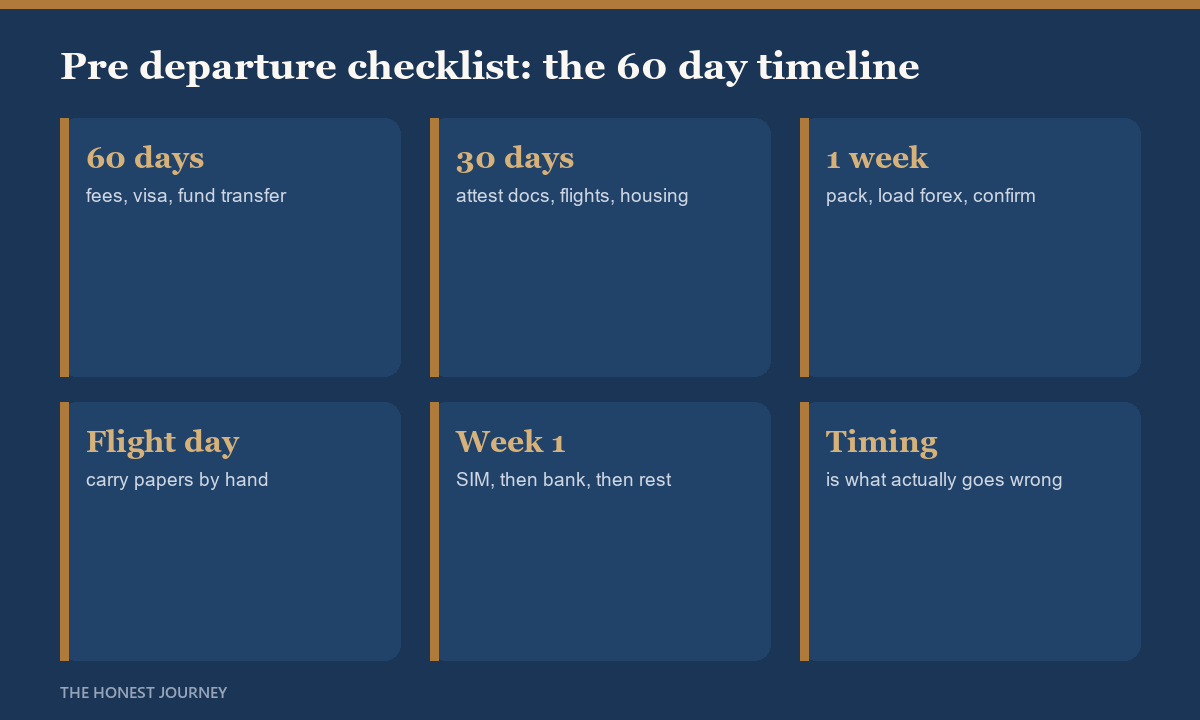
The earliest tasks are the ones with the longest lead times, so they come first. Confirm and accept your admission and pay any enrolment deposit. Pay the visa-linked fees that unlock everything else, the SEVIS fee for the US, the CAS and IHS for the UK, the equivalent for your country. Start the visa application itself, since appointment slots and processing are the least predictable part of the whole process.
On the money side, begin arranging how your funds will move. If you are on an education loan, make sure the disbursement and the sanction letter are lined up with your fee deadlines, covered in the disbursement process guide. Decide how you will carry and transfer money, a forex card plus the first fee transfer, and understand the A2 form and LRS rules before you send anything abroad. These take time and cannot be rushed in the final week.
30 days before: documents, flights, accommodation and insurance
With the big applications moving, the middle month is about the physical and logistical setup. Get your documents in order and attested where needed: transcripts, degree and mark sheets, and any certificate that requires attestation for job or academic use abroad. Make photocopies and digital scans of everything. Booking flights around this point often balances price and certainty once your visa is on track.
This is also the window to sort accommodation and insurance, both of which have scam and cost traps worth avoiding. Secure at least temporary accommodation before you land rather than gambling on finding a place on arrival, and do it safely, the accommodation before arrival guide covers the fake-listing scam that targets Indian students. Buy any required health insurance, and note whether your university mandates its own plan so you do not pay twice.
One week before: pack, load, confirm
The final week is for packing and confirming, not for starting anything new. Pack to the honest rule that weight is your real budget, documents and medicines and essentials first, comfort bulk last, laid out in the country packing guides such as things to carry to the USA. Keep all original documents in your cabin bag, never in checked luggage.
Load your forex card and carry a small amount of local cash for the first day. Carry prescription medicines in original packaging with the doctor’s prescription. Confirm your accommodation check-in and your airport-to-accommodation plan for arrival. Sort your phone so you are reachable, an eSIM or a plan for a local SIM on arrival, covered in the SIM abroad guide. Tell your bank you are travelling so your Indian cards are not blocked.
Flight day and arrival: what you carry by hand
On the day, the only things that matter are the ones you cannot replace and the ones immigration will ask for. Hand-carry your passport with the visa, your I-20 or CAS, your admission letter, and your financial proof including the loan sanction letter. Keep photocopies and scans as backup. Have your accommodation address and a local contact written down and reachable offline.
Immigration will ask why you are entering and may ask for your I-20 or CAS and proof of funds, so keep them at the top of your bag, not buried. Declare any food you are carrying. Once through, your first-week jobs begin: a local SIM, a bank account, and the everyday items you deliberately did not carry.
The first week abroad: set up the essentials
Your checklist does not end at the airport. The first week is a short, ordered list of its own: get a local SIM or activate your eSIM so you have a number for everything else, open a local bank account, covered in opening a bank account abroad, and buy the bulky essentials you left behind, bedding, a proper winter coat, kitchen basics. Complete any university registration or check-in, and any local residence registration your country requires within its deadline. Doing these in order, number first, then bank, then the rest, saves you the circular trap where each one seems to need the others.
The honest closing take
A good departure is almost entirely about timing. The exciting parts, the packing and the goodbyes, are the easy ones. The parts that go wrong are the early, boring, long-lead tasks: the fees, the visa, the attested documents, the safe accommodation, the money movement. Spread them across the eight weeks before you fly, keep your papers in your cabin bag, and treat the first week abroad as its own short checklist rather than an afterthought. Do that and you arrive as the calm student, not the one fixing avoidable problems from a foreign airport.
FAQ
When should I start pre-departure preparation?
Start about 60 days before your flight with the long-lead tasks: confirm admission, pay visa-linked fees like SEVIS or CAS, begin the visa application, and arrange how your funds will move. Documents, flights, accommodation and insurance follow at around 30 days, and packing in the final week.
What documents must I hand-carry, not check in?
Carry your passport with the visa, your I-20 or CAS, admission letter, and financial proof including the loan sanction letter in your cabin bag, with photocopies and scans as backup. Never put these in checked luggage that can be lost or delayed.
Should I arrange accommodation before I arrive?
Yes, at least temporary accommodation, and do it safely. Never wire a deposit to a landlord or listing you cannot verify, as fake listings specifically target incoming Indian students. Secure a verified temporary place first and find permanent housing after you land.
What are the first things to do after I land?
In order: get a local SIM or activate an eSIM, open a local bank account, complete university and any residence registration, and buy the bulky essentials you did not carry. Doing the SIM and bank first unlocks almost everything else.
How do I carry money for the journey and first days?
Load a forex card before you fly and carry a small amount of local cash for the first day, then open a local bank account in your first week. Understand the A2 form and LRS rules before transferring larger sums for fees.