Short answer. The honest packing list for a student flying to the USA is short, because your real constraint is not what you want to bring, it is weight. Most airlines give you two checked bags of 23kg.
Fill them with what is genuinely expensive, hard to find, or legally required, not with a mountain of masala and steel utensils that Amazon and the local Indian store already sell in your college town. The things that actually matter are your documents, your prescription medicines with a doctor’s letter, a working unlocked phone, a forex card with a little cash, and one set of Indian formals. Almost everything else is cheaper bought there in your first week. Pack for the person you will be on day one, not for a fear of never seeing India again.
Every year a departing student sends me a photo of a bed covered in three open suitcases and a spreadsheet of items colour-coded by priority, and the list is always heaviest on the things they will regret carrying. Ten kilos of dry snacks. A pressure cooker. Bedsheets. A winter jacket bought in a Delhi summer that will not survive a Boston January. The instinct is understandable, you are leaving home and you want a piece of it in the bag, but luggage weight is a hard budget and every kilo of comfort food is a kilo you cannot use for something you truly cannot replace.
This guide is the honest version: what is worth the weight, what to leave behind because it is cheaper or freely available in the US, the customs rules that actually get Indian students fined or stopped, and what to buy in your first week instead of carrying. If you are still working out the money side, read how much money to carry abroad and the best forex card for students alongside this, and if the US is still a maybe, the cost of studying in the USA is the honest starting point.
Start with the weight budget, not the wish list
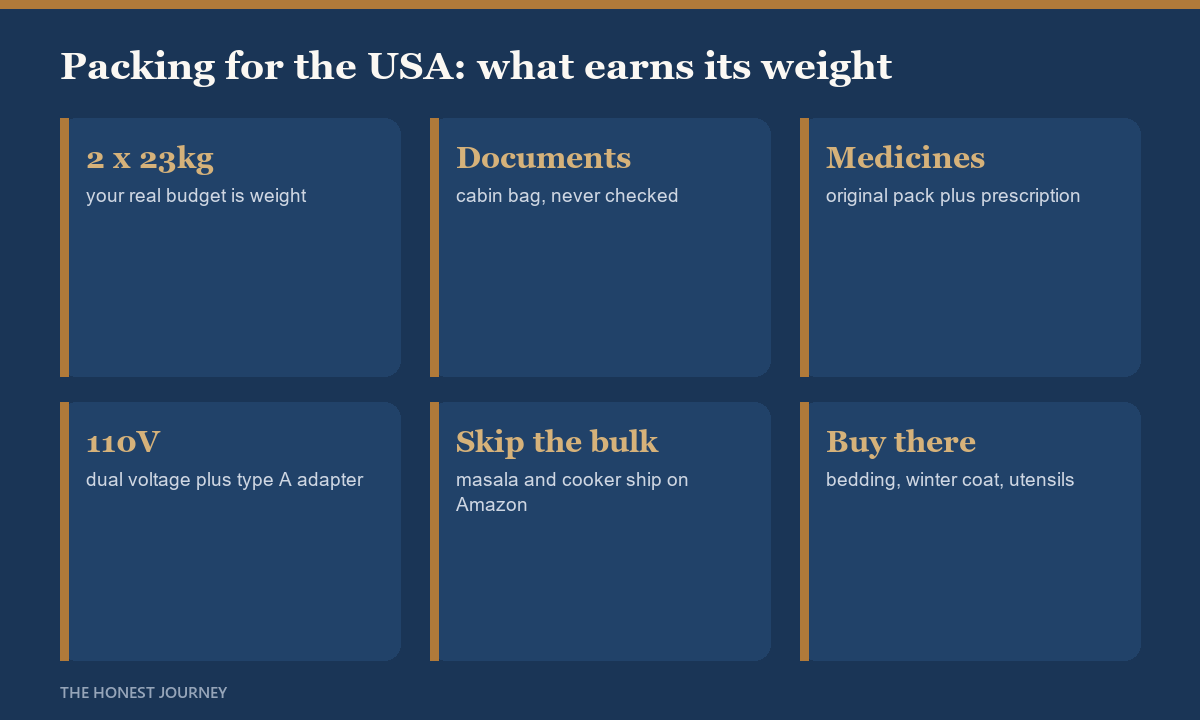
Most airlines flying India to the US on a student ticket allow two checked bags of 23kg and one cabin bag of around 7 to 8kg. That is roughly 53kg for your entire life abroad, and it fills faster than you think once documents, a laptop, shoes and a coat are in. So the first move is not to make a list of everything you might want. It is to accept that you have about 46kg of checked space and to spend it deliberately.
The test for every item is simple and worth applying honestly: is this expensive to buy in the US, hard to find there, or legally required at entry? If the answer to all three is no, it probably should not be in the bag. A packet of your favourite biscuits fails all three, the Indian store two miles from most campuses stocks it. Your original degree certificate passes, you cannot re-buy it and you may need it. Sort the whole pile through that filter before you pack a single thing.
The documents that must travel in your cabin bag
These are the only truly irreplaceable items, and they never go in a checked bag that can be lost or delayed. Keep originals plus photocopies plus digital scans, and carry them on your person or in the cabin bag:
- Passport with the F-1 visa stamp, and your I-20, which you must hand-carry, not check in.
- University admission letter and SEVIS fee receipt.
- Financial proof: bank statements, the education loan sanction letter, and any sponsor affidavit. The sanction letter as proof of funds guide covers what the letter must say.
- Academic records: original transcripts, degree and mark sheets, plus attested copies. You will need these for on-campus jobs and any future applications.
- Immunization and medical records, including any required vaccination proof your university asks for.
- Passport-size photographs (carry 10 to 15, US and Indian sizes), and a printed set of emergency contacts.
Put a full set of photocopies in your checked bag and email scans to yourself, so a lost cabin bag is an inconvenience and not a crisis.
Medicines: carry them right or risk being stopped
This is the item Indian students get most wrong, and getting it wrong at US customs is genuinely serious. Carry any prescription medication in its original packaging, with the doctor’s prescription and ideally a signed letter from the doctor stating what the medicine is and why you take it. Bring enough for the first two to three months while you find a local doctor, since a US prescription is needed to refill there.
Common over-the-counter Indian medicines are fine in reasonable personal quantities, a basic kit of paracetamol, antacids, a course of your usual cold and stomach remedies, and any regular medication. But some ingredients common in India are controlled or banned in the US, so do not carry large unlabelled strips of anything, and never carry medicine for someone else. If in doubt about a specific drug, check before you fly rather than at the counter.
Electronics and the voltage reality
The US runs on 110 to 120V with type A and B plugs, while India is 230V. Most modern laptops, phones and camera chargers are dual-voltage (check the fine print, it will say 100 to 240V) and only need a cheap plug-shape adapter, not a heavy voltage converter. Anything single-voltage and India-only, a 230V hair dryer, trimmer or iron, will burn out or need a bulky converter, so leave it and buy a cheap US one there.
Carry an unlocked phone. A phone locked to an Indian carrier is a headache when you set up a US number, and sorting a SIM is one of your first-week jobs, covered in the getting a SIM abroad guide. Bring your laptop, chargers, a power strip or two (US strips work fine too), earphones, and a small universal adapter. Skip the region-specific gadgets you can replace for a few dollars.
Clothes: pack light, buy the winter coat there
Bring clothes for your first few weeks and the season you land in, not a year’s wardrobe. Everyday wear, comfortable shoes, and one set of Indian formals or ethnic wear for cultural events and Diwali on campus, which are genuinely worth the space because they are expensive and hard to find well-fitted in the US.
The honest mistake is packing Indian winter clothing for a real US winter. An Indian sweater is not a Boston or Chicago January. Proper cold-weather gear, a real insulated coat, thermals, snow boots, is better and often cheaper bought in the US at the start of the season, and it is built for the temperatures you will actually face. Carry one warm layer for the airport and first days, then buy the serious winter kit there.
Food and kitchen: the myth worth busting
This is where the most weight gets wasted. You do not need to carry ten kilos of masala, ready-to-eat packets, and a pressure cooker. Every US college town of any size has an Indian grocery store, and Amazon ships every spice, dal, and brand of atta you grew up with to your door, often within a day. A pressure cooker, steel plates and basic utensils are all cheap on Amazon or at Walmart and Target, and carrying them costs you luggage you need for things you cannot replace.
What is worth a little space is a small starter kit for your first week before you have shopped: a modest set of your core spices, a few tea bags, and any very specific homemade item, a pickle or podi, that you genuinely cannot buy. Pack liquids and pickles in sealed bags inside checked luggage so a leak does not ruin everything, and remember the customs rules below. Everything past a small starter kit is weight you will wish you had spent elsewhere.
US customs and food rules that actually matter
US Customs and Border Protection takes food seriously, and the fines for not declaring are real. The safe rules for a student:
- Declare all food. On the arrival form, if you are carrying any food, tick yes. Declaring is free; failing to declare prohibited food can mean a fine of hundreds of dollars.
- Prohibited or risky: fresh fruits and vegetables, seeds, meat and meat products, and most dairy. Do not carry these.
- Generally allowed if declared: commercially packaged and sealed spices, dals, packaged snacks, tea, and most dry vegetarian packaged foods. Homemade items are riskier, when unsure, leave it.
The principle is simple: carry only sealed, labelled, vegetarian dry goods, declare everything, and do not gamble on fresh or homemade food to save a trip to the Indian store.
Money for the journey and the first days
You do not need to carry large cash. A forex card loaded before you fly plus around 100 to 200 US dollars in small notes for the taxi, first meals and any immediate need is the sensible setup. Setting up a US bank account is a first-week task, covered in opening a bank account abroad, and until then the forex card handles day-to-day spending without carrying risk. For the full picture of how much to move and how, see how much money to carry abroad.
Buy it there in week one, do not carry it
A short list of what almost every student is better off buying in the US in the first few days rather than dragging across an ocean: bedsheets, pillows and towels (Walmart, Target or Costco, cheap and bulky to carry), the serious winter coat and boots, a pressure cooker and kitchen basics, a study lamp and stationery, and toiletries in bulk. Carry a two-day supply of toiletries and buy the rest on arrival. This single decision frees up more luggage than any other, and none of it is worth the weight.
The honest closing take
The best-packed student bags I have seen are the ones that look almost empty of “India” and full of the few things that genuinely cannot be replaced. Your documents, your medicines packed correctly, a working phone, a forex card, one set of formals, and clothes for the first weeks. Everything else, the food, the utensils, the winter clothing, the comfort bulk, is either cheaper there, freely available, or better bought for the climate you are actually moving into. Pack light, declare your food, keep your papers in the cabin bag, and leave room for the fact that your new life will be bought mostly after you land, not carried in with you.
FAQ
How much luggage can I carry from India to the USA as a student?
Most airlines on a student ticket allow two checked bags of 23kg each and one cabin bag of about 7 to 8kg, roughly 53kg total. Confirm the exact allowance with your airline, as it varies, and never check in your I-20 or passport.
Can I carry Indian food to the USA?
Yes, in limited, sensible quantities of sealed, commercially packaged, vegetarian dry goods like spices, dals, packaged snacks and tea, and you must declare all food on arrival. Do not carry fresh fruit, vegetables, seeds, meat or dairy, which are prohibited. Declaring is free; not declaring can mean a fine.
Should I carry a pressure cooker and utensils to the USA?
Usually not. Pressure cookers, steel plates and kitchen basics are cheap on Amazon, Walmart and Target and are not worth the luggage weight. Carry a small starter kit of core spices at most, and buy the kitchen there in your first week.
What medicines can I bring, and how?
Bring regular prescription medicines in their original packaging with the prescription and ideally a doctor’s letter, enough for two to three months. A basic over-the-counter kit is fine in personal quantities. Some ingredients common in India are controlled in the US, so check any specific drug before you fly and never carry medicine for someone else.
Do I need a voltage converter for my devices in the USA?
Usually only a plug-shape adapter. The US runs on 110 to 120V; most laptops, phones and chargers are dual-voltage (marked 100 to 240V) and just need a type A or B adapter. Single-voltage Indian appliances like hair dryers or irons will not work safely, so buy those in the US instead.
Should I pack winter clothes from India?
Carry one warm layer for the airport and first days, but buy the serious winter coat, thermals and snow boots in the US. Indian winter wear is not built for a real US winter, and proper cold-weather gear is often cheaper and better bought there at the start of the season.