Short answer. The all-in cost of studying in the USA for Indian students in 2026 depends on the level: roughly ₹1.1 crore to ₹2.3 crore for a four-year Bachelor’s, ₹35 lakh to ₹1.1 crore for a two-year Master’s, and ₹1.35 crore to ₹2.5 crore for a two-year MBA.
A typical STEM Master’s at a mid-tier state school sits around USD 38,000 to 55,000 per year in tuition plus living, which the I-20 form captures as the official cost of attendance and which doubles as your proof of funds for the F1 visa. SEVIS is a one-time USD 350, the visa fee is USD 185, and the on-campus work cap of 20 hours a week barely covers groceries.
Got your admit? Next, plan the move with our pre-departure checklist and what to carry to the USA.
Every February I get the same messages from cousins and neighbours. “My son got admit, the I-20 says 72,000 dollars, is that real?” The honest answer is yes, that number is real, and it is also exactly what the consulate will ask you to prove. The cost of studying in usa for indian students is not what the brochure says. It is what the I-20 says, and that is what your loan and your bank balance both have to add up to.
This post walks through what the I-20 actually means, what the visa process costs on top of it, what you can realistically earn during the program, and what the rupee total looks like across undergraduate, Master’s and MBA programs in 2026. If you are still mapping out the bigger picture, the full guide on studying in the USA for Indian students covers admissions, visas and timelines end to end.
Once you have the number for the USA, the rest of the picture is close by: the USA vs UK comparison.
The I-20 is the only cost number that matters
The I-20 is the form a US university issues once you accept admission and submit financial proof. It carries a single number called the cost of attendance, which the school estimates as one year of tuition plus mandatory fees, on-campus room and board, books, health insurance and personal expenses. That number is what the US Department of State uses as the benchmark for your F1 visa proof of funds.
You do not get to negotiate this number. The university decides it based on its own zip code and program structure, and the consulate accepts it at face value. If the I-20 says USD 68,500 for year one, you need to show liquid funds (savings, fixed deposits, a sanctioned education loan, or a combination) that cover at least year one in full, with year two demonstrably fundable.
The cost of attendance has four components, and they vary in honesty.
| Component | State school (typical) | Private school (typical) | How accurate the estimate is |
|---|---|---|---|
| Tuition and mandatory fees | USD 28,000 to 42,000 | USD 52,000 to 68,000 | Exact. This is what the school will bill. |
| Room and board | USD 12,000 to 16,000 | USD 16,000 to 22,000 | Conservative. Off-campus shared housing is often cheaper. |
| Health insurance | USD 2,500 to 4,500 | USD 3,500 to 5,500 | Mandatory through the university, usually no opt-out for F1. |
| Books, supplies, personal | USD 2,000 to 3,500 | USD 2,500 to 4,000 | Overstated. Most students spend half. |
The room and board figure is the one you can actually beat. Shared off-campus housing with a roommate in a non-coastal state often runs USD 600 to 900 a month including utilities. The tuition figure is the one you cannot. Out-of-state surcharges at public universities are the main reason a state school can still cost USD 50,000 a year for an international student.
Faz's ruleThe I-20 cost of attendance is the visa officer's number. It is also the bank's number for proof of funds. Treat it as a hard floor for your funding plan, not a wish list.
Do not show up to the visa interview with funds that fall short of the I-20 figure by even ten percent and hope the officer will be lenient. They will not. The fastest way to a 214(b) refusal is incomplete financial documentation, and the second fastest is funds that look arranged at the last minute.
State school vs private school: the real tuition gap
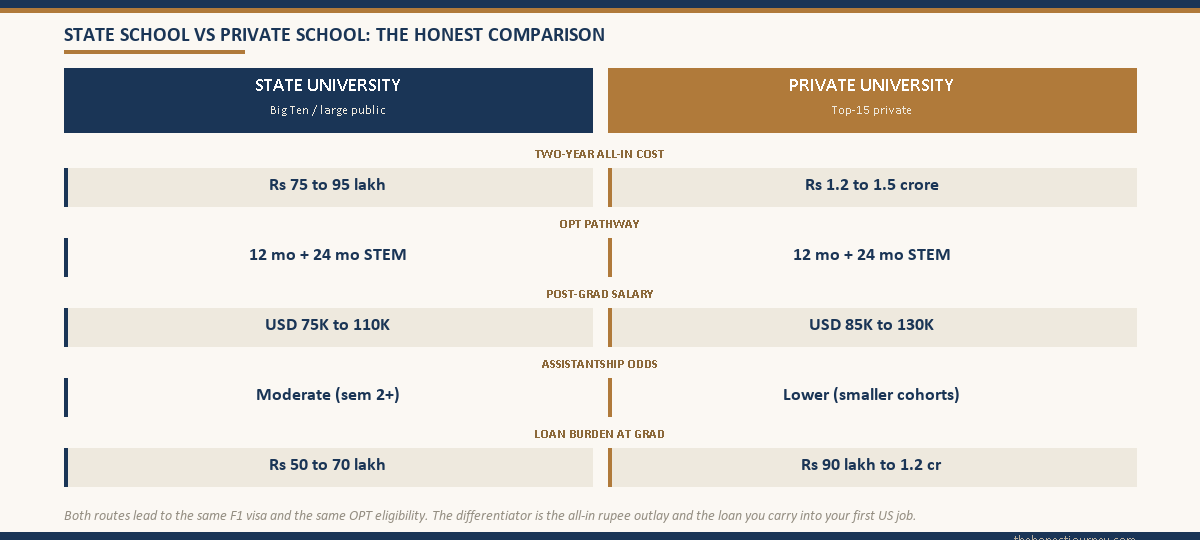
The headline number people quote, “US Master’s costs one crore”, is for a private university. The honest middle of the market is a state university, where tuition for an international student is closer to USD 30,000 to 40,000 a year. Both routes lead to the same F1 visa, the same OPT eligibility, and the same job market.
A two-year Master’s at a Big Ten state university with out-of-state international tuition typically lands at USD 75,000 to 95,000 total. The same program at a top-15 private university lands at USD 130,000 to 170,000. Public universities in less expensive states (Texas, Florida, Arizona, Indiana, Ohio) sit at the lower end of the state school range.
Scholarships and graduate assistantships change the math, so it is worth checking the scholarships for Indian students to study abroad before you finalise your budget. A teaching or research assistantship typically covers a tuition waiver plus a monthly stipend of USD 1,800 to 2,800. These are competitive and usually surface in semester two onwards. Browse program funding patterns through EducationUSA, the US government’s official international student advising network, and College Board for accredited program listings.
Undergraduate (Bachelor’s) cost: the four-year number
A Bachelor’s degree in the USA is the most expensive route an Indian student can take, for one simple reason: it runs four years, not two. The per-year numbers look similar to a Master’s, but you pay them twice as many times, and international undergraduates get almost no need-based financial aid.
| Cost per year | Public / state university | Private university |
|---|---|---|
| Tuition and mandatory fees | USD 22,000 to 38,000 | USD 42,000 to 60,000 |
| Living, room and board | USD 12,000 to 18,000 | USD 16,000 to 22,000 |
| Health insurance and personal | USD 3,000 to 5,000 | USD 4,000 to 6,000 |
| All-in per year | USD 37,000 to 61,000 | USD 62,000 to 88,000 |
| Four-year total (at ₹84/USD) | ₹1.1 crore to ₹1.8 crore | ₹1.9 crore to ₹2.6 crore |
At ₹84 to the dollar, a four-year Bachelor’s at a state university lands around ₹1.1 crore to ₹1.8 crore all-in, and a private university crosses ₹2 crore comfortably. Merit scholarships do exist for strong international applicants, and a good one can knock 20 to 40 percent off tuition, but they are competitive and rarely cover living costs. Need-based aid, the kind US citizens rely on, is almost never available to Indian undergraduates.
The honest counterweight is time. A Bachelor’s graduate gets 12 months of OPT, and if the major is STEM-designated, the same 24-month STEM-OPT extension a Master’s student gets. Four years in the US also makes a follow-on US Master’s or a domestic job far easier than applying cold from India. But you are financing four years of the most expensive tuition in the world before any of that pays off, so the loan math is heavier than for any Master’s. Most families fund undergrad through a mix of collateral-backed education loan for USA studies and substantial savings, because unsecured NBFC caps rarely stretch to a ₹1.5 crore-plus four-year bill.
MBA cost: the two-year premium
An American MBA is the single most expensive two-year program on this page. Tuition alone at a top business school now runs USD 80,000 to 100,000 a year, and even mid-tier programs sit at USD 60,000 to 80,000. Add living in the cities where these schools cluster (Boston, New York, the Bay Area, Chicago) and the two-year all-in number is in a different league from a state-school Master’s.
| Business school tier | Two-year tuition | Two-year all-in (with living) | ₹ at 84/USD |
|---|---|---|---|
| M7 / top-15 (Harvard, Wharton, Stanford, Booth, Kellogg) | USD 160,000 to 200,000 | USD 210,000 to 260,000 | ₹1.8 crore to ₹2.2 crore |
| Top 15 to 40 | USD 120,000 to 160,000 | USD 160,000 to 210,000 | ₹1.35 crore to ₹1.75 crore |
| Mid-tier / regional | USD 90,000 to 120,000 | USD 125,000 to 165,000 | ₹1.05 crore to ₹1.4 crore |
Harvard Business School’s tuition alone moved to roughly USD 84,760 for the 2026 to 2027 year, and a two-year M7 MBA all-in sits at ₹1.8 crore to ₹2.5 crore once you count living, health insurance, a laptop, recruiting trips and the two summers. This is the number that makes families pause, and they are right to.
Two things soften it. First, post-MBA salaries from a top US school are genuinely high, USD 120,000 to 175,000 base plus a signing bonus, which changes the repayment math on even a ₹1.5 crore loan. Second, a growing number of US MBA programs are now STEM-designated, which unlocks the 24-month STEM-OPT extension and three years of work runway instead of one. Before you take on an MBA-sized loan, run the post-MBA salary against the EMI honestly, and read the education loan for MBA guide for how lenders treat business-school lists.
SEVIS, the F1 visa fee, and the small line items that add up
Beyond tuition and living, there are four mandatory fees that every F1 applicant pays before the visa interview. None of them are large on their own. Together they cross ₹80,000 to ₹1 lakh.
| Fee | Amount | What it is |
|---|---|---|
| SEVIS I-901 fee | USD 350 | One-time fee to SEVP to register your record in the student tracking system. |
| F1 visa application fee (MRV) | USD 185 | Non-refundable consular fee, paid before booking the visa slot. |
| Visa issuance fee (reciprocity) | Usually zero for Indian nationals | Some countries pay extra. India currently does not for F1. |
| VFS and biometric collection | Roughly ₹1,500 to 2,500 | Paid in INR at the VFS centre during the appointment. |
The SEVIS fee receipt and the MRV fee receipt both have to be carried to the visa interview. The SEVIS receipt is the one that proves your I-20 has been activated in the system, and the consular officer will check it.
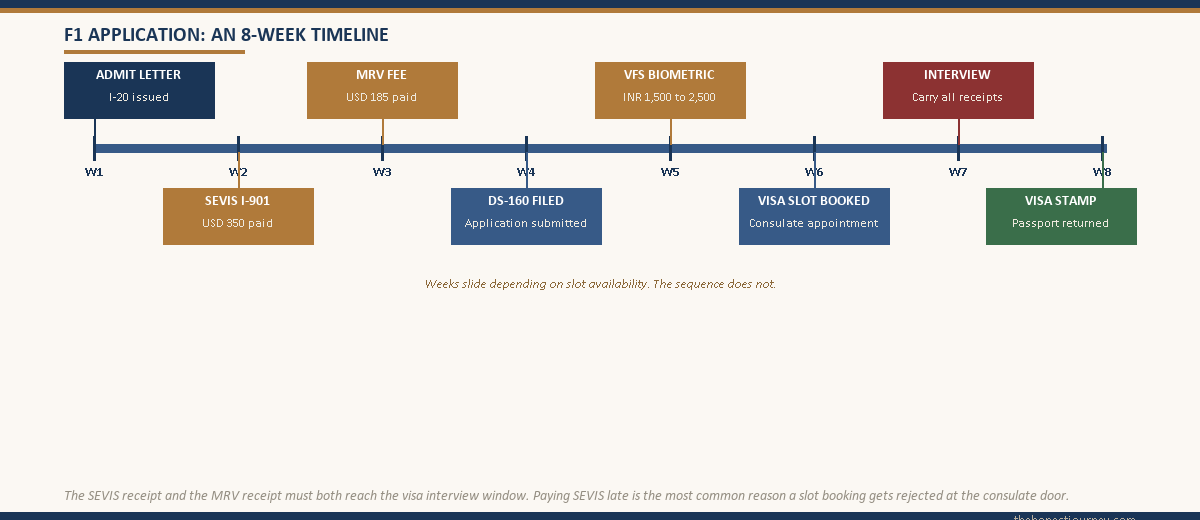
The SEVIS and MRV fees are paid by the student or family directly, not through loan disbursement. The amounts are small and the receipts are needed well before the loan tranche schedule activates. Plan to fund the first USD 535 plus VFS charges from your own account.
On-campus work, OPT and STEM-OPT: what you can actually earn
F1 students can work up to 20 hours a week on campus during semesters and full time during official breaks. Pay is usually USD 12 to 18 an hour for teaching assistant grading, library work, lab assistant or dining hall roles. That works out to around USD 1,000 to 1,400 a month, which covers groceries, phone bill and transport. It does not meaningfully offset tuition.
Off-campus work is not permitted in the first academic year. After that, CPT covers credited internships and OPT (Optional Practical Training) kicks in after graduation. The USCIS guidance for students and exchange visitors is the source for current rules.
OPT gives 12 months of work authorisation after graduation, with no employer sponsorship needed. STEM-OPT extends this by 24 months for degrees on the official STEM Designated Degree Program list. A STEM Master’s graduate earning USD 75,000 to 110,000 a year for three years on OPT and STEM-OPT generates enough post-tax savings (often USD 90,000 to 140,000) to substantially repay even a ₹60 lakh loan. A non-STEM Master’s with only 12 months of OPT is a tighter financial proposition.
Faz's ruleSTEM-OPT is the line between a US Master's that pays for itself and one that does not. Check the official STEM Designated Degree Program list before you accept the admit, not after.
The university’s marketing page sometimes lists a program as “STEM-aligned” when the specific CIP code is not actually on the STEM list. The CIP code on your I-20 is what counts. Ask the international student office in writing, save the email.
Proof of funds for the F1 visa: what the consulate accepts
The consular officer at the F1 interview has roughly two to four minutes per applicant. In that window they decide whether you have funds for at least year one and a credible plan for year two. Funds documentation is the single largest reason for 214(b) refusals.
What the consulate accepts as proof of funds:
- Sanctioned education loan letter from an Indian bank, with the amount and disbursement schedule.
- Savings account statements (last 6 months, parent or self).
- Fixed deposit receipts in the name of the sponsor.
- Liquid mutual fund statements.
- Sponsor’s income tax returns and salary slips.
- Property documents are accepted as supporting context only, not as primary liquid funds.
The total has to cover at least year one in full and demonstrably support year two. A sanctioned loan covering the full two years up front is the cleanest documentation. What does not work is a vague promise of future funds, an FD that matures only after the program starts, or money that arrived in the bank in the last 30 days without explanation. For the full breakdown see the proof of funds for student visa guide and the education loan India complete guide.
A worked Rs total: two-year STEM Master’s at a state university in 2026
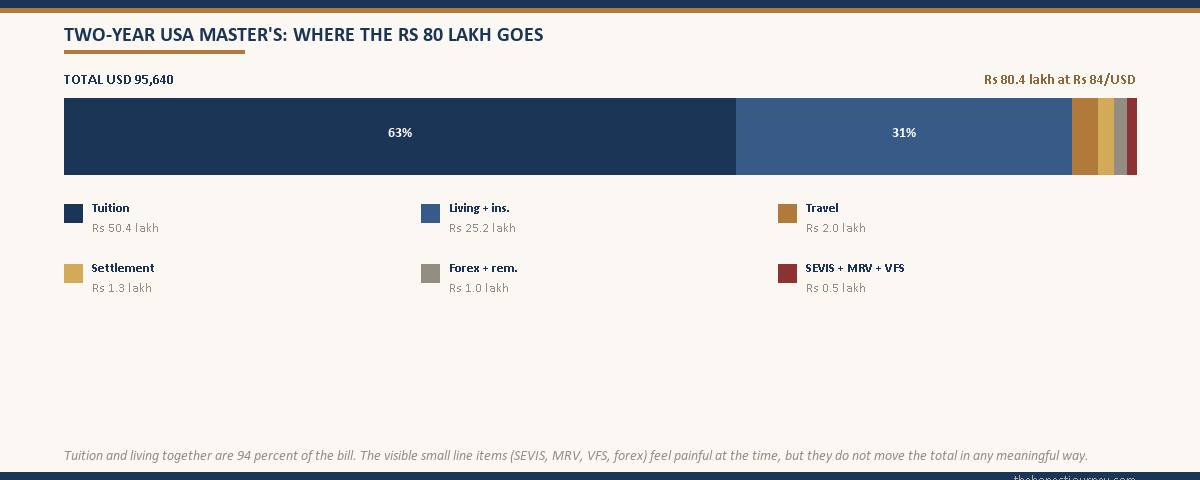
The cleanest way to make the numbers concrete is to walk through a specific case. A Master’s in Computer Science or Data Science at a typical Big Ten or large state university, USD 38,000 tuition and USD 16,000 living per year, two-year program, no scholarship in year one, modest assistantship from semester three onwards.
| Line item | USD | Rs (at ₹84/USD) |
|---|---|---|
| Year 1 tuition + mandatory fees | USD 38,000 | ₹31.9 lakh |
| Year 2 tuition (with partial assistantship waiver) | USD 22,000 | ₹18.5 lakh |
| Year 1 living + insurance | USD 18,000 | ₹15.1 lakh |
| Year 2 living + insurance (offset by on-campus job + stipend) | USD 12,000 | ₹10.1 lakh |
| SEVIS + MRV + VFS | USD 540 | ₹45,000 |
| Round-trip flights (2 trips home over 2 years) | USD 2,400 | ₹2.0 lakh |
| Initial settlement (deposit, furniture, first-month groceries) | USD 1,500 | ₹1.3 lakh |
| Forex spread + remittance charges (estimated) | USD 1,200 | ₹1.0 lakh |
| Two-year all-in total | USD 95,640 | ₹80.4 lakh |
A two-year STEM Master’s at a state university with partial assistantship lands around ₹75 to 85 lakh in 2026. A program with no assistantship sits closer to ₹90 lakh to ₹1 crore. A top-tier private university with no funding lands at ₹1.2 crore to ₹1.5 crore. The number scales with school choice, not country. Forex is small in the table but consistent across two years of remittance. Using a forex card or a wire through an SBI or BoB international branch instead of a credit card keeps this manageable, and you should understand the A2 form and LRS rules for sending money abroad before each transfer. See the best forex card for students post.
Faz's ruleThe honest number for a state-school STEM Master's in 2026 is around ₹80 lakh all-in for two years, not ₹30 lakh and not ₹1.5 crore. Anyone quoting outside that band for a state school is either selling something or working from old numbers.
The misleading numbers come from two places. Consultants quote tuition-only figures to make the program sound affordable. Forums quote private-school totals to make a state school sound like a steal by comparison. The honest middle is what you should plan for.
Funding the gap: loan, savings, or both
Few Indian families have ₹80 lakh sitting liquid. The standard structure is a sanctioned education loan for USA studies for the bulk, with family savings covering SEVIS, visa fees, flights and initial settlement. PSU banks like SBI (Global Ed-Vantage), Bank of Baroda, Canara and Bank of India sanction up to ₹1.5 crore for premier universities with collateral, at roughly 9.5 to 11 percent. Unsecured loans through NBFCs (Avanse, Auxilo, HDFC Credila) go up to ₹75 lakh for select institute lists at 11.5 to 13.5 percent. The moratorium covers the program duration plus 6 to 12 months after, and capitalised interest during the moratorium adds meaningfully to the post-graduation EMI. For the full funding picture see the studying abroad from India cost and funding guide.
The honest closing take
The cost of studying in the USA from India is a band, not a number. Where you land depends on three choices: public vs private, STEM vs non-STEM, assistantship-eligible field vs not. A state-school STEM Master’s at ₹80 lakh all-in with three years of OPT income is a fundamentally different financial product from a private non-STEM Master’s at ₹1.4 crore with a single year of OPT.
The I-20 number is non-negotiable, but the program choice that produces it is yours. Two equally capable students with offers from a top-15 private school and a Big Ten state school often end up in similar US jobs three years out, with a ₹50 to 70 lakh difference on the loan they are still repaying.
The most useful thing you can do before accepting an admit is calculate the full two-year rupee number, the post-OPT realistic income, and the EMI on the loan you would need. If those three numbers tell a coherent story, the admit is worth taking.
Once the budget for the USA is clear, the visa is the next hurdle. The fees, funds proof and processing are in the USA student visa guide.
Cost is only half the question. See is studying in the USA worth it for the salary, payback period and return on this spend.
FAQ
How much does it cost to study in USA from India in 2026?
A two-year Master’s at a US state university typically costs ₹75 lakh to ₹1 crore all-in, including tuition, living, insurance, visa fees, flights and forex. The same program at a top-tier private university lands at ₹1.2 crore to ₹1.5 crore. STEM Master’s at state schools with partial assistantship in year two sit closer to ₹80 lakh all-in. The exact number depends on the I-20 cost of attendance the university issues, which captures tuition, mandatory fees, on-campus room and board, health insurance and personal expenses.
What is the I-20 form and why does it matter for cost?
The I-20 is the form a US university issues after you accept admission and submit financial documents. It carries a number called the cost of attendance, which is one year of tuition plus mandatory fees, on-campus room and board, books, health insurance and personal expenses. This number is non-negotiable. The US consular officer uses it as the benchmark for your F1 visa proof of funds, and your sanctioned loan plus liquid family savings have to cover at least year one in full with year two demonstrably fundable.
How much is the SEVIS fee for F1 students in 2026?
The SEVIS I-901 fee is USD 350, paid one time to the Student and Exchange Visitor Program. You pay it after receiving the I-20 and before booking the visa interview. The SEVIS receipt has to be carried to the F1 visa interview because it proves your record has been activated in the system. It is paid directly by the student or family, not through the bank loan disbursement, because the amount is small and the receipt is needed well before the loan tranche schedule begins.
What is the F1 visa fee for Indian students?
The F1 visa application fee, also called the MRV fee, is USD 185 in 2026. You pay it before booking the visa slot at the US consulate or embassy in India. It is non-refundable, even if the visa is refused. On top of this, there is a small VFS biometric collection charge of around ₹1,500 to 2,500 paid in INR at the VFS centre. Indian nationals do not currently pay a separate visa issuance reciprocity fee for the F1 category.
Can F1 students work in the USA?
F1 students can work up to 20 hours a week on campus during the academic semester, and full time during official breaks. Typical pay is USD 12 to 18 an hour for roles like teaching assistant grading, library work, lab assistant or dining services. Off-campus work is not permitted in the first academic year. After that, CPT covers credited internships during the program, and OPT provides 12 months of post-graduation work authorisation, extended by 24 months for STEM-designated degrees.
What is OPT and how long does it last?
OPT (Optional Practical Training) is a work authorisation that lets F1 graduates work in the United States for 12 months after completing their degree, in a role related to their major. No employer sponsorship is required. For students whose degree is on the official STEM Designated Degree Program list, STEM-OPT adds another 24 months, taking the total post-graduation work runway to 36 months. STEM-OPT is the financial swing factor that often justifies the cost of a US Master’s for Indian students.
Is a US state university cheaper than a private university?
Yes, meaningfully. A two-year Master’s at a state university for an international student typically costs USD 75,000 to 95,000 all-in, compared to USD 130,000 to 170,000 at a top-tier private university. The F1 visa process, OPT eligibility and US job market access are identical for both. The brand on the degree and the rupee number on the loan are what change. For Indian families balancing loan size against post-graduation earnings, a state-school STEM program is often the more honest financial choice.
Can I cover the USA cost with an Indian education loan?
Yes. PSU banks like SBI (Global Ed-Vantage), Bank of Baroda, Canara and Bank of India sanction up to ₹1.5 crore for premier US universities with collateral, at roughly 9.5 to 11 percent. NBFCs like Avanse, Auxilo and HDFC Credila offer unsecured loans up to ₹75 lakh for select institute lists at 11.5 to 13.5 percent. The sanctioned loan letter is accepted by the US consulate as proof of funds, provided the amount covers at least year one of the I-20 cost of attendance.
How much does a Bachelor’s degree in the USA cost for Indian students?
A four-year Bachelor’s degree in the USA costs an Indian student roughly ₹1.1 crore to ₹1.8 crore all-in at a public state university, and ₹1.9 crore to ₹2.6 crore at a private university, covering tuition, living, insurance and fees. It is the most expensive study route to the USA, not because the yearly cost is higher than a Master’s, but because you pay it for four years instead of two. International undergraduates get almost no need-based aid, though competitive merit scholarships can reduce tuition by 20 to 40 percent.
How much does an MBA in the USA cost for Indian students?
A two-year MBA in the USA costs an Indian student roughly ₹1.05 crore to ₹1.4 crore at a mid-tier school and ₹1.8 crore to ₹2.5 crore at an M7 or top-15 business school, including tuition and living. Tuition alone at a top program now runs USD 80,000 to 100,000 a year. The high cost is offset by strong post-MBA salaries of USD 120,000 to 175,000 base, and many US MBA programs are now STEM-designated, which extends post-study work authorisation from 12 months to 36 months.
Faz · The Honest Journey · 2026