Short answer. For an Indian student the USA student visa is the F-1. Your university issues Form I-20 after admission and proof of funds, you pay the SEVIS I-901 fee of USD 350, complete the DS-160 and pay the MRV fee of USD 185, then attend a consular interview. That interview decides it, more than any document.
For an Indian student, the USA student visa is the F-1. Your university issues the Form I-20 after admission and proof of funds, you pay the SEVIS I-901 fee of USD 350, complete the DS-160 online and pay the MRV visa application fee of USD 185, then attend a consular interview at a US embassy or consulate. That interview is the deciding step, more than any document, and unlike most countries it is where the visa is won or lost.
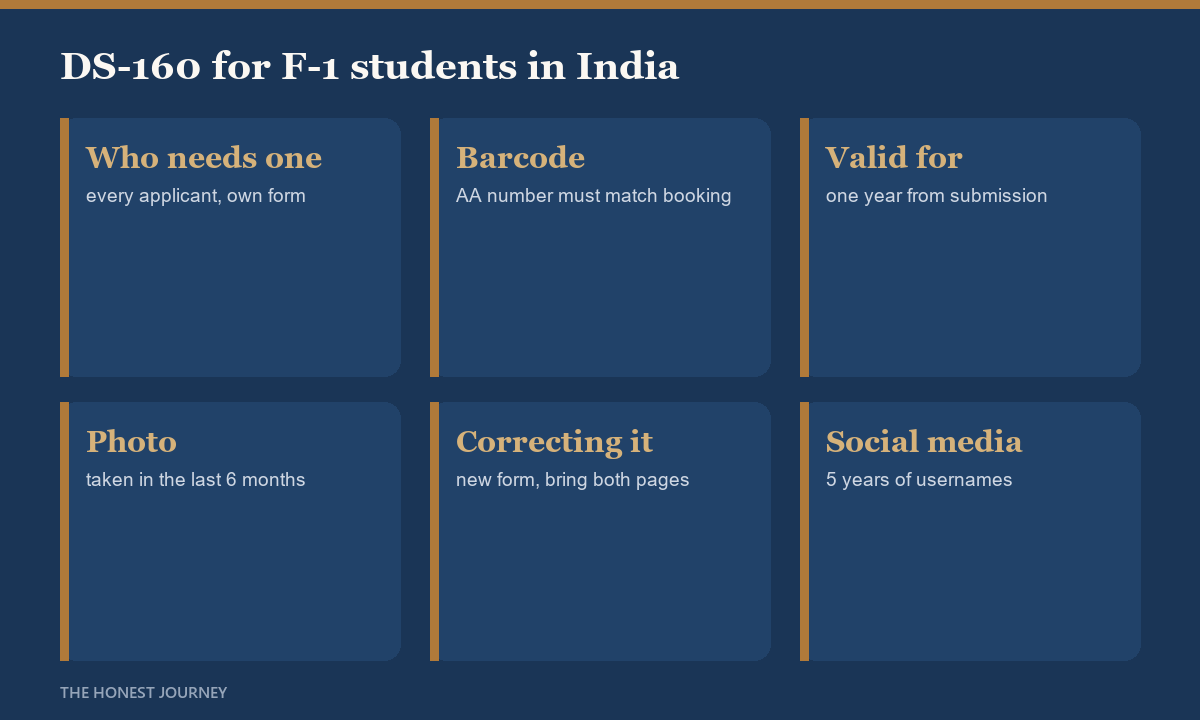
Filling the form itself? See the DS-160 rules for F-1 students in India.
Still at the application stage? See whether US universities need a WES evaluation.
For your work rights after graduating, see OPT and the duration of status rule.
Got your admit? Next, plan the move with our pre-departure checklist and what to carry to the USA.
A boy I mentored two years ago had a flawless file. Admit from a good engineering school, a loan sanction that covered everything, a father with a steady business. He still got refused on his first attempt under Section 214(b). The officer asked him three questions, he rambled on the second one, and that was it. He went back six weeks later, answered cleanly, and walked out approved. Nothing changed on paper between the two attempts. What changed was how he showed up at the window. That is the thing nobody tells you about the American visa.
This post stays strictly in the visa lane. It is the F-1 route, the fees, the funds-proof rule, the interview, the refusal reality, and the work rights that come attached. If you want tuition tables, city-by-city living costs, or the admissions and decision side, that lives in the study in USA for Indian students guide. Here we only talk about getting the stamp.
The F-1 fees, in INR
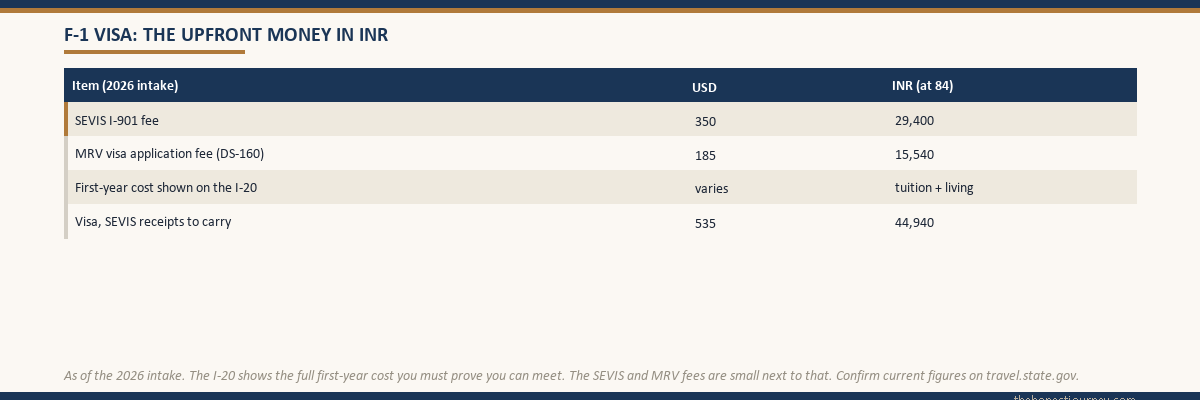
Let me put the cash outlay on the table first, because the rest of the post is unpacking the process around these numbers. The planning rate through this article is ₹96 per US dollar. It moves, so re-check it the week you pay, and confirm each fee on travel.state.gov before you transfer anything. These are the 2026-intake figures and they change.
| Fee (one-time, per applicant) | USD | INR (at 96) |
|---|---|---|
| SEVIS I-901 fee | 350 | 33,600 |
| MRV visa application fee (DS-160) | 185 | 17,760 |
| Funds shown on the I-20 (first-year cost) | varies, see below | varies |
| Government fees before funds proof | 535 | ~51,360 |
So the pure government cost of an F-1 application, before you account for the money you have to prove you possess, is about ₹51,000 at ₹96 per dollar. That is small. The expensive part of an American visa is never the fee. It is the funds you must demonstrate on the I-20, and it is the work you put into the interview. Treat the SEVIS and MRV fees as the easy boxes and put your real energy into the two things that actually decide the outcome.
The F-1 route, step by step
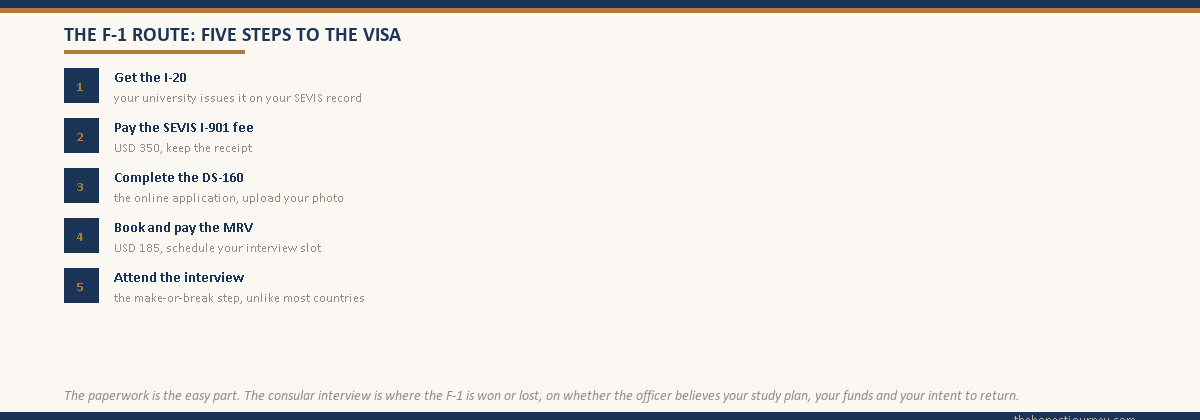
The American process has a specific order, and getting the sequence wrong wastes weeks. You cannot pay SEVIS before you have an I-20, and you cannot book an interview before you have paid both fees. Here is the chain as it actually runs.
First, the university issues your Form I-20. This happens after you have an admission offer and after you have shown the school you can fund the first year. The I-20 is the document that makes you an F-1 candidate, and it carries a SEVIS ID number you will use at every later step. Second, you pay the SEVIS I-901 fee of USD 350 online and keep the receipt, because you must carry it to the interview. Third, you complete the DS-160 online, the actual visa application form, and you pay the MRV fee of USD 185. Fourth, you book the interview appointment through the official appointment system. Fifth, you attend the interview at the embassy or consulate. The interview is the only step where a human being decides your case, and it is the one that matters.
The official appointment and document-tracking system for Indian applicants is ustraveldocs.com, and the authoritative rules for the F-1 and every fee live on travel.state.gov. Use those two and nothing else. The American visa attracts an enormous industry of agents and consultants, and almost none of what they tell you is anything you cannot read for free on those two government sites.
Faz's ruleThe interview is the visa, not the paperwork. In most countries a strong file gets you the stamp. For the US, a strong file gets you to the window, and then a three-minute conversation decides it.
Indians spend months perfecting documents and almost no time on the conversation. That is backwards for America. The officer has your whole file on a screen and roughly two minutes. They are reading you, not your folder. Practise speaking clearly about your course, your funding, and why you will return, until it is calm and natural.
The funds-proof rule: the I-20 number is the target
This is where the real money sits, and it works differently from most countries. There is no fixed government figure you must show. The amount is set by your university and printed on your I-20, and it is the estimated cost of your first year, tuition plus living expenses, as that specific school calculates it. Your job is to prove you can cover that exact number.
That means the funds-proof target for a state university in the Midwest might be USD 40,000, while a private university on the coast might print USD 75,000 on the same kind of degree. Both are real F-1 figures. The one that applies to you is the one on your own I-20, not a national average. At ₹96 per dollar, that is a funds-proof requirement of roughly ₹38 lakh to ₹72 lakh, which you must demonstrate is available and accessible.
The funds can come from family savings, a sanctioned education loan, a scholarship or assistantship shown on the I-20, or a combination. What matters is that the money is real, traceable, and that you can explain it in one sentence at the interview. A loan sanction letter, fixed deposits, and a clean bank trail are stronger than a sudden large balance that appeared last month. The full breakdown of what an American degree actually costs, year on year, is in the cost of studying in USA for Indian students post, and how families assemble that pot through borrowing is in the education loan for USA post. On this page the number matters only as the thing you must prove.
Faz's ruleFunds proof for the US is not a magic number, it is your I-20 number. Stop asking what amount to show and read the figure your own university printed, because that is the only one the officer cares about.
Every week someone asks me how many lakhs to keep in the bank for a US visa. There is no single answer. Your school did the math and put it on the I-20. Match that, make it traceable, and be able to say in one breath who is paying and how. That clarity beats a bigger balance you cannot explain.
Section 214(b): how refusals actually work
Almost every F-1 refusal comes under Section 214(b) of the US Immigration and Nationality Act. It is worth understanding exactly what it means, because the name sounds technical and the reality is simple. Under 214(b), every visa applicant is assumed to be an intending immigrant until they convince the officer otherwise. You have to prove two things in that short interview: that you have the funds to study without working illegally, and that you are a genuine non-immigrant who will return to India after your studies.
That second point, non-immigrant intent, is the one Indians stumble on. The officer is judging whether you are really going to study or really going to stay. They look at the coherence of your plan: does this course make sense for your background, can your family fund it without strain, do you have reasons to come back. A 214(b) refusal is not a permanent ban. It means you did not overcome the presumption that day. You can reapply, and many people are approved on a second attempt with no new documents, simply by interviewing better.
The honest part is this. A weak file with a strong, clear applicant often beats a strong file with a nervous, evasive one. The officer cannot see your heart, so they read your answers. Vague funding, a course that does not fit your degree, memorised speeches, or contradicting your own DS-160 are what trigger 214(b). The official explanation of the ground and how to reapply is on travel.state.gov, and it is worth reading before you book.
The interview: what they actually ask
The interview is short, often two to three minutes, in English at the window. The questions cluster around four areas: why this university and course, who is funding you and how, what you plan to do after, and your ties to India. Each of them tests one of three things: that you are a genuine student, that you can pay, and that you will leave after your studies.
The process around it has tightened. Since September 2025 nearly every student interviews in person, in their own country, and since June 2025 F-1 applicants must set their social media to public and list five years of accounts on the DS-160. We cover the questions group by group, with what each one is really checking, in our guide to F-1 visa interview questions.
Work rights on the F-1: on-campus, CPT, OPT
The F-1 comes with real work rights, and they are one of the genuine strengths of the American route, but they are staged and rule-bound. During your studies you may work on-campus, typically up to 20 hours a week during term and full-time in breaks. Off-campus work tied to your course comes through Curricular Practical Training, or CPT, which lets you take authorised internships and placements that are a required part of your programme.
CPT tightened in August 2026. Guidance to schools on 24 August 2026 (SEVP Broadcast Message 2608-02) says CPT is allowed only where the practical training is required of every student in the programme, domestic and international, so the degree cannot be completed without it. An internship taken through an optional elective does not qualify. Several universities paused or tightened CPT approvals in response, so if internships during the course are part of your plan, ask the international office whether your programme has a required practicum before you accept the admit.
The bigger prize is Optional Practical Training, or OPT, which gives you up to 12 months of work authorisation in your field after graduation. If your degree is in a designated STEM field, you can apply for a 24-month STEM OPT extension on top, for 36 months of work authorisation in total. That three-year window is a large part of why the American degree can repay, because it gives you real time to earn in dollars before any longer-term visa question. The work rights are mentioned here only as part of what the F-1 grants. How they feed the return-on-investment decision, and how the US compares against other destinations on exactly this point, is in the USA vs UK for Indian students comparison and the USA vs Canada for Indian students comparison.
One caution worth holding. Working outside these authorised channels, even a casual cash job, is a status violation that can end your F-1 and any future US visa hope. The work rights are generous when you stay inside them and unforgiving when you do not. Never improvise on this.
The honest take on the F-1
The American student visa is the one where paperwork is necessary but not sufficient. Canada, the UK, Australia and the rest are largely document exercises: assemble the right proofs, meet the funds bar, and the decision follows the file. The US adds a human gate at the end, and that gate is where Indian applicants with perfect files still get turned away. It is not unfair, it is just different, and once you understand that the whole preparation changes.
So do the boring parts properly. Get the I-20, pay the SEVIS and MRV fees, fill the DS-160 honestly, and make your funds traceable to a sentence you can say out loud. Then spend the real preparation on the three minutes that decide it: knowing your course, your funding, and your reasons to return so well that no follow-up rattles you. The F-1 rewards clarity and punishes evasion. Be clear and honest, and the heightened 2025 scrutiny stops being a threat and becomes background noise. Always confirm the current figures and rules on travel.state.gov and book through ustraveldocs.com, because everything else you will be told is someone trying to sell you certainty that only the officer can give.
Planning to bring your spouse? They can come on an F-2 visa and they cannot legally work, which changes the loan maths completely. See the F2 visa page.
FAQ
How much is the SEVIS fee for an F-1 visa?
The SEVIS I-901 fee for the F-1 visa is USD 350 as of the 2026 intake, about ₹33,600 at ₹96 per dollar. You pay it online after your university issues the I-20 and before you attend the interview, and you must carry the payment receipt to the window. It is a one-time fee per SEVIS record. Confirm the current figure on travel.state.gov before you pay, because US fees are revised periodically.
What is the MRV fee and the DS-160 for a US student visa?
The DS-160 is the online non-immigrant visa application form you complete before booking your interview. The MRV fee is the visa application fee paid alongside it, USD 185 for the F-1 as of the 2026 intake, about ₹17,760 at ₹96 per dollar. The DS-160 confirmation page and the MRV receipt are both required to schedule the appointment. Fill the DS-160 carefully and honestly, because the officer interviews you directly against the answers you gave on it.
What is the Form I-20 and who issues it?
The Form I-20 is the document your US university issues after you are admitted and after you show the school you can fund the first year. It carries your SEVIS ID and the estimated first-year cost, and it is what makes you eligible to apply for an F-1 visa. You cannot pay the SEVIS fee or book an interview without it. Check that every detail on the I-20, especially your name and the funding figure, matches your other documents exactly.
How much money do I need to show for a US student visa?
There is no fixed government figure. You must prove you can cover the first-year cost printed on your I-20, which the university calculates as tuition plus living expenses. That is commonly USD 40,000 to USD 75,000, roughly ₹38 lakh to ₹72 lakh at ₹96 per dollar, depending on the school. The funds can be savings, a sanctioned loan, or a scholarship, but they must be traceable and explainable in one sentence at the interview. Confirm your exact number on your own I-20.
What is a Section 214(b) refusal and can I reapply?
Section 214(b) means the officer was not convinced you are a genuine non-immigrant who will return to India, or that your funds are sufficient. It is the most common F-1 refusal and it is not a permanent ban. You can reapply, and many applicants are approved on a second attempt with no new documents, simply by interviewing more clearly. The cause is usually vague funding, an unconvincing study plan, or weak ties answers, not a paperwork flaw. Read the official explanation on travel.state.gov.
What questions does the US visa officer ask?
The interview is short and clusters around four areas: why this university and course, who is funding you and how, what you plan to do after graduation, and your ties to India. The officer wants a candidate who knows their own plan cold and answers consistently with the DS-160 and I-20. Avoid memorised speeches, because follow-up questions break them. Practise speaking about your real plan in your own words until it is calm and natural, since the conversation, not the file, decides the outcome.
Can I work in the US on an F-1 visa?
Yes, within authorised channels. You may work on-campus, usually up to 20 hours a week during term, and take internships through Curricular Practical Training where your programme requires them of every student, a condition SEVP enforced more strictly from August 2026. After graduation, Optional Practical Training gives 12 months of work in your field, and a designated STEM degree adds a 24-month extension, for 36 months of work authorisation in total. Working outside these channels is a status violation that can end your F-1. Stay strictly inside the authorised options and the work rights are genuinely generous.
How long does US student visa processing and the wait take?
Two waits matter. First, the wait for an interview appointment, which varies by consulate and season and can stretch in peak months, so book as early as your I-20 allows. Second, after the interview, most approvals are processed within days, though some cases go into additional administrative processing that adds weeks. There is no single guaranteed timeline, so apply well ahead of your programme start date. Check current appointment availability on ustraveldocs.com and confirm any timing rules on travel.state.gov.
Faz · The Honest Journey · 2026