Short answer. The US is the only one of the big six destinations that will say yes to your spouse and then take away everything that makes the yes useful. They can come. They can live with you for the whole programme. They cannot work.
Not a part time job, not a remote contract for an Indian employer, not freelance work paid into an Indian account. Nothing.
This is the F-2 visa, and it is the most misunderstood document in the entire Indian study abroad journey. People hear “your spouse can come with you” and stop listening. The sentence that matters comes after.
What follows is exactly what F-2 permits, exactly what it forbids, what a single income household actually costs in the US, and the three routes out that people take once they understand the trap.
What F-2 actually is
F-2 is the dependant status attached to your F-1 student visa. Your spouse and your children under 21 can hold it for as long as you hold valid F-1 status.
It grants the right to live in the United States. That is essentially the entire list. Everything else is a restriction.
Work: no, in every form
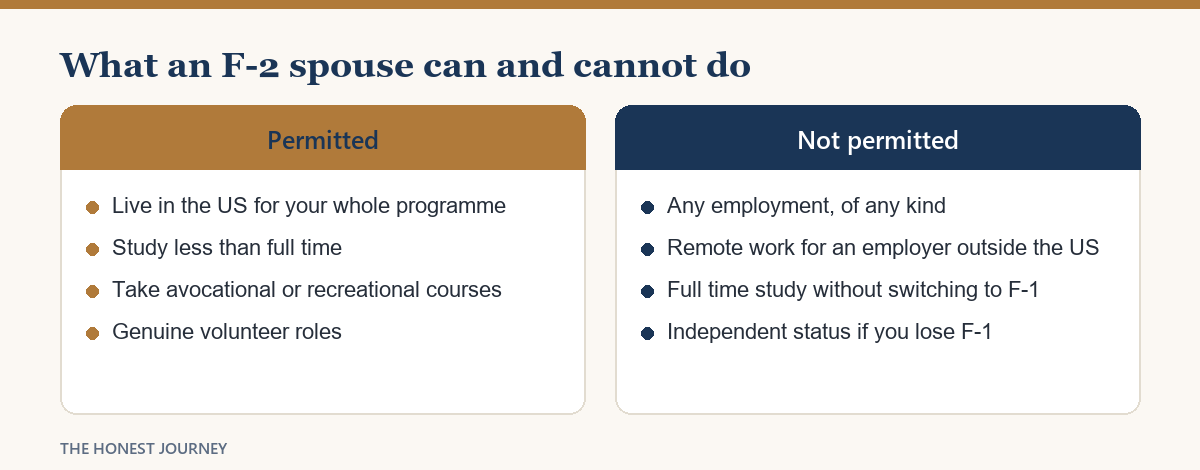
F-2 holders cannot be employed under any circumstances. There is no equivalent of the H-4 EAD that some spouses of H-1B workers can obtain. There is no application, no waiting period, no exception for hardship.
The part that catches Indian families specifically: remote work for an employer outside the US can still count as unauthorised employment. A spouse who keeps their Bengaluru job and works from an apartment in Boston is on genuinely risky ground. People do it. People also get caught, and the consequence lands on the F-1 holder’s status as much as the F-2 holder’s.
Volunteer work is allowed, but narrowly. It has to be a role that is genuinely voluntary, of the kind nobody is normally paid to do. Unpaid work at a business that would otherwise employ someone is not volunteering, it is unauthorised employment without a salary.
Study: restricted, not banned
An F-2 spouse may study less than full time. They may also take courses that are avocational or recreational in nature, so language classes, hobby courses and similar are fine.
What they cannot do is enrol full time. Full time study requires changing status to F-1 in their own right, which means their own admission, their own I-20, and their own funding. Children in F-2 status can attend school full time, so this restriction is really about the accompanying spouse.
Status: entirely derivative
This is the risk nobody prices. F-2 status exists only as an extension of your F-1 status. If you drop below a full course load without authorisation, if you lose status for any reason, if your programme ends and you do not transition properly, your spouse loses status at the same moment.
One household, one immigration risk, and no second income to absorb the shock if something goes wrong.
Faz's ruleAn F-2 spouse is not a second adult in the household economy. Legally they are a dependant of your visa, and financially they are a second cost with no offsetting income.
Every other country on the shortlist lets a spouse contribute something, even if capped. The US is the one that says come along and then removes the ability to earn. That has to be priced before you accept the offer, not after.
What it costs to bring a spouse who cannot earn
There is no neat official figure here, because the cost is structural rather than a fee. You are funding two adults in one of the most expensive countries in the world, on a student budget, for two years, with a legal bar on the second adult earning anything.
Take a typical two year master’s in a mid cost US city.
| Line | You alone | You plus an F-2 spouse |
|---|---|---|
| Tuition, 2 years | $50,000 to $80,000 | $50,000 to $80,000 |
| Rent, 2 years | $21,600 (shared) | $38,400 (one bedroom) |
| Food, transport, utilities | $14,400 | $26,400 |
| Health insurance | $4,000 | $9,000 to $12,000 |
| Total, 2 years | $90,000 to $120,000 | $124,000 to $157,000 |
| Roughly in INR | ₹75 lakh to ₹1 crore | ₹1.03 crore to ₹1.31 crore |
Figures use mid 2026 rates and vary widely by city. Treat them as sizing, not quotes.
The delta is roughly $34,000 to $37,000 over two years, which is around ₹28 to 31 lakh. That is the price of bringing a spouse who cannot contribute a dollar toward it.
Health insurance deserves a separate mention because people forget it entirely. Most universities require coverage for dependants and the family plan costs are not small. Budget $2,000 to $3,000 per person per year, and check your specific university’s requirement before you commit, because some mandate their own plan at a higher rate.
What it does to the loan
This is where the F-2 decision stops being about visas and becomes a ten year financial commitment.
A student going alone might borrow ₹45 lakh. The same student bringing a spouse borrows ₹70 to 75 lakh to cover the same degree, because the second adult’s living costs have to come from somewhere and there is no second income.
At around 10.5% over 10 years, ₹45 lakh carries an EMI near ₹61,000. ₹73 lakh carries an EMI near ₹98,000. That difference of ₹37,000 a month, every month, for a decade, is what the F-2 decision actually costs.
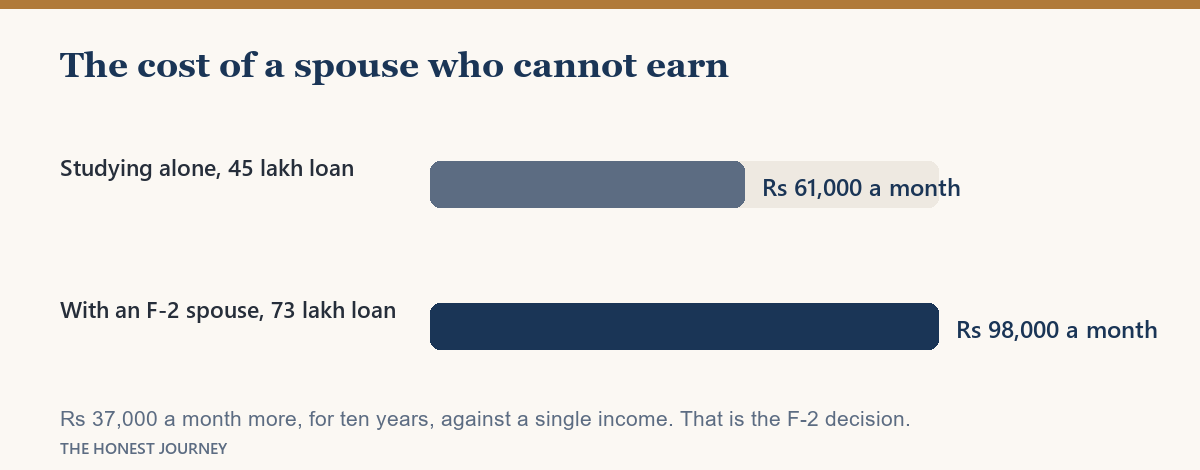
Whether that is survivable depends entirely on the outcome you get. On a $110,000 to $130,000 new graduate salary in tech or finance it is tight for a couple of years and then fine. On a $70,000 salary in a lower paying field, in a high cost city, supporting two people, it is genuinely hard. And if the job search runs long, or the H-1B lottery does not come through, it becomes the problem that defines the decade. Our USA education loan guide covers sanction sizing, and is studying in the USA worth it covers the payback maths without a dependant.
Three household outcomes
Numeric archetypes, not people.
The one that works. A student on a funded master’s or PhD with a stipend of $2,200 to $2,800 a month plus a tuition waiver. The stipend covers a modest two person household in a low cost university town. The loan is small or absent because tuition is waived. The spouse uses the time for less than full time study, builds toward their own F-1 or a professional qualification, and the household comes out of the programme with two employable people and little debt. Funding is what makes the F-2 route work, far more than salary does.
The one that strains. A self funded two year master’s, ₹73 lakh borrowed, spouse on F-2, student lands a $95,000 role on OPT. The EMI of ₹98,000 is roughly a third of take home pay after US taxes and rent for two. It is payable, and it is joyless. Every decision for five years runs through the loan. The household usually recovers, but the margin for a job change, an illness or a bad year is close to zero.
The one that breaks. Same loan, same F-2 spouse, but the graduate role does not arrive inside the OPT window, or arrives at a level that does not clear the EMI. Two adults, one of whom is legally barred from earning, a ₹73 lakh debt, and a visa clock running. This is the specific combination that turns an education loan into a decade long problem, and the F-2 restriction is what removes the obvious escape route, which in any other country would be the spouse taking a job.
The three ways out
Change status to F-1. Your spouse applies to their own programme, gets their own I-20, and becomes a student in their own right. This unlocks on campus work, and later CPT and OPT, so it converts a legally idle adult into someone with a career path. The cost is another tuition bill, which is why it works best where the second programme is cheap, funded, or at a community college. For couples where both partners have careers to protect, this is frequently the right answer despite the cost.
Go alone first, reunite on OPT or H-1B. The single most common workable plan. You do the programme alone, keep the loan at ₹45 lakh instead of ₹73 lakh, and bring your spouse once you are earning. If you reach H-1B, your spouse holds H-4, and H-4 spouses of certain H-1B holders can obtain work authorisation, which F-2 spouses never can. The route from F-2 to earning runs through your own status, so getting yourself established first is the faster path for the household.
Choose a different country. Worth stating plainly, because the comparison is not close. Germany gives spouses full work rights on family reunion. Australia allows 48 hours per fortnight. If both partners working matters more than the US specifically, the US is the wrong destination and no amount of planning fixes that. See the full country comparison.
Children on F-2
The position for children is much better than for spouses, and it is worth separating clearly because families conflate the two.
Children under 21 can hold F-2 status and, unlike your spouse, they can attend school full time. Public school from kindergarten through grade 12 is free in the United States, including for children in F-2 status. For a family with school age children that is a substantial benefit which does not appear in any cost table, and it is one of the genuine arguments in favour of bringing the family rather than leaving them in India.
The constraint is the age cliff. F-2 status for a child ends at 21. A child who turns 21 during your programme ages out and must either leave or obtain status in their own right, usually by being admitted to a university as an F-1 student. If you have a child in their late teens, map that date against your programme dates before you apply, because the transition needs lead time and it is not automatic.
Higher education is the other catch. An F-2 child can attend school, but attending a US university full time requires changing to F-1 status, with their own admission and funding, and they will typically pay international student fees rather than in state rates.
What to verify before you commit
Four things worth confirming with your specific university before you accept an offer, because they vary and they are all expensive to discover late.
Dependant health insurance. Ask whether the university mandates its own plan for dependants or accepts external coverage. Some institutions require their plan at a considerably higher rate than the market, and for two or three people that difference can run to several thousand dollars a year.
Family housing. Ask whether university family housing exists and what the waitlist looks like. Where it exists it is usually well below market rent, and it is often the single largest saving available to a student with dependants. Where it does not, you are on the open market in an unfamiliar city.
The I-20 for dependants. Each dependant needs their own I-20, and the university must issue it with evidence of additional funding for each person. Your financial documents must cover the whole family, not just you, and the amounts are specified by the school.
Assistantship rules. If you are hoping for a funded position, ask early whether the stipend and tuition waiver assume a single student. Funded positions are what make the F-2 route work financially, and the difference between a funded and unfunded offer is far more consequential for a married applicant than for a single one.
Faz's ruleFunding, not salary, is what makes the American family route work. A funded place with a stipend changes this decision more than any job offer afterwards could.
The households that come through a US programme with a spouse and no debt are almost always the funded ones. If you are married and considering the US, chasing an assistantship is worth more effort than chasing a higher ranked school.
The same question, answered by country
The rules differ enormously, and four of the eight changed in the last two years. If a different destination is on your list, start there instead, or see the full country comparison.
- New Zealand, the most generous of the eight
- Germany, with full spousal work rights
- Australia, where partners work capped hours
- Canada, where the 16 month rule decides it
- the UK, where taught masters cannot bring family
- Ireland, where only PhD students qualify
- the Netherlands, closed by an income floor
Frequently asked questions
Can an F-2 spouse work in the USA?
No. F-2 holders cannot work under any circumstances, including remote work for an employer outside the United States. There is no work authorisation available to F-2 holders, unlike the H-4 EAD available to some spouses of H-1B workers. Genuine volunteer roles are permitted.
Can my spouse study on an F-2 visa?
Only less than full time, or courses that are avocational or recreational. Full time study requires changing status to F-1, which needs their own admission, I-20 and funding. Children in F-2 status can attend school full time.
Can an F-2 spouse work remotely for an Indian company?
This is risky and commonly misunderstood. Remote work performed while physically in the US can be treated as unauthorised employment regardless of where the employer or the bank account sits. Get proper legal advice before assuming it is safe.
How much extra does an F-2 dependant cost?
Around $34,000 to $37,000 over a two year programme, roughly ₹28 to 31 lakh, driven by larger accommodation, higher food and transport costs, and dependant health insurance. None of it is offset by income.
What happens to my spouse if I lose F-1 status?
They lose F-2 status at the same time. F-2 is entirely derivative of your status, which means the household carries a single point of immigration failure with no second income to absorb it.
Is it better to bring my spouse later on H-4?
For most couples, yes. H-4 spouses of certain H-1B holders can obtain work authorisation, which F-2 spouses never can. Studying alone and reuniting once you are working keeps the loan smaller and gives your spouse a route to earning.
The honest closing
The F-2 visa is not a trap because it is hidden. It is published, unambiguous, and easy to find. It is a trap because of how the question gets asked. People ask “can my spouse come with me” and the answer is yes, so they stop.
The question that matters is “can my spouse earn while we are there”, and in the US the answer is no, for the entire duration, with no exception and no application.
If you can fund two people through two years without a second income, and you want the US degree, this is a legitimate choice made with open eyes. If your plan quietly assumed your partner would pick up work once you arrived, that plan does not exist, and it is far better to discover that now than after a resignation letter has been handed in.