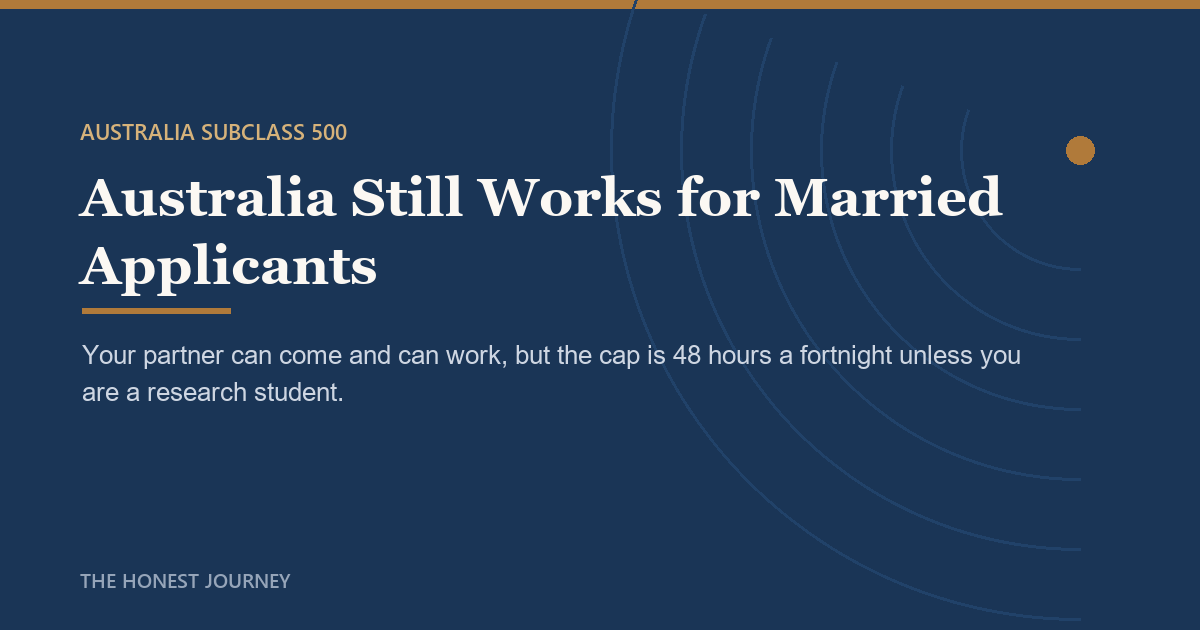
Short answer. Australia is one of only two destinations on the standard Indian shortlist where bringing a spouse still works properly. Your partner can come for the whole duration of your subclass 500 visa, and they can work.
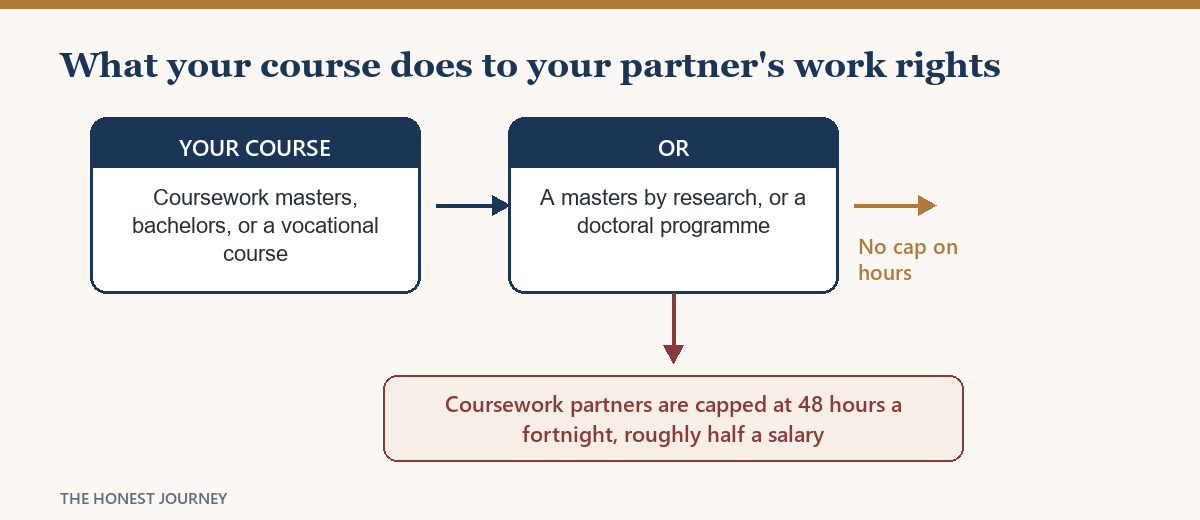
The catch is in how much. Work rights for dependants are capped at 48 hours a fortnight, and that cap lifts entirely only if you are on a master’s by research or a doctorate. If you are doing a coursework master’s, which is what most Indian students in Australia do, your partner is on the capped side of that line.
Forty eight hours a fortnight is real money. It is roughly a half time job. What it is not is a full second salary, and households that budget it as one are the households that get into trouble.
What the student dependent visa in Australia gives you
Your spouse or de facto partner and your dependent children can accompany you for the length of your student visa. They hold their own visas, granted in line with yours, and they must apply to extend whenever you extend.
That last point catches people. Dependant visas do not automatically follow yours when you renew. They lodge separate applications at the same time, with separate fees, and a gap in their status is their problem to fix, not something the department resolves quietly in the background.
The work rights split
This is the rule that decides the household budget.
| Your course | Your partner can work |
|---|---|
| Coursework master’s | 48 hours per fortnight |
| Bachelor’s degree | 48 hours per fortnight |
| Vocational or VET course | 48 hours per fortnight |
| Master’s by research | Unlimited |
| Doctoral programme | Unlimited |
The pattern is the same one running through every country on this shortlist. Research degrees are treated generously, taught coursework degrees are not. Australia is simply the mildest version of it: coursework students’ partners are restricted rather than excluded, which is more than the UK, Ireland or the USA offer.
What you must show
Bringing family raises the funds you must evidence. The additional amounts are specific:
- AUD 10,394 for a partner
- AUD 4,449 per dependent child
That is roughly ₹5.7 lakh for a partner and ₹2.4 lakh per child at mid 2026 rates, on top of your own funds and tuition.
There is also school. If you bring children of school age, you must budget for their education, and in most states international students’ children pay fees at government schools. This varies significantly by state and is one of the larger unbudgeted costs families hit. Check the specific state before you commit, because the difference between New South Wales and Victoria is not trivial.
Separately, from 1 July 2026 the student visa application charge starts from AUD 2,500 per application. With a partner and a child, three applications is a meaningful sum before anyone has flown anywhere. Our proof of funds guide covers how these amounts are evidenced.
Faz's ruleForty eight hours a fortnight is a buffer, not a salary. Size the loan as if your partner earns nothing and let their income be the thing that absorbs a bad semester.
It covers roughly half of a second adult in most Australian cities. Households that treat it as core income are the ones that discover the gap in month five, which is exactly when there is no flexibility left.
The money, honestly
Take a coursework master’s in a major Australian city, two people, two years.
| Line | You alone | You plus a partner |
|---|---|---|
| Tuition, 2 years | AUD 70,000 to 90,000 | AUD 70,000 to 90,000 |
| Living costs, 2 years | AUD 58,000 | AUD 82,000 |
| Partner earnings, capped | Not applicable | AUD 43,000 to 50,000 |
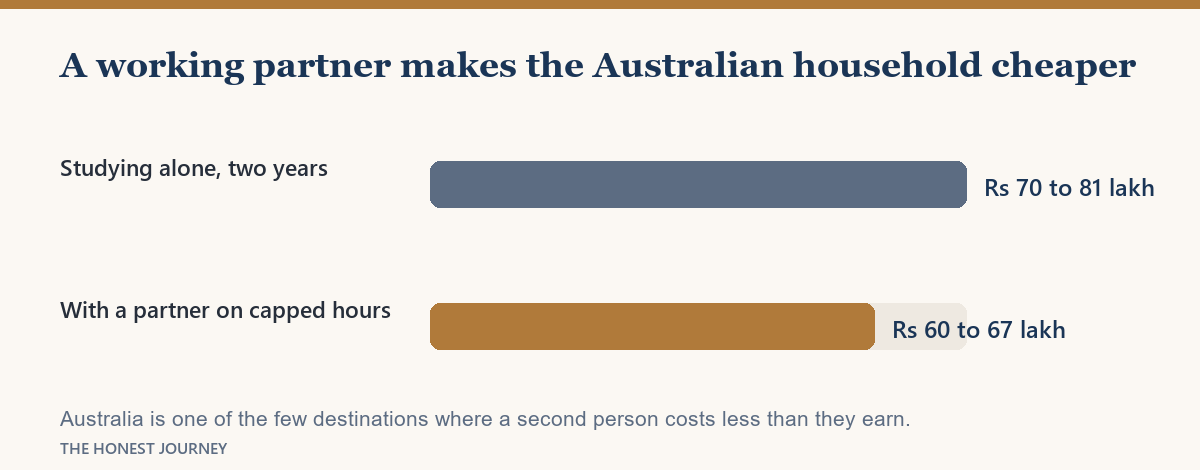
| Net cost | AUD 128,000 to 148,000 | AUD 109,000 to 122,000 |
| Roughly in INR | ₹70 to 81 lakh | ₹60 to 67 lakh |
Figures use mid 2026 rates and vary by city. Treat them as sizing, not quotes.
The result is worth sitting with, because it is counterintuitive. Bringing a partner to Australia makes the household cheaper overall, not more expensive, because 48 hours a fortnight at Australian award wages of AUD 24 to 28 an hour earns more than the second person costs.
Australia is one of the only destinations where that is true. In the US it is emphatically false. In the UK for a taught master’s the question does not arise. That is the genuine, under discussed argument for Australia as a destination for married applicants, and it barely features in how the country is marketed.
Two caveats on that number
First, it assumes your partner finds steady work reasonably quickly. Australian employers are used to hiring on student and dependant visas, so this is more achievable than in most countries, but a three to six month search is normal and should be budgeted.
Second, the cap is genuinely enforced. 48 hours a fortnight is monitored, breaching it puts both visas at risk, and no employer relationship is worth that. Treat the cap as fixed.
Three household outcomes
Numeric archetypes, not people.
The one that works. A two year coursework master’s in Adelaide or Brisbane, lower rent than Sydney, partner working 48 hours a fortnight at AUD 26 an hour, earning around AUD 2,250 a month. Combined living costs for two run about AUD 3,400 a month. The gap is covered by the loan, which is sized at ₹35 lakh for tuition and the shortfall rather than ₹60 lakh for everything. Both leave with Australian work history, and the 485 post study work visa lets them keep earning while the loan is repaid.
The one that strains. The same programme in Sydney, where rent for a one bedroom eats AUD 2,600 a month on its own. The partner’s capped income covers rent and very little else. The household is functional but has no margin, and the loan at ₹55 lakh is being carried on a single student budget until graduation. It works, but any disruption, an illness or a lost job, goes straight onto the credit card.
The one that breaks. A household that modelled the partner’s income as a full time salary rather than a capped one. The budget assumed AUD 4,300 a month, the reality is AUD 2,250, and the ₹22 lakh annual gap was never funded. This is not a visa failure, it is an arithmetic failure, and it is the single most common way Australian plans go wrong for married applicants. The rule is capped hours. Budget the capped number.
Practical points that matter
Apply together where possible. Including your family in the original application is cleaner and usually faster than adding them later as subsequent entrants. Adding a partner mid course is possible, but it invites questions about whether the relationship predated your application, and evidence of a genuine ongoing relationship is assessed carefully.
Evidence the relationship properly. For de facto partners this matters more than for married couples. Australia takes relationship evidence seriously: joint finances, shared accommodation history, communication records. Thin evidence is a common refusal reason and it is entirely avoidable with preparation.
Remember the renewal. When you extend your student visa, your family must lodge their own extensions at the same time. Diarise it well ahead. A lapsed dependant visa is far more painful to fix than to prevent.
Think about the 485. Post study work visas generally allow dependants with better work rights than the student visa does. If the capped hours are the binding constraint, that constraint loosens once you graduate onto a 485. Our Australia student visa guide covers the route in detail.
School fees for children, the cost nobody budgets
This is the largest unbudgeted expense for Australian families and it deserves its own section, because the answer is genuinely surprising to most Indian applicants.
In most Australian states, children of temporary visa holders pay fees to attend government schools. This is not the case in most comparable countries. In Canada and Germany school is generally free for dependants, and in the USA public school is free. Australia charges.
Rates vary substantially by state and change annually, running from roughly AUD 5,000 to over AUD 10,000 per child per year at government schools, with exemptions in some states and for some visa subclasses. Some states charge nothing for dependants of certain student categories, particularly research students and scholarship holders.
The variation is large enough to change your choice of state. A family with two school age children could face AUD 20,000 a year in one state and close to nothing in another, which over a two year programme is a difference of around 22 lakh rupees. Check the current schedule for the specific state before you commit, and check whether your visa subclass or scholarship carries an exemption.
Faz's ruleAustralia is the one destination on this list that charges school fees to dependent children, and the amount varies enough by state to be worth choosing a state over.
Two children at ten thousand dollars each per year is twenty thousand a year that most families never modelled. In some states the same family pays nothing. Check before you choose the city.
What changes on the 485
The capped hours are a study stage restriction, not a permanent one.
When you finish and move onto a Temporary Graduate visa, subclass 485, you are a worker rather than a student. Dependants included on that visa are generally not subject to the 48 hour fortnightly cap that applies during study. For a household that has been running on half a salary, the transition to a full one is a material improvement, and it usually arrives at the same moment loan repayment begins.
Two things to plan for. Family members must be included in the 485 application or added later, and adding later is more complicated than including from the start. And the 485 has its own eligibility conditions including age limits and qualification requirements, which have tightened in recent years, so confirm your eligibility rather than assuming it. Our is studying in Australia worth it page covers the post study picture in more detail.
Evidencing a de facto relationship
If you are not formally married, this is where Australian applications most often fail, and the failure is preventable.
Australia recognises de facto partners, but the evidentiary bar is real. You generally need to show the relationship has existed for at least twelve months, and that it is genuine and continuing. Useful evidence includes joint bank accounts and financial commitments, a shared lease or utility bills in both names, a sustained communication history, photographs across time rather than from one occasion, and statements from people who know you both.
Thin evidence assembled in the fortnight before lodging reads exactly like thin evidence assembled in the fortnight before lodging. If a de facto application is likely to be part of your plan, start building the record months ahead. For married couples this is far simpler, though a marriage certificate alone with no cohabitation evidence can still attract questions.
The same question, answered by country
The rules differ enormously, and four of the eight changed in the last two years. If a different destination is on your list, start there instead, or see the full country comparison.
- New Zealand, the most generous of the eight
- Germany, with full spousal work rights
- Canada, where the 16 month rule decides it
- the USA, where an F-2 spouse cannot work
- the UK, where taught masters cannot bring family
- Ireland, where only PhD students qualify
- the Netherlands, closed by an income floor
Frequently asked questions
What are the new rules for a student dependent visa in Australia?
The core position is unchanged: a spouse, de facto partner and dependent children can accompany a subclass 500 holder, with work capped at 48 hours per fortnight unless the primary student is on a master’s by research or a doctorate. What did change is cost. From 1 July 2026 the student visa application charge starts from AUD 2,500 per application, and required funds are AUD 10,394 for a partner and AUD 4,449 per child.
Can my spouse work full time in Australia on a dependant visa?
Only if you are enrolled in a master’s by research or a doctoral programme. If you are on a coursework master’s, a bachelor’s or a vocational course, your partner is capped at 48 hours per fortnight.
How much extra money do I need to show for family?
AUD 10,394 for a partner and AUD 4,449 per dependent child, roughly ₹5.7 lakh and ₹2.4 lakh, on top of your own funds and tuition.
Is it cheaper to bring my partner to Australia?
Usually, yes, which is unusual. At award wages of AUD 24 to 28 an hour, 48 hours a fortnight earns more than a second adult costs in most Australian cities. Australia is one of the few destinations where a partner is net positive to the household budget.
Do my children have to pay school fees in Australia?
In most states, yes. Children of international students generally pay fees at government schools, and the amount varies significantly by state. Check the specific state before you commit, as this is a commonly missed cost.
What happens to my family’s visas when I extend mine?
They must lodge separate extension applications at the same time. Dependant visas do not renew automatically alongside yours, and a lapse is theirs to resolve.
How much is the Australian student visa fee in 2026?
From 1 July 2026, the student visa application charge starts from AUD 2,500 per application unless you are exempt. With a partner and a child that is three separate applications.
The honest closing
Australia is the pragmatic choice for a married applicant. It does not have Germany’s generosity, but it has something Germany does not: you can study in English, the job market absorbs dependants readily, and the arithmetic on bringing a partner comes out positive rather than negative.
What it asks in return is that you take the cap seriously. Forty eight hours a fortnight is the rule, it is enforced, and it earns roughly half of what a full time job would. Build the budget on that number and the plan holds comfortably. Build it on a full salary that your partner is not permitted to earn, and you will discover the gap somewhere around month five, with a loan already drawn and no way to increase it.
For the wider comparison against Germany, Canada and the rest, see the country by country breakdown. For the money side of the degree itself, cost of studying in Australia and the Australia education loan guide cover the rest.