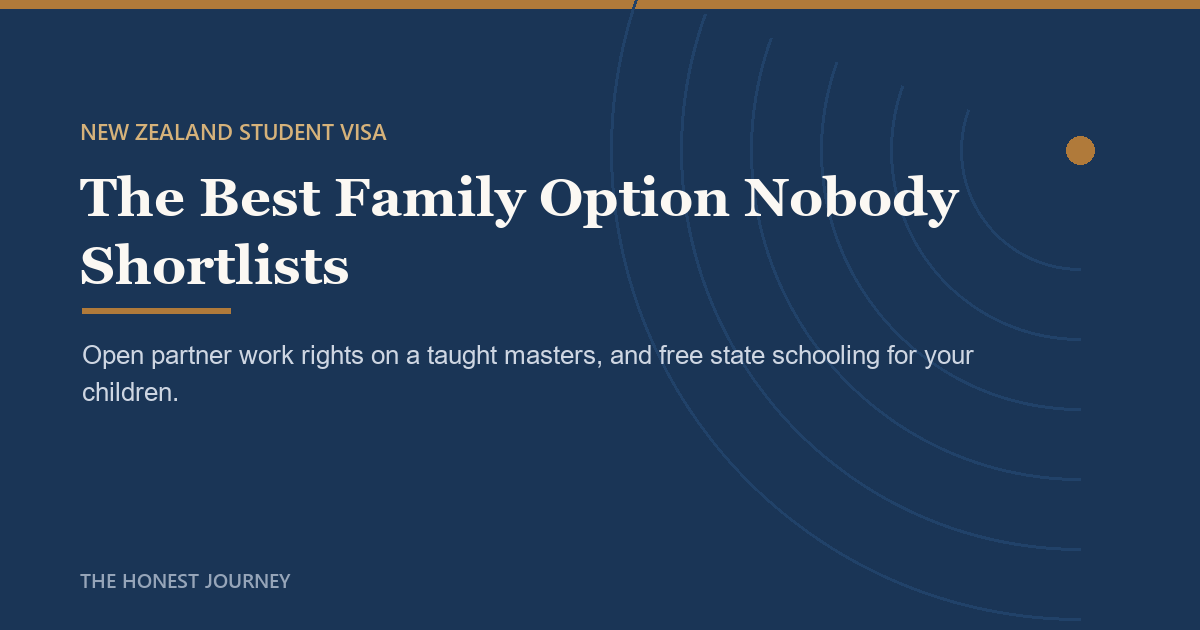
Short answer. New Zealand is the destination almost nobody puts on the shortlist, and for a married Indian applicant with children it may be the best English speaking option available.
If you are doing a master’s, your partner can get open work rights. Not capped hours like Australia. Not barred entirely like the USA. Open, unrestricted, any employer, for the duration of your study. And your school age children attend state school as domestic students, which means free, unlike Australia where you would pay international fees.
That combination exists in only one other country on the standard shortlist, and that country is Germany, where you would need German. This page is the honest version of what New Zealand offers, and what the eligibility conditions actually are.
The rule, and the level that decides it
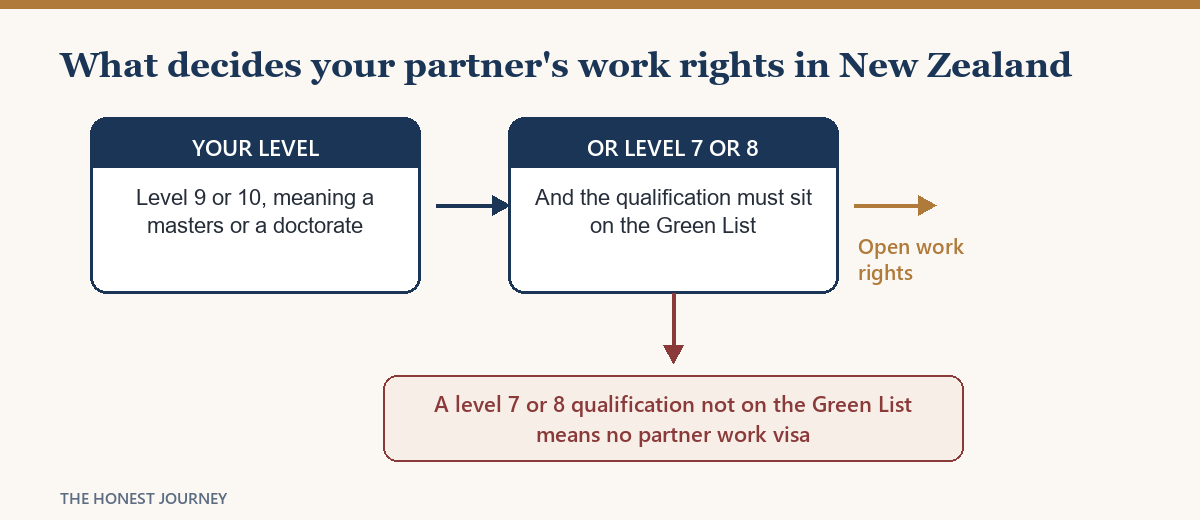
Your partner may be eligible for a Partner of a Student Work Visa, which carries open work rights, if you are:
- Studying at level 9 or 10, which means a master’s or a doctorate, or
- Studying at level 7 or 8 in a qualification that appears on the Green List
Level 9 is the one that matters for most Indian applicants, because the one to two year master’s is the standard route. If you are doing a master’s in New Zealand, your partner gets open work rights. There is no course type test beyond the level, no research versus taught distinction of the kind that shuts out UK and Irish applicants, and no cap on hours of the kind Australia applies.
If you are studying at level 7 or 8, a bachelor’s or bachelor’s with honours, the qualification must be on the Green List, which is New Zealand’s list of occupations in shortage. That is a real constraint and it is where most refusals in this category come from, so check the current list against your exact qualification rather than assuming.
Faz's ruleA New Zealand masters gives your partner open work rights. No cap, no research versus taught test, no course type condition. Only Germany matches that, and Germany needs German.
This is the single most underrated fact for married Indian applicants. New Zealand barely features on shortlists, and on this specific question it beats Australia, the UK, Ireland and the USA outright.
What open work rights actually mean
Worth being precise, because “work rights” means different things in different countries.
A Partner of a Student Work Visa is an open work visa. Your partner can apply for any job, with any employer, in any occupation, for as long as your student visa is valid. There is no hours cap. There is no employer sponsorship requirement. There is no occupation restriction.
Compare that against the alternatives on a like for like basis:
| Country, for a taught master’s student | Partner work rights |
|---|---|
| New Zealand | Open, unrestricted |
| Germany | Full rights, but usually needs A1 German |
| Australia | Capped at 48 hours per fortnight |
| Canada | Only if the programme runs 16 months or longer |
| UK | Cannot bring a partner at all |
| Ireland | Cannot bring a partner at all |
| USA | Can bring, cannot work at all |
Children, where New Zealand quietly wins
This is the part that changes the maths for families and it is almost never mentioned in destination comparisons.
School age children of eligible students can apply for a Dependent Child Student Visa, and they are treated as domestic students. That means state school tuition is free.
Set that against Australia, where children of temporary visa holders pay fees at government schools in most states, running from roughly AUD 5,000 to over AUD 10,000 per child per year. For a family with two school age children over a two year programme, that is a difference of around ₹22 lakh between the two countries, for the same decision.
There is an income condition attached. For dependent children you generally need to show gross annual income of approximately NZ$58,240, which is set at 80% of the median wage. From 9 March 2026 the median wage benchmark rose to NZ$35.00 per hour, so this figure moves when that benchmark moves. Check the current threshold rather than relying on this number twelve months from now.
In practice, a partner on an open work visa earning a full time wage clears that threshold comfortably, which is why the partner visa and the child visa work together as a package rather than as separate hurdles.
The money
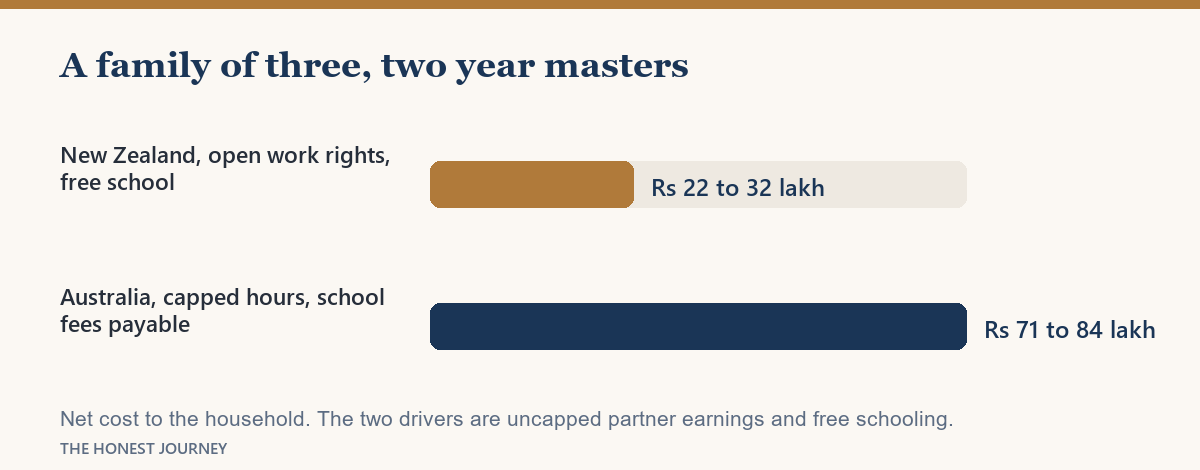
Take a two year master’s, two adults and one school age child.
| Line | New Zealand | Australia |
|---|---|---|
| Tuition, 2 years | NZ$60,000 to 80,000 | AUD 70,000 to 90,000 |
| Living costs, family of three | NZ$78,000 | AUD 92,000 |
| School fees for one child | Zero, domestic student | AUD 10,000 to 20,000 |
| Partner earnings, 2 years | NZ$95,000 to 120,000, open | AUD 43,000 to 50,000, capped |
| Net cost to the household | NZ$43,000 to 63,000 | AUD 129,000 to 152,000 |
| Roughly in INR | ₹22 to 32 lakh | ₹71 to 84 lakh |
Figures use mid 2026 rates and vary by city. Treat them as sizing, not quotes.
The gap is not marginal. For a family of three, New Zealand comes out roughly ₹45 lakh cheaper than Australia across a two year master’s, and the two drivers are the same two facts: uncapped partner earnings and free schooling.
That does not automatically make New Zealand the right answer. The job market is smaller, salaries are lower than Australia’s, and post study migration pathways are narrower than they were. But if the question is how a family gets through two years abroad without a crushing loan, this is the strongest answer in English.
Three household outcomes
Numeric archetypes, not people.
The one that works. A level 9 master’s in Wellington or Christchurch, partner arrives on an open work visa and finds full time work at NZ$28 an hour within four months, one child in free state school. Household income of roughly NZ$4,000 a month against living costs of NZ$3,200. The loan is ₹18 to 22 lakh for tuition only, and it is being serviced from surplus before graduation. This is a genuinely comfortable version of studying abroad with a family, and very few people know it exists.
The one that strains. A level 7 bachelor’s qualification that turns out not to be on the Green List. The partner is not eligible for the open work visa, the household falls to one income, and the plan that was built on two salaries is suddenly a ₹50 lakh single income proposition in a country with modest wages. This is the specific New Zealand failure mode and it is entirely avoidable by checking the Green List before applying.
The one that breaks. Rarely a rules failure. It is usually the job market. Auckland aside, New Zealand is a small economy and some professions have very few employers. A partner with a specialised background can hold open work rights and still not find relevant work for eight or nine months. Open rights are permission, not a job. Size the loan as though the partner earns nothing for the first six months.
What happens after you graduate
The family position generally improves rather than deteriorating, which matters because it is where the Canadian route trips people up.
New Zealand offers post study work rights to eligible graduates, and once you move onto that footing you are a worker rather than a student. Partner and child options attach to your employment rather than to your course level, so the level 9 test that governed the study stage stops being the deciding factor.
If you then move into skilled employment, the pathway continues through New Zealand’s work visa categories, several of which carry partner and dependent child provisions. The practical read is that a household that arrives together on a master’s can usually stay together through study, job search and employment without the partner losing the right to work at any point.
Two honest caveats. Post study work eligibility has tightened over recent years and depends on your qualification and where you studied, so confirm your specific position rather than assuming the two or three year figures you may have read. And New Zealand’s residence pathways are genuinely narrower than they were, so treat migration as a possible outcome rather than a plan.
Why so few Indian applicants consider it
Worth addressing directly, because the gap between how good New Zealand is on this question and how rarely it appears on shortlists is unusually wide.
Three reasons, and only one of them is a good one. The agent network pushes Australia, Canada and the UK because that is where the commissions and the volume are. The universities are less globally famous, so ranking driven shortlists skip them. And the economy is genuinely small, which is the legitimate concern.
That last point deserves weight. New Zealand’s population is roughly that of a mid sized Indian city. Some professions have a handful of serious employers nationwide. If your partner works in a narrow specialisation, open work rights may not convert into a job, and that risk is real in a way it is not in Toronto or Sydney.
But if your partner works in something broadly employable, healthcare, trades, hospitality, retail management, IT support, teaching, then the small economy matters far less than the uncapped hours and the free schooling do.
Faz's ruleOpen work rights are permission, not a job offer. In a small economy that distinction matters more than it does anywhere else on the shortlist.
New Zealand gives your partner the best legal position available in English. Whether that converts depends entirely on how many employers exist for what your partner actually does. Check that before you decide, not after you land.
What to check before you commit
Your qualification level. Level 9 or 10 and you are through. Level 7 or 8 and you need the Green List. This single fact decides whether the household has one income or two, so establish it before you pay a deposit.
The Green List, if you are at level 7 or 8. It changes. Check the current version against your exact qualification, not a similar sounding one.
The income threshold for children. Around NZ$58,240 gross, tied to 80% of the median wage, which rose on 9 March 2026. It moves. Confirm the current figure at the time you apply.
Separate fees per applicant. Each dependant pays their own application fee. A partner and two children is four applications, not one.
The job market for your partner’s field. More important in New Zealand than anywhere else on this list, because the economy is small. Open work rights are worth exactly as much as the local demand for what your partner does.
The same question, answered by country
The rules differ enormously, and four of the eight changed in the last two years. If a different destination is on your list, start there instead, or see the full country comparison.
- Germany, with full spousal work rights
- Australia, where partners work capped hours
- Canada, where the 16 month rule decides it
- the USA, where an F-2 spouse cannot work
- the UK, where taught masters cannot bring family
- Ireland, where only PhD students qualify
- the Netherlands, closed by an income floor
Frequently asked questions
Can my partner work in New Zealand while I study?
Yes, with open work rights, if you are studying at level 9 or 10, which covers master’s and doctoral programmes, or at level 7 or 8 in a qualification on the Green List. A Partner of a Student Work Visa carries no hours cap and no employer restriction.
Do my children pay school fees in New Zealand?
No, in most cases. School age children of eligible students can apply for a Dependent Child Student Visa and are treated as domestic students, so state school tuition is free. This is a significant advantage over Australia, which charges international fees in most states.
What income do I need to bring my children to New Zealand?
Approximately NZ$58,240 gross per year, set at 80% of the median wage. The median wage benchmark rose to NZ$35.00 per hour on 9 March 2026, so this figure changes when the benchmark does. A partner working full time on an open work visa generally clears it.
Is New Zealand better than Australia for a family?
On cost, usually yes, and by a wide margin. Uncapped partner work rights plus free schooling can make New Zealand roughly ₹45 lakh cheaper than Australia for a family of three over a two year master’s. Australia has the larger job market and higher salaries, so the trade is cost against opportunity.
Does a taught master’s qualify, or do I need research?
A taught master’s qualifies. New Zealand tests the qualification level, not whether the course is taught or research based. That is why it is more open than the UK and Ireland, which both restrict family rights to research students.
What if my course is a bachelor’s degree?
Then the qualification must be on the Green List for your partner to get the open work visa. If it is not, your partner cannot get work rights through this route, and the household is on a single income. Check before applying.
The honest closing
New Zealand is a small country with a small job market and it will not suit everyone. Salaries trail Australia’s, some professions have very few employers, and the post study migration pathways are narrower than the marketing suggests.
But on the specific question this cluster is about, whether your family can come and whether they can earn, New Zealand gives the most generous answer available in English. Open partner work rights on a taught master’s, and free schooling for your children. The UK and Ireland say no outright. The USA says yes and then bars your spouse from earning. Australia says yes and caps it.
If you are married, have children, and the household needs two incomes to make studying abroad survivable, New Zealand deserves a place on your shortlist that it almost never gets. For the full comparison see the country by country breakdown, and for the rest of the New Zealand picture, the New Zealand student visa guide, cost of studying in New Zealand and the New Zealand education loan guide.