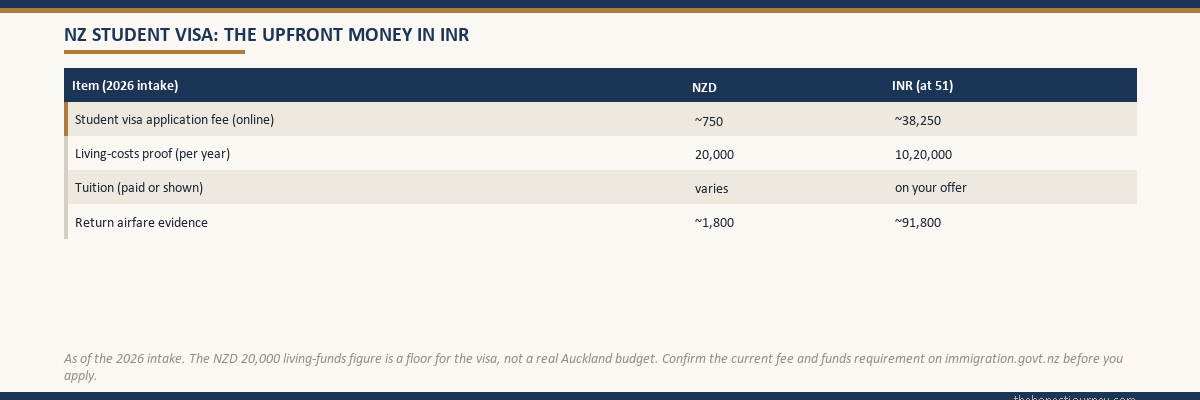
Short answer. For an Indian student, the New Zealand fee-paying student visa is the route to study at a recognised institution. As of the 2026 intake the online application fee is roughly NZD 750, and you must show about NZD 20,000 a year for living costs on top of tuition that is paid or arranged.
A genuine-intent assessment applies, and at ₹51 per NZD that funds floor is about ₹10.2 lakh. Confirm the current figures on immigration.govt.nz.
A cousin of a friend applied for this visa two intakes ago, sure he had a clean file. His offer letter was solid, his tuition receipt was in order, and he assumed the money side was a formality because his father had the funds. The visa came back with a request for more evidence on where the money had come from and how long it had been sitting in the account. He scrambled for three weeks to put together bank statements and a source-of-funds letter that he should have prepared on day one. He got the visa, but late, and he missed the start of orientation. The lesson stuck with me: in New Zealand the money is rarely about the amount, it is about the story behind it.
This post stays strictly in the visa lane. It is the permit type, the application route, the fee, the funds proof, the genuine-intent test, work rights, and the honest refusal reality. It does not re-tell tuition tables or city-by-city living costs. If you want the admissions and course side, that lives in the study in New Zealand for Indian students guide, and the full rupee budget sits in the cost of studying in New Zealand post. Here we only talk visa.
What the New Zealand fee-paying student visa actually is
The visa most Indian students apply for is the fee-paying student visa. The name is literal: it is for students who are paying full international tuition at an approved education provider, as opposed to those on a scholarship or an exchange arrangement, who use different visa categories. For a Master’s, a Bachelor’s, or a recognised diploma at a New Zealand university or institute of technology, this is your route.
It is granted for the length of your course, typically up to the duration of your programme plus a short buffer, and it lets you study full time, work within set limits, and travel in and out of the country. Immigration New Zealand runs the whole process online through their portal, and you apply yourself once you hold an offer of place from an approved provider. The official category page and the current requirements live on immigration.govt.nz, which is the only source you should treat as authoritative for fees and rules, because both change between intakes.
The fees, in INR
Let me put the visa-side numbers on the table before anything else. The planning rate through this article is ₹51 per NZD. It moves, so re-check it the week you pay. These are the costs that belong to the visa process itself, not your tuition or living budget, which sit in the cost post.
| Visa-side item | NZD | INR (at 51) |
|---|---|---|
| Online fee-paying student visa application fee | ~750 | ~38,250 |
| Living-funds proof required (per year) | ~20,000 | ~10,20,000 |
| Medical examination and chest X-ray (if required) | ~250 to 450 | ~12,750 to 22,950 |
| Police clearance certificate (India) | ~30 equivalent | ~1,500 |
Two honest notes on this table. First, the living-funds figure is not a fee you pay to immigration. It is money you must prove you have access to, which is a very different thing from money you hand over. Second, the medical and police costs vary by where and how you get them done, so treat them as a small variable layer, not a fixed price. The application fee itself is the one clean, fixed number, and even that is stated here as the 2026 intake figure that you must reconfirm on immigration.govt.nz before you pay.
Faz's ruleThe NZD 20,000 is a funds-proof floor, not your real living budget. Plan your actual money on the city you will live in, then keep the NZD 20,000 proof on top as a separate box to tick.
People read NZD 20,000 and think that is what a year in Auckland costs. It is the minimum immigration wants to see you can access for living, on top of tuition. What Auckland actually costs to live on can be higher. Treat the funds proof as a compliance step you satisfy separately, and budget the real city number in the cost post.
The proof of funds: amount is easy, story is hard
The financial requirement has two parts that people collapse into one. The first is tuition, which must be paid in full or formally arranged before the visa is granted, usually shown by a receipt from the institution or a confirmed loan sanction. The second is living costs, where you must show access to roughly NZD 20,000 for the first year of study. At ₹51 per NZD that living floor is about ₹10.2 lakh, sitting on top of whatever your tuition comes to.
Here is the part that catches Indian applicants. Immigration New Zealand does not just want to see a number in an account. They want to see that the money is genuinely available to you, where it came from, and that it has not appeared overnight purely to pass the test. A lump sum that landed in the account a week before you applied, with no explanation, reads as borrowed-to-show, and that is exactly the kind of thing that triggers a request for more evidence or a refusal. Bank statements covering a reasonable history, a clear source-of-funds explanation, and a loan sanction letter if you are financing the year all matter more than the raw balance on the day. The detailed mechanics of assembling and documenting this are in the proof of funds for student visa guide.
If you are funding the year through a loan, the sanction letter is doing double duty: it satisfies the bank and it satisfies immigration as a credible source of the money. How that loan is structured for New Zealand specifically, including the secured and unsecured bands, sits in the education loan for New Zealand post. The visa page only cares that the funds are real, documented, and traceable.
The genuine-intent assessment
New Zealand, like most serious study destinations now, applies a genuine-intent or genuine-student assessment. The officer is asking one underlying question: are you actually coming to study, or is the course a route to something else. This is not a hostile assumption, it is a filter, and a genuine student passes it without much drama as long as the file tells a coherent story.
What that story looks like in practice: your chosen course makes sense given your academic background and career direction, your funds are real and explained, and your plans after the course are plausible. A sharp jump from an unrelated field into a course with no obvious connection, weak or unexplained finances, or vague answers about why this course and why New Zealand all weaken the genuine-intent read. You do not need a perfect, linear CV. You need a file where the pieces fit together and a clear reason for the choice you are making. Officers see thousands of applications, and the ones that pass cleanly are the ones that do not need explaining.
Faz's ruleGenuine intent is judged on whether the pieces of your file fit together, not on whether your CV is perfect. A coherent story beats an impressive but disjointed one.
I have seen strong students get a request for more evidence because their course choice looked random against their degree, and average students sail through because their plan was clear and their money was clean. Decide why this course and why New Zealand before you apply, and make sure the file says it for you.
The application route, step by step
The process is online and you run it yourself. You do not need an agent for the mechanics, though you may choose to use one. The honest sequence looks like this.
- Get your offer of place. You apply to and receive an offer from an approved New Zealand education provider. This is the document everything else hangs on. The approved-provider list and the wider study picture are on studywithnewzealand.govt.nz.
- Pay or arrange tuition. For a fee-paying student visa you generally show that tuition is paid or that funding is formally in place, usually a receipt or a loan sanction.
- Assemble your funds and supporting evidence. Bank statements with history, the source-of-funds explanation, your living-funds proof of around NZD 20,000, medical and police certificates where required, and anything that supports your genuine intent.
- Submit online and pay the fee. You apply through the immigration portal, upload your documents, and pay the application fee of roughly NZD 750.
- Wait for assessment and decision. The officer may request more evidence. Respond fully and quickly. Then the decision comes.
The single most common cause of delay is an incomplete file that triggers a back-and-forth. Every request for more evidence adds days or weeks. A complete, well-documented application submitted once is almost always faster than a thin one submitted early.
Processing time: the honest version
This is where I will not give you a tidy number, because there is not an honest one. Processing time for the fee-paying student visa varies a lot by season and by how clean your file is. In quiet periods a complete application can be decided in a few weeks. In the run-up to a major intake, when volumes spike, the same application can take considerably longer. The published processing-time indicators on immigration.govt.nz are the only figure worth quoting, and even they are averages that hide a wide spread.
The practical takeaway is to apply early once you have a complete file, not to apply the moment you have an offer with the documents half-ready. Early-and-complete beats early-and-thin every time, because the thin file collects a request for evidence that resets your clock. Build the buffer into your timeline: give yourself comfortably more time than the published average suggests, especially for a peak intake.
Work rights on the visa
The fee-paying student visa typically allows you to work up to 20 hours a week during term time and full time during scheduled holidays, provided your course and level qualify. This is genuine money and useful experience, but it is a living-cost supplement, not a way to fund tuition or close a funding gap. You should never present part-time earnings to immigration, to a bank, or to yourself as the thing that pays for your year. The honest mechanics of student work abroad, including how much it actually offsets, are in the part-time work while studying abroad post.
The genuine upside comes after the course. An eligible qualification can lead to a post-study work visa, which gives you a runway to stay and work in New Zealand for a period after graduation. That window is a real part of why the New Zealand ticket can repay, but the eligibility and duration depend on your qualification and level, and those belong to the decision and study-in conversation rather than this visa page. Check the current post-study work rules on immigration.govt.nz, because they have changed in recent years.
Success and refusal: what actually separates the two
Let me be plain about why files get refused, because the pattern is consistent. The two dominant reasons are funds credibility and weak genuine-student evidence. It is rarely the amount of money. It is whether the money is believable: explained source, reasonable history, traceable path into the account. And it is rarely a bad student. It is whether the course choice and the plan hold together as a genuine intention to study.
The contrast below is the most useful thing on this page. The strong file and the weak file often have the same balance in the bank and the same offer letter. The difference is everything around them.
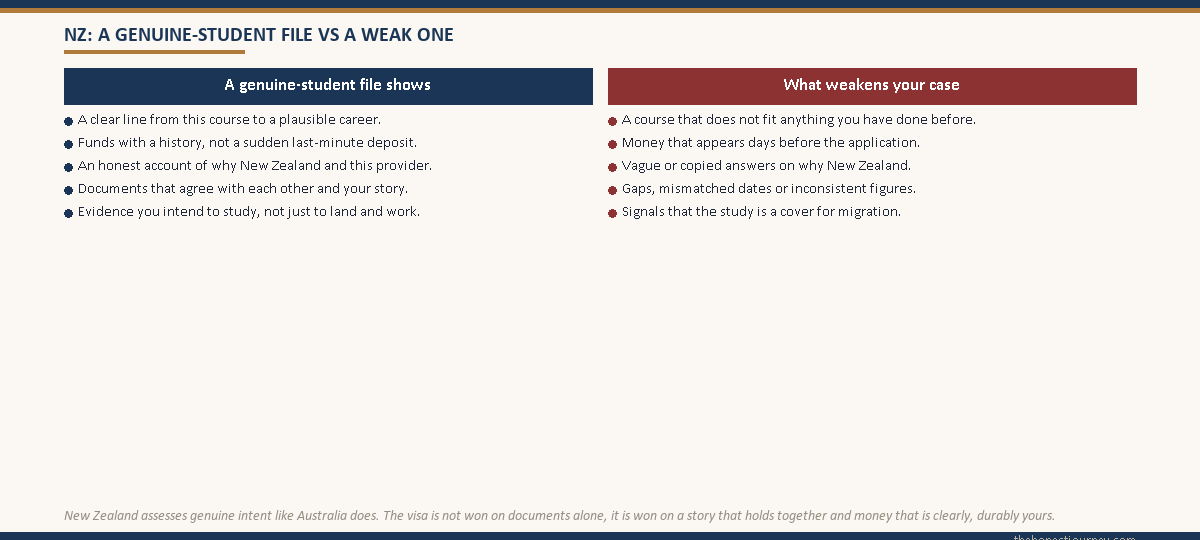
If your file has the clean side of that comparison, the amount you are showing matters far less than people fear. If it has the weak side, no balance is large enough to fix it. Build the strong-file version before you submit, and the visa stops being a gamble and becomes a process.
The honest take on the New Zealand student visa
The New Zealand fee-paying student visa is not a hard visa for a genuine, well-funded student. It is an online, self-run process with a moderate fee and a clear funds floor. The friction is almost entirely self-inflicted: thin documentation, an unexplained source of funds, or a course choice that does not fit the applicant. Fix those three things and the process is predictable.
The two real risks to manage are timing and credibility. Timing, because processing swings with the season and a request for evidence can cost you orientation. Credibility, because immigration cares more about whether your money and your plan are believable than about the raw numbers. Prepare the source-of-funds story as carefully as the balance, decide why this course and why New Zealand before you apply, give yourself a generous timeline, and confirm every figure on immigration.govt.nz for your intake. Do that, and the visa is the easy part of the journey, not the scary one.
New Zealand is unusually good for families. A masters gives your partner open work rights and your children free state schooling. See the New Zealand dependants page.
FAQ
How much is the New Zealand student visa fee for Indian students?
As of the 2026 intake, the online fee-paying student visa application fee is roughly NZD 750, which is about ₹38,250 at ₹51 per NZD. This is the visa application charge only and does not include your tuition, living costs, or the medical and police certificate costs. Visa fees change between intakes, so confirm the current figure on immigration.govt.nz before you pay, because the number you see online today is the one that applies.
How much money do I need to show for a New Zealand student visa?
You must show access to roughly NZD 20,000 a year for living costs, about ₹10.2 lakh at ₹51 per NZD, on top of tuition that is paid or formally arranged. Immigration also wants to see that the money is genuinely available, with a documented source and a reasonable history in the account. A lump sum that appeared days before you applied, with no explanation, weakens the file. Confirm the current living-funds figure on immigration.govt.nz.
How long does the New Zealand student visa take to process?
Processing time varies a lot by season and by how complete your file is. In quiet periods a clean application can be decided in a few weeks, while peak-intake volumes can stretch it considerably longer. The only figure worth quoting is the published processing-time indicator on immigration.govt.nz, and even that is an average hiding a wide spread. Apply early with a complete file, and build a generous buffer into your timeline rather than trusting the average.
What is the success rate of the New Zealand student visa?
There is no single reliable public number, and any consultancy quoting a precise rate is guessing. The honest framing is that a genuine, well-funded student with a coherent file has a strong chance, while the refusals cluster around two issues: funds credibility and weak genuine-student evidence. The amount of money matters far less than whether it is explained and traceable. Build the clean-file version of your application and the odds are firmly in your favour.
Can I work 20 hours a week on a New Zealand student visa?
Yes, the fee-paying student visa typically allows up to 20 hours of work a week during term time and full time during scheduled holidays, provided your course and level qualify. This is a genuine living-cost supplement, not a way to fund tuition. Never present part-time earnings as the thing that closes your funding gap, to immigration, to a bank, or to yourself. Confirm the current work conditions attached to your specific visa on immigration.govt.nz.
What is the genuine-intent assessment for the New Zealand student visa?
It is a check on whether you are genuinely coming to study rather than using the course as a route to something else. Officers look at whether your course fits your academic background and career direction, whether your funds are real and explained, and whether your post-course plans are plausible. You do not need a perfect CV, you need a file where the pieces fit together. A coherent story passes cleanly, while a random course choice or vague answers weaken it.
Why do New Zealand student visas get refused?
The two dominant reasons are funds credibility and weak genuine-student evidence. Refusals are rarely about the amount of money, they are about whether the money is believable: documented source, reasonable history, a traceable path into the account. They are rarely about a bad student, they are about whether the course choice and plan hold together as a genuine intention to study. Fix documentation and coherence before you submit, and most refusal triggers disappear.
Can I get a post-study work visa after studying in New Zealand?
Yes, an eligible qualification can lead to a post-study work visa that lets you stay and work in New Zealand for a period after graduation. The exact eligibility and duration depend on your qualification and its level, and the rules have changed in recent years, so check the current post-study work settings on immigration.govt.nz. This runway is a real part of why the New Zealand route can repay, but the detail belongs to the decision and study-in conversation, not the visa application itself.
Faz · The Honest Journey · 2026