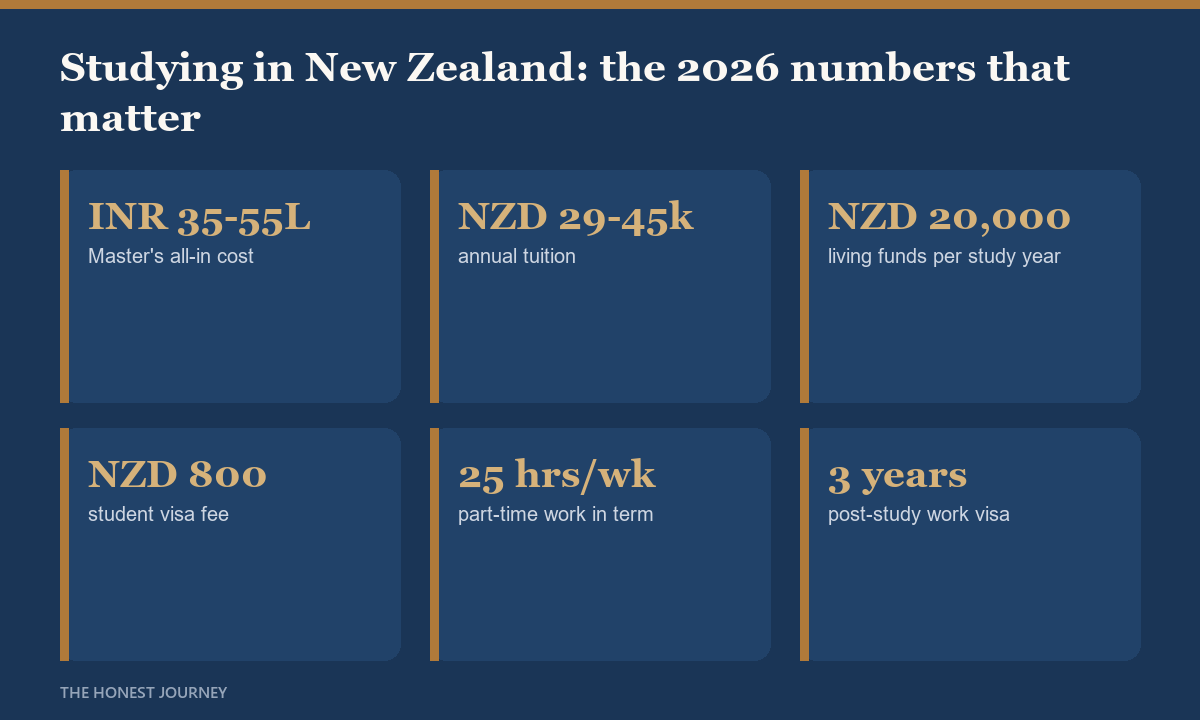
Short answer. The all-in cost of studying in New Zealand for Indian students in 2026 runs roughly ₹35 lakh to ₹55 lakh for a two-year Master’s, sitting between the affordable Europe options and expensive Australia.
Tuition is NZD 29,000 to 45,000 a year for most Master’s, living runs NZD 18,000 to 28,000 a year, and the visa needs proof of NZD 20,000 for each year of study. At ₹52 to the New Zealand dollar, it is a mid-priced destination with a strong three-year post-study work visa.
New Zealand is the destination Indian families often overlook, then warm to once they compare it properly with Australia. It offers a similar English-speaking, high-quality education and a genuinely generous post-study work visa, usually at a lower total cost than Australia. When someone asks me “why New Zealand over Australia?” the honest answer is often simply the maths: comparable outcomes, a few lakh less, and a friendlier immigration tone. The cost of studying in New Zealand for Indian students is the quiet middle option that rewards a closer look.
This post walks through New Zealand tuition by field, living costs by city, the NZD 20,000 proof-of-funds rule and the visa fee, part-time work and the three-year post-study work visa, and the honest rupee total in 2026. If you are still mapping the bigger picture, the full guide on studying in New Zealand for Indian students covers admissions, the visa and timelines end to end.
If you are weighing New Zealand against the other English-speaking destinations, it helps to see them side by side: the best country to study abroad for Indian students.
Tuition: what a New Zealand Master’s costs
New Zealand has eight universities, all state-funded and all internationally ranked, so quality is consistent across the country. Tuition for international students varies by field, with technical and healthcare programs at the top and general arts and business lower. Most Master’s run one to two years depending on the structure.
| Program field | Annual tuition (NZD) | Rupees per year (at ₹52 per NZD) |
|---|---|---|
| Arts, business, social sciences | NZD 29,000 to 38,000 | ₹15.1 lakh to ₹19.8 lakh |
| Computing, IT, management | NZD 34,000 to 45,000 | ₹17.7 lakh to ₹23.4 lakh |
| Engineering, healthcare, science | NZD 40,000 to 65,000 | ₹20.8 lakh to ₹33.8 lakh |
| Bachelor’s (per year, 3 years) | NZD 28,000 to 42,000 | ₹14.6 lakh to ₹21.8 lakh |
The universities behind these numbers include Auckland, Otago, Victoria University of Wellington, Canterbury and Massey, all English-taught and all recognised globally. For an Indian student the New Zealand tuition band sits a notch below Australia’s Group of Eight and well below the USA, while the degree carries similar weight in an English-speaking job market.
Faz's ruleCompare New Zealand to Australia line by line before you decide. For a similar English-taught degree and a similar or better post-study work visa, New Zealand usually comes in several lakh cheaper. It is the value alternative Indian families keep overlooking.
Australia gets the attention because of its bigger Indian diaspora and louder marketing, but New Zealand quietly offers the same core package: English instruction, ranked universities, and a three-year post-study work visa. On a strict cost comparison it often wins, and the smaller student population can mean a less crowded job market on graduation. It deserves a real place on the shortlist, not an afterthought.
Living costs, city by city
Auckland is the most expensive city, as the largest and the main employment hub. Wellington sits close behind, while Christchurch, Dunedin and the smaller university towns are meaningfully cheaper for both rent and daily living.
| City | Rent (room, per week) | Total monthly living (NZD) | Rupees per month |
|---|---|---|---|
| Auckland (expensive) | NZD 250 to 380 | NZD 2,200 to 3,000 | ₹1.14 lakh to ₹1.56 lakh |
| Wellington, Hamilton (mid) | NZD 220 to 320 | NZD 2,000 to 2,600 | ₹1.04 lakh to ₹1.35 lakh |
| Christchurch, Dunedin (affordable) | NZD 170 to 260 | NZD 1,600 to 2,200 | ₹83,200 to ₹1.14 lakh |
Dunedin, home to the University of Otago, is consistently one of the most affordable university cities in New Zealand, with student rents well below Auckland. Choosing Christchurch or Dunedin over Auckland can save NZD 8,000 to 12,000 a year in living costs, which is ₹4 lakh to ₹6 lakh, with no difference in the quality or recognition of the degree, since all eight universities are state-funded and ranked.
Faz's ruleThe visa asks you to prove NZD 20,000 a year, but Auckland will cost you closer to NZD 28,000. Fund to what the city actually costs, not to the visa minimum, or you will run short by March of your first year.
The NZD 20,000 proof-of-funds figure is a floor set for the whole country, and it is genuinely enough in Dunedin. In Auckland it is not. Students who plan their entire budget around the visa minimum, then land in Auckland, discover the gap the hard way. Always budget to the real cost of your specific city, and treat the visa figure as the bare minimum it is.
Proof of funds, the visa fee and health cover
New Zealand’s student visa requires proof of living funds on top of tuition, plus the visa fee itself and mandatory health and travel insurance. None is as steep as Australia’s AUD 2,000 visa charge, which is part of New Zealand’s cost advantage.
| Item | Amount | What it is |
|---|---|---|
| Proof of living funds (per year of study) | NZD 20,000 | Minimum living funds required by Immigration New Zealand, shown alongside tuition. |
| Student visa application fee | About NZD 750 to 850 | Paid to Immigration New Zealand with the application. |
| Health and travel insurance | NZD 700 to 1,000 per year | Mandatory comprehensive cover for the visa duration. |
| Medical and biometrics | ₹7,000 to 10,000 | Health examination and biometric collection in India. |
The NZD 20,000 living requirement is per year of study, so a two-year Master’s effectively asks you to show funds for both years alongside first-year tuition. A sanctioned Indian education loan letter is accepted as proof. Comprehensive health and travel insurance is mandatory for the visa, and the broader picture on cover is in the health insurance for study abroad guide. The proof-of-funds details are in the proof of funds for student visa guide.
Part-time work and the post-study work visa
New Zealand recently raised the part-time work allowance to 25 hours a week during term, up from 20, with full-time work permitted during scheduled breaks. At New Zealand student wages this brings in a useful monthly amount that offsets living costs, especially outside Auckland where costs are lower. The realistic earnings picture is in part-time work while studying abroad.
The headline benefit is the post-study work visa, which lets Master’s graduates stay and work for up to three years, one of the most generous windows in this cluster. New Zealand’s immigration system is also relatively transparent about skilled-residence pathways compared to the US green-card backlog. A graduate earning a New Zealand starting salary of NZD 55,000 to 75,000 across three years can repay a large part of the loan and build a genuine case for residence, which is what makes the mid-range cost worthwhile.
A worked rupee total: two-year Master’s in 2026
The cleanest way to make it concrete is a specific case. A two-year Master’s in IT or Business at a strong university in a mid-cost city like Wellington or Hamilton, NZD 36,000 tuition per year, part-time work from the second semester.
| Line item | NZD | Rupees (at ₹52 per NZD) |
|---|---|---|
| Year 1 tuition | NZD 36,000 | ₹18.7 lakh |
| Year 2 tuition | NZD 36,000 | ₹18.7 lakh |
| Year 1 living + rent | NZD 24,000 | ₹12.5 lakh |
| Year 2 living (offset by part-time work) | NZD 18,000 | ₹9.4 lakh |
| Health and travel insurance (2 years) | NZD 1,700 | ₹88,400 |
| Student visa fee | NZD 800 | ₹41,600 |
| Round-trip flights (2 trips home) | NZD 4,000 | ₹2.1 lakh |
| Initial settlement (bond, setup) | NZD 2,500 | ₹1.3 lakh |
| Forex spread + remittance | NZD 1,400 | ₹72,800 |
| Two-year all-in total | NZD 124,400 | ₹64.7 lakh |
A two-year Master’s in a mid-cost city lands around ₹48 lakh to ₹55 lakh all-in in 2026 for most fields, and the worked example above sits at the higher end because it uses a full two-year structure with mid-city living. A one-year Master’s or a cheaper city like Dunedin can pull the total toward ₹35 lakh to ₹42 lakh, while an engineering or healthcare Master’s in Auckland climbs past ₹60 lakh. Flights from India to New Zealand are notably higher than to Europe, so that line is larger here. Understand the A2 form and LRS rules for sending money abroad and pick an efficient route. The best forex card for students post covers the options.
Faz's ruleNew Zealand's honest number is ₹35 lakh to ₹55 lakh depending on program length and city, usually a few lakh under Australia for a comparable degree and the same three-year work visa. It is the value pick that gets ignored because the marketing is quieter.
The cost gap with Australia is real but not huge, so do not choose on price alone. Choose New Zealand when the specific university and program fit, and take the modest saving and the calmer immigration environment as a bonus. The three-year post-study work visa is the number that should weigh most heavily, because that is what turns the whole investment into a return.
Funding it: loan and savings
A New Zealand Master’s at ₹35 lakh to ₹55 lakh usually needs a sanctioned loan for the bulk, with family funds covering the visa, insurance and flights. PSU secured loans cover reputable New Zealand universities comfortably, and collateral-free NBFC loans reach the lower end of the range for select course and university lists. The sanctioned loan letter also helps satisfy the NZD 20,000 per year proof-of-funds requirement. See the education loan for New Zealand guide for lender specifics, and the broader studying abroad from India cost and funding guide and education loan India complete guide for the full picture. New Zealand university scholarships and the New Zealand Excellence Awards, listed in scholarships for Indian students to study abroad, can reduce the tuition line.
The honest closing take
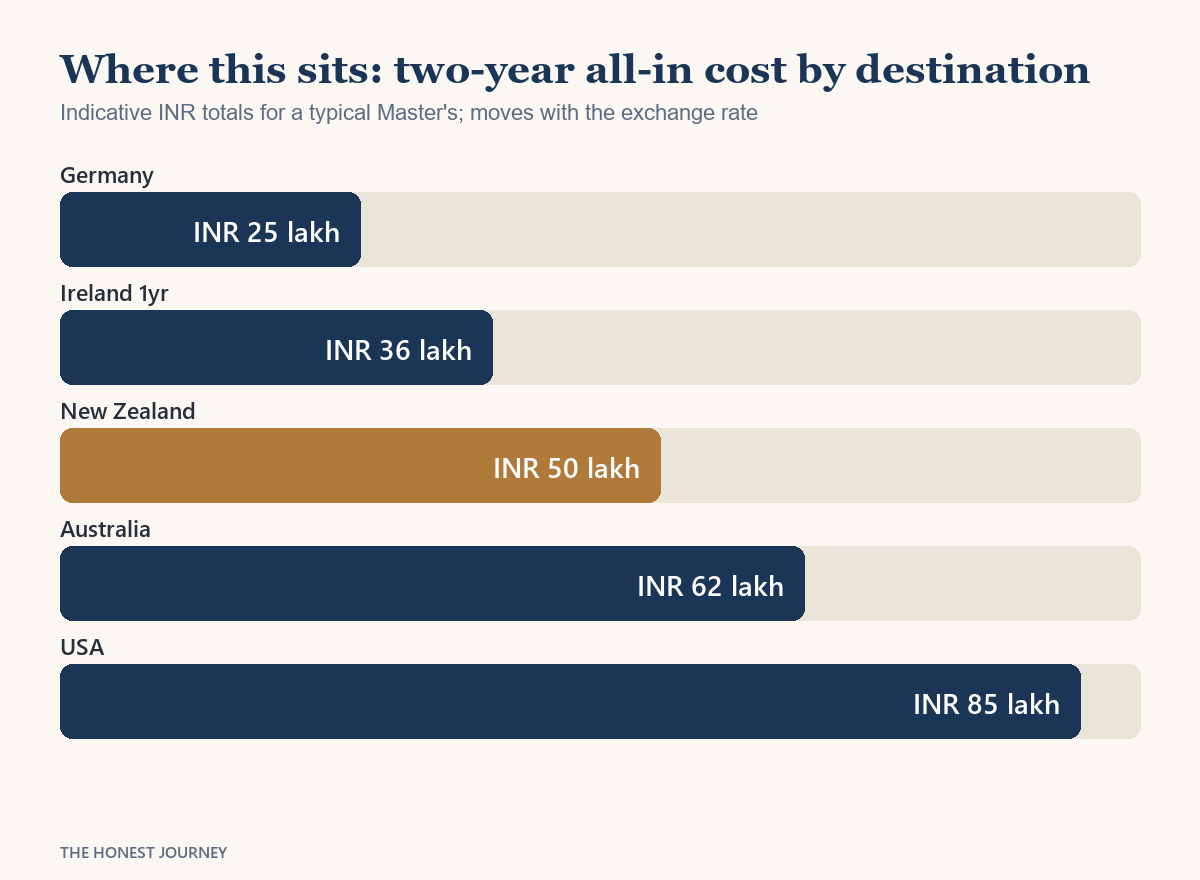
New Zealand is the sensible middle of this cluster, cheaper than Australia and the USA, more expensive than Germany or a French public university, and carrying one of the best post-study work visas of the lot at up to three years. For an Indian student who wants English-taught education, ranked universities, and a clear work-and-stay pathway without USA-tier cost, it is a strong and underrated choice.
The two honest points to plan around are the city gap and the flights. Auckland costs far more than Dunedin or Christchurch, so match your budget to your actual city rather than the national visa minimum. And factor in that flights to New Zealand from India are longer and pricier than to Europe, which nudges the total up. Neither is a dealbreaker, but both are easy to underestimate.
If you have compared New Zealand honestly against Australia and it comes out a few lakh cheaper for a comparable degree and the same three-year work visa, that saving is real. Combined with a calmer immigration environment, it makes New Zealand one of the smartest value picks for Indian students in 2026.
Once the budget is clear, the visa is the next hurdle. The funds proof, fee and processing are in the New Zealand student visa guide.
Ready to fund it? Most Indian students route the loan through the PM Vidyalakshmi portal. That guide covers the step by step application and the 13 banks linked to it.
FAQ
How much does it cost to study in New Zealand from India in 2026?
A two-year Master’s in New Zealand typically costs ₹48 lakh to ₹55 lakh all-in for an Indian student, and the full range across program lengths and cities is roughly ₹35 lakh to ₹55 lakh. A one-year Master’s or a cheaper city like Dunedin can land near ₹35 lakh to ₹42 lakh, while an engineering or healthcare Master’s in Auckland climbs past ₹60 lakh. Tuition runs NZD 29,000 to 45,000 a year for most fields, living is NZD 18,000 to 28,000 a year, and the visa requires proof of NZD 20,000 in living funds for each year of study, about ₹10.4 lakh at ₹52 to the New Zealand dollar.
How much money do I need to show for a New Zealand student visa?
Immigration New Zealand requires proof of at least NZD 20,000 in living funds for each year of study, shown alongside your tuition, which is roughly ₹10.4 lakh at ₹52 to the New Zealand dollar. For a two-year Master’s that means demonstrating funds for both years plus first-year tuition. A sanctioned Indian education loan letter is accepted as proof. Be aware that NZD 20,000 is a national minimum and is genuinely enough in Dunedin or Christchurch, but Auckland costs closer to NZD 28,000 a year, so budget to your actual city.
Is New Zealand cheaper than Australia for Indian students?
Usually yes, by a few lakh for a comparable degree. New Zealand tuition sits a notch below Australia’s Group of Eight, living costs outside Auckland are lower than Sydney or Melbourne, and the student visa fee is far below Australia’s AUD 2,000. Both offer English instruction, ranked universities and a three-year post-study work visa for Master’s graduates. The gap is real but not huge, so New Zealand is best chosen when the specific university and program fit, with the saving and the calmer immigration environment as a bonus rather than the sole reason.
What is the post-study work visa in New Zealand?
New Zealand’s post-study work visa lets Master’s graduates stay and work for up to three years, one of the most generous windows among study destinations. During this time you can work full time for any employer in any field. New Zealand’s skilled-residence pathways are relatively transparent compared to the US green-card backlog, so a graduate earning a starting salary of NZD 55,000 to 75,000 across three years can repay much of their loan and build a genuine case for residence, which is what makes the mid-range study cost worthwhile.
Can Indian students work part-time in New Zealand?
Yes. New Zealand recently raised the part-time work allowance to 25 hours a week during term time, up from 20, with full-time work permitted during scheduled breaks. At New Zealand student wages this brings in a useful monthly amount that offsets living costs, particularly outside Auckland where daily costs are lower. Combined with the three-year post-study work visa, the work rights make New Zealand a practical choice for students who intend to earn back a large part of their study cost locally.
Which New Zealand city is cheapest for Indian students?
Dunedin, home to the University of Otago, is consistently one of the most affordable university cities, followed by Christchurch, both well below Auckland for rent and daily living. In these cities total monthly living runs NZD 1,600 to 2,200 against NZD 2,200 to 3,000 in Auckland. Choosing Dunedin or Christchurch over Auckland can save NZD 8,000 to 12,000 a year, which is ₹4 lakh to ₹6 lakh, with no difference in degree quality, since all eight New Zealand universities are state-funded and internationally ranked.
Do I need collateral for a New Zealand education loan?
Not always. PSU banks sanction secured loans for reputable New Zealand universities with collateral at roughly 9.5 to 11 percent, and the sanctioned letter helps satisfy the NZD 20,000 per year proof-of-funds requirement. Collateral-free NBFC loans are available for select university and course lists, usually up to around ₹50 lakh with a strong co-applicant, which can cover a mid-range New Zealand Master’s. Because the visa requires a documented living figure plus tuition, a loan sized to cover both is the cleanest proof of funds.
Faz · The Honest Journey · 2026