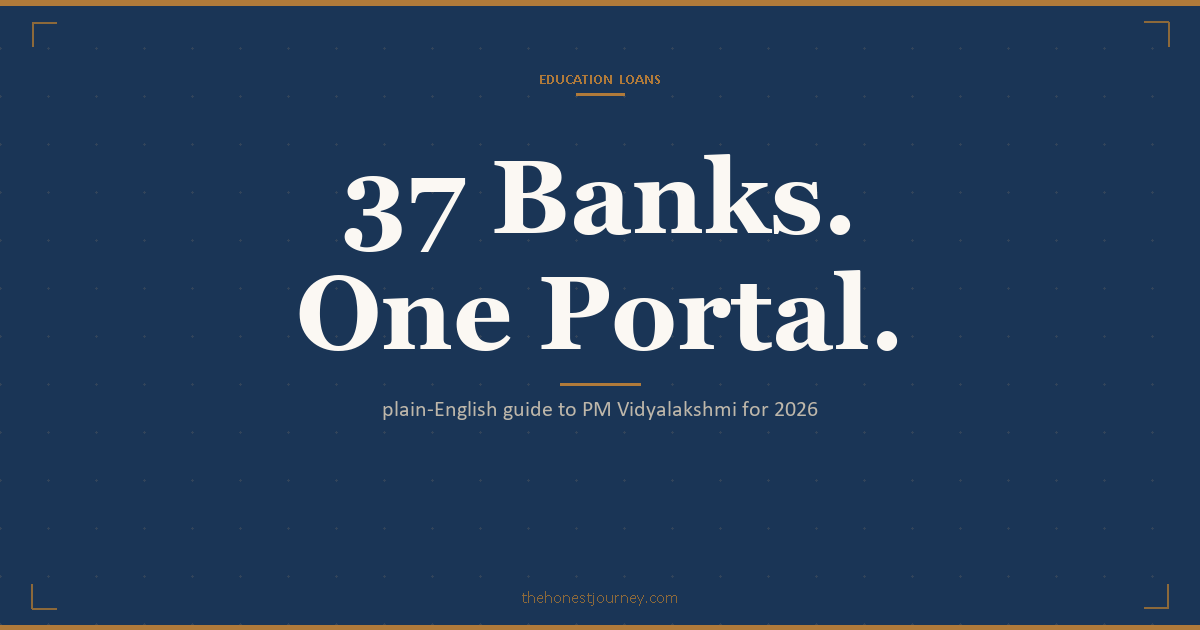
Short answer. PM Vidyalakshmi is not a separate loan, it is a single-window portal that routes your application to existing bank schemes and adds a 3% interest subvention during the moratorium for families under 8 lakh annual income at one of 1,425 approved institutions.
Collateral-free up to 7.5 lakh via the CGFSEL guarantee, fully digital, but underwriting and rejection still happen at the bank branch.
Before you apply, check what the interest subvention is worth with the education loan interest subsidy calculator.
For the full guide, read Education Loan in India: The Complete 2026 Guide.
If your family income is above the subsidy limit, a fully funded scholarship is the other honest route to weigh before you borrow. See our ranked guide to fully funded scholarships for Indian students.
How to apply for PM Vidyalakshmi, step by step
The whole point of the portal is a single application that several banks can see and respond to. Here is the honest version of the flow, without the breathless tone.
- Confirm your institution is eligible. Your college must be one of the Quality Higher Education Institutions on the approved list. If it is not, the scheme does not apply to you, no matter how good your profile is.
- Register on the official portal. Go to the official PM-Vidyalaxmi portal at pmvidyalaxmi.co.in. Use your own email and mobile, not an agent’s, and never a lookalike domain.
- Fill the Common Education Loan Application Form once. One form is read by multiple banks, so you do not re-apply bank by bank.
- Pick your preferred banks. Choose lenders that fund your course and country. Banks respond with offers, which gives you room to compare rate and processing fee.
- Upload documents. Admission letter, fee structure, KYC for you and your co-applicant, income proof, and academic records. Keep file sizes within the portal limits.
- Track and respond. Watch the dashboard, answer bank queries quickly, and compare any offers on the real numbers, not the headline rate.
One honest caution. Apply only on pmvidyalaxmi.co.in. Lookalike domains that mimic the name exist, and they are not the official portal.
PM Vidyalakshmi, guide by guide
The portal raises the same handful of questions for almost everyone. Each guide below goes deep on one of them, from choosing a bank to reading a rejection.
- which banks actually fund abroad study
- portal login and application status
- what to do if your loan is rejected
- which subsidy scheme is actually yours
- the portal versus applying to the bank directly
- the documents and eligibility checklist
The scheme everyone talks about, almost no one explains clearly
A father called me last month. His daughter had cracked NIT Trichy, and he had read three news articles plus two bank pages about PM Vidyalakshmi. He still could not answer the basic questions. Is her college eligible? Does the 3% subvention apply to the whole loan? What happens after the moratorium? Is it really collateral-free, or is that only for some slabs? Will the bank actually approve it, or is this a press release that hasn’t reached the branch yet?
Faz's rule
PM Vidyalakshmi is not a separate loan scheme. It is a portal that surfaces existing bank loans under one application.
Interest rates, eligibility, and rejection rates still come from the individual banks. The portal does not change the underwriting.
I had to go read the scheme document myself before I could help him. This post is the version of that conversation I wish existed online. It is plain English, it names the gaps, and it tells you what to do if your college is not on the 1,425 list.

The answer in 80 words
PM Vidyalakshmi (approved November 2024 by the Union Cabinet) gives meritorious students admitted to one of 1,425 Quality Higher Education Institutions (a list expanded from 860 in 2025) a collateral-free, guarantor-free education loan. Up to ₹7.5L gets a 75% credit guarantee from the government to the bank. Up to ₹10L gets a 3% interest subvention during the moratorium if family income is under ₹8L per year. About 7 lakh students are expected to benefit from the interest subvention over the 2024-25 to 2030-31 period. If your college is not on the QHEI list, you apply for a standard education loan instead.
The whole scheme in one view:
| What you get | The honest detail |
|---|---|
| Approved | November 2024 by the Union Cabinet, as a Central Sector Scheme |
| Who qualifies | Students admitted to one of the 1,425 Quality Higher Education Institutions (QHEIs) |
| Collateral and guarantor | Not required up to ₹7.5L, backed by a 75% government credit guarantee to the bank |
| Interest subvention | 3% during the moratorium on loans up to ₹10L, if annual family income is under ₹8L |
| Where you apply | The official Vidya Lakshmi portal, one Common Education Loan Application Form read by several banks |
| If your college is not listed | You apply for a standard education loan instead. The scheme does not apply |
The basic facts, no jargon
Let me lay out what the scheme actually does, because banks describe it like a pamphlet and the government website is bare.
Who runs it. The Department of Higher Education under the Ministry of Education. Operational portal: the official PM-Vidyalaxmi portal. Scheme listing: myScheme. The old vidyalakshmi.co.in portal (run by Protean) still exists for legacy applications under the previous regime, but new PMV applications go through the new portal.
Who qualifies. A student admitted to one of 1,425 Quality Higher Education Institutions (QHEIs). The list is derived from NIRF top 100 (overall, category, and subject-wise), all Institutes of National Importance (IITs, IIMs, AIIMS, NITs, IISc, IISERs), central universities, and state institutions ranked in the NIRF top 200 in their category. The list is refreshed annually based on NIRF rankings.
Three benefits stacked.
- Collateral-free and guarantor-free loan up to ₹7.5L with a 75% credit guarantee from the government to the lending bank. The bank’s risk is cut to 25%, which is why they say yes.
- 3% interest subvention on loans up to ₹10L during the moratorium period, for students whose annual family income is up to ₹8L and who are not already covered by other central or state interest subvention schemes.
- Single common portal, one application, multiple banks. You do not have to walk into five branches.
The 3% subvention is paid by the government directly to the bank, reducing the effective interest you pay during your course plus the standard 1-year moratorium after course completion.
When PM Vidyalakshmi works (success scenario)
A 19-year-old from Pune, daughter of a school teacher (father) and a tailoring-business owner (mother), combined household income ₹6.8L per year. She got into IIT Madras for a B.Tech in Electrical Engineering. Annual fees plus hostel: about ₹2.6L. Four-year requirement: ₹10.4L all-in.
Faz's rule
37 banks, one portal. Single application visible to multiple lenders simultaneously.
The PM Vidyalakshmi portal compresses 4-6 weeks of sequential applications into a single submission. Lenders compete to make offers, which gives the borrower negotiating leverage on rate and processing fee.
She applied through vidyalakshmi.co.in in July 2025, picked SBI as the preferred bank. Because her family income was below ₹8L, she qualified for the 3% interest subvention slab. Because IIT Madras is on the QHEI list (it is INI plus NIRF top 5), the loan was collateral-free up to ₹7.5L, and SBI extended the remaining ₹2.9L on the same application using standard education-loan terms.
Sanctioned in 41 days. SBI’s base rate at the time was 9.65%; with the 3% subvention during moratorium, her effective in-moratorium rate dropped to 6.65%. Disbursal happened semester-wise directly to the institute. Total interest saved over the 4-year course plus 1-year moratorium: approximately ₹1.42L compared to the same loan without PMV.
She owes nothing until 12 months after she finishes the degree, and even then her EMI starts from a smaller capitalised-interest base because the subvention covered three-quarters of the moratorium interest accruals.
That is what the scheme is designed to do and that is what it did.
The neutral middle (it worked, but not how he expected)
A 21-year-old from Indore, son of a mid-level PSU employee earning ₹9.4L per year. He got into IIIT Hyderabad (on the QHEI list, NIRF subject-wise top 20). Family income ₹9.4L put him just outside the ₹8L cutoff for the 3% interest subvention. The collateral-free and credit-guarantee benefits still applied.
He took a ₹9L loan. No collateral, no guarantor, sanctioned in 38 days. But because his family income was over ₹8L, he paid the full bank rate (about 10.4% at the time) throughout the moratorium. Interest accrued and capitalised normally.
He told me later he had not realised the 3% subvention was income-gated. He assumed PMV was a flat 3% rebate for everyone. It is not. The credit guarantee makes the loan possible without collateral; the subvention is a separate, income-tested benefit on top.
Was it still a good outcome? Yes. He got a loan his father’s PSU salary could not have collateralised for anything close to that amount otherwise, and the bank’s standard rate is still cheaper than any NBFC. But the headline “3% subvention” did not apply to him, and nobody at the branch flagged it until he asked.
When PM Vidyalakshmi fails or disappoints (struggle scenario)
A 20-year-old from a tier-3 town in Andhra Pradesh. He got admission to a well-regarded private engineering college in Vijayawada with reasonable placement history. Total fees plus living: about ₹14L over four years. Family income ₹4.2L per year (well below the threshold). He went to vidyalakshmi.co.in expecting to qualify for everything.
Faz's rule
PM Vidyalakshmi turns down more applications than it approves. Not because the scheme is bad, but because most applicants are applying for the wrong slab at the wrong institution.
The 75 percent credit guarantee only applies up to ₹7.5L at one of the 1,425 QHEI institutions. Outside that envelope it behaves like any other bank loan.
His college was not on the 1,425 QHEI list. It is a respected regional institution, but it did not crack NIRF top 200 for engineering in the relevant year. The portal would not let him submit a PMV application; it routed him to standard education-loan options.
The standard loan path is fine and it exists, but it was not what he expected. With family income at ₹4.2L he qualified for CSIS, the Central Sector Interest Subsidy Scheme, which gives full interest subvention during the moratorium for EWS students (family income below ₹4.5L) on loans up to ₹10L. The CSIS benefit is in some ways more generous than PMV’s 3% slab, but you have to apply for it as a separate route, the awareness is poor, and his bank’s branch officer did not bring it up. He took a standard loan at 10.6% with collateral (his father’s small plot of land valued at ₹16L) and ended up paying full interest during the moratorium.
The failure mode here was not the scheme. It was the gap between what people read in the news and what the rule book says. PMV is for the 1,425. If your college is outside that list, the older CSIS scheme may still be your best friend, and nobody is advertising it.

PM Vidyalakshmi vs CSIS, the older scheme nobody mentions
This is the most important comparison in this post.
Faz's rule
The 75% credit guarantee on loans up to ₹7.5L is the most underused feature.
It makes unsecured loans viable for profiles that traditional underwriting would reject, low co-applicant CIBIL, no collateral, smaller-tier institutions. Underused mostly because most families don’t know it exists.
CSIS (Central Sector Interest Subsidy Scheme):
– Eligible to EWS students with annual family income up to ₹4.5L
– Covers full interest during the moratorium (course duration + 1 year)
– Maximum loan amount eligible for subvention: ₹10L (but you can borrow more, only the first ₹10L is subsidised)
– Applies to studies in India only, at NAAC-accredited or NBA-accredited institutions, or central/state government institutions
– Not collateral-free by itself; collateral terms are bank-defined
– Administered through Canara Bank as the nodal bank, claims routed via the Department of Higher Education
PM Vidyalakshmi:
– Eligible to students at the 1,425 QHEIs
– 3% interest subvention (not full) during moratorium, on loans up to ₹10L
– Income threshold: family income up to ₹8L
– Adds a 75% credit guarantee on loans up to ₹7.5L (this is the collateral-free piece)
– Single common-application portal
What if you qualify for both? The scheme guidelines say you cannot stack the interest subvention component. If you are eligible for CSIS, you take CSIS (the full interest cover is more generous for EWS students). PMV’s credit-guarantee piece is separately useful because it is what makes the loan collateral-free, but the 3% subvention does not get added to CSIS’s full coverage. In practice: EWS families at a QHEI college should apply through PMV portal but claim CSIS for the subvention because CSIS pays more. The credit guarantee still applies.
What if your college is not on the 1,425 list
This is the question the official portal does not answer cleanly.
If your institution is not on the QHEI list, you cannot claim PMV’s 75% credit guarantee or its 3% interest subvention. You can still apply for:
- A standard education loan under the IBA Model Education Loan Scheme. Most banks offer collateral-free amounts up to ₹4-7.5L based on internal policy; above that, you will need collateral or a strong co-applicant.
- CSIS, if your family income is under ₹4.5L and the college is NAAC/NBA accredited. Many colleges outside the NIRF top 200 still meet this. Check your institution’s accreditation page.
- State-level subsidy schemes. Tamil Nadu, Kerala, Karnataka, Maharashtra, and several others run their own education-loan interest waivers for state-domicile students. These are under-publicised and worth a 30-minute search of your state’s higher education department site.
- Private NBFCs (HDFC Credila, Avanse, Auxilo) if the bank route does not work. Rates will be 1.5-3% higher than SBI, so this is your fallback, not your first choice, and our bank vs NBFC interest rate comparison shows exactly what that gap costs. The full paperwork picture for any lender is in our guide on documents required for an education loan.
The most expensive mistake I see is families assuming “no PMV = no government help.” There is help. It is just behind a different door.
Decision framework: answer these seven questions
- Is your college on the 1,425 QHEI list at the official PM-Vidyalaxmi portal? If no, skip PMV. Go to CSIS / standard loan / state schemes.
- Is your family’s annual income below ₹8L? If yes, you qualify for the 3% interest subvention. If no, you still get the credit guarantee but not the subvention.
- Is your family’s annual income below ₹4.5L? If yes, check CSIS. Its full-interest-during-moratorium benefit may beat PMV’s 3% slab.
- Is your loan amount under ₹7.5L? If yes, the credit guarantee makes it fully collateral-free and guarantor-free. If above ₹7.5L, the portion above will need collateral or a co-applicant per bank policy.
- Is your course at an Indian institution? PMV is India-only. For abroad studies, see our guide on education loans without collateral for abroad studies.
- Do you have a co-applicant with clean credit (parent or guardian)? Even on collateral-free loans, banks check co-applicant CIBIL. Below 700 is a soft rejection risk.
- Are you applying at least 60 days before fees are due? Realistic disbursal is 30-90 days, and you can see how it varies by lender in our breakdown of education loan approval time. Cutting it closer means you may have to pay first semester yourself.
Profile factors that predict your scenario
PMV works cleanly for students at IITs, IIMs, AIIMS, NITs, IISc, IISERs, central universities, and NIRF top 100 institutions whose family income is genuinely under ₹8L and whose loan need is under ₹10L. That is the scheme’s design target, and it is delivering for that cohort.
It works partially for students at QHEI institutions whose family income is above ₹8L. They get the collateral-free benefit but not the interest subvention.
It does not work, and it was never going to work, for students at colleges outside the QHEI list. That is not a bug. The scheme is explicitly merit-and-quality-linked, and 1,425 institutions is a hard ceiling.
The other variable nobody mentions: bank branch awareness. PMV was approved in November 2024. As of mid-2026, many smaller branches still treat it as a new product and route applications slowly. SBI’s main branches and HDFC’s larger metro branches are processing fastest. If your nearest branch is struggling, escalate to the regional office or switch banks within the same portal application. You are not stuck with the first bank’s sluggishness.
Don’t apply for PMV if
- Your college is not on the QHEI list. The portal will reject you. Pursue CSIS or standard loan instead.
- You need the funds in less than 30 days. Realistic disbursal is 30-90 days for first-time applicants. If your fee deadline is in two weeks, take a short-term bridging arrangement (some banks offer pre-sanctioned letters) or use family funds and apply for reimbursement later.
- You want to study abroad. PMV is India-only. Period.
- Your co-applicant has a CIBIL score under 650 or active default history. Even with the credit guarantee, banks check co-applicant credit. You will get rejected, the rejection will sit on your CIBIL, and your next application becomes harder.
- Your family income is comfortably above ₹8L and you do not need the interest subvention. You can still apply for the credit-guarantee piece, but if you have collateral available and a clean co-applicant, a standard education loan at the same bank may be processed faster and with less paperwork friction.
The honest closing
PM Vidyalakshmi is a real scheme with real benefits and it is helping a meaningful number of students at India’s top institutions get to those institutions without putting their family’s home or land at risk. It is also not a free education programme, it is not available abroad, and it is not a substitute for thinking clearly about whether you should borrow ₹10L for the degree you are choosing.
Faz's rule
If your target college is not on the 1,425 QHEI list, the PMV credit guarantee does not apply to you. Start with a regular bank loan rather than going through the portal as a formality.
Applying anyway adds two weeks to the timeline without changing the outcome. Bank applications run in parallel to PMV, not after.
If you are at one of the 1,425, and your family income is under ₹8L, the scheme is straightforwardly good. Apply. If you are anywhere else on the matrix, read the alternatives section again and pick the route that actually fits. The decision is yours, and it stays yours.
FAQ
How do I register and log in on the Vidya Lakshmi portal?
Create an account on the official Vidya Lakshmi portal with your own email and mobile number, verify it, then use the student login to reach your dashboard. From there you fill the Common Education Loan Application Form once. Never register through a lookalike domain or through an agent’s login.
Can I apply online for PM Vidyalakshmi and track the status?
Yes, the whole process is online. One application form on the portal goes to the banks you pick, and you track each bank’s response and document requests from the same dashboard. Compare the real offer numbers, the rate and the processing fee, not the headline rate.
Is PM Vidyalakshmi loan really collateral-free?
Yes, up to ₹7.5L, for students at the 1,425 QHEI institutions. The government provides a 75% credit guarantee to the bank, which removes the bank’s need for physical collateral or a third-party guarantor on that slab. Loans above ₹7.5L will follow each bank’s standard collateral policy for the portion above the guarantee. A co-applicant (usually a parent) is still required for documentation and CIBIL check.
How do I check my Vidyalakshmi loan status?
Log into the official PM-Vidyalaxmi portal with the credentials you created at application. The dashboard shows application stage (submitted, under review, sanctioned, disbursed) and which bank is processing. For the older scheme, the legacy vidyalakshmi.co.in portal has its own status page. Call the bank’s education-loan cell only if the portal status has not moved in 14 days; branch escalation is faster than the central helpline.
Which colleges are eligible under PM Vidyalakshmi?
The 1,425 QHEIs are: all Institutes of National Importance (IITs, IIMs, AIIMS, NITs, IISc, IISERs), NIRF top 100 overall plus category-specific top 100s, central universities, and state institutions ranked in NIRF top 200 within their category. The list is updated annually based on NIRF rankings and published on the PMV portal. Search your institution name on the portal before you assume eligibility.
What is the interest rate of Vidyalakshmi loan?
PMV itself does not set the interest rate; each bank sets its own rate per RBI guidelines, and SBI typically prices education loans between 8.5% and 11.5% depending on institution tier and loan size. PMV adds a 3% interest subvention on top of the bank’s rate during moratorium, but only for loans up to ₹10L and only if family income is under ₹8L. The subvention reduces what you effectively pay during course + 1 year; it does not change the headline rate.
Can I get PM Vidyalaxmi for abroad studies?
No. PMV is for studies at the 1,425 listed Indian Quality Higher Education Institutions only. For overseas studies you need a standard education loan from a public-sector bank, a private bank, an NBFC like Credila or Avanse, or an international lender like Prodigy Finance. The collateral-free cap is much lower abroad, the rates are higher, and the eligibility logic is entirely different. SC and ST students heading abroad may also qualify for the National Overseas Scholarship.
What is the difference between Vidyalakshmi and PM Vidyalakshmi?
Vidyalakshmi (the older portal at vidyalakshmi.co.in, run by Protean) launched in 2015 as a common application portal for education loans across multiple banks. It was an application aggregator, not a subsidy scheme. PM Vidyalakshmi, approved in November 2024, is the new scheme with a credit guarantee, an interest subvention, and a new portal at pmvidyalaxmi.co.in. The old portal still exists for legacy applications; new applicants should use the new one.
How long does PM Vidyalakshmi disbursal actually take?
30 to 90 days is the realistic range for first-time applicants at QHEI institutions where the bank branch has processed PMV before. Smaller branches or branches new to the scheme can take longer. The portal sanctions, then the bank does its own KYC and verification, then disbursal goes semester-wise to the institute (not to you). Plan to apply 60 days before your first fee deadline at minimum.
Does PM Vidyalakshmi qualify for Section 80E tax benefit?
Yes. Interest paid on a PMV education loan is fully deductible under Section 80E of the Income Tax Act, with no upper cap on the deduction amount and a maximum 8-year claim window. The 3% interest subvention paid by the government does not affect your deduction; you only deduct what you actually pay. Important caveat: Section 80E only applies in the Old Tax Regime. Full details in our Section 80E guide.
Faz · The Honest Journey · 2026
Institution count updated September 2026. The QHEI list is refreshed against the latest NIRF rankings, and stood at 1,425 institutions in the PIB backgrounder of 29 July 2026. Check the official directory for your own college rather than any list on a blog.