Cluster FAQ
INR loan vs USD loan (Prodigy, MPOWER): which is right for me?
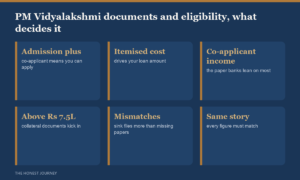
INR loans (SBI, HDFC Credila, Avanse, Auxilo, Axis) at 9-14% INR carry no forex risk but require co-applicant income proof and often collateral above Rs 7.5L. USD loans from Prodigy Finance or MPOWER Financing at 11-13% USD do not require an Indian co-applicant or collateral but compound forex risk against you as the rupee weakens. Over a 10-year repayment with a 15% weaker rupee, the USD loan can become 25-40% more expensive in INR terms than the headline rate suggests. INR loans usually win unless your family genuinely cannot provide a co-applicant or any collateral. Full math in Education Loan Without Collateral for Abroad Studies.
Should the loan be in my name or in my parent's name?
Tax-wise, the parent should be primary borrower if they are salaried, in the 30% slab, and intend to pay EMIs from post-tax income anyway. Section 80E follows the borrower, and the parent's deduction is worth more than the student's would be in the early years. Credit-wise, the student-as-primary-borrower is appropriate when the student has a CIBIL history and the parent's income is irregular (self-employed, retired). This needs to be decided at sanction stage, not after, the borrower's name is hard to change once the loan is disbursed. See Education Loan Tax Benefit (Section 80E) for the regime decision.
At what loan amount does collateral become unavoidable?
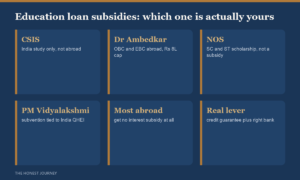
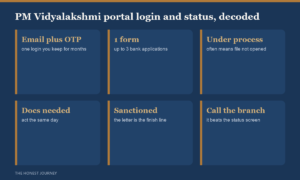
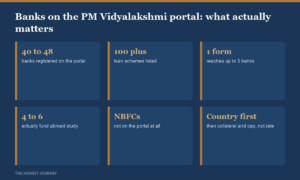
Up to Rs 7.5 lakh, every IBA-aligned bank can lend without collateral or third-party guarantee. Rs 7.5L to Rs 40L is the no-collateral zone with NBFCs (HDFC Credila, Avanse, Auxilo) for premier universities only. Above Rs 40L, collateral is mandatory across the board, except for top-20 US/UK schools with HDFC Credila or Axis Bank. The PM Vidyalakshmi scheme offers collateral-free up to Rs 7.5L with a 75% government credit guarantee, which fills the gap for lower-tier institutions. See PM Vidyalakshmi Portal Education Loan.
PSU bank vs private bank vs NBFC: which is best for my profile?
PSU banks (SBI, Bank of Baroda, Union Bank) offer the lowest rates (8.05-10.5%) but are stricter on collateral, slower on disbursal, and limited on premier-university lists. Private banks (Axis, ICICI, HDFC main bank) sit in the middle. NBFCs (HDFC Credila, Avanse, Auxilo) are fastest on disbursal and most flexible on premier universities, but charge 10.5-14% and require co-applicant CIBIL above 700. For IIM-A/B/C and a few other top institutions, SBI Scholar Loan at 8.05-8.15% is unmatched. For US top-50 master's with no collateral, HDFC Credila or Avanse usually wins.
Old Tax Regime vs New Tax Regime when I have an education loan: which should I pick?
Section 80E only works in the Old Regime. The New Regime, which became default in FY2023-24 and was made more attractive in Budget 2025, does not allow the 80E deduction on education loan interest. If you (or the parent borrower) have HRA, a home loan, 80C in full, and 80D, the Old Regime usually wins even with 80E added. If those deductions are thin, the New Regime can still win despite losing 80E. Run the actual numbers using the e-filing portal calculator, not on vibes. Worked example with a Rs 40L loan at 11% is in Education Loan Tax Benefit (Section 80E).
What actually happens if I cannot repay the loan?
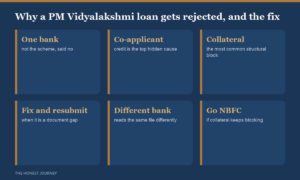
First missed EMI triggers a late fee and a flag on the borrower's CIBIL within 30-60 days. After 90 days of non-payment, the account is classified as a Non-Performing Asset and the lender begins recovery. For unsecured loans, recovery means civil suits against the borrower and co-applicant, wage garnishment in some cases, and a 7-year hit to CIBIL that prevents most future borrowing. For collateral-backed loans, the lender can move to attach and sell the pledged asset (typically the parents' property). The PM Vidyalakshmi 75% credit guarantee softens this for the lender but does not erase the borrower's liability. The honest answer: education loans are personal debt with real consequences. Plan repayment under the worst-case salary scenario, not the expected one.