Short answer. Scholarships for Indian students fall into three groups: government schemes (National Overseas Scholarship, Fulbright-Nehru, Commonwealth, Chevening, DAAD), private trust awards (Inlaks Shivdasani, JN Tata Endowment, Aga Khan, KC Mahindra), and university-specific aid. Almost all are fully or substantially funded, and almost all have single-digit selection rates.
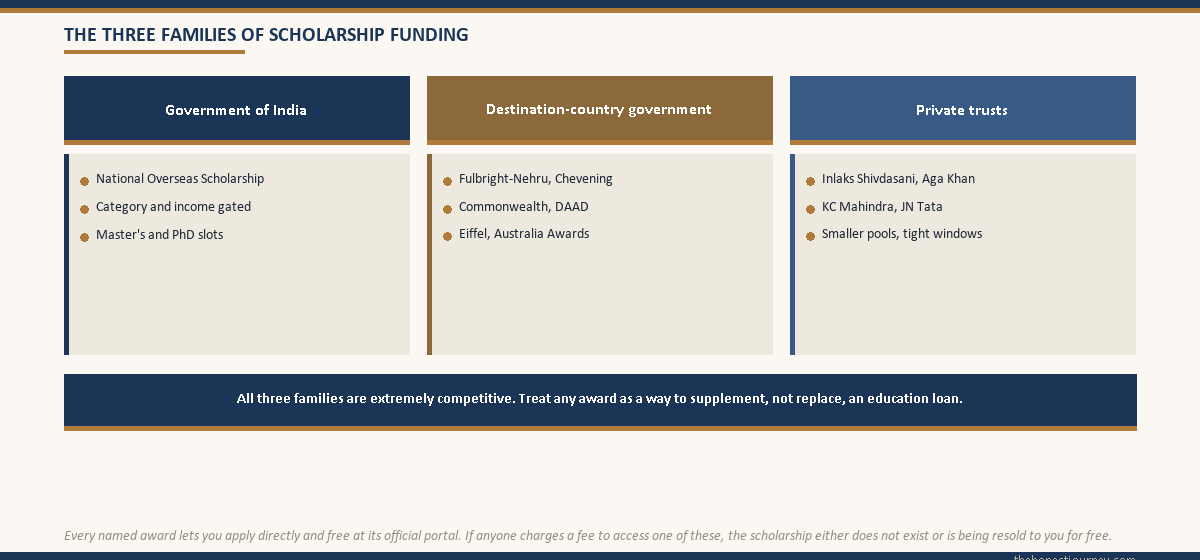
The real scholarships for Indian students to study abroad fall into three honest groups: government schemes (National Overseas Scholarship for SC and ST, Fulbright-Nehru for the USA, Commonwealth and Chevening for the UK, DAAD for Germany), private trust awards (Inlaks Shivdasani, JN Tata Endowment, Aga Khan, KC Mahindra), and university-specific aid. Almost all of the named ones are fully or substantially funded, and almost all are extremely competitive, with single-digit selection rates. Treat them as a way to cut a loan down, not a way to avoid one.
More named scholarships on the site: Rhodes for Oxford, Stipendium Hungaricum and the DSU scholarship in Italy.
Also on the site: the MEXT scholarship for Indian students, the Global Korea Scholarship, and interest free loan scholarships from JN Tata, KC Mahindra and Narotam Sekhsaria.
A student I mentor spent four months last year hunting scholarships before she filed a single loan application. She told me she did not want to “start her career in debt.” I understood the instinct. I also watched her miss the SBI Global Ed-Vantage window for her September intake because she was waiting on a Chevening result that, statistically, was never likely to come.
She got the loan in the end, late and stressed. The lesson she gave me, which I now give everyone, is this. Apply for scholarships seriously, but build the loan plan in parallel from day one. The scholarship is the bonus. The loan is the floor.
What “scholarships for Indian students to study abroad” honestly means
There is a whole industry built on the phrase: aggregator sites, “we will find you a scholarship” agencies, paid databases, and consultancies that take a cut. I am going to ignore all of that, because the legitimate funding for an Indian student going abroad comes from a short, knowable list of sources, and every one of them lets you apply directly and free.
The three groups that actually matter are these. Government scholarships, funded either by the Government of India or by the destination country’s government. Private trust and foundation awards, funded by Indian philanthropic endowments. And university-specific aid, funded by the institution you are applying to. If someone is charging you a fee to “access” a scholarship, that scholarship either does not exist or is freely available at its official portal.
The honest frame to hold throughout: these are competitive on a level most people underestimate. A fully funded government scholarship to a top destination often selects fewer than one in twenty serious applicants, and sometimes fewer than one in fifty. That does not mean do not apply. It means do not stake your funding timeline on winning one.
Government scholarships funded by the Government of India
The flagship here is the National Overseas Scholarship. It is run by the Ministry of Social Justice and Empowerment for students from Scheduled Castes, denotified nomadic and semi-nomadic tribes, landless agricultural labourers, and traditional artisan categories, with a family income ceiling (currently around ₹8 lakh per year, verify the live figure). It funds a fixed number of slots each year for Master’s and PhD study abroad, covering tuition, a maintenance allowance, airfare, and visa and health costs for selected fields. Applications open through the official portal and the income and category certificates are non-negotiable.
This is the most generous India-funded route for eligible students, and it is genuinely full funding rather than a token grant. The catch is the narrow eligibility (it is category and income gated by design) and the fixed slot count, which makes it sharply competitive within the eligible pool. The canonical place to check eligibility, slot numbers, and the application window each year is the National Scholarship Portal at scholarships.gov.in, which is the single official source for all Government of India scholarship notifications. Treat any other site claiming to “process” your National Overseas Scholarship as noise.
Faz's ruleOnly ever apply for a Government of India scholarship through scholarships.gov.in or the ministry's own portal, never through a paid intermediary.
Every year someone forwards me a WhatsApp from an “education consultant” offering to secure a National Overseas Scholarship for a fee. There is no fee, and there is no shortcut. The selection is done by a committee on merit and eligibility. Paying someone does not move you up the list. It just means you paid for something the government gives away free.
Government scholarships funded by the destination country
For the biggest destination-government awards, there are now honest standalone guides: the Chevening Scholarship and Commonwealth Scholarship for the UK, the Fulbright-Nehru Fellowship for the USA, the DAAD Scholarship for Germany, and the EU-wide Erasmus Mundus Joint Master’s. If you want them ranked by realistic odds, see fully funded scholarships for Indian students.
These are often the strongest awards because the host government wants international talent and funds it properly. For an Indian student the names worth knowing by destination are these.
| Scholarship | Destination | Funder | What it covers |
|---|---|---|---|
| Fulbright-Nehru | USA | USIEF (US and India joint) | Tuition, living stipend, airfare, health cover for Master’s and research |
| Chevening | UK | UK FCDO | Full tuition, monthly stipend, travel, for a one-year Master’s |
| Commonwealth Scholarship | UK | UK CSC (FCDO) | Full tuition, stipend, airfare, for Master’s and PhD |
| DAAD scholarships | Germany | German government (DAAD) | Monthly stipend, often tuition-free at public universities anyway, travel and insurance |
| Eiffel Excellence | France | French government | Monthly allowance, travel, insurance, partial fee support |
| Australia Awards | Australia | Australian government | Full tuition, living allowance, airfare (development-focused fields) |
Fulbright-Nehru, administered in India by the United States-India Educational Foundation, is the headline route to a funded Master’s or research stay in the USA. It is academically demanding and the application opens roughly a year before the intake. Details and the live cycle are at the official foundation site, usief.org.in. Because a US Master’s is the single most expensive abroad option, this award removes the largest possible loan, but it selects a very small number of people from a very large applicant pool.
For the UK, the two big government routes are Chevening and the Commonwealth Scholarship. Chevening is funded by the UK Foreign, Commonwealth and Development Office and is a full ride for a one-year Master’s, with applications at chevening.org. It weighs leadership and a clear post-study plan heavily, not just grades. The Commonwealth Scholarship, run by the Commonwealth Scholarship Commission and also FCDO-funded, leans toward fields with development impact and covers Master’s and PhD, with the official portal at cscuk.fcdo.gov.uk.
For Germany, DAAD is the central body, and the German public-university model already keeps tuition near zero, so a DAAD stipend mostly covers living costs and makes the whole thing close to free for a strong applicant. Start at the official directory, daad.de, and search by your field and level, because DAAD is an umbrella for many specific programmes rather than one single award.
Private trust and foundation scholarships
India has a small set of serious philanthropic endowments that fund students abroad, and these deserve more attention than they get because the application pools are smaller than the government ones and the awards are substantial.
The Inlaks Shivdasani Foundation funds full or substantial support for postgraduate study at top universities in the US, UK and Europe across a wide range of disciplines. It is merit-led and famously rigorous at the interview stage. The KC Mahindra Education Trust runs interest-supported scholarships for postgraduate study abroad, with a fixed number of larger top awards each year. The Aga Khan Foundation runs a need-based scholarship for students from specific developing-country contexts, structured as a half grant and half loan, so part of it has to be repaid (be clear-eyed about that when you compare it against a pure grant).
Then there is the JN Tata Endowment, which people routinely describe wrongly. The JN Tata Endowment is a loan-scholarship hybrid, not a pure grant. It gives selected students a loan scholarship that must be repaid, plus, for some recipients, a smaller travel grant and a gift award on top. Calling it “the Tata scholarship” as if it were free money sets families up for a shock when the repayment terms arrive. It is a low-friction, reputation-backed loan with a partial grant element, which is genuinely useful, but it is money you mostly pay back. Compare its effective cost against a subsidised bank loan before assuming it is automatically the better deal.
Faz's ruleRead the exact funding structure of every private award. A 'scholarship' that is half loan, like Aga Khan or JN Tata's main component, is debt you have to plan to repay.
I have watched two students treat the JN Tata Endowment as a grant and budget as if their tuition were covered free. It is not. It is largely a loan with a small gift on top. The Endowment is a fine instrument and the brand opens doors, but if you do not read the repayment terms you will mis-plan your finances by lakhs. Read the fine print on every private award, every time.
The honest selectivity on these private trusts is real. The top awards go to a handful of people a year out of thousands of applications. The application windows are tight and often close in the winter before an autumn intake, so the timing trap here is even sharper than the government schemes. If you are eyeing one of these, the single most important date is the closing date, and you should mark it the moment you decide to apply.
University-specific aid, the route people skip
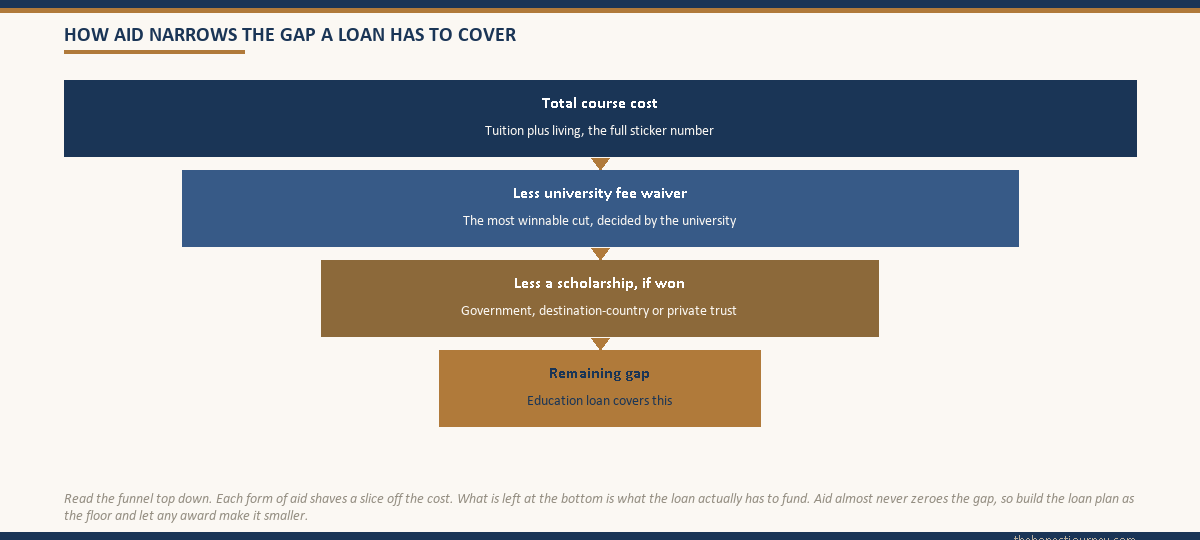
This is the most overlooked and, statistically, the most winnable category. Almost every reputable university abroad offers its own scholarships, fee waivers, assistantships and need-based aid, and these are decided by the university directly rather than a national committee. A partial tuition waiver of 20 to 50 percent from the university you are already admitted to can shave more off your loan than chasing a long-shot national scholarship.
For Master’s students, the relevant forms are merit scholarships (awarded on your application strength, sometimes automatically), departmental fee waivers, and, in the US especially, graduate assistantships that pay a stipend and waive part of tuition in exchange for teaching or research work. For PhD students abroad, full funding through an assistantship or fellowship is often the norm rather than the exception, which is why a funded PhD can cost the student nothing while a self-funded Master’s costs a fortune.
The way to find these is unglamorous but reliable. Go to the official website of each university you are applying to, find its financial aid or scholarships page for international students, and read it line by line. There is no central database that does this better than the universities’ own pages, and any aggregator claiming to is just scraping those pages and adding noise. The university aid you are eligible for is usually flagged in or alongside your admission offer, so read the offer letter carefully too.
How scholarship timing collides with your loan timeline
This is the part that costs people real money, so I want to be precise. The big government and trust scholarships open their applications six months to a year before the intake and announce results late, sometimes only a couple of months before the course starts. Your visa, your proof of funds, and your loan disbursement all have hard deadlines that do not wait for a scholarship result.
If you wait for a scholarship decision before starting your loan, you risk missing the bank’s sanction window, the visa proof-of-funds requirement, and in some cases the university deposit deadline. The fix is not to give up on scholarships. The fix is to run both tracks at once. File your scholarship applications on their own calendar, and file your education loan application the moment your admission offer arrives, treating them as parallel processes that do not depend on each other.
If a scholarship comes through, you simply draw down less of the sanctioned loan, or use the award to clear the principal early. Banks have no problem with a partially used sanction. What they cannot fix is a sanction that was never applied for in time. The mechanics of how much a bank will actually lend, and how the deciding-between-saving-and-borrowing maths works, are walked through in my maximum education loan amount India guide and my education savings vs loan post.
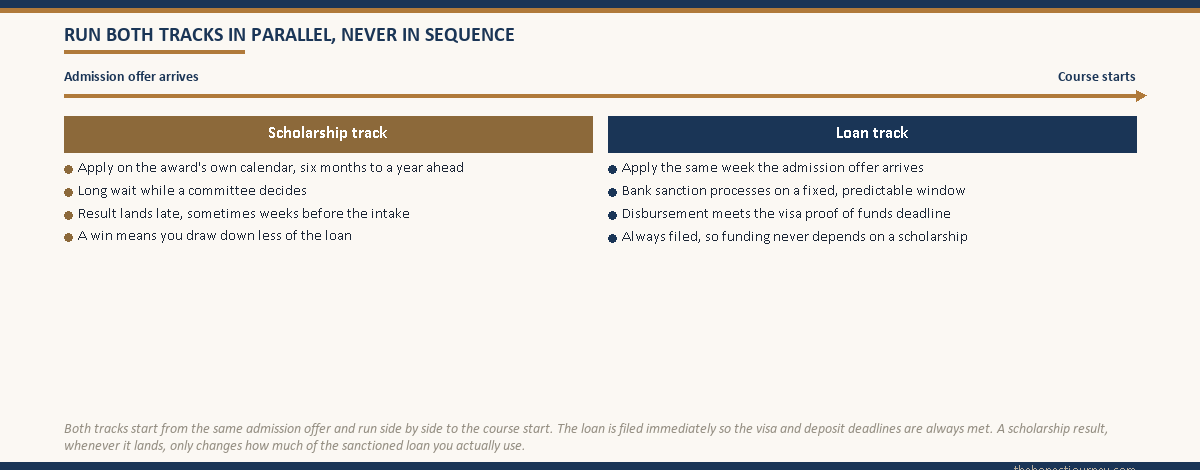
Faz's ruleApply for the loan the week your admission offer lands, on a separate track from every scholarship. Never make your funding wait on a scholarship result.
The single most expensive mistake I see is treating the loan as a backup you will arrange “if the scholarship does not work out.” By the time the scholarship rejection arrives, the loan window may be tight and the visa clock is ticking. Run them in parallel from day one. A scholarship win just means you borrow less. A scholarship loss with no loan filed means a deferred admission.
What scholarships realistically cover, and what they do not
Even a fully funded scholarship rarely covers every rupee. Read each award’s terms for what is included. A “full” scholarship usually means tuition plus a living stipend plus airfare. It often does not include the visa fee, the health surcharge or insurance, the initial settling-in costs, or a buffer for currency movement and emergencies. The destination cost guides for the two priciest routes, my cost of studying in USA for Indian students and cost of studying in UK for Indian students posts, lay out exactly which line items a scholarship leaves you to cover.
This is why I keep returning to the same frame. A scholarship reduces the loan. It very rarely eliminates the need for one entirely, unless you have a full government or destination-country award plus your own savings for the gaps. For the vast majority of students, the realistic plan is a loan as the foundation and a scholarship, if won, as the thing that makes the loan smaller and the repayment shorter.
The honest closing take
If I were advising a student starting their abroad plan today, here is the order I would give. Build the loan plan first, because it is the only funding source you control. File the loan application the week the admission offer arrives. Then, on a completely separate calendar, apply seriously for the scholarships you are genuinely eligible for: the government schemes if your category and field fit, the private trusts if your profile is strong, and above all the university’s own aid, which is the most winnable of the lot.
Be honest with yourself about the odds. The named government and trust scholarships are extremely competitive, and a single-digit success rate is normal for the best of them. Apply anyway, because the upside of a full ride is enormous and the application itself sharpens your story for the visa and the university. But never let the hope of one delay the loan that actually gets you on the plane.
The students who do this well end up in one of two good places. They win an award and draw a smaller loan, or they win nothing and still have a funded plan that started on time. Chase the scholarships. Build the loan. In that order, and at the same time.
FAQ
What scholarships can Indian students get to study abroad?
Indian students can apply for three main groups. Government of India schemes like the National Overseas Scholarship for eligible SC, ST and similar categories. Destination-country government awards like Fulbright-Nehru for the USA, Chevening and Commonwealth for the UK, DAAD for Germany, Eiffel for France and Australia Awards. And private trust awards like Inlaks Shivdasani, JN Tata Endowment, Aga Khan and KC Mahindra. University-specific aid sits alongside these. All are competitive, so treat them as a way to shrink a loan rather than replace it.
What is the National Overseas Scholarship?
The National Overseas Scholarship is a Government of India scheme run by the Ministry of Social Justice and Empowerment for students from Scheduled Castes, denotified and nomadic tribes, landless agricultural labourers and traditional artisan categories, within a family income ceiling. It funds a fixed number of slots each year for Master’s and PhD study abroad, covering tuition, a maintenance allowance, airfare and certain costs. It is genuinely full funding for selected students but narrowly gated by category and income. Apply only through the official portal at scholarships.gov.in.
Is Fulbright-Nehru fully funded?
Yes, for selected fellows the Fulbright-Nehru programme is substantially funded, typically covering tuition, a living stipend, airfare and health cover for a Master’s or research stay in the USA. It is administered in India by the United States-India Educational Foundation, and the live cycle and exact benefits are published at usief.org.in. Because a US degree is the most expensive abroad route, the award removes a large potential loan. It is also academically demanding and very competitive, with applications opening roughly a year before the intake.
How competitive is Chevening?
Chevening is highly competitive. It is a fully funded UK government scholarship for a one-year Master’s, covering tuition, a monthly stipend and travel, funded by the Foreign, Commonwealth and Development Office. Selection weighs leadership potential, networking ability and a clear post-study plan heavily, alongside academics, so a strong CGPA alone is not enough. The applicant pool is large and the award count limited, so success rates are low. Apply at chevening.org, and run a loan application in parallel because the result arrives close to the intake.
Is JN Tata a scholarship or loan?
The JN Tata Endowment is a loan-scholarship hybrid, not a pure grant. Its main component is a loan scholarship that must be repaid, and some recipients additionally receive a smaller travel grant and a gift award. People often call it “the Tata scholarship” as if it were free, which is misleading. It is a reputation-backed loan with a partial grant element, genuinely useful and low friction, but largely money you pay back. Read the repayment terms carefully and compare its effective cost against a subsidised bank loan before assuming it is the cheaper option.
When do scholarship applications open?
Most major government and trust scholarships open six months to a year before the intake and announce results late, sometimes only a couple of months before the course starts. Chevening, Commonwealth, Fulbright-Nehru and the National Overseas Scholarship each run on their own annual calendar, so check the official portal for the live window. Private trust windows often close in the winter before an autumn intake, making them the tightest on timing. Mark the closing date the moment you decide to apply, and never let a pending result delay your loan application.
Can a scholarship fully cover studying abroad?
Rarely in full. Even a fully funded scholarship usually means tuition plus a living stipend plus airfare, and often leaves out the visa fee, health surcharge or insurance, settling-in costs and a buffer for currency swings and emergencies. Only a complete government or destination-country award combined with your own savings for the gaps truly covers everything. For most students the realistic plan is a loan as the foundation and a scholarship, if won, as the thing that makes the loan smaller and the repayment shorter rather than unnecessary.
Should I wait for a scholarship before taking a loan?
No. Scholarship results arrive late, while your visa proof of funds, university deposit and bank sanction window have hard deadlines that do not wait. Waiting for a result risks missing the loan window entirely and forcing a deferred admission. File the education loan the week your admission offer arrives, and run scholarship applications on a separate track. If an award comes through you simply draw down less of the sanctioned loan or clear the principal early. Banks have no problem with a partially used sanction.
Faz · The Honest Journey · 2026