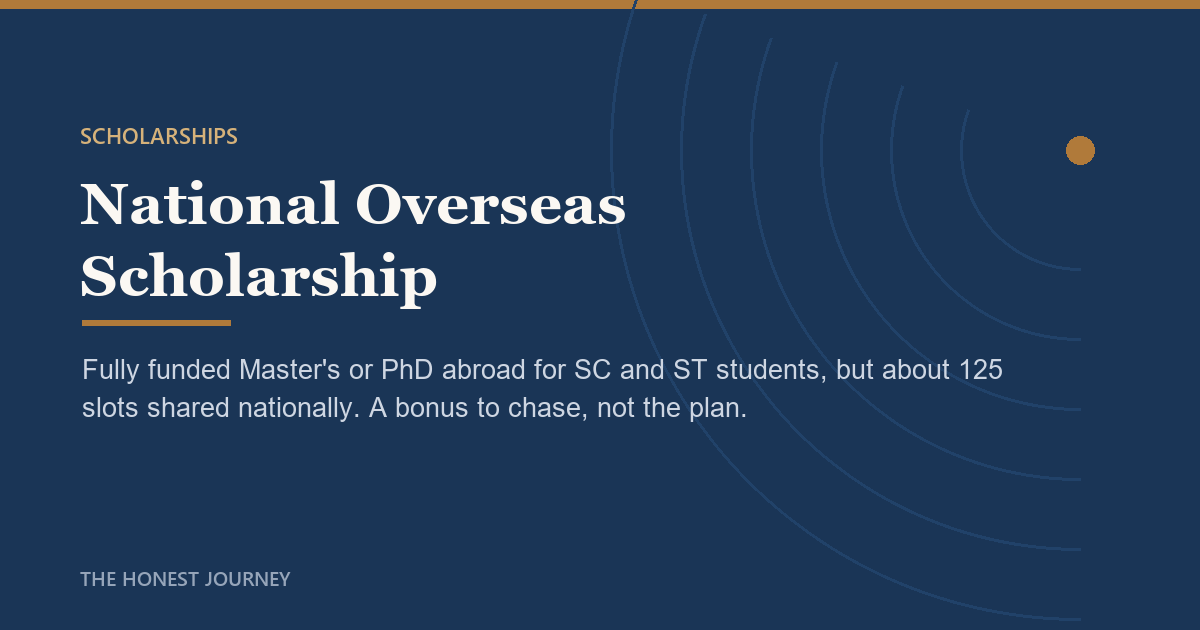
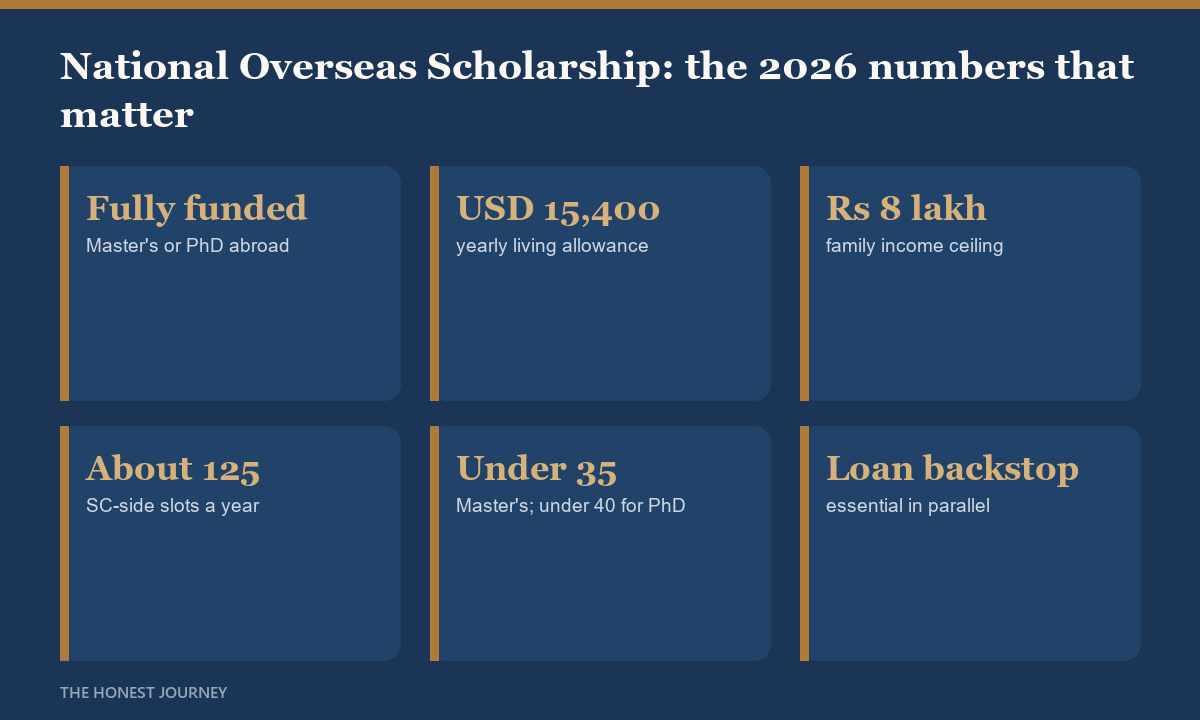
Short answer. The National Overseas Scholarship fully funds a Master’s or PhD abroad for SC, ST, denotified tribe, landless labourer and traditional artisan students. It covers tuition, a yearly living allowance of USD 15,400 (GBP 9,900 in the UK), airfare and visa fees. Roughly 125 SC-side slots exist each year, so treat it as a bonus beside a loan.
The National Overseas Scholarship fully funds a Master’s or PhD abroad for SC, ST, denotified tribe, landless labourer and traditional artisan students, covering full tuition, a yearly living allowance of USD 15,400 (GBP 9,900 in the UK), one-time airfare and visa fees, but the whole country shares roughly 125 SC-side slots a year, so the real odds are lottery-thin and it must sit beside a loan, not replace one. It is one of the few genuinely government-funded routes to a foreign degree for students from these communities, and it is worth every hour the application takes. It is also small enough that treating it as your funding plan, rather than a bonus on top of a plan, is how people lose an intake.
A reader from a Scheduled Caste family in Nagpur wrote to me last year, certain that the National Overseas Scholarship would cover his entire MS in the United States, so he had not started any loan paperwork. His profile was strong: a first-class engineering degree, family income just under the ceiling, admission to a top-100 university. I told him what I will tell you here. Apply with everything you have, but understand that a few thousand eligible students compete for about 125 places across every subject and every country, and keep a loan sanction moving in parallel. He was not selected. He started his degree anyway, in the same intake, on the loan he had wisely kept alive.
This guide walks through what the scheme actually pays, the two separate versions of it (one for SC and related communities, one for ST students), who really qualifies, the honest odds, and what you still need to fund yourself. If you are mapping the wider funding picture first, start with the full list of scholarships for Indian students to study abroad and the reality check on fully funded scholarships for Indian students.
A scholarship changes how much you borrow, not your loan interest. For how the subsidy schemes compare for those who still need a loan, see which subsidy scheme is actually yours.
What the National Overseas Scholarship actually covers
When the scheme is called fully funded, that is broadly accurate, and more generous than most private awards. It pays the actual tuition billed by your foreign university, a fixed annual maintenance allowance for living costs, and the incidental costs of getting there and settling in. The edges still matter, so read them before you assume the allowance stretches further than it does.
| What the scheme pays | Detail | What it does not cover |
|---|---|---|
| Tuition fees | Full tuition as billed, paid directly to the university through the Indian mission abroad | Any shortfall if the university revises fees mid-course |
| Annual maintenance allowance | Around USD 15,400 a year in most countries, GBP 9,900 a year in the UK, for living costs | The gap in a high-cost city where the allowance does not cover rent and food alone |
| Airfare | One-time economy airfare from India to the study country and back | Mid-course trips home or family travel |
| Visa and other fees | Visa fees, a contingency or equipment grant, and local registration or poll taxes where applicable | Dependant visas, dependant travel and a partner or child’s living costs |
| Duration | The full length of a Master’s or PhD, subject to satisfactory progress reports | A second degree, or time beyond the sanctioned course length |
The maintenance allowance is calibrated for one student living carefully, not for a family and not for a premium lifestyle. In an expensive city it covers the essentials if you share accommodation and cook, and little more. If you are bringing a spouse or child, budget their costs entirely on your own, on top of the award. Understand the wider destination number in the relevant guide, for example the cost of studying in the USA or the cost of studying in the UK, before you assume the allowance clears it.
Faz's ruleFully funded here means one student, one degree, one modest standard of living. It is generous, and it is still not a family budget.
The most common regret I hear is from married applicants who assumed the maintenance allowance would carry a partner too. It will not. If you are bringing a dependant, plan their visa, flight and living costs as a separate line you fund yourself.
There are two schemes, not one, and applicants confuse them
This is the part that trips people, because the name is shared but the scheme is split by community and run by two different ministries on two different portals. Applying on the wrong one wastes a cycle.
| Version | For whom | Run by | Where to apply |
|---|---|---|---|
| National Overseas Scholarship (SC etc.) | Scheduled Caste, denotified nomadic and semi-nomadic tribes, landless agricultural labourers, traditional artisans | Ministry of Social Justice and Empowerment | The NOS portal at nosmsje.gov.in |
| National Overseas Scholarship (ST) | Scheduled Tribe students | Ministry of Tribal Affairs | The tribal overseas portal at overseas.tribal.gov.in |
The SC-side scheme carries the larger and better-known allocation of about 125 slots a year. The ST scheme is separate, smaller, and administered on its own timeline. The coverage and the spirit are similar, full funding for a foreign Master’s or PhD for meritorious low-income students, but the eligibility fine print, the exact allowance and the deadlines are set by each ministry. Always work from the notification on your own portal, not from a summary like this one, because the numbers move each cycle.
Who is actually eligible, and the bar that trips people
The criteria read simply and clear a smaller field than most applicants expect. The scheme is aimed squarely at low-income, high-merit students from the notified communities, going abroad for a postgraduate research or taught degree.
| Requirement | The honest reading |
|---|---|
| Community | You must belong to one of the notified categories for the version you apply under, SC and related communities, or ST on the tribal portal. |
| Family income | Total gross family income from all sources must not exceed ₹8 lakh a year. This ceiling rules out many otherwise strong applicants, so check it against your last completed financial year. |
| Course level | Master’s or PhD abroad only. This is not for a bachelor’s degree or a diploma. A postgraduate or doctoral admission is required. |
| Academic bar | Typically at least 60 percent or the equivalent in the qualifying degree, plus admission to a highly ranked foreign university, often within the QS top bracket the scheme specifies each year. |
| Age | Usually below 35 years for a Master’s and below 40 for a PhD as at the cut-off date. Older applicants are ruled out even with a strong profile. |
The income ceiling and the age limit are the two criteria that quietly disqualify the most people. A family a little over ₹8 lakh, or an applicant a year past the age bar, is simply out, regardless of merit. Confirm both against the current notification before you invest a month in the application. The official pages, the Department of Social Justice and Empowerment scheme listing and the Ministry of Tribal Affairs portal, carry the current-cycle detail.
The honest odds: how small 125 slots really is
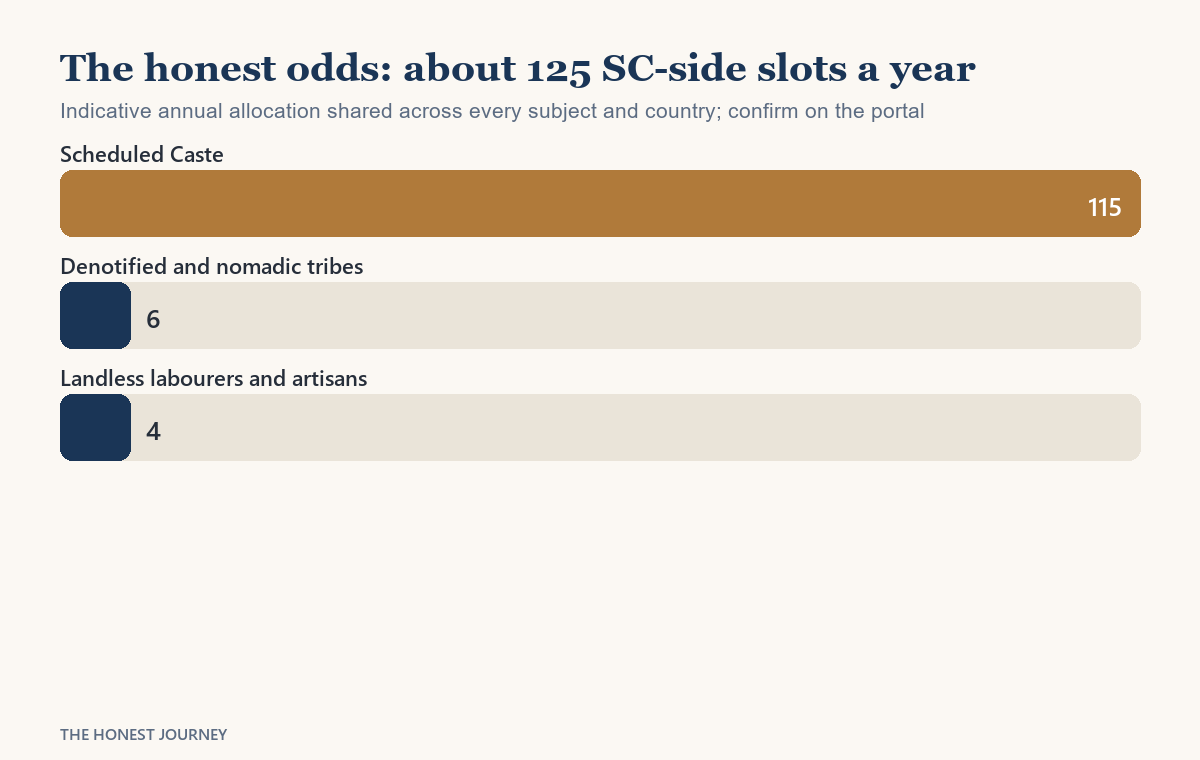
This is the section other guides skip. The SC-side scheme funds on the order of 125 students a year, split across every eligible community, every subject and every destination country. The allocation is roughly 115 places for Scheduled Caste students, about 6 for denotified and nomadic tribe students, and about 4 for landless agricultural labourers and traditional artisans. Against thousands of eligible admits nationwide, that is a low single-digit acceptance rate at best, and for the smaller sub-quotas it is thinner still.
Those are not bad odds for a fully funded government award, and the scheme is a genuine ladder for students who have very few others. But they are still long odds, and selection is not a lottery of luck alone. It weighs the ranking of your university, the strength of your academic record, the relevance of your subject to national development priorities, and a clean income and category verification. A top-100 admission with a well-documented file competes far better than a mid-ranked one.
Treat the scheme as one lane in a funding plan that has other lanes running at the same time. The students who handle it well apply for the National Overseas Scholarship, keep a loan sanction moving, and check every other scholarship they qualify for in parallel. The ones who struggle are those who bet a whole intake on 125 shared places.
The timeline and the application, step by step
Both versions run on a fixed annual cycle with a short application window, usually a few weeks in the first half of the year for the main selection round. Miss the window and you wait a full year, so the calendar matters as much as the essays.
| Stage | Rough timing | What happens |
|---|---|---|
| Portal opens | Around April for the main round | The online form opens for a fixed window, often about 40 days. Draft documents before this. |
| Application window | A few weeks, into around June | Submit the form, your admission or offer proof, income and category certificates. |
| Document verification | After the window closes | Authorities verify category, income, academic records and university eligibility. |
| Selection | Following weeks | Candidates are ranked and shortlisted against the available slots, sometimes with an interview. |
| Award and disbursal | Before the course start | Sanction is issued, tuition is routed through the Indian mission, allowances begin. |
The documents that most often derail an application are the income certificate and the category certificate. Both must be current, in the exact format the portal specifies, and consistent with what you declared. A mismatch between your stated income and your certificate is a common rejection reason. Assemble these early, because chasing a corrected certificate inside a 40-day window is how strong applicants miss the deadline.
Faz's ruleGet the income and category certificates in the portal’s exact format weeks before the window opens, not during it.
A wrong-format or expired certificate is the quiet killer of these applications. The scheme has almost no tolerance for document mismatches, and the window is too short to fix one mid-flight. Treat the paperwork as the real deadline.
Where the scheme falls short, and what you still fund yourself
Even a full award has edges, and a rejected application leaves the whole bill. Both cases need a funding backstop, which is why the honest structure is scholarship plus loan, not scholarship or loan.
- The 125-slot reality. Most eligible applicants are not selected. If the scheme is your only plan, a rejection leaves you scrambling for a loan in peak season.
- The income ceiling. A family income a little above ₹8 lakh rules you out entirely, however strong your admission.
- Dependants and the high-cost gap. A partner or child is your cost, and in an expensive city the maintenance allowance may not fully cover even a single student.
- The timing gap. Universities often want a deposit before your sanction and disbursal land. You need bridging funds even if you eventually win.
Keep a sanctioned loan ready in parallel. Because these are low-income families, the collateral-free routes matter most here: an education loan for abroad studies without collateral, the government-backed PM Vidyalakshmi route for eligible institutions, and the interest subsidy under the CSIS scheme for families within the income limit. A sanctioned loan also doubles as clean proof of funds for your student visa, which a pending scholarship result cannot provide.
Faz's ruleChase the scholarship with everything, and fund the degree as if you will not get it. Those two are not in conflict. They are the plan.
A sanctioned loan you never draw down costs you almost nothing. A missed intake because you bet on 125 shared slots costs you a full year and often a second attempt at the age bar. The asymmetry is obvious once you see it.
The honest closing take
The National Overseas Scholarship is a genuinely valuable route, and for a student from a Scheduled Caste, Scheduled Tribe or the other notified communities, it can be the difference between a foreign degree and none at all. It is fully funded in the ways that matter, it is government-backed, and it exists precisely to open a door that private funding often keeps shut. For a low-income, high-merit applicant with a strong admission, it is worth every hour.
What it is not is a funding strategy on its own. The slots are few, the income and age bars are hard, and the paperwork is unforgiving. The students who benefit most apply seriously while treating the award as upside, not as the floor of their plan. Run the honest study-abroad math, keep a collateral-free loan moving, and let this scheme be the win that erases your borrowing rather than the bet that decides whether you go at all.
FAQ
Is the National Overseas Scholarship really fully funded?
Yes, for one student for one degree. It covers full tuition paid directly to your foreign university, an annual maintenance allowance of around USD 15,400, or GBP 9,900 in the UK, one-time economy airfare both ways, visa fees and a contingency grant. It does not fund a lavish lifestyle, dependants, or time beyond your sanctioned course. In a high-cost city the allowance covers a single student living carefully, so a spouse or child’s costs are entirely your own.
Who is eligible for the National Overseas Scholarship?
Students from Scheduled Caste, denotified nomadic and semi-nomadic tribes, landless agricultural labourers and traditional artisan communities apply under the Ministry of Social Justice and Empowerment version, while Scheduled Tribe students apply under a separate Ministry of Tribal Affairs scheme. You need a total family income under ₹8 lakh a year, admission to a Master’s or PhD at a highly ranked foreign university, usually at least 60 percent in your qualifying degree, and you must be within the age limit, generally below 35 for a Master’s and below 40 for a PhD.
What are the real chances of getting the National Overseas Scholarship?
Low, because the numbers are small. The SC-side scheme funds on the order of 125 students a year across every community, subject and country, split roughly into 115 Scheduled Caste places, about 6 for denotified and nomadic tribes, and about 4 for landless labourers and traditional artisans. Against thousands of eligible admits, that is a low single-digit acceptance rate. It is a genuine opportunity, but you should apply while keeping a loan ready, not treat it as your funding plan.
How do I apply for the National Overseas Scholarship?
Apply online on the correct portal for your community. SC and related communities use the NOS portal at nosmsje.gov.in run by the Ministry of Social Justice and Empowerment, and Scheduled Tribe students use overseas.tribal.gov.in run by the Ministry of Tribal Affairs. The main round usually opens around April for a window of about 40 days. Submit the form with your admission proof, income certificate and category certificate, all in the portal’s exact format, then the authorities verify and shortlist against the available slots.
What is the income limit for the National Overseas Scholarship?
The total gross family income from all sources must not exceed ₹8 lakh a year, measured for the last completed financial year. This ceiling is strict and is one of the most common reasons otherwise strong applicants are ruled out. Your declared income must match your official income certificate exactly, because a mismatch is a frequent rejection reason. Confirm the current figure on your portal, as the ceiling can be revised between cycles.
Can I take an education loan along with the National Overseas Scholarship?
Yes, and you should. Because only about 125 SC-side slots exist nationally, the honest approach is to apply for the scholarship while keeping a sanctioned education loan ready in parallel, ideally a collateral-free route given the low income ceiling. If you win, you draw down less or cancel the loan. If you do not, you have not lost the intake. A sanctioned loan also serves as clean proof of funds for your student visa, which a pending scholarship result cannot.
Does the National Overseas Scholarship cover a PhD?
Yes. Both the SC-side and ST versions fund a full Master’s or a PhD abroad, subject to satisfactory progress, and the PhD age limit is usually higher, generally below 40 years. It does not fund a bachelor’s degree or a diploma, and it will not fund a second degree once you have used the award. If your plan is doctoral study at a highly ranked foreign university and you meet the income and category criteria, the scheme is one of the few government routes that will fund it in full.
Faz · The Honest Journey · 2026