Short answer. The all-in cost of studying in UK for Indian students in 2026 for a one year Master’s lands between ₹35 lakh and ₹65 lakh depending on the university tier and city.
Tuition runs GBP 20,000 to GBP 38,000, London living adds GBP 13,347 per year while non-London stays around GBP 10,224, the Immigration Health Surcharge is GBP 776 per year, and the visa fee is GBP 524. Add a 28 day proof of funds window and forex spread, and a Russell Group London Master’s totals roughly ₹55 lakh.
Got your admit? Next, plan the move with our pre-departure checklist and what to carry to the UK.
The first time I sat down to map the actual UK Master’s cost for a friend’s daughter applying to King’s College London, I realised the consultancy quote she had been working with skipped three line items entirely. The Immigration Health Surcharge was not in the spreadsheet, the proof of funds figure was a year out of date, and the living cost used was the non-London number even though the program was in central London.
This post walks through every line that actually leaves your account, with 2026 numbers verified against UK government sources, and ends with a worked rupee total for a typical one year Master’s so the planning is honest rather than aspirational. For the wider picture beyond cost, the complete guide to studying in the UK for Indian students covers applications, visas and the move itself.
Tuition by university tier: what you actually pay
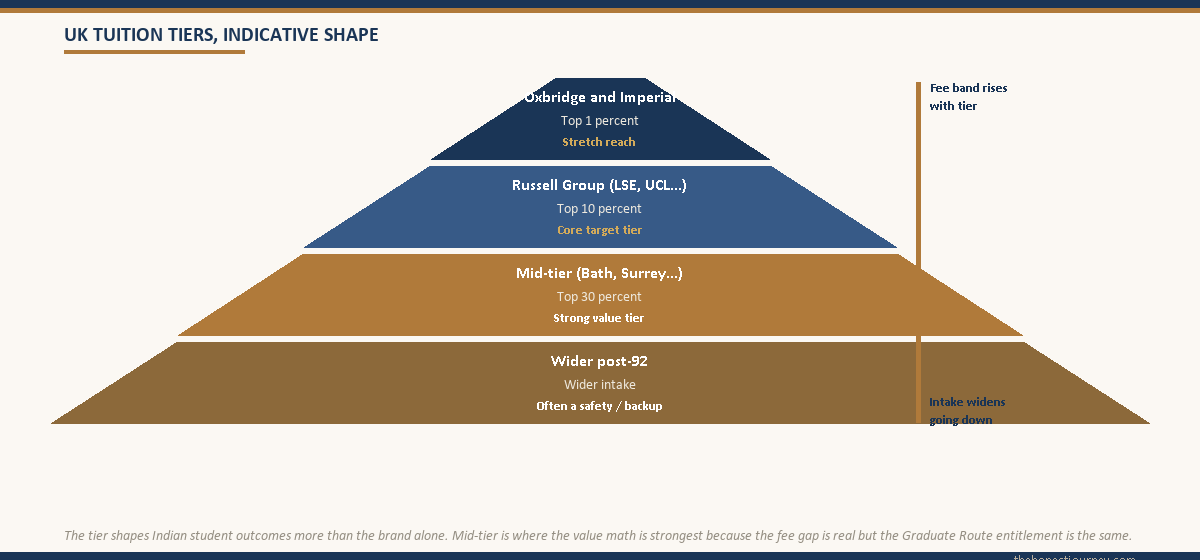
The cost of studying in UK for Indian students starts with tuition, and tuition varies more by university tier than by subject. The three tiers Indian families usually consider are Russell Group (the 24 research intensive universities including Oxford, Cambridge, Imperial, LSE, UCL, KCL, Edinburgh, Manchester), mid-tier post-1992 universities with strong subject reputations (Loughborough, Bath, Surrey, Leeds), and the wider post-92 group (former polytechnics that became universities after 1992).
| University tier | Typical taught Master’s tuition (per year) | STEM / Business premium |
|---|---|---|
| Oxbridge and Imperial | GBP 32,000 to GBP 45,000 | MBA can cross GBP 70,000 |
| Russell Group (LSE, UCL, KCL, Edinburgh, Manchester) | GBP 25,000 to GBP 38,000 | Business and Engineering at the top of the band |
| Mid-tier (Bath, Surrey, Loughborough, Leeds) | GBP 22,000 to GBP 28,000 | Smaller premium, 10 to 15 percent |
| Wider post-92 (Greenwich, Brunel, Coventry) | GBP 16,000 to GBP 22,000 | Often flat across subjects |
A taught Master’s in the UK is typically 12 months including the dissertation period, so the tuition figure is the full program cost rather than per year for a multi year course. This is one of the genuine cost advantages of the UK over the US, where a Master’s usually runs 18 to 24 months.
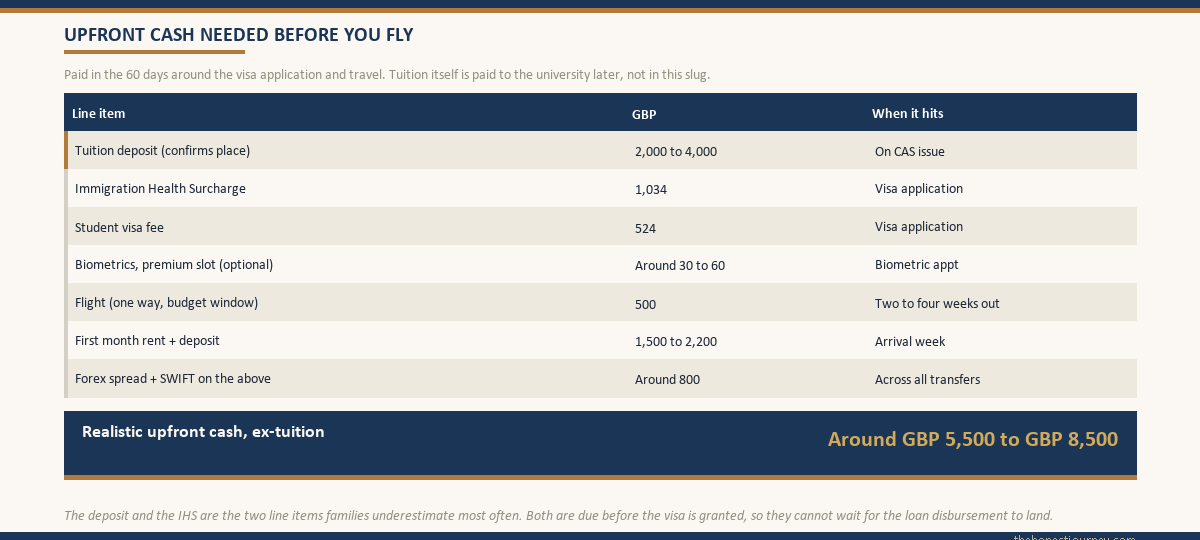
The published tuition fee on the university website is what you pay. The UK does not have the US style “cost of attendance” inflation where the sticker price differs from the actual bill. What does shift the number is the deposit schedule, where most universities want GBP 2,000 to GBP 4,000 upfront to confirm your place, which counts towards the first instalment.
Living costs: London vs the rest of the UK
The UK Home Office sets a specific monthly figure that the visa officer expects to see in your proof of funds, and it splits clearly between London and the rest of the country. For 2026, the Student visa financial requirement is GBP 1,483 per month for courses in London and GBP 1,136 per month for courses outside London, capped at nine months for the proof of funds calculation.
That works out to GBP 13,347 for London and GBP 10,224 for non-London as the minimum proof of funds living component. In practice, real living costs sit close to these figures because the Home Office benchmarks against actual student spending, with a small buffer either way depending on whether you cook at home and share accommodation.
| Living cost item | London (per month) | Non-London (per month) |
|---|---|---|
| Accommodation (single room, shared flat) | GBP 800 to GBP 1,100 | GBP 500 to GBP 750 |
| Groceries and household | GBP 200 to GBP 280 | GBP 180 to GBP 240 |
| Transport (Zone 1 to 3 student Oyster) | GBP 110 | GBP 50 to GBP 80 |
| Mobile, internet, utilities share | GBP 70 to GBP 100 | GBP 60 to GBP 90 |
| Personal, social, occasional travel | GBP 150 to GBP 250 | GBP 120 to GBP 200 |
| Realistic monthly total | GBP 1,330 to GBP 1,840 | GBP 910 to GBP 1,360 |
Manchester, Edinburgh, Leeds, Bristol and Glasgow sit at the upper end of the non-London band. Coventry, Sheffield, Newcastle, Belfast sit at the lower end. Even within London the difference between Zone 2 (Whitechapel, New Cross) and Zone 1 (Bloomsbury, South Kensington) is meaningful, often GBP 200 per month on rent alone.
Faz's ruleThe Home Office living cost figure is not a cap, it is a floor for the visa. Real spending is usually 10 to 25 percent above it once you actually arrive.
Plan with the realistic monthly total from the table, not the minimum visa figure. If your loan or savings only cover the visa minimum, you will be cooking exclusively at home from month two and that is a hard life when the dissertation hits.
The 28 day proof of funds rule, explained properly
This is the rule that catches the most Indian applicants off guard. Under the Student visa requirements, the funds you show as proof must have been held in your account (or your parent’s account if you are using a sponsor letter) for a continuous period of at least 28 consecutive days, ending no more than 31 days before you apply for the visa.
The 28 day window applies to the full amount, not the closing balance. If the balance dips below the required figure for even one day during the 28 day window, the window resets. This is why timing the proof of funds is something you start planning two months before the visa appointment, not the week before.
What counts as acceptable proof: a bank account in your name or the official sponsor’s name, a fixed deposit certificate, or a sanctioned education loan letter from a recognised lender. Mutual funds, NSCs, PPF, EPF and shares are not accepted. A loan sanction letter from a scheduled commercial bank or NBFC is accepted, and unlike the bank balance route, the loan sanction does not need the 28 day seasoning. For the broader picture of acceptable instruments and timing across countries, see the proof of funds for student visa post.
The total to be shown is tuition (less any deposit already paid) plus the nine month living cost figure for your university’s city. So for a GBP 28,000 program in London with GBP 4,000 already paid as deposit, the proof of funds total is GBP 24,000 plus GBP 13,347 living equals GBP 37,347. At ₹110 per GBP that is around ₹41 lakh seasoned in the account for 28 days, which is why most families rely on the loan sanction route rather than parking that much cash.
The Immigration Health Surcharge: GBP 776 per year, paid upfront
The Immigration Health Surcharge is the per year fee that gives Tier 4 / Student visa holders full access to the National Health Service for the duration of the visa. The current rate, as set by the Home Office healthcare immigration page, is GBP 776 per year for students.
The IHS is paid upfront for the full duration of the visa, not annually. A one year taught Master’s visa is usually issued for the program length plus four months, so the IHS charged is GBP 776 for the first year plus a pro-rated amount for the four month extension, totalling roughly GBP 1,034 paid as a single online payment during the visa application.
The IHS is non refundable once paid except in very narrow circumstances (visa refused, application withdrawn before decision, or the surcharge was overpaid). If you leave the UK early after completing the program, the unused IHS portion is not refunded.
Visa fee, biometrics, BRP to eVisa transition
The Student visa application fee for applying from outside the UK is currently GBP 524. This is paid online during the application and is non refundable whether the visa is granted or refused.
Biometrics (fingerprints and photograph) are submitted at a UKVCAS or VFS Global centre in India during the application process. The biometric enrolment fee is bundled into the visa application in most cases, though some centres charge a separate convenience fee of around ₹1,500 to ₹3,000 for premium or out of city appointments.
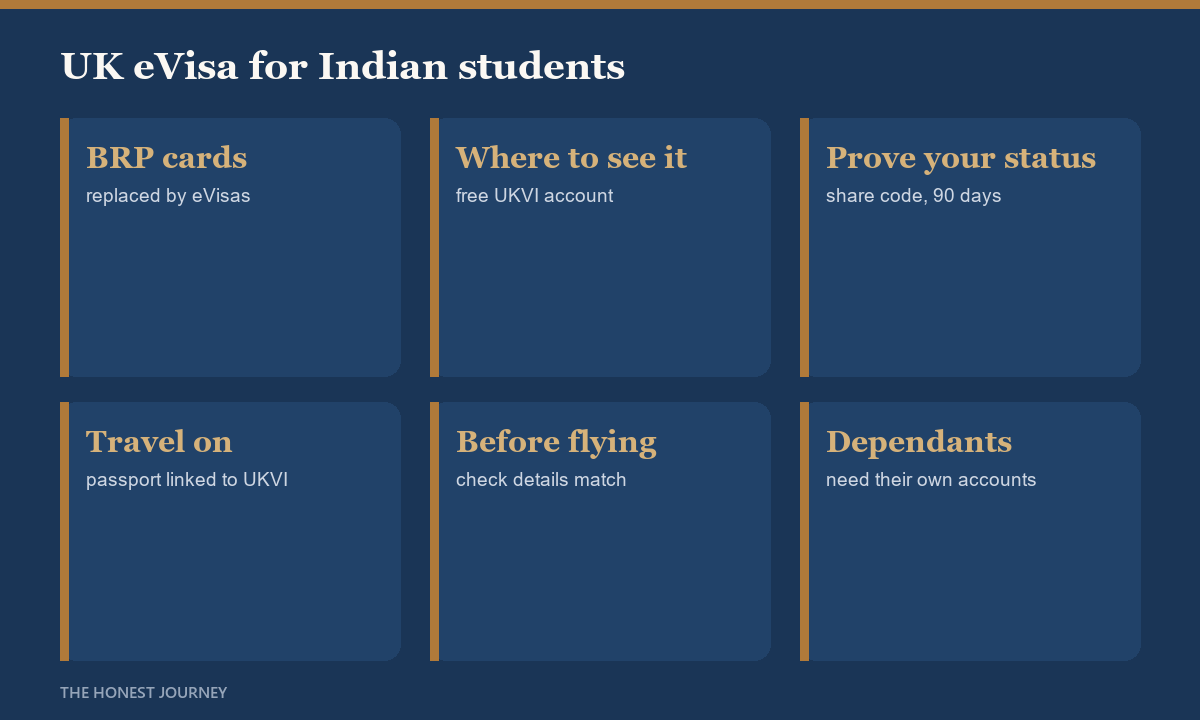
The Biometric Residence Permit physical card is being phased out as the UK transitions to the eVisa system through 2025 and into 2026. New applicants now receive an eVisa linked to their passport rather than a physical card. The transition does not change the visa fee, the rights, or the proof of status requirements, but it does change how you prove your right to study, work and rent in the UK. The UKCISA student advice service tracks the latest position for international students.
The Graduate Route: two years of post study work, no sponsor needed
The Graduate Route visa allows students who complete a UK degree to stay and work for two years (three years for PhD graduates) without needing an employer sponsor. This is the single biggest reason a UK Master’s at GBP 28,000 is genuinely competitive with a Canadian or Australian PG diploma despite the higher upfront cost.
The Graduate Route is applied for from within the UK after course completion and before the Student visa expires. The application fee is GBP 880 and the IHS is GBP 776 per year for both years upfront, so around GBP 2,432 total. There is no salary threshold, no employer sponsorship requirement, and you can switch jobs freely or work multiple part time jobs.
After the two year Graduate Route, switching to a Skilled Worker visa requires sponsorship from a Home Office licensed employer and the role meeting the salary threshold (currently GBP 38,700 for most roles, with reductions for new entrants). The honest read is that the Graduate Route gives you a runway, but staying long term still depends on landing a sponsored role within those two years.
Faz's ruleThe Graduate Route is the only reason the UK math works for most Indian Master's students. Without those two work years, the GBP 50,000 spend has no recovery period.
Plan the program around the Graduate Route from day one. Pick the city for graduate job density, not just the university name. London and Manchester have the deepest entry level hiring markets, Edinburgh is strong for finance and tech, and the rest depend heavily on the subject.
Working part time on the Student visa
Student visa holders studying a full time degree at degree level or above are allowed to work up to 20 hours per week during term and full time during official vacations. The 20 hour cap is strict, monitored, and a breach is grounds for visa curtailment.
At London Living Wage of GBP 13.85 per hour, 20 hours per week works out to roughly GBP 1,108 per month gross, before tax. The personal allowance of GBP 12,570 per year means most student earnings are below the income tax threshold, so the take home is close to the gross. Realistically this covers about 60 to 80 percent of living costs in London and most of living costs outside London, but it does not move the needle on tuition.
The first three months of any program are when part time work is hardest to find because employers prefer candidates who have settled and have a UK bank account, NI number and address proof. Budget for the first three months as a no income period regardless of what the part time job market looks like on paper.
Worked total for a one year Master’s: the honest rupee number
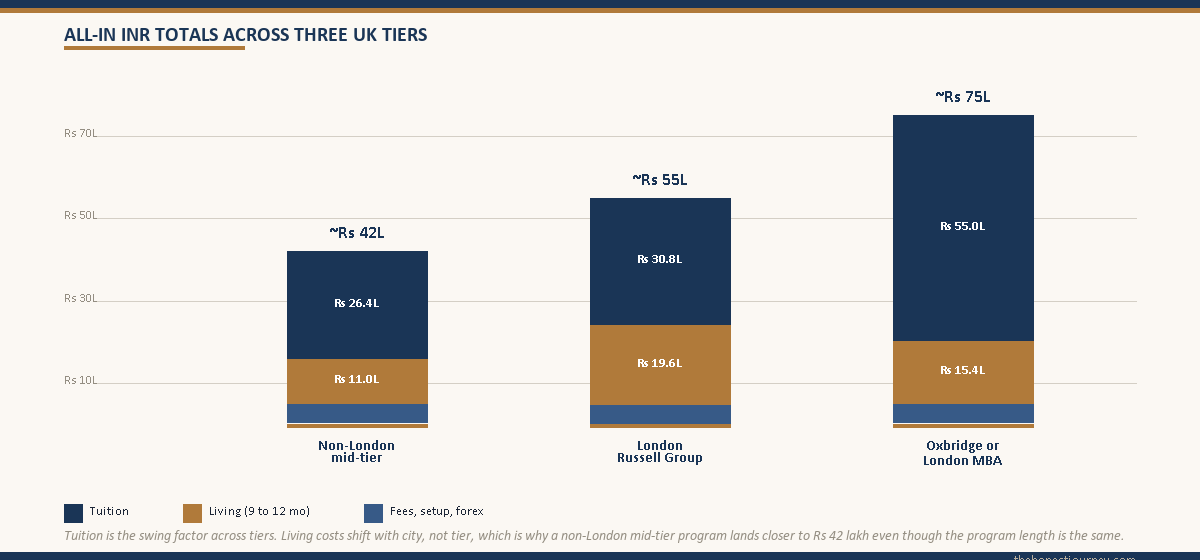
Putting it all together for a representative case: a Russell Group taught Master’s in London with tuition of GBP 28,000, the full nine month proof of funds living amount, and all the mandatory fees.
| Line item | GBP | INR equivalent (at ₹110 per GBP) |
|---|---|---|
| Tuition (one year taught Master’s) | 28,000 | 30,80,000 |
| Living costs (nine months at GBP 1,483 London rate) | 13,347 | 14,68,170 |
| Extra three months living (post course, on Graduate Route) | 4,449 | 4,89,390 |
| Immigration Health Surcharge (16 months pro-rated) | 1,034 | 1,13,740 |
| Student visa fee | 524 | 57,640 |
| Flights (one way, India to UK, budget window) | 500 | 55,000 |
| Initial setup (deposit, rent advance, basics) | 1,500 | 1,65,000 |
| Forex spread, SWIFT charges, GST on conversion | Roughly 800 | 88,000 |
| All-in total (London Russell Group) | ~50,154 | ~55,16,940 |
For a mid-tier non-London Master’s (say Loughborough or Surrey at GBP 24,000 tuition), the same calculation drops to roughly ₹42 lakh because tuition is lower, living is significantly lower, and the IHS and visa fee are flat. For an Oxbridge or Imperial program with MBA level fees, the total can cross ₹75 lakh.
This is before any tuition scholarship. The Chevening, Commonwealth and several university specific scholarships can knock GBP 5,000 to GBP 25,000 off the tuition line, though they are competitive and require an early application timeline. For program search and application timelines, the UCAS postgraduate portal is the central reference, and the QS World University Rankings are the league table most Indian employers recognise for UK university tiers. For a broader country comparison of all-in costs and funding routes, see the studying abroad from India cost and funding guide.
Funding the spend: loan vs savings vs hybrid
For a ₹55 lakh total spend, very few Indian families fund the entire amount from savings, and even fewer should. A sanctioned education loan for UK studies usually carries the bulk of it. The structural reasons: Section 80E gives an income tax deduction on the interest portion of the loan for up to eight years, the moratorium period covers the program plus six months to one year so EMIs start only after you have begun earning, and keeping family savings invested at 10 to 12 percent equity returns while the loan runs at 9 to 11 percent often leaves you ahead even after interest cost.
For unsecured loans (no collateral), most public sector banks cap at ₹7.5 lakh, which means ₹55 lakh forces either collateral (residential property, FD lien, LIC policy) or an NBFC route (Avanse, Auxilo, HDFC Credila) where unsecured ceilings reach ₹60 to ₹75 lakh for premier UK universities. For the full unsecured route mechanics, see the education loan for abroad studies without collateral post.
For the forex side of the spend, a loaded forex card is the standard play once you arrive because the spread is materially lower than a debit card swipe abroad. For the comparison of which cards work and which do not, see the best forex card for students post.
Faz's ruleA UK Master's done on full self funding from parental savings is almost always worse math than a partial loan with savings deployed elsewhere, because Section 80E plus a moratorium plus invested savings beats the loan rate over the tenure.
Run the actual numbers with an honest moratorium and an honest equity return assumption. The “loans are bad” instinct from earlier generations was right when rates were 14 percent and 80E did not exist. At 10 percent with 80E, it is wrong.
The honest closing take
A UK one year Master’s at a Russell Group university in London costs around ₹55 lakh all-in for 2026, with non-London mid-tier programs landing closer to ₹42 lakh and Oxbridge or MBA programs crossing ₹75 lakh. The headline tuition is only about 55 to 60 percent of the actual spend, with living costs, IHS, visa fee, forex spread and the inevitable first month setup making up the rest.
The two genuine cost advantages of the UK over the US, Canada and Australia are the 12 month program length and the Graduate Route. The two year post study work visa without sponsor requirement is what makes the math close, though if the budget feels tight it is worth weighing an alternative European destination such as studying in France for Indian students, because two years of UK earnings at entry level can clear a meaningful chunk of the loan even after London rent.
The two recurring planning mistakes I see Indian families make: underbudgeting living costs by using the visa minimum instead of the realistic figure, and missing the 28 day proof of funds window by trying to assemble the balance in the wrong account at the wrong time. Both are fully avoidable if the timeline is started two months before the visa appointment instead of two weeks.
Once the budget for the UK is clear, the visa is the next hurdle. The fees, funds proof and processing are in the UK student visa guide.
Cost is only half the question. See is studying in the UK worth it for the salary, payback period and return on this spend.
FAQ
How much does it cost to study in UK for Indian students?
The all-in cost of a one year UK Master’s for an Indian student in 2026 ranges from roughly ₹35 lakh to ₹65 lakh depending on the university tier and city. A Russell Group Master’s in London at GBP 28,000 tuition with full living costs, IHS, visa fee, flights and setup comes to around ₹55 lakh. A mid-tier non-London program with GBP 24,000 tuition lands closer to ₹42 lakh. Oxbridge, Imperial and MBA programs can cross ₹75 lakh. Tuition is only 55 to 60 percent of the total, with the rest going to living costs, mandatory fees and setup.
What is the UK student visa proof of funds amount?
The proof of funds requirement is tuition fees outstanding (after any deposit paid) plus nine months of living costs at the Home Office monthly figure. For 2026 this is GBP 1,483 per month for London (totalling GBP 13,347) and GBP 1,136 per month outside London (totalling GBP 10,224). The full amount must be held in your or your sponsor’s account for 28 consecutive days ending no more than 31 days before you apply for the visa. A sanctioned education loan letter from a recognised lender is accepted as proof and does not need the 28 day seasoning, which is why most Indian applicants use the loan route.
Is the Immigration Health Surcharge mandatory for UK student visa?
Yes. The IHS at GBP 776 per year is mandatory for all Student visa applicants and is paid as a single upfront amount covering the full visa duration. A one year taught Master’s visa is usually issued for program length plus four months, so the IHS charged is roughly GBP 1,034 total. The IHS gives full National Health Service access for the duration of the visa, comparable to private health insurance in countries that do not include it. It is non refundable except in very narrow circumstances.
How much does living in London cost a student?
Realistic monthly living costs in London for a student in 2026 are GBP 1,330 to GBP 1,840, with the Home Office visa minimum set at GBP 1,483. Accommodation in a shared flat runs GBP 800 to GBP 1,100 for a single room, groceries around GBP 250, transport on a Zone 1 to 3 student Oyster card GBP 110, and the rest going to mobile, utilities share and personal spending. Outside London the realistic figure drops to GBP 910 to GBP 1,360 per month, with the visa minimum at GBP 1,136.
Can I work part time on a UK student visa?
Yes. Student visa holders studying a full time degree at degree level or above can work up to 20 hours per week during term and full time during official university vacations. At London Living Wage of GBP 13.85 per hour, this works out to roughly GBP 1,108 per month gross, covering 60 to 80 percent of London living costs. The 20 hour cap is strictly monitored and breaching it is grounds for visa curtailment. The first three months are usually a no income period because employers want UK address proof, an NI number and a UK bank account before hiring.
How much does a UK Master’s cost in total INR?
At an exchange rate of around ₹110 per GBP for 2026 planning, a Russell Group London Master’s totals approximately ₹55 lakh, a mid-tier non-London Master’s around ₹42 lakh, and an Oxbridge or MBA program up to ₹75 lakh and beyond. The ₹55 lakh figure breaks down as roughly ₹30.8 lakh tuition, ₹14.7 lakh nine months living, ₹1.1 lakh IHS, ₹57,000 visa fee, ₹55,000 flights, ₹1.65 lakh setup, plus forex spread. The headline tuition is only about 55 to 60 percent of the actual outlay.
What is the Graduate Route work visa?
The Graduate Route allows Indian students who complete a UK degree to stay and work for two years (three years for PhD graduates) without needing an employer sponsor or meeting a salary threshold. It is applied for from inside the UK after course completion, costs GBP 880 plus GBP 1,552 IHS for the two years, and allows free job switching and multiple part time roles. This two year runway is the single biggest reason a UK Master’s at ₹55 lakh remains competitive with cheaper Canadian or Australian PG diplomas, because it gives a meaningful period to recover the spend through UK earnings.
Do I get a Biometric Residence Permit or an eVisa?
The UK is transitioning from the physical Biometric Residence Permit card to a digital eVisa system through 2025 into 2026, and new Student visa applicants now receive an eVisa linked to their passport rather than a physical card. The visa fee, the rights to study, work and rent, and the IHS requirement are unchanged. What changes is how you prove your status to employers, landlords and the NHS, which is now done through the online “View and prove” service. UKCISA tracks the latest position for international students applying through the transition.
Faz · The Honest Journey · 2026