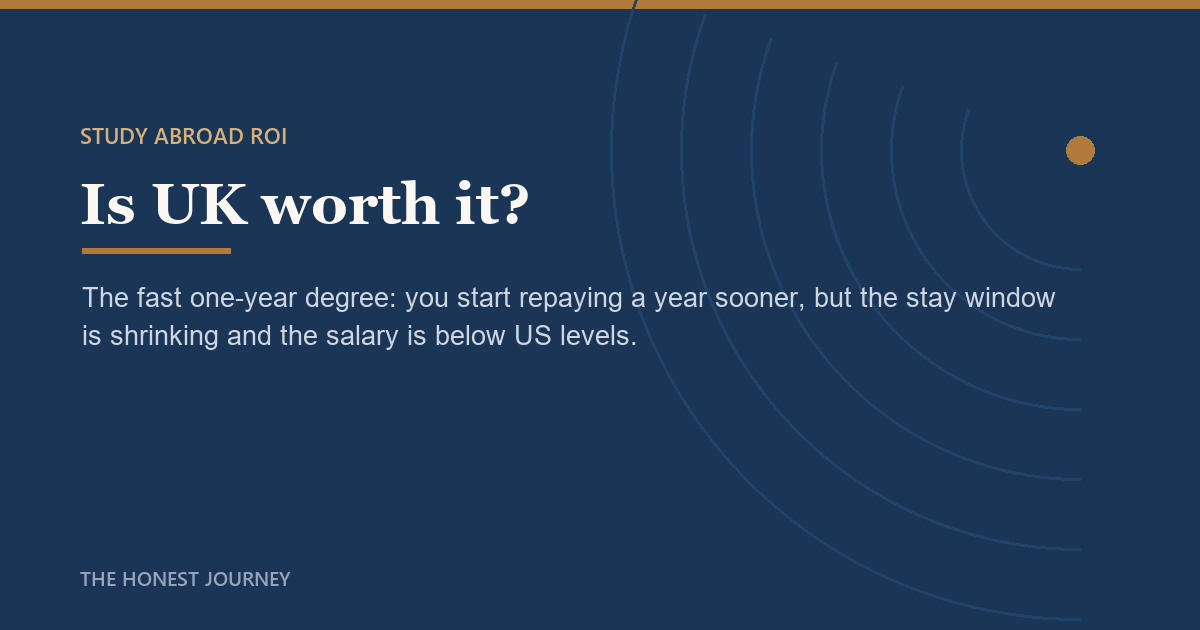
Short answer. The UK gives Indian students the fastest route to a foreign degree and foreign earnings: a one-year Master’s, so repayment starts a year sooner than almost anywhere else. An ₹32 to 45 lakh graduate salary clears an ₹40 lakh loan in four to six years if you stay. The stay window shrinks to 18 months from 2027.
The honest answer on whether studying in the UK is worth it for Indian students: the UK gives you the fastest route to a foreign degree and foreign earnings, a one-year Master’s, so you start repaying a year sooner than almost anywhere else, and a ₹32 to 45 lakh graduate salary clears a ₹40 lakh loan in four to six years if you stay. But the stay window is shrinking to 18 months from 2027, staying long term needs an employer to sponsor you above a GBP 38,700 salary, and the pay does not reach US levels. The UK is worth it if you value speed and a strong brand, can line up sponsorship or a planned return, and borrow within reach of a mid-range salary. It is weaker if your only goal is long-term settlement, because the runway is tightening.
The payback period assumes a work window that is shrinking. See the UK Graduate Route 18 month cut.
A student I know finished her UK Master’s in twelve months, was earning in London by the thirteenth, and had cleared a ₹42 lakh loan inside five years on a finance salary. The one-year format was the whole point: half the living cost of a two-year degree, and a year less delay before the salary started paying the loan back. Another student, same university, humanities degree, could not find a sponsoring employer before her Graduate Route visa expired, came home, and is now repaying the same size loan on an Indian salary. The UK rewarded the first for speed and market fit, and punished the second for a shrinking stay window she had not planned around.
This post is the return question, not the cost question; the price detail lives on the cost of studying in the UK post. I will walk the all-in cost in rupees, what you actually earn after UK tax, how fast the loan clears whether you stay or return, and the specific risks, the 2027 Graduate Route cut and the sponsorship threshold, that decide the outcome. For the math I use ₹106 per pound throughout; treat it as the planning frame.
If you are still choosing the country, the wider view is in is studying abroad worth it and the USA vs UK comparison.
The ROI question in one paragraph
The UK is the fast, moderate-return option. Its one-year Master’s is the structural advantage nobody prices properly: you pay one year of living instead of two, and you begin earning, and repaying, a full year earlier than in the USA, Germany, Canada or Australia. That speed genuinely lifts the return. The catch is the ceiling and the runway. UK graduate pay is solid but well below US levels, and the post-study window is being cut to 18 months from January 2027, after which staying needs an employer willing to sponsor you above GBP 38,700. So the UK pays back reliably and quickly if you find your footing fast, but it does not offer the enormous US upside, and its stay pathway is narrowing. It is a speed play, not a settlement play.
Total all-in cost in INR
The UK looks expensive per year but the one-year format contains it. A Master’s runs roughly GBP 16,000 to 32,000 in tuition, about ₹17 to 34 lakh, with living for the single year around GBP 12,000 to 15,000, roughly ₹12.7 to 15.9 lakh, higher in London. All-in, a UK Master’s commonly lands between ₹36 and 55 lakh, and because it is one year, that is the whole bill, not a per-year figure you double.
That single-year structure is the UK’s quiet financial strength. A two-year US or Australian Master’s doubles the living cost and delays your salary by a year; the UK compresses both. Most students fund the ticket with a loan of ₹35 to 50 lakh, and as always the moratorium interest matters, but the shorter course means a shorter moratorium and less accrued interest than a two-year program.
| Cost item | One-year UK Master’s |
|---|---|
| Tuition (full program) | ~₹17 to 34 lakh |
| Living (one year) | ~₹13 to 21 lakh |
| Rough all-in study cost | ~₹36 to 55 lakh |
| Typical loan shape | ₹35 to 50 lakh, shorter moratorium |
| Structural advantage | One year, so salary starts a year sooner |
The breakdown and loan-product detail sit on the cost of studying in the UK post and the education loan for UK post. The point for the ROI is that the UK bill is a one-time number, and the loan starts earning its keep a year before a two-year degree would.
Faz's ruleThe UK degree pays back a year faster than a two-year degree for a simple reason: it is one year long. You save a year of living cost and gain a year of salary. That single fact is the strongest thing on the UK balance sheet.
People compare UK tuition to two-year destinations and call it expensive, but they forget the UK Master’s is half the duration. One year of living, not two, and your loan repayment starts twelve months earlier. That compressed timeline is worth several lakh in real terms and is the main reason the UK return holds up despite modest salaries.
What you actually earn
UK graduate pay is respectable but not spectacular, and being honest about the number is essential. A Master’s graduate commonly starts around GBP 30,000 to 42,000, roughly ₹32 to 45 lakh gross at ₹106, with finance, consulting and tech in London reaching the top of that band and beyond. Outside those fields and outside London, starting pay clusters nearer the bottom.
UK tax and National Insurance are moderate, so take-home on a GBP 35,000 salary is around GBP 27,000 to 28,000, about ₹28 to 30 lakh a year in hand. London rent then takes a heavy slice, which is why the same salary stretches much further in Manchester, Birmingham or Leeds. For loan maths, a disciplined graduate outside the most expensive rent can direct ₹8 to 14 lakh a year at the balance.
The honest ceiling point: the UK does not pay like the USA. A strong US STEM graduate out-earns a strong UK graduate by a wide margin in gross terms. What the UK offers instead is a faster start and a globally respected brand, especially from its best-known universities, which carries real weight back in India too. You are buying speed and signal, not the highest salary.
The payback period, said plainly
Two scenarios frame the return, and the UK’s gap between them is narrower than the USA’s.
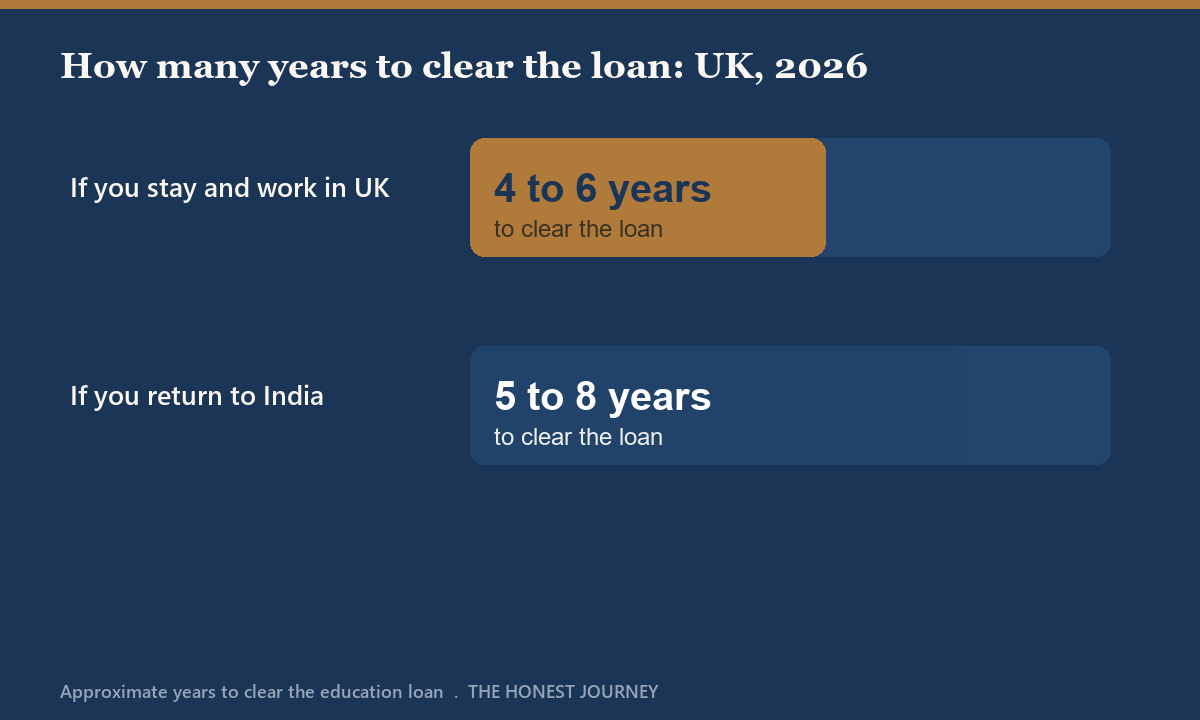
Scenario one, you stay and work in the UK. A graduate on GBP 35,000, directing ₹10 to 14 lakh a year at a balance near ₹45 lakh after a short moratorium, clears the loan in roughly four to six years. A London finance or tech graduate on GBP 45,000-plus does it faster. This is a solid, reliable return, not the explosive US payback, but dependable, and it starts a year sooner because of the one-year course.
Scenario two, you return to India. A UK Master’s from a recognised university, especially a well-known one, carries strong brand value in the Indian market, and a returning graduate often commands ₹12 to 25 lakh a year. The same ₹45 lakh balance then takes five to eight years to clear. The degree clearly helped the career, and the one-year format meant less debt than a two-year equivalent, so even the return column is more survivable than the US worst case.
| Payback factor | Stay in the UK | Return to India |
|---|---|---|
| Typical salary | GBP 30k to 42k (~₹32 to 45L) | ~₹12 to 25 lakh |
| Annual take-home in hand | ~₹26 to 34 lakh | ~₹10 to 18 lakh |
| Realistic yearly loan repayment | ~₹10 to 14 lakh | ~₹5 to 8 lakh |
| Years to clear ~₹45 lakh | ~4 to 6 years | ~5 to 8 years |
| What decides it | Finding a sponsor before the window closes | No sponsorship secured in time |
Because the loan is smaller than a US one and the brand value on return is high, the UK’s two columns sit closer together than the USA’s. The risk is real but the downside is gentler.
Faz's ruleThe UK worst case is milder than the US worst case, because the loan is smaller and the brand travels home well. But the stay window is shrinking, so the good column now demands you move fast on a sponsoring job.
The UK return column is more forgiving than the American one: a one-year degree means a smaller loan, and a recognised UK Master’s carries real weight in the Indian market. But the path to staying is narrowing from 2027, so if settlement matters, you must plan the sponsorship route early rather than assume the Graduate Route will carry you.
The risks that break the ROI
Three risks decide whether the UK investment lands well, and two of them are policy changes you can plan around.
The first is the Graduate Route cut. The post-study work visa currently gives two years, but from January 2027 it is being reduced to 18 months. That is still usable, but it shortens the runway to find a role and, crucially, to convert to a sponsored work visa before it expires. Anyone starting a UK course now should plan the job search from day one, not after graduating.
The second is the sponsorship threshold. To stay beyond the Graduate Route you generally need an employer to sponsor you on a Skilled Worker visa, and the general salary threshold sits at GBP 38,700. Plenty of graduate roles start below that, which means not every job that keeps you employed will keep you in the country. The honest version is that staying long term needs a specific kind of well-paid, sponsoring employer, not just any job.
The third is the salary ceiling itself. Because UK pay is well below US levels, a very large loan is harder to justify here than a moderate one. The UK maths works cleanly on a ₹35 to 45 lakh loan against a mid-range salary; it strains on a ₹55 lakh loan unless you hit the London high end. Borrow in proportion to a realistic, not best-case, UK graduate salary.
A worked payback example
Take one student, a one-year UK Master’s graduate, ₹42 lakh loan at 11 percent.
| Step | Figure |
|---|---|
| Loan borrowed | ₹42 lakh at 11 percent |
| Balance after short moratorium | ~₹46 to 48 lakh |
| UK starting salary | GBP 35,000 = ~₹37.1 lakh gross |
| Take-home after UK tax and NI | ~GBP 27,500 = ~₹29.2 lakh |
| Yearly amount toward loan | ~₹12 lakh |
| Payback if staying | ~4 to 5 years |
| Payback if returned to India | ~6 to 8 years |
The staying column is a clean, dependable return: a moderate loan cleared in about half a decade on a solid salary, helped by the fact you started earning a year earlier than a two-year degree would allow. The returning column is longer but softened by a smaller loan and a brand that sells well in India. Same student, and the fork is whether a sponsoring employer materialises before the Graduate Route runs out.
When the UK is worth it, when it is not
It comes down to speed, brand, and how much settlement matters to you.
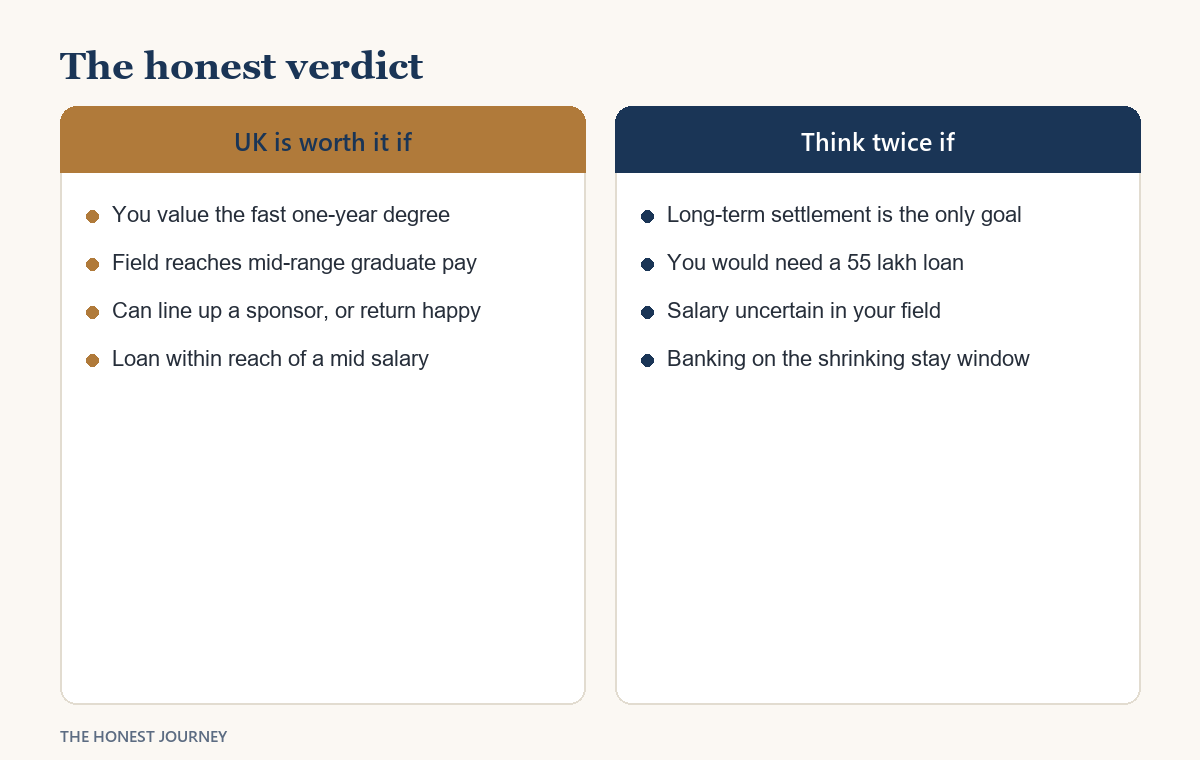
The UK is worth it if you value the one-year format and the faster start it gives, your field is one that hires graduates into GBP 35,000-plus roles, you can either line up a sponsoring employer or are happy to return to India with a strong brand, and you borrow within reach of a mid-range UK salary. For that profile the UK delivers a quick, reliable payback and a degree that opens doors on both sides of the world.
Think twice if your single goal is long-term settlement abroad, because the Graduate Route is shrinking and the GBP 38,700 sponsorship threshold is a real filter, or if you would need a ₹55 lakh loan against an uncertain salary. For a pure settlement objective, Canada or Australia offer clearer, longer, points-based routes, and the UK vs Australia comparison lays that trade out.
One note for everyone: because the UK degree takes one year and carries strong brand value, a planned return to India is a genuinely good outcome here, not a fallback. Many students get the best of the UK by taking the fast degree, a couple of years of experience, and bringing both home.
The honest take
The finance graduate who cleared her loan in five years used the UK exactly as it rewards: fast degree, quick job, disciplined repayment. The humanities graduate who returned was not careless, but she assumed the stay window would sort itself out, and it did not. The UK did not change between them; one planned around its narrowing runway and the other did not.
So compress it to the honest test. Do you value speed and brand over the highest possible salary, is your field one that reaches the mid-range graduate pay, and have you planned the stay-or-return question rather than left it to chance? If yes, the UK gives one of the faster, more reliable returns in international education. If your whole plan rests on long-term settlement, price the 2027 changes carefully and read the study in the UK page before you commit a rupee. Decide against the shrinking window, not the brochure.
Funding the move with a loan? Start with the complete education loan guide, then apply through the PM Vidyalakshmi portal, the government route most Indian students use.
A one-year UK degree is often an MBA decision. See the MBA math for working professionals.
FAQ
Is a UK Master’s degree worth it for Indian students in 2026?
For most students who value speed and brand, yes. The one-year format means half the living cost of a two-year degree and a salary that starts a year sooner, so a ₹40 lakh loan clears in four to six years on a solid UK salary. It is a weaker choice if your only goal is permanent settlement, because the Graduate Route drops to 18 months from 2027 and staying needs a sponsoring employer above GBP 38,700. Worth it for speed and career signal, less so as a pure settlement play.
How long does it take to repay a UK education loan?
If you stay and work in the UK, roughly four to six years on a mid-range graduate salary, faster in London finance or tech. If you return to India, the same loan takes about five to eight years on an Indian salary. The UK loan is usually smaller than a US one because the course is a single year, so both columns are more survivable than the US equivalents, and repayment begins a year earlier than a two-year degree allows.
What salary can an Indian student expect after studying in the UK?
A Master’s graduate commonly starts at GBP 30,000 to 42,000, about ₹32 to 45 lakh gross, with London finance, consulting and tech at the top of that band. Take-home after UK tax and National Insurance is around ₹28 to 30 lakh on a GBP 35,000 salary. UK pay is solid but well below US levels, so the UK sells speed and brand rather than the highest ceiling, and the same salary stretches much further outside London.
What is the biggest risk of studying in the UK now?
The shrinking stay window. The Graduate Route post-study visa drops from two years to 18 months from January 2027, and staying beyond it needs a Skilled Worker sponsorship above GBP 38,700, which many graduate roles do not meet. If long-term settlement is your goal, that narrowing runway is the main risk, and you should plan the sponsored-job search from the start rather than assume the post-study visa will carry you to permanent residence.
Is the one-year UK Master’s a real financial advantage?
Yes, and it is underrated. A one-year course means you pay a single year of living cost instead of two and start earning, and repaying, a full year earlier than in the USA, Germany, Canada or Australia. That compressed timeline is worth several lakh in real terms and shortens the loan moratorium, which is the main reason the UK return holds up despite salaries that are lower than American ones.
Can Indian students settle permanently in the UK after studying?
It is possible but not easy. After the Graduate Route you generally need a Skilled Worker visa from a sponsoring employer paying above GBP 38,700, and after five years on that you can apply for settlement. The route exists, but each step has a real filter, and the post-study window is shrinking, so it demands early planning and a well-paid, sponsoring role. For a smoother, points-based settlement path, Canada and Australia are often more predictable.
Should I take a large loan to study in the UK?
Keep it proportionate to a realistic UK salary. The maths works cleanly on a ₹35 to 45 lakh loan against a mid-range graduate salary, but a ₹55 lakh loan strains unless you reach the London high end. Because UK pay is lower than US pay, a very large loan is harder to justify here. Borrow against a normal, not best-case, salary, and remember the one-year format already keeps the total lower than a two-year destination.
Is the UK or USA a better return for Indian students?
The USA has the higher ceiling, the UK the faster and more reliable payback. A US STEM graduate who stays out-earns a UK graduate by a wide margin, but the US path runs through a visa lottery and a long green-card queue. The UK pays less but starts a year sooner, costs less because of the one-year course, and carries a brand that sells well in India. For raw upside choose the USA; for speed, lower risk and a strong return home, the UK often wins. The full split is in the USA vs UK comparison.
Faz · The Honest Journey · 2026