Short answer. Apply for the Graduate Route by 31 December 2026 and you get two years; apply from 1 January 2027 and you get 18 months. The application date decides it, not your course end date. Switching to Skilled Worker needs a graduate level job paying 41,700 pounds, or 33,400 under the new entrant rate that Graduate visa holders use.
The UK Graduate Route gives you two years of unsponsored work rights if you apply on or before 31 December 2026, and only 18 months if you apply on or after 1 January 2027. PhD graduates keep three years either way. What decides which one you get is the date your application is submitted, not the date your course ends, so a student who finishes in late 2026 and waits until January to file loses six months of work rights for no reason. The visa costs 937 pounds plus a health surcharge of about 1,035 pounds per year, cannot be extended, and is not a route to settlement on its own. It is a job hunting window, and the window just got smaller at the same moment the job you need to find got harder to qualify for.
Your Graduate Route status will also be an eVisa: UKVI accounts and share codes explained.
Almost every Indian student I speak to about the UK has the same mental model: do the master’s, get the two year Graduate Route, find a job in that time, switch to a work visa, and the maths works out. That model was reasonable in 2023. It is now out of date in two separate ways at once, and most of the advice still circulating has only caught up with one of them.
The first change is the one that gets the headlines. The Graduate Route is being cut from two years to 18 months. The second change is quieter and matters more: the Skilled Worker visa you were planning to switch into has moved substantially out of reach for a typical fresh graduate. Read together, those two facts change the honest answer to “is a UK master’s worth it” for a lot of people. This page lays out exactly what the Graduate Route is, what the cut actually costs you, the deadline mechanic that most students will get wrong, and what has to be true for the plan to still work. If the UK is still a maybe for you, read it alongside our honest ROI breakdown for the UK and the UK student visa guide.
What the Graduate Route actually is
The Graduate Route is an unsponsored post study work visa. That word “unsponsored” is the whole point of it and the reason it is valuable. You do not need a job offer to get it, you do not need an employer willing to hold a sponsor licence, and once you have it you can work almost any job at almost any level, switch employers freely, or be self employed. For a period after graduating, you are simply allowed to be in the UK and earn.
To qualify you must be inside the UK on a Student visa when you apply, and you must have successfully completed an eligible course. Your university reports your completion to the Home Office, and you cannot apply before they have done so. You do not need to have collected your certificate or attended a ceremony, but you do need that confirmation to have landed. Practically, this means the timing is partly in your university’s hands, which is exactly why the deadline below is dangerous.
What it is not is a path to staying permanently. The Graduate Route cannot be extended and does not count towards settlement. When it expires you either have switched to something else, most commonly the Skilled Worker visa, or you leave. It buys you time and freedom to job hunt. It does not buy you a future by itself.
The cut: two years becomes 18 months on 1 January 2027
The government confirmed the reduction after signalling it in the 2025 immigration white paper, and it is now stated plainly on the official guidance page. The rule is:
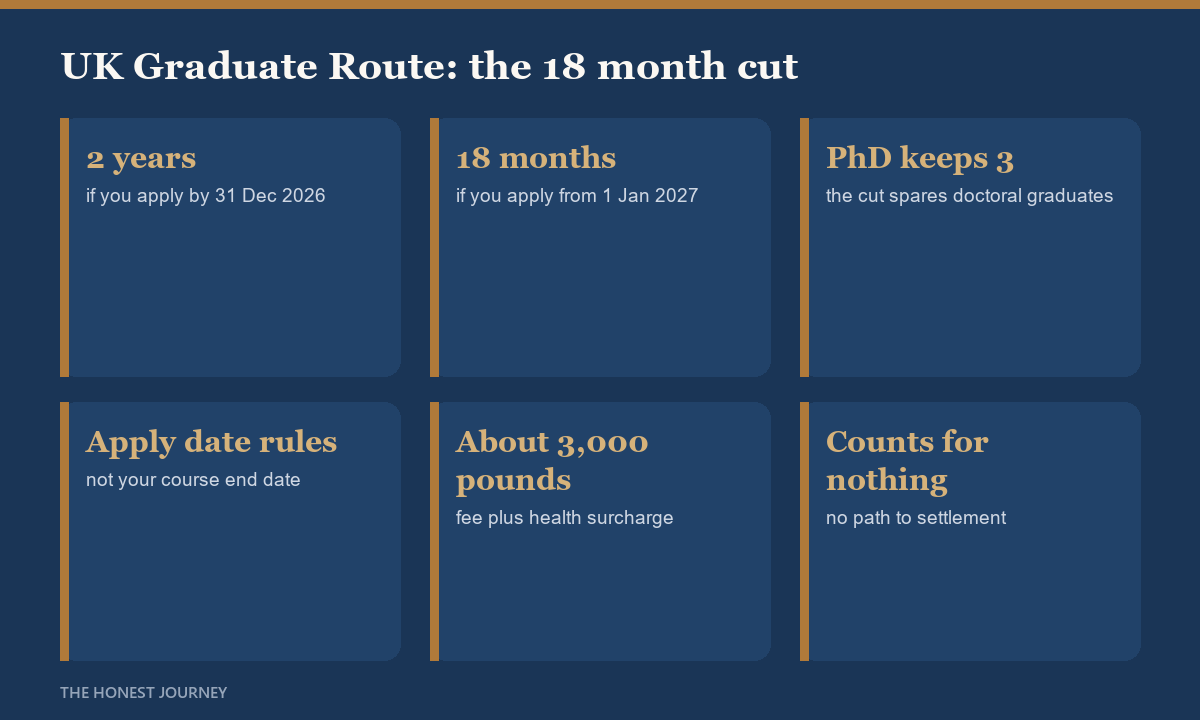
- Apply on or before 31 December 2026: 2 years (bachelor’s and master’s graduates).
- Apply on or after 1 January 2027: 18 months (bachelor’s and master’s graduates).
- PhD and doctoral graduates: 3 years, unchanged by this cut.
Read that list again and notice what it keys off. It is not your course end date. It is not your intake. It is not when you graduated. It is the date your Graduate Route application is submitted. That single detail is where students are going to lose six months, and it is the most useful thing on this page.
The deadline mechanic almost everyone will get wrong
Picture the standard September 2025 intake master’s student. Teaching ends in the summer of 2026, the dissertation goes in around September, and results are confirmed somewhere between late October and December depending on the university. Under the old rules none of that timing mattered much. Under the new rules it decides whether you get 24 months or 18.
If your university confirms your completion in November 2026 and you apply that month, you are on the two year route. If your results slip into January, or if they confirm in December but you decide to travel home for a few weeks and file in the new year, you are on the 18 month route. Same course, same student, same performance, six months of legal work rights gone because of an administrative date.
So if you are finishing in 2026, treat this as a hard operational deadline rather than a piece of background news:
- Chase your university about exactly when they will report your completion to the Home Office. Ask the international student office directly, in writing, and ask for the expected date rather than a vague reassurance.
- Do not leave the UK around your expected completion window if you can avoid it. You must be in the UK to apply, so a badly timed trip home can cost you the deadline.
- Have the money ready before results land. The fee plus the health surcharge for two years runs to roughly 3,000 pounds and it is payable at application. Scrambling to arrange funds in late December is how people miss the date.
- Apply the week you are able to. There is no advantage whatsoever to waiting, and in this specific window there is a six month penalty for it.
If you are starting a UK course in 2026 or later, you should simply plan on 18 months. Almost every degree beginning in 2026 will finish after the change takes effect, so build your budget and your job hunting timeline around a year and a half, and treat anything more as a bonus.
What it costs
The Graduate Route is not cheap, and the surcharge is the part that surprises people because it scales with the length of the visa.
- Application fee: 937 pounds.
- Immigration Health Surcharge: around 1,035 pounds for each year of the visa, payable upfront as a lump sum.
For a two year Graduate Route that is roughly 937 plus 2,070, so about 3,000 pounds due in one payment. At current rates that is somewhere in the region of three lakh rupees landing at exactly the moment your student loan disbursements have stopped and you do not yet have a salary. There is a bitter irony in the 18 month version being cheaper, since you pay less surcharge, but paying 800 pounds less for six months less of work rights is not a saving worth having.
Budget for this from the beginning rather than treating it as a surprise at the end. If you are funding the UK with a loan, check whether your sanction covers post study visa costs, because many do not. Our guide to the cost of studying in the UK covers where this sits in the full picture.
The second squeeze: switching to Skilled Worker got much harder
This is the part that the “Graduate Route cut to 18 months” headlines mostly miss, and it matters more than the cut itself.
The Graduate Route only has value if you can convert it into something durable, and for most graduates that something is the Skilled Worker visa. On 22 July 2025 the bar for that visa moved sharply upward on two axes at once:
- Skill level. Sponsored roles must now sit at RQF Level 6, meaning graduate level work, up from RQF Level 3 previously. A large number of jobs that used to be sponsorable simply are not any more. A temporary shortage list keeps some Level 3 to 5 occupations sponsorable at a lower salary floor, but that list is time limited and narrow.
- Salary. The general threshold is now about 41,700 pounds, and you must be paid the higher of that figure or the specific going rate for your occupation code. There is a lower new entrant rate, and it applies to you specifically: if you are switching from the Graduate visa, you can be paid 70 percent of the going rate as long as the salary is at least 33,400 pounds, for up to four years of total stay. Relevant PhD holders have their own reduced rate of about 37,500 pounds.
Be honest about what those numbers mean. 41,700 is well above what a typical fresh master’s graduate earns in a first UK role, and even the 33,400 new entrant floor sits above many graduate starting salaries outside a handful of sectors. A qualifying salary is achievable in software engineering, quantitative finance, some consulting and some specialised engineering. It is a genuine stretch in marketing, general management, HR, most of the social sciences, hospitality, and a great many of the business master’s programmes that Indian students are most heavily recruited into.
And the employer still has to hold a sponsor licence and be willing to use it on you, which many small and mid sized UK employers are not. So the real sequence is: find an employer who sponsors, in a role at graduate level, paying above the threshold, within 18 months, while on a visa that tells every recruiter you have a clock running.
So is the UK still worth it?
I am not going to tell you the UK is finished, because that is as lazy as the agents telling you nothing has changed. The honest answer is that the UK has become a much more conditional bet, and the conditions are now specific enough that you can actually check whether you meet them before you spend the money.
The plan still works reasonably well if you are going into a field with genuine UK demand and salaries clearing roughly 42,000 pounds for graduates, if you are doing a PhD and therefore keep three years, or if you have prior work experience that lets you enter above graduate scale. It works if your degree is a means to a specific sponsorable occupation you have already researched, and if you are prepared to job hunt from month one rather than month twelve.
It works much less well if you are doing a general business or management master’s with no prior experience and expecting the market to sort it out, if your plan depends on “any job to start, then upgrade later” because that entry rung has largely been removed, or if your loan repayment maths quietly assumed two or three years of UK earnings. That last one is the dangerous case, because the loan is real whether or not the visa works out. If that is you, run the numbers again in our UK ROI guide before you commit, and read the honest comparison of Ireland versus the UK, since Ireland currently offers 24 months after a master’s.
If you cannot reach the salary threshold
For a large number of graduates, particularly outside technical fields, even the new entrant floor will not be reachable in a first UK role. That is worth confronting early rather than discovering at month sixteen. There are a few genuine alternatives, and a few things people wrongly believe are alternatives.
Use the new entrant rate. Switching from the Graduate visa qualifies you as a new entrant, so your floor is 70 percent of the occupation’s going rate with a minimum of £33,400, rather than £41,700. It is time limited: your total stay on that basis cannot exceed four years. Make sure a prospective employer’s immigration adviser applies it rather than quoting you the headline number.
Check the going rate, not just the general threshold. You must be paid the higher of the two, and for some occupation codes the going rate sits below £41,700, in which case the general threshold governs. For others it sits well above. Look up the specific code for the job you are targeting rather than reasoning from the general figure.
Consider the Global Talent route if you have a strong research, academic or digital technology profile, since it does not require employer sponsorship or a salary threshold at all. It is genuinely competitive but it is not restricted to the eminent, and researchers with good endorsements do obtain it.
Consider moving. This is the option nobody wants to hear and the one that most often makes sense. Ireland currently offers two years after a master’s with a conversion route that is considerably more accessible, and it is English speaking and adjacent. Canada offers three years and counts the time towards permanent residence. If your field cannot clear the UK bar, the honest move is to take your UK degree somewhere it converts rather than spending eighteen months proving it does not.
What is not a solution: waiting for the threshold to fall, hoping a small employer will obtain a sponsor licence for you specifically, which is expensive and slow and rarely happens for a single junior hire, or taking a role below RQF Level 6 in the belief you can upgrade later. That entry rung was removed deliberately.
What to do with the 18 months if that is what you get
Assuming you land on the shorter route, the difference between people who convert and people who go home is mostly about when they start, not how hard they try at the end.
Start applying before you graduate, not after the visa arrives. Graduate schemes at the large sponsoring employers, which are the ones most likely to hold licences and pay above threshold, recruit roughly a year ahead. If you wait until your Graduate Route is stamped, you have already missed the cycle that was built for you. Check every target employer against the public register of licensed sponsors before you invest time in an application, because an unsponsored employer cannot hire you at the end no matter how well the interviews go. And be honest with yourself at the twelve month mark about whether the trajectory is real, because that is the point at which you still have time to pivot to another country or plan a return rather than scrambling in the final weeks.
The students who struggle most are not the ones who fail to find a job. They are the ones who spend fourteen months applying to employers who were never able to sponsor them in the first place.
The honest take
The Graduate Route is still a genuinely useful visa and the UK is still a genuinely good place to study. But the version of the plan that was sold to a lot of students, go, get two years, it will work out, has been quietly revised twice in opposite directions: less time to find the job, and a higher bar for the job that counts. Nobody has been especially loud about the second half.
If you are finishing in 2026, the single most valuable thing you can do this month is find out exactly when your university will confirm your completion, and make sure you file your Graduate Route application before 31 December 2026. Six months of work rights are sitting on that one date. If you are still deciding whether to go at all, do the arithmetic with 18 months and a 41,700 pound threshold in it, not with the old assumptions. If it still works, go with confidence. If it only works on the old numbers, you have found something out cheaply, and that is worth more than a comfortable answer.
Rules verified September 2026 against official UK government guidance. Immigration rules change often and the detail matters, so always confirm the current position on gov.uk/graduate-visa before you act on anything here.
Frequently asked questions
Does the 18 month cut apply to me if my course started before 2027?
What matters is when you apply, not when you started or finished. If your Graduate Route application is submitted on or before 31 December 2026 you get two years, even if your course began years earlier. Submit on or after 1 January 2027 and you get 18 months.
Do PhD students still get three years?
Yes. The reduction applies to bachelor’s and master’s graduates. Doctoral graduates continue to receive three years.
Can I extend the Graduate Route?
No. It cannot be extended and does not lead to settlement by itself. Before it expires you must switch to another visa, usually Skilled Worker, or leave the UK.
Can I apply for the Graduate Route from India?
No. You must be physically in the UK on a valid Student visa at the time you apply. This is why travelling home around your completion date is risky if you are close to the December deadline.
Do I need a job offer to get the Graduate Route?
No, and this is its main advantage. It is unsponsored, so you can apply with no job lined up and then work almost any role, change employers, or work for yourself while it lasts.
What salary do I need to switch to Skilled Worker?
Generally around 41,700 pounds, or the going rate for your occupation code if that is higher. If you are switching from the Graduate visa you count as a new entrant, so the floor drops to 70 percent of the going rate with a minimum of 33,400 pounds. The role must also be at RQF Level 6 or above and the employer must hold a sponsor licence.
Does time on the Graduate Route count towards permanent residence?
No. Time spent on the Graduate Route does not count towards settlement. Only time on qualifying routes such as Skilled Worker counts, which is another reason to switch as early as you can rather than using the full window.