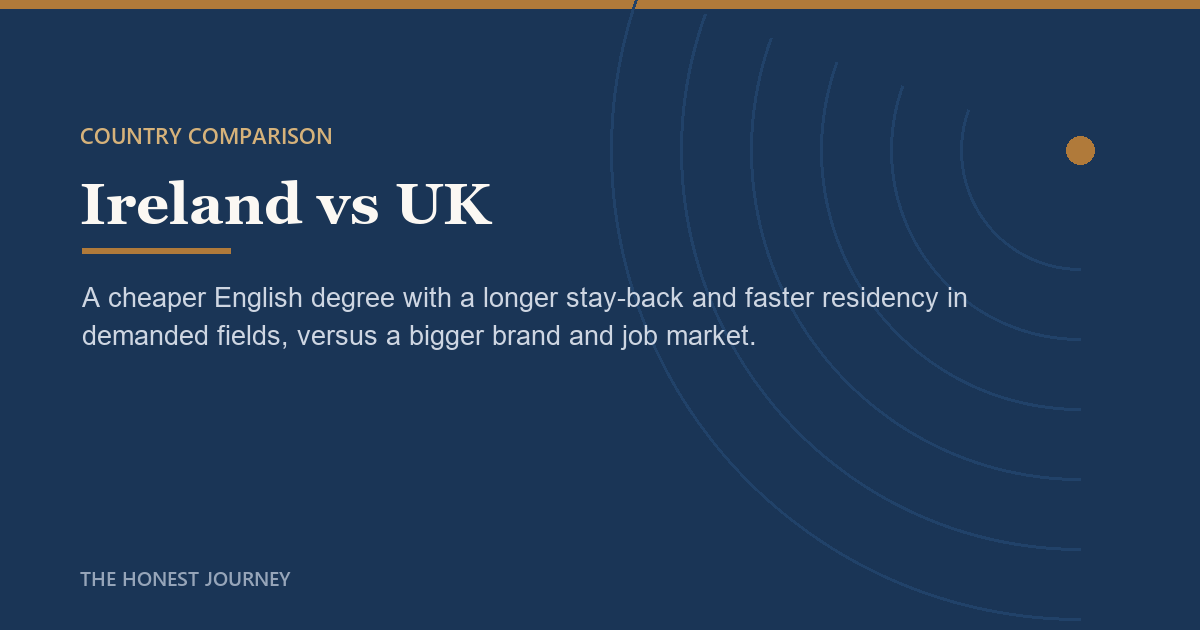
Short answer. The honest Ireland versus UK split for Indian students: Ireland costs a bit less, gives a 24-month post-study stay-back, and can reach Stamp 4 long-term residency in about three years through its Critical Skills route, all in English with strong tech and pharma access.
The UK is more expensive and its Graduate Route drops to 18 months from January 2027, with settlement needing a sponsored job at GBP 38,700 held for five-plus years, but it carries a bigger brand and a far larger job market. Choose Ireland for a faster, cheaper route to staying, the UK for brand and scale.
A pharma graduate I know had offers from Dublin and Manchester and assumed the UK was the obvious pick because of the name. Her cousin, already in Ireland, pushed back: same language, lower cost, a longer stay-back, and a faster route to residency in exactly her field. She chose Ireland, and a year in she is on a Critical Skills track that the UK simply would not have offered her on the same timeline. The UK degree would have been excellent too. Nobody had shown her that Ireland quietly wins on the things she actually cared about.
That quiet comparison is what this post is about. Ireland and the UK look almost interchangeable, both English, both close, both respected, so the decision is usually made on brand alone, which hides real differences in cost, stay-back length, and the route to residency. I will compare them honestly on total cost in rupees, the work window after graduation, the residency pathway and its odds, earnings, and the risk you are actually signing up for. The country-specific process detail stays on the dedicated pages.
For the math I use ₹106 per pound and ₹90 per euro throughout. Rates move, so treat these as the planning frame.
If you are weighing other routes too, these go deeper: the UK vs Canada comparison and the USA vs UK comparison.
The core tension in one paragraph
Ireland is the quieter, more settleable option. It is English, home to the European bases of big tech and pharma, a little cheaper than the UK, and it gives a 24-month post-study stay-back plus a Critical Skills route that can reach long-term Stamp 4 residency in about three years. The trade-offs are a smaller job market and higher rents in Dublin, but for someone in a demanded field, Ireland is often the faster, cheaper path to actually staying.
The UK is the bigger-brand, bigger-market option. A one-year Master’s finishes fast, the brand is globally famous, and the job market, especially in London finance, is far larger. But it is more expensive, the Graduate Route falls to 18 months from January 2027, and settlement needs a sponsored job paying at least GBP 38,700 for five unbroken years. You get scale and prestige, but the stay is costlier and slower.
Total cost in INR, compared honestly
The two are close, with Ireland usually a little cheaper on tuition but carrying its own hidden cost in private health insurance.
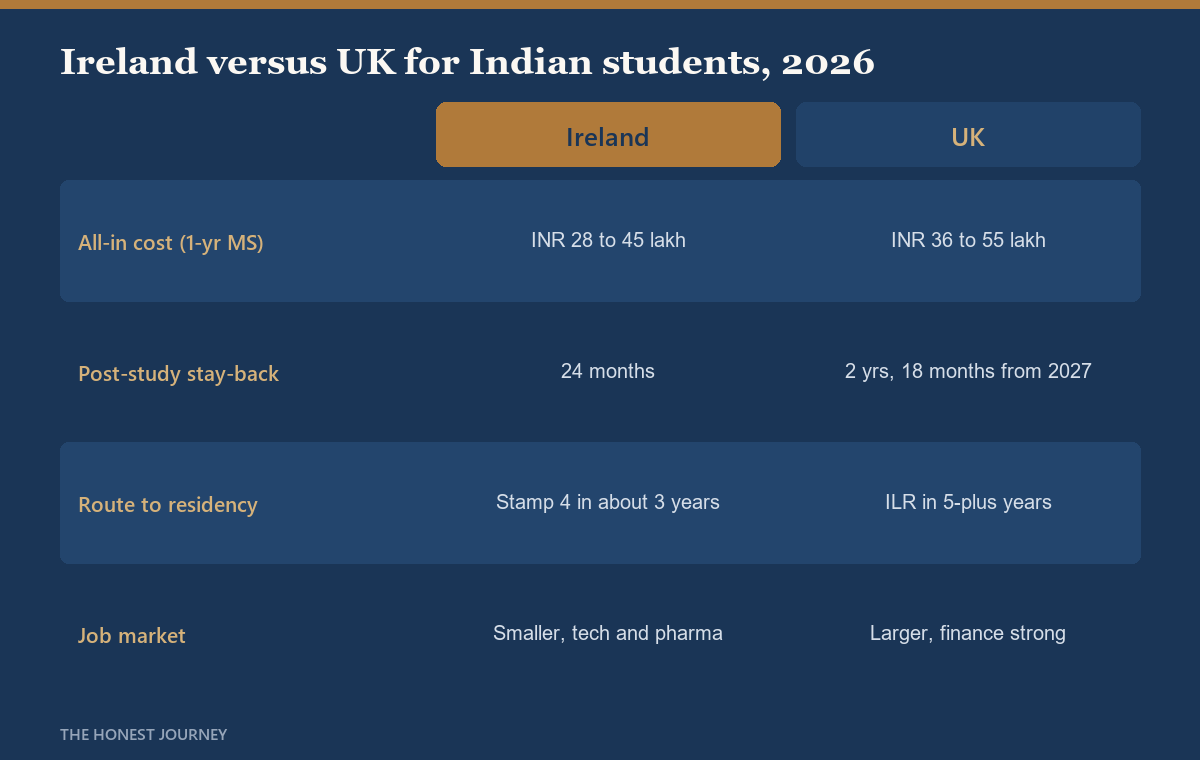
For the UK, a one-year Master’s runs roughly GBP 16,000 to 38,000 in tuition, about ₹17 to 40 lakh, with London living around GBP 1,529 a month and other cities near GBP 1,171, so all-in a one-year UK Master’s commonly lands around ₹36 to 55 lakh, plus the visa fee rising to GBP 937 and the Immigration Health Surcharge of GBP 1,035 per year, which buys NHS access. The detail is in the cost of studying in UK post.
For Ireland, a one-year Master’s runs roughly EUR 12,000 to 25,000 in tuition, about ₹10.8 to 22.5 lakh, with Dublin living high, but total tuition often below the UK. The catch is that Ireland has no NHS equivalent for students, so you must buy private health insurance of about EUR 400 to 600 a year. All-in, a one-year Irish Master’s commonly lands around ₹28 to 45 lakh. The detail is in the cost of studying in Ireland post.
| Item | Ireland (1-year Master’s) | UK (1-year Master’s) |
|---|---|---|
| Tuition (full program) | ~₹11 to 23 lakh | ~₹17 to 40 lakh |
| Living (full program) | ~₹16 to 22 lakh | ~₹15 to 20 lakh |
| Rough all-in total | ~₹28 to 45 lakh | ~₹36 to 55 lakh |
| Health cost | Private insurance EUR 400 to 600/yr | IHS GBP 1,035 per year (NHS access) |
| Program length | 1 year | 1 year |
Ireland is usually the cheaper of the two, mostly on tuition, though Dublin rents narrow the gap and private health insurance adds a line the UK folds into the IHS. Both are one-year Master’s, so both let you start earning quickly. The loan-product side sits in the education loan for Ireland post and the education loan for UK post.
Faz's ruleIreland is cheaper, gives a longer stay-back, and reaches long-term residency faster in demanded fields. The UK is pricier but has a far bigger job market and a stronger brand. That is the whole trade.
On paper Ireland quietly beats the UK on cost, stay-back length, and speed to residency, especially in tech and pharma. The UK wins on brand and the sheer size of its job market, particularly London finance. Pick the one whose strengths match your field and your goal.
The work window after you graduate
Both give a post-study window, but Ireland’s is now longer while the UK’s is shrinking.
In Ireland, the Third Level Graduate Programme lets graduates of Level 8, 9 or 10 qualifications stay for 24 months to seek employment, working full-time for any employer during that time. Once you secure a qualifying job, you move onto a General Employment Permit or, in demanded fields, a Critical Skills Employment Permit, which is the fast lane to residency. The official rules are on the Irish immigration service.
In the UK, the Graduate Route lets a Master’s graduate work without sponsorship, but the duration falls from two years to 18 months for those applying from January 2027, after which staying needs a sponsored Skilled Worker visa. The official rules are on gov.uk.
| Work window factor | Ireland | UK Graduate Route |
|---|---|---|
| Length after Master’s | 24 months (stay-back) | 2 years, 18 months from Jan 2027 |
| Job offer needed to start | No | No |
| Next step to stay | Critical Skills or General Employment Permit | Sponsored Skilled Worker visa |
| Route to residency | Stamp 4 in about 3 years (Critical Skills) | ILR in 5-plus years |
| Demanded-field advantage | Strong, Critical Skills list | Occupation and salary dependent |
The residency pathway and its odds, said plainly
This is the heart of the decision, and Ireland has the quiet edge for demanded fields.
In Ireland, the fast route is the Critical Skills Employment Permit, aimed at high-demand occupations such as tech, engineering, healthcare and pharma. It gives immediate family reunification benefits and leads to long-term residency, Stamp 4, in about two years of employment, so from graduation the whole path to Stamp 4 can run around three years. That is genuinely fast for an English-speaking country. The catch is that the fast route depends on landing a job on the Critical Skills list above its salary threshold.
In the UK, settlement, called Indefinite Leave to Remain, needs a Skilled Worker visa with a sponsoring employer, a role paying at least GBP 38,700, and five unbroken years, with the timeline proposed to extend further. The earliest realistic path from your first study day is around seven years. The UK job market is far larger, which helps you find that sponsored role, but the timeline and salary bar are higher.
One honest note on citizenship: India does not permit dual citizenship, so eventually naturalising as Irish or British would mean giving up your Indian passport in either country. The difference is in the residency stage, where Ireland’s Stamp 4 route is faster and does not require you to surrender anything. The plain version: Ireland reaches secure long-term residency faster, especially in demanded fields; the UK takes longer and needs a high-paying sponsor, but sits on a much bigger job market.
Faz's ruleIreland can reach long-term Stamp 4 residency in about three years through its Critical Skills route; the UK needs five-plus years and a sponsored GBP 38,700 job. In a demanded field, Ireland is the faster settle.
If you are in tech, pharma, engineering or healthcare, Ireland’s Critical Skills route is a genuinely fast, English-language path to residency that the UK cannot match on timeline. The UK’s advantage is the size of its job market, which makes finding a sponsor easier. Match the country to your field.
Earnings and risk
UK graduate salaries span a wide range, strong in London finance and tech, roughly GBP 30,000 to 40,000 and well above in elite roles, about ₹32 to 42 lakh gross and up. Irish graduate salaries are also strong, especially in the tech and pharma multinationals clustered around Dublin, commonly EUR 35,000 to 45,000, about ₹31.5 to 40.5 lakh gross, with demanded roles paying more. The two are broadly comparable, with the UK ahead at the top of finance and Ireland strong in tech and pharma.
The risk split is about scale versus speed. The UK risk is the sponsorship cliff in a shrinking window: a fast degree, then a scramble for a sponsored role above GBP 38,700, softened by a large job market. The Ireland risk is a smaller job market and high Dublin rents, offset by a longer stay-back and a faster residency route in demanded fields. Model the UK on landing a sponsored role in a big market; model Ireland on landing a Critical Skills job in a smaller but targeted one.
A worked INR comparison for one candidate
Take one student, a computer-science or pharma graduate from India with an admit to an Irish university and a UK Russell Group university. Same person, two roads.
| Factor | Ireland (1-year Master’s) | UK (1-year Master’s) |
|---|---|---|
| Tuition | EUR 20,000 = ~₹18L | GBP 26,000 = ~₹27.6L |
| Living | EUR 18,000 = ~₹16.2L | GBP 16,000 = ~₹17L |
| All-in study cost | ~₹34.2 lakh | ~₹44.6 lakh |
| Post-study stay-back | 24 months | 2 years, 18 months from Jan 2027 |
| Starting salary (gross) | ~₹31.5 to 40.5L/yr | ~₹32 to 42L/yr and up |
| Route to residency | Stamp 4 in about 3 years (Critical Skills) | ILR in 5-plus years, sponsored |
The Irish road costs around ₹10 lakh less here, gives a longer settled stay-back, and reaches secure residency faster in a demanded field, at a similar salary. The UK road costs more and takes longer to residency, but sits on a much larger job market and a stronger brand. The numbers favour Ireland on cost and speed to staying, and the UK on scale and prestige, which is exactly the trade. Whether the whole thing is worth it for you is the bigger question in the is studying abroad worth it post.
Choose Ireland if, choose UK if
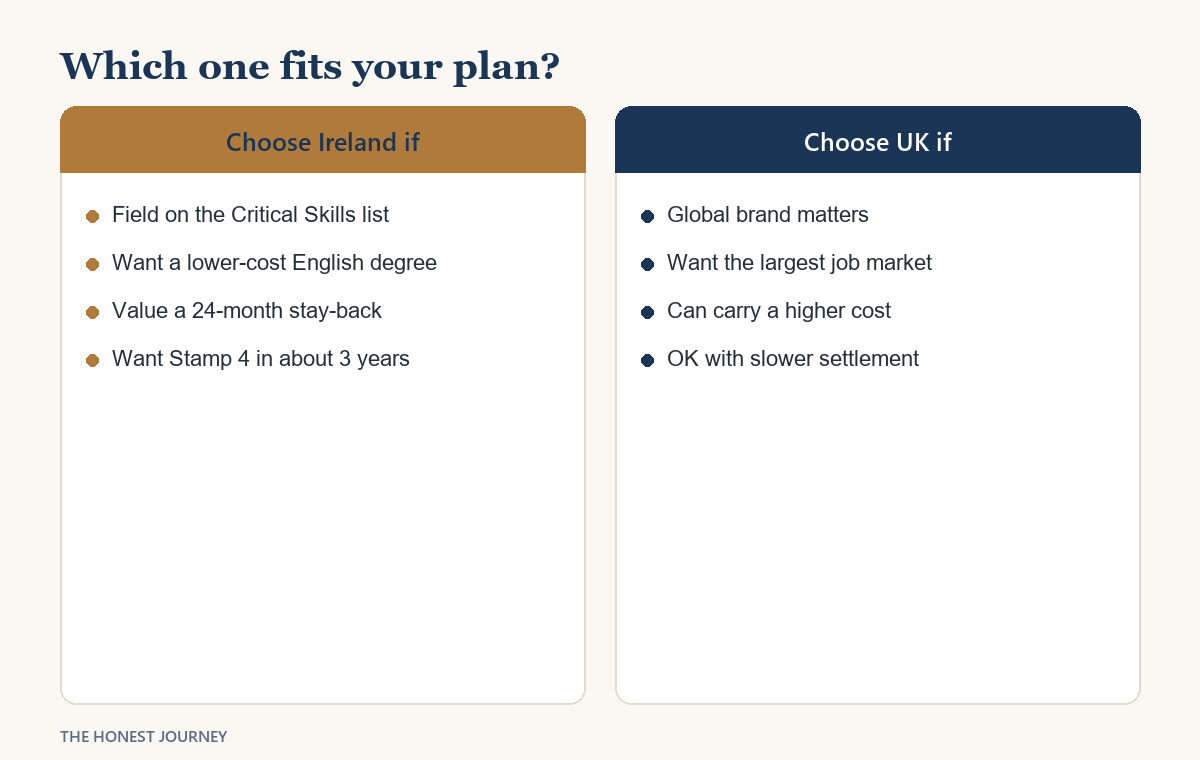
It comes down to whether you want a faster, cheaper route to staying or a bigger brand and market.
Choose Ireland if you are in a demanded field like tech, pharma, engineering or healthcare, you want a lower-cost English-language degree, and you value a 24-month stay-back and a Critical Skills route that reaches secure residency in about three years. Ireland rewards students whose field sits on its Critical Skills list, giving them one of the faster English-speaking paths to staying in this comparison.
Choose the UK if the global brand matters for your field such as finance or consulting, you want the largest possible job market to find a sponsoring employer, and you can carry the higher cost and the slower settlement timeline. The UK rewards scale and prestige, and it is excellent if your goal is a strong sponsored role in a big market or a confident return to India.
One honest note for both: an Irish or UK Master’s plus a few years of real foreign work experience is also a strong route back into the Indian job market, and for many students that return is the smartest plan from the start. Do not assume staying abroad is the only good outcome.
The honest take
My pharma friend does not regret choosing Ireland for a second. Same language, lower cost, a longer stay-back, and a residency route that fits her field precisely. The UK degree would have carried a bigger name, but on the things she actually wanted, staying and cost, Ireland quietly won.
So compress it to one question: is your field on Ireland’s Critical Skills list, and do you want to stay? If yes, Ireland is often the cheaper, faster, English-language route to residency. If you want the biggest brand and job market and can carry the higher cost and slower settlement, the UK is the stronger scale play. Decide your field and your goal first, then pick. And read the process detail on the study in Ireland page and the study in UK page before you commit a rupee.
Funding the move with a loan? Start with the complete education loan guide, then apply through the PM Vidyalakshmi portal, the government route most Indian students use.
FAQ
Is Ireland or the UK cheaper for Indian students?
Ireland is usually a little cheaper, mainly on tuition. A one-year Irish Master’s commonly lands around ₹28 to 45 lakh all-in, while a one-year UK Master’s runs around ₹36 to 55 lakh. Dublin rents narrow the gap, and Ireland adds private health insurance of about EUR 400 to 600 a year since there is no NHS equivalent, whereas the UK folds health into the Immigration Health Surcharge. Both are one-year degrees, so both let you start earning quickly.
Which has the longer post-study stay-back?
Ireland, especially from 2027. Ireland’s Third Level Graduate Programme gives 24 months to seek work after a Level 8, 9 or 10 qualification. The UK Graduate Route currently gives two years but drops to 18 months for Master’s graduates applying from January 2027. So from 2027, Ireland’s stay-back is longer, and it leads into the Critical Skills route, which reaches long-term residency faster than the UK’s sponsored settlement path.
Which has the faster route to permanent residency?
Ireland, for demanded fields. Ireland’s Critical Skills Employment Permit, aimed at tech, pharma, engineering and healthcare, leads to long-term Stamp 4 residency in about two years of employment, so roughly three years from graduation. UK settlement needs a sponsored Skilled Worker job paying at least GBP 38,700, held for five unbroken years, with the timeline proposed to extend, so around seven years from your first study day. Ireland is faster if your field is on its Critical Skills list.
Can I keep my Indian passport if I settle in Ireland or the UK?
At the residency stage, yes in both, since Stamp 4 in Ireland or Indefinite Leave to Remain in the UK are residency, not citizenship. The nuance is citizenship: India does not permit dual nationality, so if you later naturalise as Irish or British, you would have to give up your Indian passport in either country. Ireland’s advantage is reaching secure long-term residency faster, not a dual-citizenship benefit, since that constraint comes from Indian law.
Do UK salaries beat Irish salaries for graduates?
They are broadly comparable, with each ahead in different fields. UK graduate pay is strong in London finance and tech, roughly GBP 30,000 to 40,000 and well above in elite roles. Irish pay is strong in the tech and pharma multinationals around Dublin, commonly EUR 35,000 to 45,000, about ₹31.5 to 40.5 lakh gross. The UK edges ahead at the top of finance; Ireland is excellent in tech and pharma, where its Critical Skills route also speeds up residency.
Is the UK Graduate Route being reduced?
Yes. Master’s graduates who apply for the Graduate Route from 1 January 2027 receive 18 months rather than two years, and the government has proposed lengthening the settlement timeline separately. Confirm exactly what your intake and application date qualify for. This reduction is one reason students focused on staying increasingly compare the UK against Ireland’s longer 24-month stay-back and its faster Critical Skills residency route.
Which is better for tech and pharma students?
Often Ireland. Dublin hosts the European bases of major tech and pharma multinationals, and those exact fields sit on Ireland’s Critical Skills list, which unlocks a faster route to Stamp 4 residency. The UK has a larger overall job market and a stronger finance sector, but for tech and pharma specifically, Ireland combines strong employers, a longer stay-back, and a quicker path to staying, usually at a lower cost.
Should I choose Ireland for staying or the UK for brand?
Decide your field and goal first, because they settle the country. If you are in a Critical Skills field and want to stay, Ireland is often cheaper, offers a longer stay-back, and reaches residency faster. If the global brand matters for your field and you want the largest job market to find a sponsor, the UK is the stronger scale play despite the higher cost and slower settlement. Choosing the UK on brand alone, without checking whether Ireland fits your field better, is the most common oversight here.
Faz · The Honest Journey · 2026