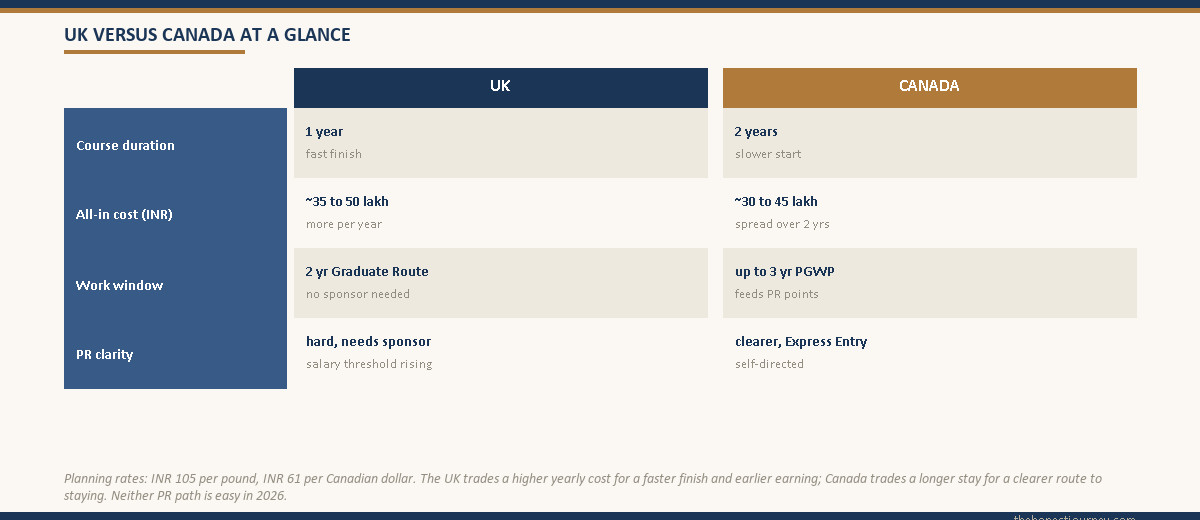
Short answer. For most Indian students the honest split is this: the UK gets you a one-year Master’s plus a 2-year Graduate Route for roughly ₹35 to 50 lakh all-in, but settling there is genuinely hard.
Canada costs a similar ₹30 to 45 lakh over a longer stay, yet its PGWP to PR runway is clearer if you plan the program right. Choose UK for speed, Canada for staying.
I have watched two cousins go down these two roads in the same year. One did a one-year Master’s in Manchester, was back working in London on the Graduate Route within fourteen months of leaving India, and is now quietly worried about what happens when those two years run out. The other went to Ontario for a two-year program, took longer and felt slower the whole way, but is now sitting inside a clearer permanent-residence track and sleeping better for it.
That is the real UK versus Canada question for an Indian student. It is not which country is better. It is which trade you want to make: fast and finished, or slower and more likely to stay. This post compares the two honestly on cost in rupees, the work window after you graduate, the PR odds, and the risk you are signing up for. I will keep the country-specific process detail out of it and point you to the dedicated pages instead.
For the planning math I use ₹105 per British pound and ₹61 per Canadian dollar throughout. Rates move, so treat these as the frame, not a quote.
If you are deciding on Canada, these go deeper: the USA vs Canada comparison and the GIC for Canada post.
The core tension in one paragraph
The UK is built for speed. A taught Master’s is usually one year, and the Graduate Route lets you stay and work for two years afterwards with no job offer needed. That is the fastest route from leaving India to earning abroad that any major destination offers. The catch is that converting those two years into long-term settlement is hard, because the Skilled Worker route needs a sponsoring employer and a salary threshold that many graduate roles do not clear.
Canada runs the opposite way. Programs are often two years, the pace is slower, and the Post-Graduation Work Permit can run up to three years depending on the length of your study program. More importantly, that work permit is designed to feed into permanent residence through Express Entry and the Provincial Nominee streams. The runway from study to PR is more clearly mapped than anywhere else in the comparison, even though Canada has been tightening study permits and PR targets since 2024.
Total cost in INR, compared honestly
The headline cost looks close, but the shape is different. The UK packs the spend into one intense year. Canada spreads a similar or slightly lower total across two years, which changes how you fund it and how soon you start earning.
For the UK, a taught Master’s at a solid university runs roughly GBP 18,000 to 30,000 in tuition, which at ₹105 is about ₹19 to 31.5 lakh. Living for one year outside London sits around GBP 12,000 to 15,000, or ₹12.6 to 15.75 lakh; London is meaningfully higher. The Home Office also wants proof of maintenance funds before the visa, currently GBP 1,023 per month outside London for up to nine months. The detailed UK numbers live in the cost of studying in UK post.
For Canada, a Master’s runs roughly CAD 20,000 to 35,000 per year in tuition, which at ₹61 is about ₹12.2 to 21.35 lakh per year. Living outside Toronto and Vancouver sits around CAD 15,000 to 18,000 a year, or ₹9.15 to 10.98 lakh. Canada raised its proof-of-funds requirement to CAD 20,635 for living costs beyond tuition and travel, so budget for that at the visa stage. The full Canada breakdown is in the cost of studying in Canada post.
| Item | UK (1-year Master’s) | Canada (2-year Master’s) |
|---|---|---|
| Tuition (full program) | ~₹19 to 31.5 lakh | ~₹24 to 42 lakh (two years) |
| Living (full program) | ~₹12.6 to 15.75 lakh (1 yr) | ~₹18 to 22 lakh (two years) |
| Proof of funds at visa | GBP 1,023/month (~₹1.07L) | CAD 20,635 (~₹12.59L) |
| Rough all-in total | ~₹35 to 50 lakh | ~₹30 to 45 lakh |
| Time to start earning | ~12 to 15 months | ~24 to 28 months |
Read that last row carefully, because it is the part families miss. The UK total is higher per year but you start earning a UK salary roughly a year sooner. Canada’s total is lower but your money is committed for two years before any graduate income arrives. On a pure cash-flow basis the UK can actually look better despite the higher sticker, which is why “Canada is cheaper” is only half true.
Faz's ruleCompare the two on cash-flow timing, not just sticker price. The UK costs more per year but you earn a UK salary a full year sooner, while Canada's lower total is locked up for two years before any graduate income arrives.
Families fixate on the bigger UK tuition number and call Canada the cheap option. Run it as cash flow instead. A year of earlier earning in pounds can close most of the gap. If you can fund the UK year without stretching, the faster payback is real, not imagined.
The work window after you graduate
This is where the two countries diverge most sharply, and it is the single most important number after cost.
The UK Graduate Route gives you two years of unsponsored work rights after a Bachelor’s or Master’s, three after a PhD. You do not need a job offer to switch onto it, you do not need a sponsor, and you can work for anyone or be self-employed. It is the most flexible post-study window in the comparison. The official terms are on gov.uk. The weakness is that it is a fixed, non-renewable window. When the two years end, you must already be on a sponsored Skilled Worker visa or you leave.
Canada’s Post-Graduation Work Permit length matches your study program length, up to a maximum of three years. A two-year Master’s typically earns a three-year PGWP, which is a longer runway than the UK’s two years. The bigger difference is purpose: the PGWP exists to let you gain the Canadian work experience that Express Entry rewards. The official rules are on canada.ca. Note that Canada narrowed PGWP eligibility for some programs in 2024, so confirm your specific program still qualifies before you commit.
| Work window factor | UK Graduate Route | Canada PGWP |
|---|---|---|
| Length after Master’s | 2 years | Up to 3 years |
| Job offer needed to start | No | No |
| Sponsor needed | No | No |
| Designed to feed PR | Not directly | Yes, builds Express Entry points |
| Renewable | No | No, one-time |
The PR odds, said plainly
Here is the honest core. Both countries have tightened in the last two years, so nobody should treat either PR route as a sure thing. But the structures are genuinely different.
In the UK, settlement runs through the Skilled Worker visa to Indefinite Leave to Remain, usually after five years of qualifying sponsored work. The hard part is getting onto the Skilled Worker visa at all: you need an employer licensed to sponsor you, and the role must clear a salary threshold that has been raised repeatedly and now sits well above many entry graduate salaries. The Graduate Route does not count toward ILR, so your two years on it are a buffer to find a sponsor, not progress toward settlement. Many graduates spend that window chasing a sponsoring job and leave when it ends.
In Canada, PR runs through Express Entry, where your Canadian study and post-study work experience directly raise your Comprehensive Ranking System score. You do not need an employer to sponsor your PR application. Canadian work experience under the PGWP, a Canadian credential, and language scores all push your ranking up, and Provincial Nominee streams add another path. Canada has lowered its immigration targets and raised CRS cut-offs since 2024, so the odds are tighter than they were, but the pathway is still self-directed in a way the UK’s is not.
So the plain version: in the UK, your PR depends on an employer choosing to sponsor you at a high salary. In Canada, your PR depends mostly on you accumulating points the system already rewards. Neither is easy now. Canada’s is more in your own hands.
Faz's ruleIn the UK your PR depends on an employer sponsoring you above a rising salary threshold; in Canada it depends mostly on points you can accumulate yourself. Neither is easy, but only one is largely in your control.
The UK Graduate Route is a search window, not a settlement track. If you do not land a sponsoring job inside two years, you leave. Canada’s PGWP feeds Express Entry directly. Decide whether you want your future resting on an employer’s decision or on your own point-building.
Earnings and time to payback
UK graduate salaries outside London commonly start around GBP 28,000 to 35,000, which at ₹105 is roughly ₹29 to 37 lakh a year gross. London pays more but costs more. Canadian graduate salaries commonly start around CAD 55,000 to 70,000, or about ₹33.5 to 42.7 lakh a year gross at ₹61, though Canadian living costs and taxes eat into that.
The numbers are closer than people assume. The UK’s edge is that you reach that salary a year sooner because the degree is shorter. Canada’s edge is the longer work permit, which gives more years to repay before any status cliff. If your priority is paying down an education loan fast, the UK’s earlier start matters; if it is building toward staying, Canada’s longer runway matters more. Either way, model your loan repayment on the work window you are near-certain to get, not on a settlement you are hoping for.
A worked INR comparison for one candidate
Take one student, an engineering graduate from India, comparing a one-year Master’s in Manchester against a two-year Master’s in Ontario. Same person, two roads.
| Factor | UK (Manchester, 1 yr) | Canada (Ontario, 2 yr) |
|---|---|---|
| Tuition | GBP 24,000 = ~₹25.2L | CAD 50,000 total = ~₹30.5L |
| Living | GBP 14,000 = ~₹14.7L | CAD 34,000 total = ~₹20.7L |
| All-in study cost | ~₹39.9 lakh | ~₹51.2 lakh |
| Post-study work window | 2 years (Graduate Route) | 3 years (PGWP) |
| Starts earning | ~month 13 | ~month 25 |
| PR pathway | Needs sponsor, hard | Express Entry, clearer |
The UK road is finished and earning by month thirteen, with a lower all-in cost in this example, but with a two-year clock and a hard settlement step. The Canada road costs more here and earns later, but buys a three-year window pointed at PR. There is no universally right answer. There is only which trade fits your goal and your loan. If you are funding most of this on a loan, the UK’s faster payback is a real advantage; the loan-product side for both sits in the education loan for UK post and the education loan for Canada post.
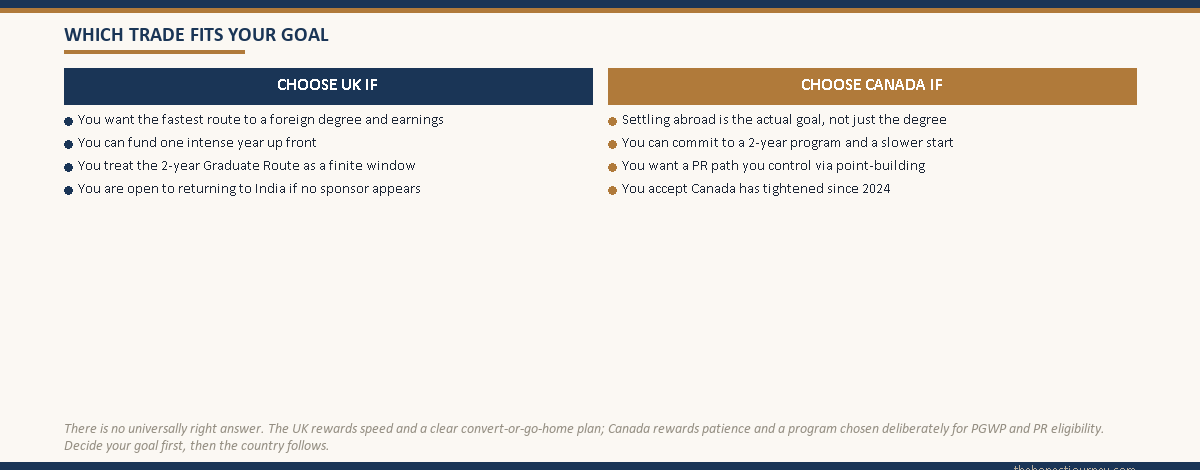
Choose UK if, choose Canada if
Strip away the detail and it comes down to what you are optimising for.
Choose the UK if you want the fastest route to a foreign degree and foreign earnings, you can fund one intense year, you are comfortable treating the two-year Graduate Route as a finite window rather than a settlement track, and you are open to returning to India or moving elsewhere if a sponsoring job does not appear. The UK rewards speed and a clear plan to either convert or go home.
Choose Canada if settling abroad is the actual goal, you can commit to a two-year program and a slower start, you want a PR pathway that depends mostly on your own point-building rather than an employer’s decision, and you accept that Canada has been tightening and the odds are not what they were in 2022. Canada rewards patience and a program chosen deliberately for PGWP and PR eligibility.
One more honest note. Both routes also feed a perfectly respectable return-to-India outcome. A UK or Canadian Master’s plus one to three years of real foreign work experience is a strong re-entry into the Indian job market, and for many students that is the smartest plan all along. Whether the whole thing is worth it for your situation is the bigger question in the is studying abroad worth it post.
The honest take
If I had to compress two cousins’ experiences into one line: the UK is the better bet if you want to go, earn, and keep your options open, and Canada is the better bet if you are reasonably sure you want to stay and are willing to play a longer, slower game for it. The UK’s risk is the settlement cliff at the end of the Graduate Route. Canada’s risk is tightening rules and a two-year commitment before any income.
Do not pick on vibes or on which country your friends chose. Pick on your honest answer to one question: am I going for the experience and the degree, or am I going to settle? Answer that first. The country falls out of the answer. And whichever you choose, read the destination process detail on the study in UK page and the study in Canada page before you commit a rupee.
Weighing more than two countries? See also UK vs Australia and Germany vs Canada for Indian students.
FAQ
Is the UK or Canada cheaper for Indian students?
Canada’s all-in total is usually slightly lower, roughly ₹30 to 45 lakh against the UK’s ₹35 to 50 lakh, but the comparison is misleading. The UK packs its cost into one year and lets you start earning about a year sooner, while Canada spreads a similar total across two years before any graduate income. On a cash-flow basis the UK can come out even or ahead despite the higher sticker price, so compare timing, not just totals.
Which has the better post-study work window, the UK or Canada?
Canada’s Post-Graduation Work Permit can run up to three years for a two-year Master’s, longer than the UK’s two-year Graduate Route. But the UK route starts a year sooner because the degree is shorter, and neither needs a job offer or sponsor to begin. The bigger difference is purpose: Canada’s PGWP is built to feed permanent residence through Express Entry, while the UK’s Graduate Route is a finite window with no direct link to settlement.
Is it easier to get PR in Canada or the UK after studying?
Canada’s pathway is more self-directed. Express Entry rewards your Canadian study, work experience, and language scores with points, and you do not need an employer to sponsor your PR application. The UK requires an employer-sponsored Skilled Worker visa above a rising salary threshold before you can work toward settlement, and the Graduate Route does not count toward it. Both have tightened since 2024, but Canada’s odds rest more in your own hands.
How long does each route take from India to earning abroad?
The UK is faster. A one-year taught Master’s means you can be working on the Graduate Route roughly 12 to 15 months after leaving India. Canada’s typical two-year Master’s pushes the first graduate salary to around 24 to 28 months. If repaying an education loan quickly is your priority, the UK’s earlier earning start is a genuine advantage; if staying long-term is the goal, Canada’s longer runway matters more.
Do UK graduate salaries beat Canadian ones?
They are closer than most expect. UK graduate salaries outside London commonly start around GBP 28,000 to 35,000, roughly ₹29 to 37 lakh a year gross. Canadian graduate salaries commonly start around CAD 55,000 to 70,000, about ₹33.5 to 42.7 lakh gross, though living costs and taxes eat into that. Neither is dramatically ahead, so let the work window and PR pathway, not the salary alone, drive your decision.
Is the UK Graduate Route enough to settle there?
No, not by itself. The Graduate Route gives two years of unsponsored work but does not count toward Indefinite Leave to Remain. To settle, you must switch onto a sponsored Skilled Worker visa before the two years end, which needs a licensed employer and a salary above a threshold that has risen repeatedly. Treat the Graduate Route as a window to find that sponsoring job, and have a plan for if you do not.
Has Canada become harder for Indian students?
Yes, somewhat. Since 2024 Canada has cut study permit numbers, raised the proof-of-funds requirement to CAD 20,635, narrowed PGWP eligibility for some programs, and lowered overall PR targets, which has pushed Express Entry cut-off scores higher. The PR pathway still exists and is still clearer than the UK’s, but the odds are tighter than they were. Confirm your specific program qualifies for the PGWP before you commit.
Should I choose based on the degree or on settling abroad?
Answer that question first, because the country falls out of it. If you want the degree and foreign work experience with options open, including a strong return to India, the UK’s speed suits you. If settling abroad is the real goal, Canada’s PGWP-to-PR runway is the better-structured bet despite the longer commitment. Picking the country before deciding your goal is how students end up in the wrong trade-off for their actual plan.
Faz · The Honest Journey · 2026