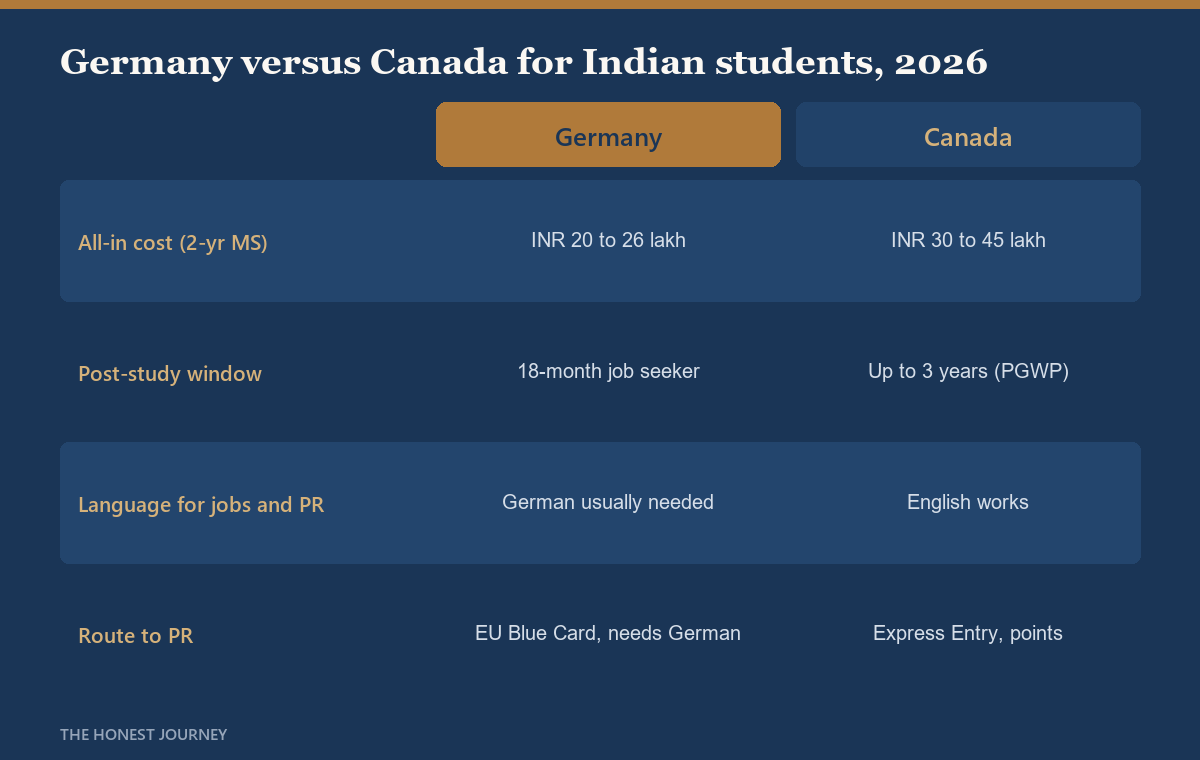
Short answer. The honest Germany versus Canada split for Indian students: Germany is the cheapest serious destination here, near-zero public tuition and roughly ₹20 to 26 lakh all-in, with a strong engineering job market, but real jobs and permanent residence effectively need German, and the post-study window is a shorter 18 months.
Canada costs far more at roughly ₹30 to 45 lakh and pays in English with a clearer PGWP-to-Express-Entry PR path, but it has tightened hard since 2024. Choose Germany for the lowest cost and engineering if you will learn the language, Canada for an English-language route to staying.
Two cousins in the same family split exactly this way last year. One took a fully funded-feeling public Master’s in Munich, tuition almost nothing, and told everyone it was a no-brainer on cost. The other paid three times as much for a Master’s in Ontario because, as her father put it, she could actually work and settle in English. A year in, the Munich cousin is strong on paper but stuck in beginner German classes to unlock the jobs she wants, and the Ontario cousin is paying a much bigger loan but already banking Canadian work experience toward PR. Neither chose wrong. Nobody had laid out the real trade before they picked.
That trade is what this post is about. Germany and Canada are the two destinations cost-conscious Indian families most often weigh against each other, and the comparison is usually done on tuition alone, which is the wrong lens. I will compare them honestly on total cost in rupees, the work window after graduation, the PR pathway and its odds, earnings and the language catch, and the risk you are actually signing up for. The country-specific process detail stays on the dedicated pages.
For the math I use ₹90 per euro and ₹61 per Canadian dollar throughout. Rates move, so treat these as the planning frame.
If you are weighing other routes too, these go deeper: the Canada vs Australia comparison and the UK vs Canada comparison.
The core tension in one paragraph
Germany is the low-cost, high-friction option. Public universities charge international students almost nothing, only a nominal semester contribution, so the ticket is the smallest of any major destination, and the industrial economy genuinely wants engineers and STEM graduates. But the friction is language. Most good jobs, most daily life, and the faster settlement routes assume German, and the post-study job-seeker window is 18 months, shorter than Canada’s. You save a fortune upfront and pay in years of language effort.
Canada is the higher-cost, lower-friction option. Tuition and living cost far more, but the whole system runs in English, the Post-Graduation Work Permit gives up to three years, and it feeds Express Entry permanent residence directly. The catch is that Canada has tightened since 2024, with study-permit caps, a higher proof-of-funds bar, and rising Express Entry cut-offs, so the pathway is real but no longer easy. You pay more upfront for an English-language route you can plan toward.
Total cost in INR, compared honestly
This is the first place the two diverge hard, and it is the reason Germany is on the list at all. The German ticket is structurally tiny because public tuition is essentially free; almost your entire cost is living. Canada is far more expensive on both tuition and living.
For Germany, public universities charge only a nominal semester contribution of EUR 100 to 350, so tuition over a two-year Master’s is often under ₹1.5 lakh in total. The real cost is living, and the visa requires a blocked account of around EUR 11,904 a year, about ₹10.7 lakh, as proof of funds. All-in, a two-year German public Master’s commonly lands around ₹20 to 26 lakh, almost all of it living and fees, not tuition. The full detail is in the cost of studying in Germany post.
For Canada, a Master’s runs roughly CAD 20,000 to 35,000 per year in tuition, about ₹12.2 to 21.35 lakh per year, with living outside Toronto and Vancouver around CAD 15,000 to 18,000 a year, or ₹9.15 to 10.98 lakh. All-in, a two-year Canadian Master’s commonly lands around ₹30 to 45 lakh, and the visa needs CAD 20,635 in proof of funds beyond tuition. The detail is in the cost of studying in Canada post.
| Item | Germany (2-year Master’s) | Canada (2-year Master’s) |
|---|---|---|
| Tuition (full program) | ~₹0 to 1.5 lakh (public) | ~₹24 to 42 lakh |
| Living (full program) | ~₹20 to 24 lakh | ~₹18 to 22 lakh |
| Rough all-in total | ~₹20 to 26 lakh | ~₹30 to 45 lakh |
| Typical loan shape | Small, often PSU-fundable or self-funded | Larger, GIC-linked |
| Proof of funds at visa | Blocked account ~EUR 11,904 (~₹10.7L) | CAD 20,635 (~₹12.59L) |
The cost gap is large and it changes the whole risk profile. A German degree can often be funded with a small loan or even family savings, so the financial downside if things do not work out is limited. A Canadian degree usually means a real loan of ₹30 lakh or more, which only pencils out if the PGWP-to-PR runway actually delivers. The loan-product side for both sits in the education loan for Germany post and the education loan for Canada post.
Faz's ruleGermany saves you a fortune in tuition but bills you in language. Canada charges you in rupees upfront but runs in English. Decide which currency you can actually pay.
A near-free German Master’s is only cheap if you can convert it into a job, and most of those jobs and the faster PR routes assume German. A Canadian Master’s costs far more upfront, but the language barrier is gone. Count the language effort as part of Germany’s real price, because it is.
The work window after you graduate
Both countries give a post-study window, but they differ in length and in what they are built to do.
In Germany, a graduate from a recognised university can apply for an 18-month residence permit to seek work related to the degree. Once you find a qualifying job, you move onto a work permit or an EU Blue Card, which is the fast lane. The 18 months is shorter than Canada’s window, and the clock is real: without German, finding a qualifying role inside that window is genuinely harder in many fields. The official framework sits with the German missions and the Make it in Germany portal, and Indian students now also need an APS certificate to apply.
In Canada, the Post-Graduation Work Permit matches your program length up to three years, so a two-year Master’s typically earns a three-year PGWP, and it is designed to build the Canadian work experience Express Entry rewards. It is not a holding pattern; it is the first step of the PR pathway. The official rules are on canada.ca. Canada narrowed PGWP eligibility for some programs in 2024, so confirm yours still qualifies.
| Work window factor | Germany | Canada PGWP |
|---|---|---|
| Length after Master’s | 18-month job-seeker permit | Up to 3 years |
| Job offer needed to start | No, but needed to convert | No |
| Language pressure | High for most qualifying jobs | Low, English works |
| Next step to stay | Work permit or EU Blue Card | Express Entry PR |
| Feeds PR directly | Yes, via Blue Card route | Yes |
The PR pathway and its odds, said plainly
This is the heart of the decision, and the two systems reward completely different things.
In Germany, the fast route to permanent residence is the EU Blue Card, granted to graduates who land a qualifying job above a salary threshold. On a Blue Card you can reach a settlement permit in as little as about 21 months if you show B1 German, or about 33 months with basic A1 German. That is genuinely fast, faster than Canada in the best case. But every step is gated by two things you must actually achieve: a qualifying salaried job, which usually needs German, and the language level itself. The system rewards German plus a skilled job, in that order.
In Canada, permanent residence runs through Express Entry, where your Canadian credential, PGWP work experience, and English scores raise your Comprehensive Ranking System score directly. No employer sponsorship is required for the PR application, and Provincial Nominee streams add a second path. Canada has cut immigration targets and raised CRS cut-offs since 2024, so it is harder than it was, but it remains a points system you can plan toward in English.
The plain version: Germany can be the faster path to settling, but only after you clear the language and land a skilled job, and both are real hurdles. Canada is a slower-feeling points climb, but it is in English and you can plan every point. Germany rewards those who commit to the language; Canada rewards those who optimise their profile.
Faz's ruleGermany can be the faster route to permanent residence on paper, but every step is gated by German. Canada is a points climb you run in English. The real question is whether you will genuinely learn a new language.
Do not be seduced by the 21-month settlement figure for Germany. It assumes B1 German and a qualifying job, neither of which is automatic. If you are certain you will learn German, Germany is superb value. If you are honest that you will not, Canada’s English-language path is the safer bet despite the cost.
Earnings, taxes and the language catch
German and Canadian starting salaries are closer than people expect, but they are taxed and gated differently. A German STEM or engineering graduate commonly starts around EUR 45,000 to 60,000, roughly ₹40.5 to 54 lakh gross at ₹90, though German social and tax deductions are high, so take-home is a smaller share than the gross suggests. A Canadian graduate commonly starts around CAD 60,000 to 80,000, about ₹36.6 to 48.8 lakh gross at ₹61. On paper Germany can pay slightly more, but the earnings only unlock if your German is good enough for the role.
That is the honest risk split. Germany’s risk is not money, since the ticket is small; it is the language wall between your degree and the jobs and PR you came for. Canada’s risk is money and tightening rules: a large loan against a PR pathway that has become more competitive since 2024. Model each honestly. For Germany, ask whether you will truly reach working German. For Canada, ask whether you can carry a ₹35 lakh-plus loan if PR takes longer than hoped.
A worked INR comparison for one candidate
Take one student, a computer-science or mechanical engineering graduate from India with an admit to a public German university and a Canadian university. Same person, two roads.
| Factor | Germany (2-year public MS) | Canada (2-year MS) |
|---|---|---|
| Tuition | ~EUR 1,400 total = ~₹1.3L | CAD 50,000 = ~₹30.5L |
| Living | EUR 24,000 = ~₹21.6L | CAD 34,000 = ~₹20.7L |
| All-in study cost | ~₹23 lakh | ~₹51 lakh |
| Post-study work window | 18-month job-seeker permit | 3 years (PGWP) |
| Starting salary (gross) | ~₹40.5 to 54L/yr | ~₹36.6 to 48.8L/yr |
| Path to stay | EU Blue Card, needs German | Express Entry, English |
The German road costs less than half as much here and carries a small loan, with gross pay that can match or beat Canada, so on pure money Germany wins clearly. The entire catch is the language: the salary and the Blue Card both assume working German. The Canadian road costs roughly ₹28 lakh more and carries a real loan, but the earnings and PR run in English. The numbers favour Germany on cost and Canada on accessibility, which is exactly the trade. Whether the whole thing is worth it for you is the bigger question in the is studying abroad worth it post.
Choose Germany if, choose Canada if
It comes down to money, language, and what staying actually means to you.
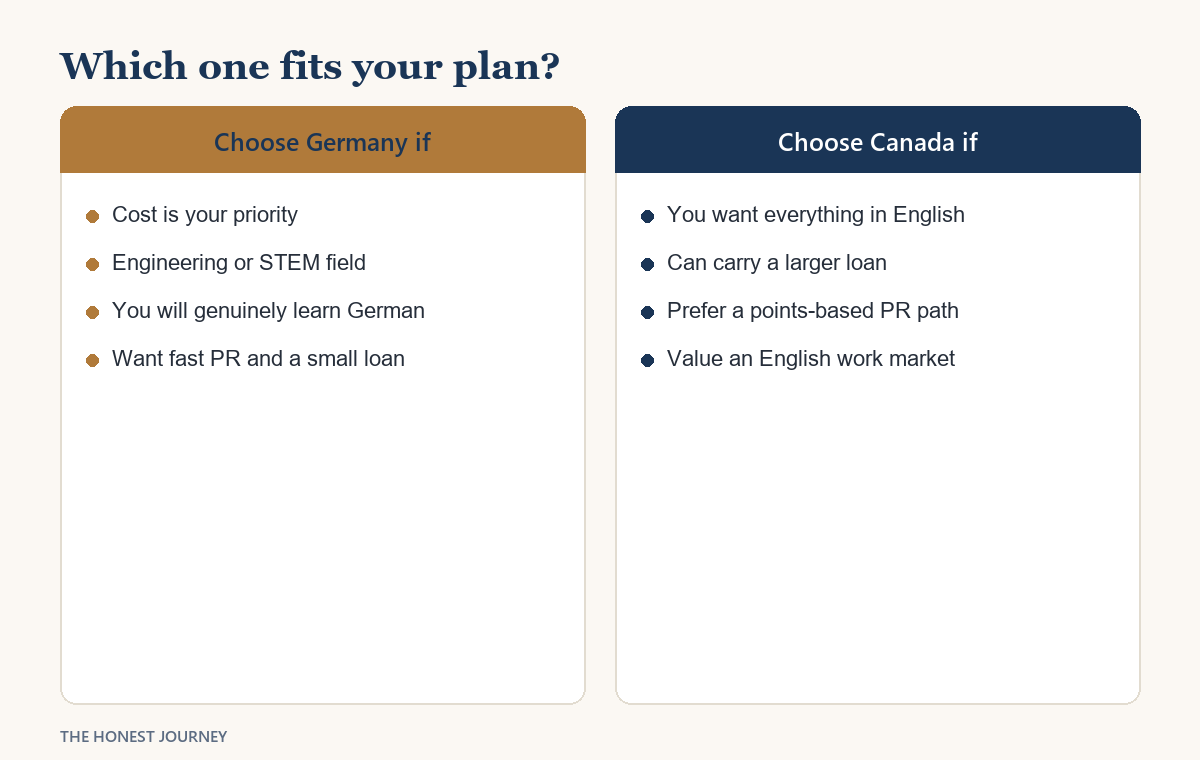
Choose Germany if cost is your priority and you want the smallest possible loan, your field is engineering, STEM or research where German industry hires hard, and above all you are genuinely willing to reach working German. If you will commit to the language, Germany offers a near-free degree, competitive pay, and one of the faster routes to permanent residence in this whole comparison.
Choose Canada if you want everything to run in English, you can carry a larger loan of ₹30 lakh or more, and you value a PR pathway you can plan toward on points rather than through a language wall. Canada rewards a program chosen deliberately for PGWP and Express Entry eligibility, and it accepts a higher cost in exchange for removing the language barrier entirely.
One honest note for both: a German or Canadian Master’s plus a few years of real foreign work experience is also a strong route back into the Indian job market, and for many students that return is the smartest plan from the start. Do not assume staying abroad is the only good outcome.
The honest take
The Munich cousin still believes she made the right call, and on cost she clearly did. But she admits she underweighted the language, and her whole plan now rests on reaching a German level she has not yet hit. The Ontario cousin paid far more and carries the bigger loan, but everything she needs to stay is in a language she already speaks.
So compress it to one question: will you truly learn German? If yes, Germany is the best value in this entire comparison, cheap to enter and fast to settle. If you are honest that you will not, Canada’s English-language PGWP-to-PR route is worth its higher price despite the recent tightening. Decide the language question first, then pick. And read the process detail on the study in Germany page and the study in Canada page before you commit a rupee.
Funding the move with a loan? Start with the complete education loan guide, then apply through the PM Vidyalakshmi portal, the government route most Indian students use.
FAQ
Is Germany or Canada cheaper for Indian students?
Germany is far cheaper. Public universities charge almost no tuition, only a nominal semester fee of EUR 100 to 350, so a two-year Master’s often costs under ₹1.5 lakh in tuition and around ₹20 to 26 lakh all-in, mostly living. A two-year Canadian Master’s commonly lands around ₹30 to 45 lakh all-in. The gap means a German degree can often be self-funded or need only a small loan, while Canada usually requires a real education loan of ₹30 lakh or more.
Do I need to know German to study or work in Germany?
Many Master’s programs are taught in English, so you can study without German. But working and settling are different. Most qualifying jobs, daily life, and the faster permanent-residence routes effectively assume German, and finding a role inside the 18-month post-study window is much harder without it. The honest rule is that you can get the degree in English, but you cannot reliably convert it into a job and PR without reaching working German, usually B1 or higher.
Which has the better post-study work window, Germany or Canada?
Canada is longer and simpler. Germany gives an 18-month residence permit to seek qualifying work after graduation, while Canada’s PGWP runs up to three years for a two-year Master’s. Canada’s window also runs in English and feeds Express Entry directly. Germany’s window is shorter and, for most qualifying jobs, gated by German. If you are confident in the language, Germany still works; if not, Canada’s window is far easier to use.
Is it easier to get PR in Germany or Canada?
It depends on the language. Germany can be faster on paper: on an EU Blue Card you can reach a settlement permit in about 21 months with B1 German, or about 33 months with basic German. But every step needs a qualifying job and the language. Canada’s Express Entry is a slower-feeling points system, but it runs in English and needs no employer sponsorship. Germany is faster if you learn German; Canada is more accessible if you do not.
Do German salaries beat Canadian salaries for graduates?
They are close, and Germany can edge ahead on gross. A German engineering or STEM graduate commonly starts around EUR 45,000 to 60,000, roughly ₹40.5 to 54 lakh gross, though high German taxes and social contributions cut take-home. A Canadian graduate commonly starts around CAD 60,000 to 80,000, about ₹36.6 to 48.8 lakh gross. The catch is that German pay only unlocks if your German is strong enough for the role, so the on-paper advantage is conditional.
Has Canada become harder for Indian students?
Yes, somewhat. Since 2024 Canada has cut study permit numbers, raised proof of funds to CAD 20,635, narrowed PGWP eligibility for some programs, and lowered PR targets, which pushed Express Entry cut-off scores higher. The PR pathway still exists and remains clearer and English-based, but the odds are tighter than in 2022. Confirm your specific program still qualifies for the PGWP before committing, and budget for a competitive Express Entry profile.
Which is better for an Indian student who wants to return to India?
Germany carries less financial risk for a planned return. Because the German ticket is small, you can gain a respected degree and foreign experience without a large loan hanging over you, which makes returning to India far less stressful. A Canadian degree plus experience is equally strong for the Indian job market, but you return having serviced a much larger loan. If returning is a real possibility, Germany’s low cost is a genuine advantage.
Should I choose Germany for cost or Canada for settling?
Decide the language question first, because it settles the country. If you will genuinely learn German, Germany gives you the lowest cost, competitive pay, and a fast settlement route, making it the best value here. If you want everything in English and can carry the larger loan, Canada’s PGWP-to-Express-Entry pathway is the more controllable route to staying. Picking on cost alone, without being honest about the language, is how students end up with a cheap degree they cannot convert into a job.
Faz · The Honest Journey · 2026