Short answer. The honest verdict: Canada and Australia are close on cost (both land roughly ₹30 to 55 lakh a year all in) and both offer a post-study work visa, but they differ on pace and odds.
Canada gives a longer PGWP (up to 3 years) and historically the clearer PR runway, while Australia pays higher graduate salaries on a shorter, regionally tilted 485 visa. Both PR systems are points-based and both are tightening hard right now. Choose on field, salary, and how much PR uncertainty you can absorb.
Canada and Australia get compared constantly, and for good reason. They are the two destinations Indian students pick when the goal is not just a degree but a realistic shot at staying and building a life. They both sell themselves on post-study work and points-based PR. And right now, both are in the middle of the sharpest tightening either has seen in a decade. So the honest comparison has to account for a moving target.
This post stays strictly in the decision lane. I will not re-explain the application process, because the study in Canada guide and the study in Australia guide already cover that end to end. Here I am putting the two head to head on the things that decide the outcome: total cost in INR, post-study work, PR pathway and odds, living costs, and the job market. I will use ₹61 per Canadian dollar and ₹61 per Australian dollar throughout (they sit close enough that the comparison stays clean), so every number is auditable.
If you are deciding on Australia, these go deeper: the education loan for Australia post.
The framing: two similar bets pulling apart
For years Canada and Australia looked almost interchangeable: comparable cost, generous work rights, points-based PR, large Indian student communities. That picture is breaking. Canada has cut study-permit volumes, capped intake, and changed PGWP eligibility rules. Australia has raised financial-proof requirements, lifted visa fees sharply, and tightened the post-study 485 visa, especially on age and field. So you are no longer choosing between two stable systems. You are choosing between two systems both moving the goalposts, and you need to read the direction of travel, not just today’s snapshot.
The good news is the core economics still rhyme. Tuition and living costs are broadly similar. The differences that matter now are pace (how long the work visa lasts), salary (Australia pays more), and PR odds (Canada historically clearer, but both tightening). Let me build each one out.
Total cost in INR, side by side
Here are realistic mid-range annual figures for a non-scholarship postgraduate student. The detailed line-by-line breakdowns live in the cost of studying in Canada post and the cost of studying in Australia post; here I only compare the totals.
| Line item (per year) | Canada | Australia |
|---|---|---|
| Tuition (PG) | CAD 22,000 to 38,000 | AUD 30,000 to 45,000 |
| Living cost | CAD 15,000 to 20,000 | AUD 24,000 to 29,000 |
| Insurance, visa, misc | CAD 2,000 to 3,000 | AUD 3,000 to 4,000 |
| Total (foreign currency, per year) | CAD 39,000 to 61,000 | AUD 57,000 to 78,000 |
| Total in INR (per year) | ₹24 lakh to 37 lakh | ₹35 lakh to 48 lakh |
Australia comes out a bit higher per year, mostly on living cost and a higher proof-of-funds bar. But course length matters: a Canadian Master’s is often two years, an Australian one can be 1.5 to 2 years, so the all-in totals converge to roughly ₹50 lakh to over ₹80 lakh for the full program in both. Treat them as broadly comparable on cost, with Australia leaning slightly more expensive per year and Canada sometimes longer overall. The financing picture for the Canadian side is in the education loan for Canada post.
Faz's ruleOn cost, Canada and Australia are close enough that money should not be your tie-breaker. Decide on work runway, salary and PR odds instead, because those gaps are real while the cost gap is small.
Families often agonise over a few lakh of tuition difference and then ignore the thing that actually moves the outcome: how long you can work afterward and how realistic PR is. The cost gap here is noise. The work and PR gaps are signal.
Post-study work: PGWP versus the 485
This is where the two diverge, and where the recent changes bite hardest.
Canada’s Post-Graduation Work Permit (PGWP) can run up to three years, tied to the length of your program, and it is an open work permit: you can work for any employer in any role. That length is its strength, because three years is a long runway to find work and build the experience PR scoring rewards. The catch is the recent rule changes: eligibility now depends more tightly on the field of study and the institution, so you must confirm your specific program still qualifies before you commit. The official source is canada.ca.
Australia’s Temporary Graduate visa (subclass 485) is shorter and has been cut back. Depending on qualification level and the rules in force when you apply, it typically runs two to three years, with extra time historically available for study in regional areas, and tighter age limits now in place. It is also an open work visa. The official framing is on studyaustralia.gov.au and the visa detail on immi.homeaffairs.gov.au. The direction of travel in Australia has been toward shorter windows and stricter conditions, so read the current rules rather than older blog posts.
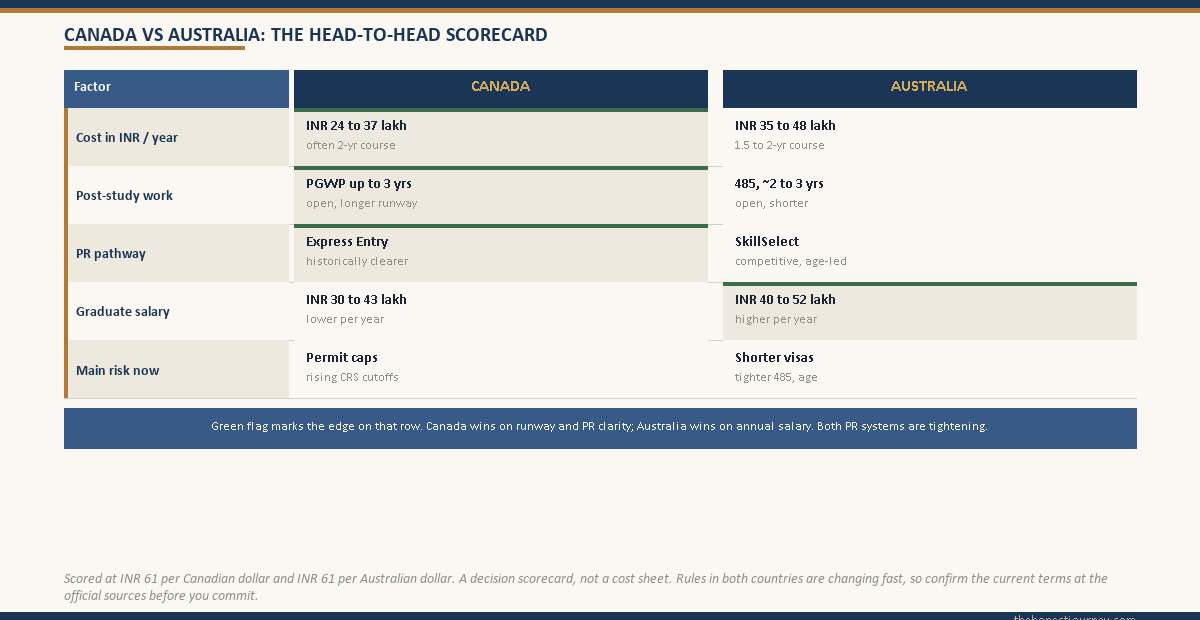
Net of the noise: Canada’s PGWP is generally the longer and more flexible runway, which historically made it the friendlier place to accumulate the Canadian work experience PR scoring rewards. Australia’s 485 is shorter but sits alongside higher salaries, so you earn more per year of it. Neither is a free pass anymore.
PR pathways: both points-based, both tightening
I will be blunt, because this is where students get misled most. Both countries run points-based PR systems, and both are actively tightening them right now. Anyone who tells you either is a guaranteed route is selling you something.
Canada uses Express Entry, a Comprehensive Ranking System that scores age, education, language and Canadian work experience, with periodic category-based draws for specific occupations. Historically it offered Indian graduates a relatively clear runway: study, work on the PGWP, build experience, score points, get invited. But cutoff scores have risen, study-permit caps have shrunk the pipeline, and the bar is higher than it was even two years ago. It is still one of the clearer student-to-PR systems in the world, but “clearer” is relative and the trend is upward pressure.
Australia uses a SkillSelect points system feeding skilled visas (subclasses 189, 190 and others), scoring age, English, qualifications, work experience and sometimes state nomination. It too has tightened: occupation lists shift, state nomination is competitive, and recent policy has pushed toward fewer, more targeted invitations. Age matters a lot in both systems, and Australia’s post-study visa age limits make this sharper.
The honest summary: Canada has historically been the clearer student-to-PR pathway, helped by the longer PGWP, but that edge is narrowing as both systems tighten. Do not choose either on the assumption PR is in the bag. If returning to India is a real possibility for you, the return to India after studying abroad post is worth reading before you bank everything on staying.
Faz's ruleTreat the PR pathway in both countries as hard and getting harder, not as a sure thing. Pick the destination whose degree and job market you would be happy with even if PR never comes through.
I have seen students pour everything into a country purely for the PR promise, then watch the points cutoff jump past them. The students who do fine are the ones who would have been content with the education and the work experience alone. Choose so that PR is upside, not the whole plan.
Salaries and the job market
Australia pays graduates more. A new graduate in a professional role in Australia commonly earns AUD 65,000 to 85,000, roughly ₹40 to 52 lakh a year. Canada pays less on average: a new graduate typically earns CAD 50,000 to 70,000, roughly ₹30 to 43 lakh a year, with strong variation by province and field. So per year of work, Australia generally puts more in your pocket, which partly offsets its higher cost and shorter visa.
On the job market, both have cooled from their peak. Canada’s rapid intake growth strained housing and entry-level hiring, which is part of why the government tightened permits. Australia’s market is steadier in some skilled sectors but its regional incentives mean the best PR-friendly opportunities are often outside the big cities. In both, your field matters more than the country: a healthcare, trades, engineering or in-demand-tech profile does well in either; a generic business Master’s struggles in both. Pick the country, then pick a field that the country’s occupation lists actually want.
A worked INR comparison on the same student
Take a student admitted to both: a two-year Master’s in Canada and a 1.5 to 2 year Master’s in Australia, both at solid mid-ranked universities, in an in-demand field. Here is how the two bets compare in rupees, at ₹61 per CAD and ₹61 per AUD.
| Factor | Canada | Australia |
|---|---|---|
| All-in study cost (full program) | ~₹60 lakh | ~₹70 lakh |
| Post-study work visa | PGWP up to 3 years, open | 485 visa, ~2 to 3 years, open |
| Typical graduate salary | CAD 50k to 70k (₹30 to 43 lakh) | AUD 65k to 85k (₹40 to 52 lakh) |
| PR system | Express Entry, historically clearer | SkillSelect, competitive, age-sensitive |
| Main risk right now | Permit caps, rising CRS cutoffs | Shorter visas, tighter 485, age limits |
| Best for | Longer runway to build PR points | Higher annual earnings, shorter stay |
Read it as a trade. Canada: slightly cheaper, a longer and more flexible work runway, historically the clearer PR path, but lower salaries and a pipeline being squeezed. Australia: a bit more expensive and higher-earning, with a shorter work window and an age-sensitive PR system. Same student, two defensible answers depending on whether they value runway length or annual earnings.
Choose Canada if, choose Australia if
Here is the decision distilled into the block I would hand someone genuinely torn.
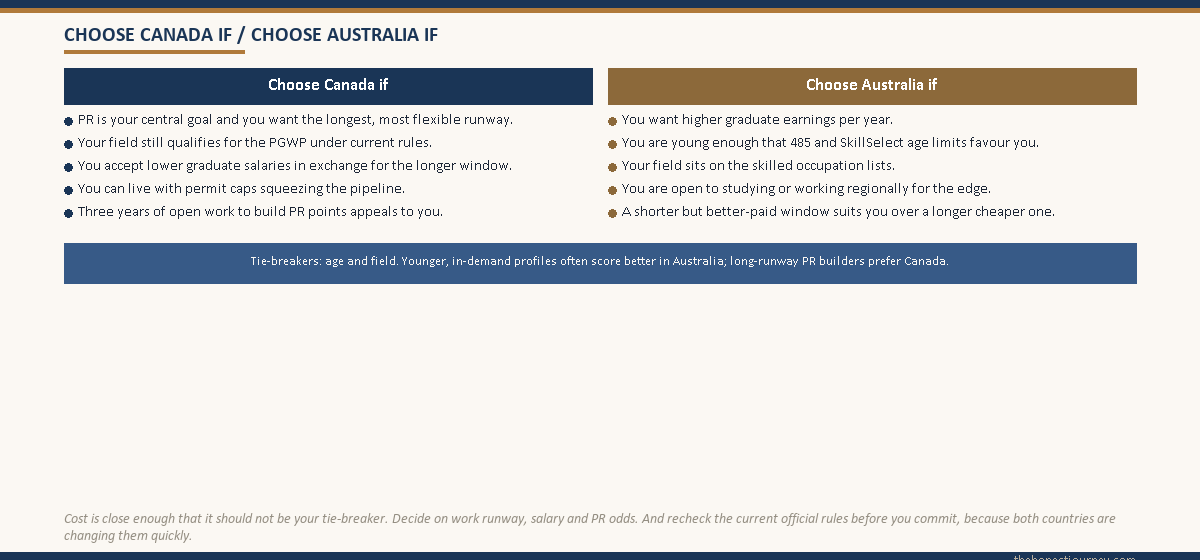
Choose Canada if permanent residency is your central goal and you want the longest, most flexible runway to earn the work experience that PR scoring rewards, your field qualifies for the PGWP under the current rules, you are comfortable with lower graduate salaries in exchange for that runway, and you can accept that the pipeline is being squeezed by permit caps. Canada has historically been the clearer student-to-PR route, and the three-year PGWP is its biggest structural advantage.
Choose Australia if you want higher graduate earnings per year, you are early enough in age that the 485 and SkillSelect age limits work in your favour, your field is on the skilled occupation lists, you are open to studying or working regionally for the visa and PR advantages, and a shorter but better-paid work window suits you better than a longer lower-paid one. Australia rewards a younger, in-demand profile willing to play the regional and occupation-list game.
If you are still torn, the tie-breakers are age and field. Younger students in occupations Australia wants often score better there; students prioritising a long, flexible runway to build PR points usually prefer Canada. And whichever you pick, recheck the current rules at the official sources before you commit, because both are changing fast.
Weighing more than two countries? See also USA vs Australia, UK vs Australia and Germany vs Canada for Indian students.
FAQ
Is Canada or Australia cheaper for Indian students?
They are close, with Australia leaning slightly more expensive per year, mainly on living costs and a higher proof-of-funds bar. Canada runs roughly ₹24 to 37 lakh a year all in, Australia roughly ₹35 to 48 lakh. But Canadian Master’s degrees are often two years while Australian ones can be 1.5 to 2 years, so the full-program totals converge to roughly ₹50 lakh to over ₹80 lakh in both. Treat cost as broadly comparable rather than a deciding factor.
Which has a better post-study work visa?
Canada’s PGWP can run up to three years and is an open work permit, making it the longer and more flexible runway, though recent rule changes tie eligibility more tightly to field and institution. Australia’s subclass 485 typically runs two to three years and has been cut back, with stricter age limits and tighter conditions. So Canada generally offers the longer window, while Australia’s shorter window sits alongside higher salaries. Always confirm the current rules before committing.
Where is PR easier, Canada or Australia?
Both are points-based and both are tightening, so neither is easy. Canada’s Express Entry has historically been the clearer student-to-PR route, helped by the long PGWP, but CRS cutoffs have risen and study-permit caps have shrunk the pipeline. Australia’s SkillSelect is competitive, age-sensitive, and dependent on shifting occupation lists and state nomination. Canada keeps a relative edge, but the gap is narrowing. Do not choose either on the assumption that PR is guaranteed.
Does Australia pay graduates more than Canada?
Generally yes. A new graduate in a professional role in Australia commonly earns AUD 65,000 to 85,000, roughly ₹40 to 52 lakh a year, while a Canadian graduate typically earns CAD 50,000 to 70,000, roughly ₹30 to 43 lakh. So per year of work, Australia usually puts more in your pocket, which partly offsets its higher cost and shorter post-study visa. Salaries vary strongly by province, state and field in both countries.
Why are both countries tightening their rules?
Rapid growth in international student numbers strained housing and entry-level job markets in both. Canada responded with study-permit caps, intake limits and stricter PGWP eligibility. Australia raised financial-proof requirements, increased visa fees, and tightened the 485 visa on age and conditions. The direction of travel in both is toward fewer, more targeted approvals. That is why you should read the current official rules rather than older guidance, and treat both PR systems as moving targets.
Does my field of study matter for the choice?
Hugely. In both countries your field matters more than the country itself. Healthcare, trades, engineering and in-demand technology profiles do well in either system, while a generic business Master’s struggles in both. Canada now ties PGWP eligibility partly to field, and Australia’s PR scoring leans on skilled occupation lists. Pick the destination first, then confirm your specific field is wanted there under the current rules before you commit to a program.
Does age affect my decision between the two?
Yes, more than most students realise. Both points systems award more points to younger applicants, and Australia’s 485 visa and SkillSelect have explicit age sensitivities. A younger student in a wanted occupation often scores better in Australia, while older students may prefer Canada’s longer PGWP runway to build the work experience that lifts their score. Age is one of the genuine tie-breakers when cost and field do not clearly favour one country.
Can I fund either with an Indian education loan?
Yes. Both Canada and Australia sit in the top tier for Indian PSU banks and NBFCs, so the structure mirrors other top destinations: amounts above the ₹7.5 lakh unsecured PSU ceiling need collateral, while NBFCs lend unsecured at higher rates. Since the all-in cost for both runs to roughly ₹50 lakh or more for the full program, most students land in the collateral tier. Model repayment against the realistic graduate salary and work-visa length, not against PR you have not secured.
Faz · The Honest Journey · 2026