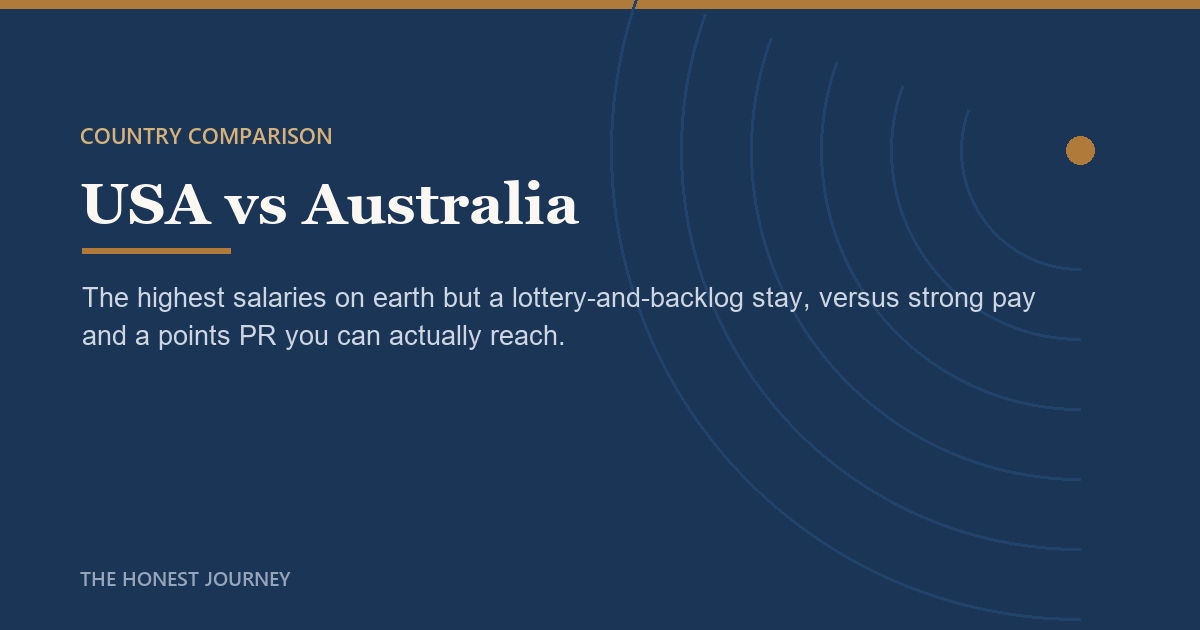
Short answer. The honest USA versus Australia split for Indian students: the US offers the highest salaries on earth and a 36-month STEM OPT runway, but staying is a brutal H-1B lottery followed by an employment-based green card queue that for Indian nationals now runs for decades, so it is earning power without a realistic settling plan.
Australia costs a bit less, pays high salaries too, gives a 2 to 4 year post-study visa (up to 6 for STEM under the India trade deal), and has a points-based PR you can actually reach in 3 to 4 years. Choose the US to earn hard and stay flexible, Australia to genuinely settle.
A reader messaged me last year, torn between a US state-university MS and an Australian Group of Eight admit. Everyone around him said the US, because of the salary. His aunt in Melbourne quietly said Australia, because he could actually stay. He picked the US, is earning well on OPT, and is now doing the mental math no consultant showed him: even if he wins the H-1B, the green card queue for Indians could outlast his career. His decision was not wrong for earning. It was never a settling plan, and nobody told him that going in.
That gap is what this post is about. The US and Australia get compared on salary and brand, which flatters the US and hides the real question of whether you can stay. I will compare them honestly on total cost in rupees, the work window after graduation, the PR pathway and its odds, earnings, and the risk you are actually signing up for. The country-specific process detail stays on the dedicated pages.
For the math I use ₹84 per US dollar and ₹55 per Australian dollar throughout. Rates move, so treat these as the planning frame.
If you are weighing the US against other routes too, these go deeper: the USA vs Canada comparison and the Canada vs Australia comparison.
The core tension in one paragraph
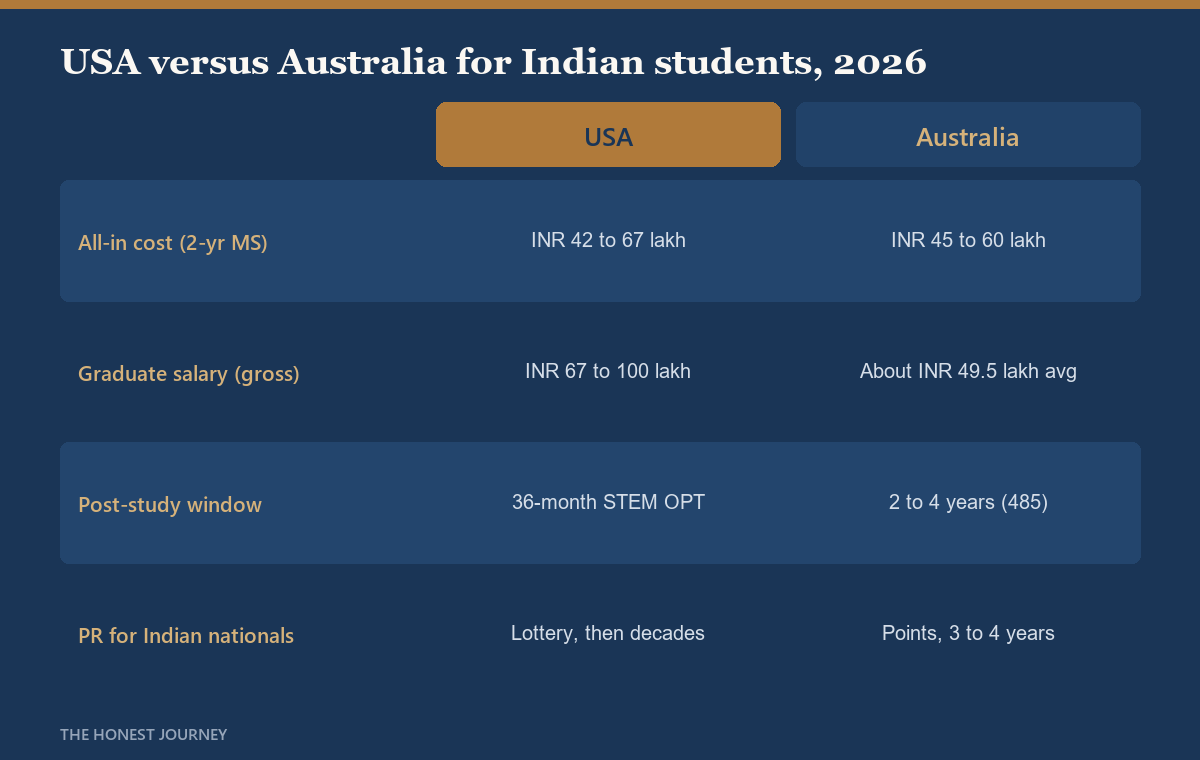
The US is the high-ceiling, high-risk option. Salaries are the highest in this comparison, a STEM degree buys 36 months of OPT, and the earning upside is enormous. But the loan is large, usually ₹42 to 67 lakh for a two-year Master’s, and staying past OPT needs an H-1B won by lottery, followed by an employment-based green card backlog that for Indian nationals is measured in decades, not years. The US is unmatched for earning and genuinely uncertain for settling.
Australia is the balanced option. Cost is high but usually a little below the US, salaries are among the highest in the world, and the post-study Temporary Graduate visa gives two to four years, with Indian STEM graduates able to access longer work rights under the ECTA trade agreement. Crucially, PR runs through a points system you can plan toward and realistically reach in three to four years. Australia trades a slightly lower salary ceiling for a settling path that actually exists.
Total cost in INR, compared honestly
Both are expensive, and the gap is smaller than people assume. The US edges higher because most US Master’s run two years with high tuition, but Australia is not the budget option some blogs claim.
For the US, a two-year Master’s commonly shows a total cost of attendance of USD 50,000 to 80,000 on the Form I-20, roughly ₹42 to 67 lakh all-in including living. That is why the US usually pushes families into collateral-backed or high-rate loans. The full numbers are in the cost of studying in USA post.
For Australia, a Master’s runs roughly AUD 35,000 to 45,000 per year in tuition, about ₹19.25 to 24.75 lakh per year, with living around AUD 24,000 to 29,000 a year, or ₹13.2 to 15.95 lakh, close to the AUD 29,710 the visa expects as proof of funds. All-in, a two-year Australian Master’s commonly lands around ₹45 to 60 lakh, plus the AUD 2,500 visa fee and OSHC health insurance. The detail is in the study in Australia post.
| Item | USA (2-year Master’s) | Australia (2-year Master’s) |
|---|---|---|
| Tuition (full program) | ~₹32 to 50 lakh | ~₹38 to 49 lakh |
| Living (full program) | ~₹18 to 25 lakh | ~₹26 to 32 lakh |
| Rough all-in total | ~₹42 to 67 lakh | ~₹45 to 60 lakh |
| Typical loan shape | Collateral or high-rate NBFC | Collateral or high-rate NBFC |
| Proof of funds at visa | Per I-20 cost of attendance | AUD 29,710 (~₹16.34L) |
The costs are broadly in the same league, so cost alone should not decide this one. Both usually mean a real loan of ₹45 lakh or more, which only pencils out if the earning runway and the settling path deliver. The difference is what you get for that loan: the US buys the highest salary, Australia buys a more probable PR. The loan-product side for both sits in the education loan for USA post and the education loan for Australia post.
Faz's ruleThe US and Australia cost about the same, so cost should not decide this. The real question is what your loan buys: the highest salary in the US, or a PR you can actually reach in Australia.
A ₹55 lakh loan is a ₹55 lakh loan either way. In the US it buys peak earning on a work window that ends in a lottery. In Australia it buys strong pay plus a points-based PR you can plan toward. Pick the outcome you value, because the price is similar.
The work window after you graduate
Both give a solid post-study window, but they lead to very different places.
In the US, an F-1 graduate gets 12 months of OPT, extended to 36 months total for a designated STEM degree. That three-year window pays well and is the engine that repays a large US loan. But OPT is temporary work authorisation, not a path to staying; to remain you need an H-1B, awarded by lottery. A non-STEM US degree gives only 12 months, a weak runway against a big loan. The official framework is on travel.state.gov.
In Australia, the Temporary Graduate visa, subclass 485, gives roughly two to four years of full-time work rights depending on qualification, and Indian STEM graduates can access extended rights under the ECTA trade agreement. It is designed to build the skilled work experience the PR points system rewards, so it is a step toward staying, not a holding pattern. The official rules are on the Department of Home Affairs.
| Work window factor | USA (STEM OPT) | Australia (485) |
|---|---|---|
| Length after Master’s | 36 months (STEM), 12 (non-STEM) | 2 to 4 years, longer for STEM under ECTA |
| Job offer needed to start | No | No |
| Next step to stay | H-1B lottery | Points-based PR |
| Odds of staying | Luck-based | Points-based, plannable |
| Feeds PR directly | No | Yes |
The PR pathway and its odds, said plainly
This is where the two split hardest, and where the US looks worst for an Indian national specifically.
In the US, there is no direct study-to-PR route. After OPT you need an employer to sponsor an H-1B, selected by an annual lottery with far more applicants than visas. Even if you win, the employment-based green card has per-country caps, and the backlog for Indian nationals is so long that applicants filing today can face a wait measured in decades. So the honest US settling picture for an Indian is two barriers stacked: a lottery you may never win, then a green card queue that can outlast your working life.
In Australia, PR runs through a points-tested system, subclasses 189, 190 and 491, where your Australian degree, skilled work experience, English scores, and age build a score you can plan toward. A well-prepared Indian graduate in a demanded occupation can realistically reach the points and apply within three to four years, with regional study and work adding extra points. It is competitive and the rules tighten, but it is a system you can strategise, not a draw you can only hope for.
The plain version: in the US, an Indian national’s permanent residence is a lottery followed by a decades-long queue. In Australia, it is a points climb you can plan and realistically finish in a few years. The US has the higher earning ceiling; Australia has a settling path that actually functions for Indians.
Faz's ruleFor an Indian national, US permanent residence can mean a green card queue measured in decades even after winning the H-1B lottery. Australia offers a points-based PR you can realistically reach in three to four years. That is the whole decision.
If you want to settle abroad and you are Indian, the US immigration math is genuinely against you, no matter how strong you are. Australia is not guaranteed either, but it is a system you can plan and finish. Do not confuse a high US salary with a place to stay.
Earnings and risk
US graduate salaries are the highest here. A STEM Master’s graduate commonly starts around USD 80,000 to 120,000, roughly ₹67 to 100 lakh gross at ₹84. Australian graduates commonly start strong too, with averages around AUD 90,000, about ₹49.5 lakh gross at ₹55, and high-demand fields paying more. The US salary edge is real, but Australia is not far behind and comes with a lower cost of living in most cities.
The risk split is the point. The US risk is the lottery cliff: peak income for three OPT years, then a coin-flip on the H-1B and a decades-long green card queue even if you win. The Australia risk is a competitive, tightening points system and a slightly lower ceiling. Model your loan repayment on the income you are near-certain to earn, the OPT window or the 485 window, and treat long-term staying as upside in the US and a realistic plan in Australia.
A worked INR comparison for one candidate
Take one student, a computer-science graduate from India with a STEM admit to a US state university and an Australian Group of Eight university. Same person, two roads.
| Factor | USA (2-year STEM MS) | Australia (2-year MS) |
|---|---|---|
| Tuition | USD 60,000 = ~₹50.4L | AUD 80,000 = ~₹44L |
| Living | USD 25,000 = ~₹21L | AUD 54,000 = ~₹29.7L |
| All-in study cost | ~₹71.4 lakh | ~₹53.7 lakh |
| Post-study work window | 36 months (STEM OPT) | 2 to 4 years (485) |
| Starting salary (gross) | ~₹67 to 100L/yr | ~₹49.5L/yr average |
| Path to stay | H-1B lottery, then decades-long GC queue | Points-based PR in 3 to 4 years |
The US road costs about ₹18 lakh more here and pays a higher salary, so on the OPT window it repays fast. But the road ends at a lottery and a green card queue that, for an Indian, may never clear. The Australian road costs less, pays a strong salary, and leads to a PR you can actually finish. The numbers favour the US for earning and Australia for staying, which is exactly the trade. Whether the whole thing is worth it for you is the bigger question in the is studying abroad worth it post.
Choose USA if, choose Australia if
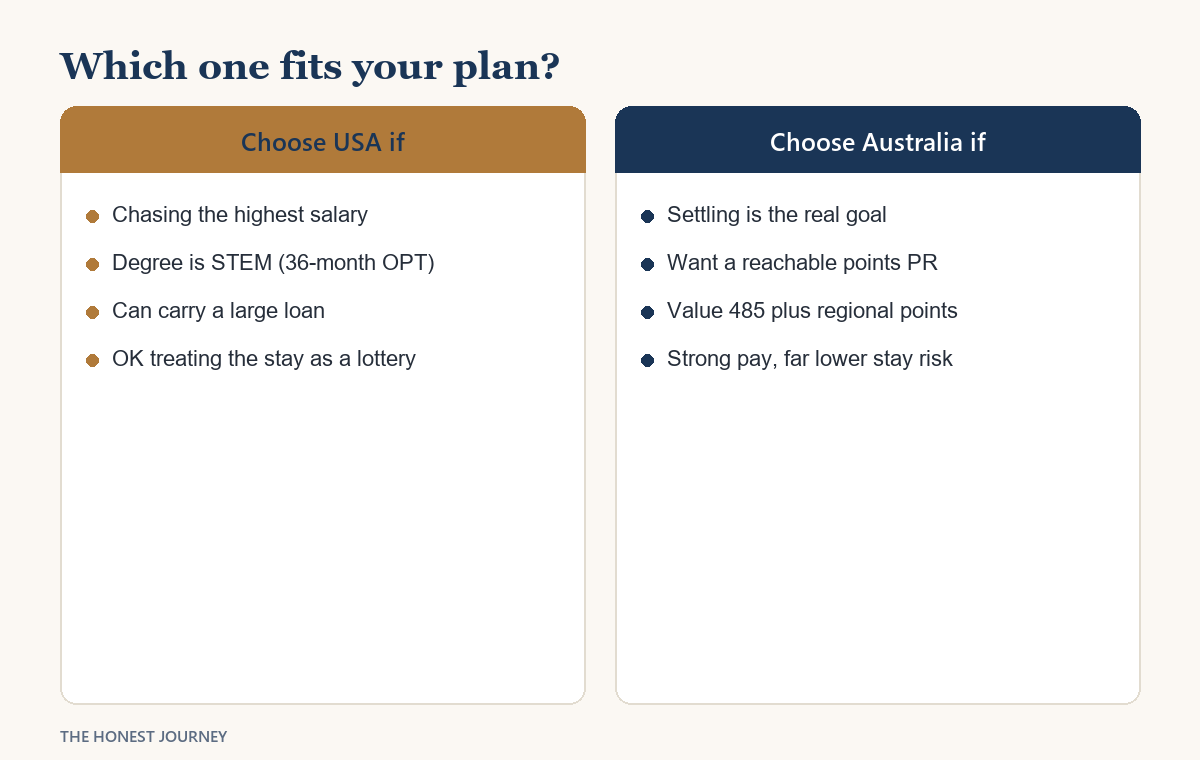
It comes down to whether you are optimising for peak earning or for actually staying.
Choose the US if your degree is STEM so you get the 36-month OPT runway, you are chasing the highest possible salary, you can carry the large loan, and you are genuinely comfortable treating long-term settlement as a lottery plus a decades-long queue you may never clear. The US rewards earning power and risk tolerance, and it is superb if your plan is to earn hard and stay flexible or return to India.
Choose Australia if settling abroad is the real goal, you want strong salaries with a points-based PR you can plan toward and realistically reach in three to four years, and you value using the 485 window and possibly regional study to build points. Australia rewards a deliberate plan and accepts a slightly lower ceiling in exchange for a settling path that genuinely works for Indian nationals.
One honest note for both: a US or Australian Master’s plus a few years of real foreign work experience is also a strong route back into the Indian job market, and for many students that return is the smartest plan from the start. Do not assume staying abroad is the only good outcome.
The honest take
My reader in the US is earning well and does not regret the experience. But he now sees clearly that his degree bought him income, not a green card, and the settling math for an Indian in the US is genuinely stacked against him. Had staying been his priority, Australia would have been the calmer, more probable bet at a similar cost.
So compress it to one question: are you going to earn hard and stay flexible, or are you going to settle? If it is earning and you can carry the loan and the lottery, the US has the higher ceiling. If it is settling, Australia’s points-based PR is the path that actually works for Indian nationals, at a comparable cost. Decide your goal first, then pick. And read the process detail on the study in USA page and the USA student visa page before you commit a rupee.
Funding the move with a loan? Start with the complete education loan guide, then apply through the PM Vidyalakshmi portal, the government route most Indian students use.
FAQ
Is the USA or Australia cheaper for Indian students?
They are broadly similar, with the US usually a little higher. A US two-year Master’s runs roughly ₹42 to 67 lakh all-in, while an Australian two-year Master’s commonly lands around ₹45 to 60 lakh including higher living costs. Both usually require a real loan of ₹45 lakh or more, so cost alone should not decide this comparison. The bigger difference is what the money buys: the highest salary in the US, or a reachable PR in Australia.
Which has the better path to permanent residence for Indians?
Australia, by a wide margin for Indian nationals. Australia’s points-based PR rewards your degree, skilled work, English and age with a score you can plan toward and realistically reach in three to four years. The US has no direct study-to-PR route: you need an H-1B won by lottery, then face an employment-based green card backlog that for Indian nationals can run for decades. The US offers a higher earning ceiling; Australia offers a settling path that actually functions.
Which has the better post-study work window?
Australia is generally longer and more useful for staying. A US STEM degree gives 36 months of OPT, or 12 months for non-STEM, leading to the H-1B lottery. Australia’s subclass 485 gives roughly two to four years, with Indian STEM graduates able to access extended rights under the ECTA trade agreement, and it feeds the PR points system directly. The US window pays more per month; the Australian window is more likely to lead to staying.
Do US salaries beat Australian salaries?
Yes, at the top end. US STEM graduates commonly start around USD 80,000 to 120,000, roughly ₹67 to 100 lakh gross, while Australian graduates average around AUD 90,000, about ₹49.5 lakh gross, with high-demand fields paying more. The US salary advantage is real and repays a loan faster on the OPT window. The catch is that the US window ends in a lottery, while Australia’s strong salary comes with a workable PR path.
What is the H-1B and green card problem for Indians in the US?
After OPT, staying in the US needs an H-1B, selected by an annual lottery with far more applicants than visas. Even winning only buys temporary status, because the employment-based green card has per-country caps and the backlog for Indian nationals is so long that new applicants can face a wait measured in decades. For an Indian student whose goal is to settle, this is the single biggest reason to weigh Australia’s points-based PR seriously.
Is Australia easier to get a visa for than the USA?
Generally yes, and faster. The Australian student visa, subclass 500, is largely online with decisions often within weeks, though it requires AUD 29,710 in proof of funds and OSHC health insurance. The US F-1 requires SEVIS registration and a mandatory in-person embassy interview, with wait times that can stretch to months for Indian applicants. Neither is guaranteed, and both scrutinise finances and intent, so prepare documents carefully for either.
Which is better if I plan to return to India?
Both are strong for re-entry, but Australia carries slightly less risk. A degree from either plus a few years of genuine foreign work experience is a strong return into the Indian job market. The difference is the loan against an uncertain stay: a large US loan bet on an H-1B you may not win is riskier than an Australian route where you at least have a workable stay option. If returning is plausible, avoid over-borrowing for a US stay that depends on a lottery.
Should I choose the USA for earnings or Australia for settling?
Decide your goal first, because it settles the country. If you want the highest salary, your degree is STEM, and you can carry the loan and the lottery risk, the US has the higher ceiling and suits earning hard then staying flexible. If settling abroad is the actual goal, Australia’s points-based PR is far more achievable for Indian nationals at a similar cost. Choosing the US for its salary without a realistic settling plan is the most common expensive mistake here.
Faz · The Honest Journey · 2026