Short answer. Studying in Australia as an Indian student costs around AUD 50,000 to 65,000 per year all-in, but the AUD 24.10 minimum wage and a 2 to 4 year post-study work visa make it one of the few destinations where part-time earnings cover a meaningful share of living costs.
Sydney and Melbourne run AUD 2,400 to 2,800 a month to live in, and student work is capped at 48 hours a fortnight, so the family still funds a real gap. PR remains genuine in healthcare, engineering, and IT shortage occupations.
Australia has a reputation as an expensive study destination, and that reputation is earned. But it also has one of the highest minimum wages in the world, a clear post-study work pathway, and real PR demand in sectors where Indian graduates are concentrated. Whether it makes sense for you depends on one thing: honest math.
This post lays out the actual numbers, the actual visa rules, and the actual PR pathway so you can decide without a sales pitch clouding your judgment. If you are still weighing destinations, our guide to the best country to study abroad for Indian students sets out the wider trade-offs.
For the full guide, read Studying Abroad From India: Cost and Funding Guide.
Australia does not use Fall or Spring. It runs Semester 1 in February and Semester 2 in July, and searching the wrong term misses deadlines. See intakes in Australia.
Australia’s Cost Reality: High Wages, High Prices
The headline that draws students to Australia is the minimum wage: AUD 23.23 per hour as of July 2024, a figure set and published by the Fair Work Ombudsman. That is not a typo. No other major study destination comes close. The UK minimum is around GBP 11.44, Canada’s federal minimum is CAD 17.30 (more on that route in the Canada study guide), and the US varies by state but most students are on state minimums well below AUD equivalent.
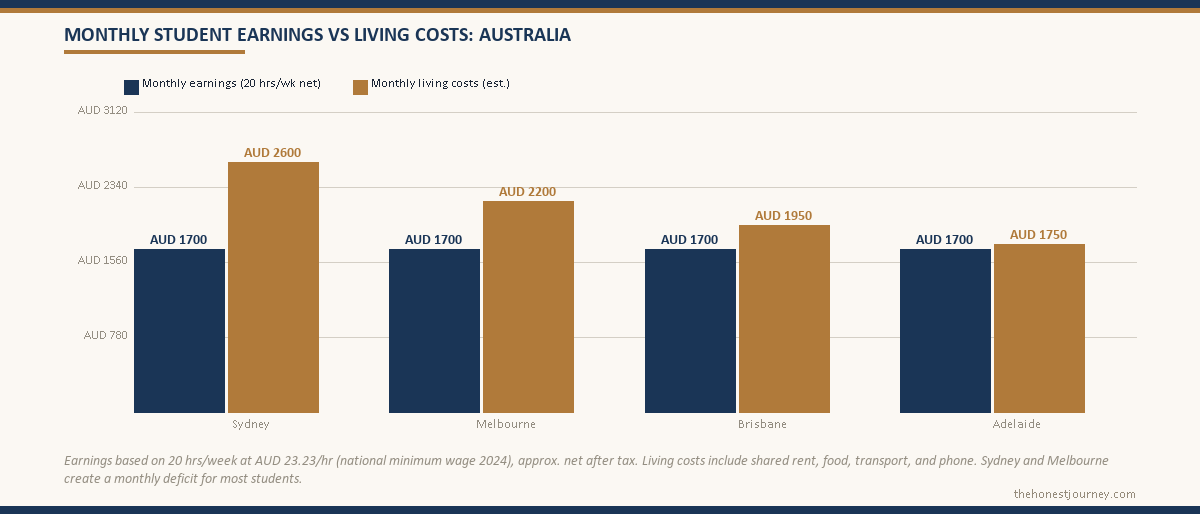
Faz's ruleAUD 2,600 monthly living costs in Sydney vs AUD 1,700 student-job earnings = monthly deficit.
Australia works if the family can fund the gap or the student secures off-campus work beyond the part-time hour cap. Most Indian students underbudget by 20-30% on Sydney and Melbourne living costs.
The catch is that Australia is expensive to live in. Sydney and Melbourne are consistently ranked among the world’s top 10 most expensive cities. High wages are real, but they are largely absorbed by high costs.
Here is what a month looks like in Sydney or Melbourne for a single student:
| Expense | Sydney/Melbourne (AUD/month) | INR equivalent (approx.) |
|---|---|---|
| Rent (shared room) | AUD 800 to 1,200 | ₹54,000 to 81,000 |
| Groceries | AUD 300 to 400 | ₹20,000 to 27,000 |
| Transport (public) | AUD 150 to 200 | ₹10,000 to 13,500 |
| Phone + internet | AUD 50 to 80 | ₹3,400 to 5,400 |
| Miscellaneous | AUD 200 to 300 | ₹13,500 to 20,000 |
| Total | AUD 1,500 to 2,180 | ₹1,01,000 to 1,47,000 |
At AUD 23.23/hr, working the legal maximum of 48 hours per fortnight (24 hours per week average), you earn roughly AUD 1,115 per fortnight before tax, or about AUD 2,000-2,200 per month after tax depending on your tax bracket. That covers living expenses in Sydney or Melbourne, but leaves almost nothing for savings or sending home.
Faz's ruleHigh wages do not mean surplus money when the city eats the difference.
The AUD 23.23 minimum wage sounds transformative until you see that a shared room in inner Sydney costs AUD 900-1,100 a month by itself. Work every legal hour and you mostly break even on living costs in the major cities. The real wage advantage kicks in on the 485 visa after you graduate, when work hours are uncapped.
Tuition Costs by Program Type
Australian universities charge international students significantly more than domestic students, and there is no subsidized route the way some EU countries offer. These are real annual figures:
| Program | Annual Tuition (AUD) | INR equivalent (approx.) | Duration |
|---|---|---|---|
| Undergraduate (Arts/Commerce) | AUD 25,000 to 35,000 | ₹17L to 24L | 3 years |
| Undergraduate (Engineering/IT) | AUD 30,000 to 42,000 | ₹20L to 28L | 4 years |
| Masters (coursework) | AUD 30,000 to 50,000 | ₹20L to 34L | 1.5 to 2 years |
| MBA | AUD 45,000 to 80,000 | ₹30L to 54L | 1.5 to 2 years |
| Nursing/Health Sciences | AUD 28,000 to 38,000 | ₹19L to 26L | 3 to 4 years |
| Vocational (VET/TAFE) | AUD 8,000 to 22,000 | ₹5.4L to 15L | 1 to 2 years |
Total program cost for a 2-year Masters at a Group of Eight university runs AUD 60,000-100,000 in tuition alone, or roughly ₹40-68 lakh before living costs. Factor in ₹24-35 lakh per year for living in Sydney or Melbourne and a two-year Masters will cost a family ₹1.2-1.7 crore all-in, and the full cost of studying in Australia for Indian students breaks every line item down. That is the honest number.
VET programs through TAFE institutions are significantly cheaper and often more directly tied to skilled migration demand. Cook, electrician, plumber, childcare worker, aged care nurse, these appear on the skills in demand lists year after year and cost a fraction of a university degree.
The 48-Hour Fortnight Work Rule: What It Actually Nets
Student visa holders in Australia can work 48 hours per fortnight during semester and unlimited hours during scheduled course breaks. The 48-hour fortnight equals 24 hours per week on average, not 20 as many students assume.
Practically, at the minimum wage and working the full legal allowance during semester:
- Gross earnings per fortnight: AUD 1,115 (48 hrs x AUD 23.23)
- Monthly gross: approximately AUD 2,230
- Monthly after-tax (at resident tax rates published by the Australian Taxation Office): approximately AUD 2,000-2,100
- Monthly after living costs in Sydney: AUD 0 to AUD 500 remaining
- Monthly after living costs in Adelaide or Brisbane: AUD 400 to AUD 800 remaining
The math tells you something important: Australia is not a place where student work earnings meaningfully offset tuition. It is a place where student work earnings can largely cover your living costs if you are strategic about the city you choose. Tuition still needs family savings or education loans, and the loan versus self-funding decision deserves a clear-eyed look before you commit, including how an education loan for Australia would be structured.
Faz's ruleWork pays for your rent in Australia, not your degree.
Students who go to Australia expecting their part-time earnings to chip away at a AUD 35,000/year tuition bill are doing the wrong math. Work earnings at the legal maximum will cover most of your monthly living expenses in a lower-cost city. The degree cost is a separate problem that needs a separate solution, savings, loan, or scholarship.
The 485 Graduate Visa: Post-Study Work Reality
The Temporary Graduate visa (subclass 485) is the main post-study work pathway. It grants the right to live and work anywhere in Australia with no employer sponsorship and no restrictions on hours or occupation.
Duration depends on your degree level and where you studied:
| Qualification | Standard duration | Regional study bonus |
|---|---|---|
| Bachelor degree | 2 years | +1 year (3 total) |
| Masters by coursework | 3 years | +1 year (4 total) |
| Masters by research | 3 years | +1 year (4 total) |
| PhD | 4 years | +1 year (5 total) |
The 485 visa is where Australia’s minimum wage advantage becomes genuinely meaningful. Working full-time at minimum wage earns roughly AUD 48,000 per year gross. Most 485 holders in IT, engineering, accounting, or healthcare earn AUD 60,000-90,000 in their first full-time role. Over 2-4 years, a 485 holder in a strong job can save ₹30-80 lakh or more depending on the role and lifestyle discipline.
One thing to note: the 485 visa does not lead directly to PR. It is a temporary visa that gives you time to build Australian work experience and collect points for the skilled migration system.
Skills in Demand: Who PR Actually Makes Sense For
Australia’s skilled migration system runs on points. Points come from age, English proficiency, qualifications, and critically, Australian work experience. But the starting gate is whether your occupation is on a relevant skills list.
Faz's ruleAustralia's points-based PR rewards regional study, age under 30, and STEM occupations.
If your profile doesn’t match those three, the PR path is significantly harder. Worth modelling your specific occupation, age, and English score against current point thresholds before committing to the Australian route.
Occupations with consistently strong demand and high points invitations as of 2024-25:
- Healthcare: Registered nurses, aged care workers, physiotherapists, pharmacists. Genuine shortage, consistent invitations, regional pathways available.
- Engineering: Civil, structural, electrical, mechanical engineers. Strong demand in infrastructure-heavy states (Queensland, Western Australia).
- Trades: Electricians, plumbers, construction project managers. Some of the most consistently invited occupations for subclass 190 and 491 state-nominated visas.
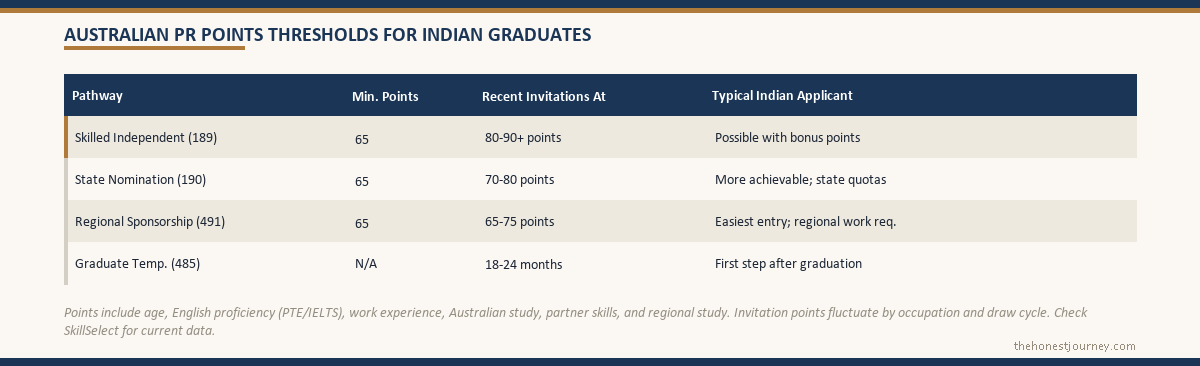
- IT: Software engineers, cybersecurity analysts, data scientists. Competitive but the volume of invitations is high. Points cutoffs in recent rounds have been 85-90+ for some occupations.
- Accounting: Auditors, tax accountants, management accountants. Reasonable demand, CAANZ or CPA recognition required for skilled assessment.
Generic management degrees, arts, law (overseas degrees need requalification), and most business courses outside accounting face poor PR prospects. The occupation list is not generous to generalist qualifications.
Faz's ruleYour occupation's position on the skills list matters more than your GPA.
Before you commit to a program, look up your target occupation on the MLTSSL and check recent invitation rounds on the Department of Home Affairs website. If your occupation has not received invitations in 6-12 months or requires 90+ points to get invited, the PR math is hard. Choose the program around the outcome you want, not the brand name.
Sydney and Melbourne vs Smaller Cities: Real Cost Comparison
The city choice is underrated in most Australia content. The university rank gap between Group of Eight institutions in Sydney/Melbourne and universities in Adelaide, Brisbane, or Perth is meaningful for some disciplines and irrelevant for others. The cost gap is always large.
| City | Monthly living cost (AUD) | Avg rent (shared room, AUD/month) | 485 job market |
|---|---|---|---|
| Sydney | AUD 1,900 to 2,500 | AUD 900 to 1,200 | Strong, competitive |
| Melbourne | AUD 1,700 to 2,300 | AUD 800 to 1,100 | Strong, competitive |
| Brisbane | AUD 1,400 to 1,900 | AUD 700 to 950 | Growing, Olympics effect |
| Adelaide | AUD 1,200 to 1,700 | AUD 550 to 800 | Smaller market, state nomination advantage |
| Perth | AUD 1,300 to 1,800 | AUD 650 to 900 | Strong in mining, engineering |
| Regional cities | AUD 1,000 to 1,400 | AUD 450 to 700 | Limited, occupation-specific |
Adelaide deserves a specific mention. The University of Adelaide is a Group of Eight institution. The cost of living is AUD 500-700/month lower than Sydney for a comparable lifestyle. South Australia has historically been one of the more generous states for 190 visa nominations. For Indian students in engineering or health who want a Group of Eight degree without Sydney prices, Adelaide is consistently undervalued.
Regional study (outside major cities) gives an extra year on the 485 visa and can improve state nomination prospects, but the trade-off is a thinner job market during and after study. Worth it for some occupations, particularly nursing and allied health where regional hospitals are actively hiring.
Who Should and Shouldn’t Choose Australia
Australia makes financial sense under specific conditions, and if you are torn between the two, our Canada vs Australia comparison for Indian students lays out the cost and PR trade-offs. Here is the honest breakdown:
Choose Australia if:
- Your target occupation is on the MLTSSL and has received consistent invitations in the past 12 months.
- You are willing to work 48 hours per fortnight every semester for 1-2 years to cover living costs and build savings discipline.
- Your family can fund or you can loan the tuition without it being a catastrophic financial burden, roughly ₹50-80 lakh for a 2-year Masters program including living costs.
- You are targeting nursing, engineering, trades, or a specific IT role where Australian work experience opens real doors.
- You are open to living in Adelaide, Brisbane, or Perth rather than defaulting to Sydney or Melbourne.
- You are serious about staying for 4-6 years post-graduation to build points and work experience for PR.
Do not choose Australia if:
- Your occupation is not on skilled migration lists and you are banking on a “general” pathway that does not exist reliably.
- You are doing an MBA expecting to leverage the brand name for an Australian corporate career. MBA ROI in Australia for international graduates is poor relative to cost unless you have 5+ years of strong prior experience.
- Your family’s financial situation means the total cost (₹80L-1.5Cr for most programs) creates serious distress regardless of outcome.
- You want to stay in Australia short-term and then return to India. The cost structure only makes sense if you are extracting value from 2-4 years of post-study work rights at full-time wages, which is really a question of whether studying abroad is worth it for your specific numbers.
- You are choosing Australia primarily because of visa ease relative to the US. That is a reasonable input but should not be the primary driver.
Health Cover, Visa Fees and the Costs That Sit Outside Tuition
Tuition and rent get all the attention, but the Australian student visa carries a set of fixed costs that families routinely leave out of the spreadsheet. The student visa application charge itself rose to AUD 1,600 in mid-2024, and that is per applicant, so a student bringing a partner pays more again. On top of that, every student must hold Overseas Student Health Cover for the full length of the visa and clear the medical test for the student visa before grant, and a single-person policy for a two-year stay runs roughly AUD 1,500 to 2,500 depending on the provider. You pay this upfront before the visa is granted, not in monthly instalments.
There is also the financial-capacity requirement. To grant the visa, the Department of Home Affairs expects evidence that you can cover the first year of living costs, currently set at AUD 29,710 for the primary student, in addition to tuition and travel. This is not a deposit you hand over, it is proof of funds, but the money has to genuinely exist and be documented, often as a loan sanction letter or bank statements with a clear source of funds.
Add the one-off setup costs once you land: a rental bond of four to six weeks rent, often AUD 2,000 to 3,000 in Sydney, plus furniture, a local SIM, and the gap before your first pay cheque. The honest planning number is to treat the first three months in Australia as costing close to double a steady-state month. Families who budget only tuition plus living costs are usually short by AUD 6,000 to 9,000 in year one.
The City Tax Trap: Why Take-Home Pay Is Lower Than It Looks
The AUD 23.23 minimum wage is genuine, but the figure students quote to each other is almost always the gross hourly rate, and Australia taxes student earnings in a way that surprises people. If you do not provide a Tax File Number to your employer, you are taxed at the top marginal rate on every dollar, which can mean nearly half your pay disappears until you fix it. So step one on arrival, before your first shift, is to apply for a Tax File Number through the Australian Taxation Office. It is free and takes about two weeks.
Even with a Tax File Number, your status matters. Most international students working part-time are treated as Australian residents for tax purposes, which means the tax-free threshold of AUD 18,200 applies and the effective tax on a typical student income is low. But casual hospitality and retail jobs, where most students end up, often do not include paid leave, and superannuation is paid on top of wages into a fund you generally cannot access until you leave Australia permanently. That superannuation, around 11.5 percent of wages, is real money but it is not spendable cash while you study.
The practical takeaway: when you model your Australian budget, work from after-tax, post-superannuation income, not the gross hourly rate multiplied by hours. A student working the full 48-hour fortnight at minimum wage clears closer to AUD 1,900 to 2,050 a month in usable cash, not the AUD 2,400 the gross figure suggests. Build the budget on the lower number and a near break-even month in Sydney becomes a planned outcome rather than a shock.
485 to PR: The Points Math in Plain Numbers
The 485 graduate visa buys you time, but PR is a separate, points-based contest, and it helps to see the numbers laid out honestly. The skilled independent visa, subclass 189, runs on an Expression of Interest where you need an invitation, and recent rounds have invited most Indian applicants only at 90 points or above for competitive occupations like accounting and general IT roles.
Here is where the points realistically come from. Age is the biggest single block: 30 points if you are between 25 and 32, dropping to 25 points from 33 to 39, and to 15 points from 40 to 44. English scores another large block: 20 points for superior English, which means an IELTS 8 in every band or the equivalent, against just 10 points for proficient English at IELTS 7. An Australian master’s degree is worth 15 points, and studying in a regional area adds 5. Three to five years of skilled work experience in Australia adds another 5 to 15 points.
Stack a realistic strong profile: a 28-year-old with superior English, an Australian master’s, regional study, and three years of local skilled work reaches roughly 30 plus 20 plus 15 plus 5 plus 10, which is 80 points, and that is often still short of an independent-visa invitation in a competitive field. This is exactly why the state-nominated 190 and the regional 491 visas matter, because they add 5 and 15 points respectively and have lower effective cutoffs. The honest message for Indian students: do not assume an Australian degree converts to PR on its own. Model your own occupation, age and English score against current invitation rounds before you choose the program, because the program you pick should serve the outcome, not the other way round.
Sorting the visa is the step most people underestimate. The full process, fees and funds proof for Australia sit in the Australia student visa guide.
Deciding between destinations? Compare USA vs Australia and UK vs Australia for Indian students.
Before you commit, weigh the payback: read is studying in Australia worth it for the honest ROI and years-to-repay math.
FAQ
How much does it cost to study in Australia for Indian students?
A complete 2-year Masters degree at a mid-to-top Australian university costs roughly AUD 60,000-100,000 in tuition (₹40-68 lakh at current rates), plus AUD 18,000-30,000 per year in living costs depending on the city. Total all-in cost for a 2-year Masters in Sydney or Melbourne is approximately ₹1.2-1.7 crore. In Adelaide or Brisbane the same degree runs closer to ₹90 lakh to 1.2 crore. These are real numbers, not optimistic projections.
Can Indian students work while studying in Australia?
Yes. Student visa holders can work 48 hours per fortnight during semester and unlimited hours during official course breaks. At the minimum wage of AUD 23.23 per hour, the maximum semester work allowance earns roughly AUD 2,000-2,100 per month after tax, enough to cover most living costs in smaller cities and most but not all living costs in Sydney or Melbourne. The honest mechanics of part-time work while studying abroad apply here in full.
What is the 485 visa and how long can you stay?
The subclass 485 Temporary Graduate visa allows international graduates to live and work in Australia after completing an eligible degree, with no employer sponsorship required. Duration is 2 years for a Bachelor’s degree, 3 years for a Masters, and 4 years for a PhD. Studying in a regional area adds one additional year to each category. The 485 visa does not directly convert to PR, it gives you time to accumulate Australian work experience and points for the skilled migration system.
Is it easy to get PR in Australia after studying there?
It is a real pathway, not an easy one. Skilled migration runs on a points-based Expression of Interest system. Most Indian graduates need 80-90+ points to receive an invitation for the independent skilled visa (subclass 189). That typically requires: under 33 years of age, 8 or 9 bands in IELTS, an Australian Masters degree (15 points), and 3-5 years of Australian work experience (10-15 points). Occupation demand matters heavily, some occupations receive invitations at 65 points while others have not received invitations in over a year. State-nominated visas (190 and 491) are often more accessible than the federal independent pathway.
Which Australian cities are cheapest for Indian students?
Adelaide is consistently the most affordable major city with a Group of Eight university. Monthly living costs run AUD 1,200-1,700 compared to AUD 1,900-2,500 in Sydney. Brisbane and Perth fall in between. Regional towns are cheaper still but have limited job markets. For students prioritizing financial sustainability, Adelaide and Brisbane offer a meaningful cost advantage without sacrificing university quality across most disciplines.
Which courses have the best PR prospects in Australia for Indian students?
Healthcare (registered nursing, aged care, physiotherapy), civil and electrical engineering, construction trades, and specific IT roles (cybersecurity, software engineering) have the strongest and most consistent skilled migration demand. Accounting qualifications recognized by CAANZ or CPA Australia also perform well. Generalist MBAs, arts, communications, and most social science degrees face poor skilled migration outcomes. Before enrolling, check your target occupation against the current MLTSSL on the Department of Home Affairs website and look at recent invitation rounds in SkillSelect.