Short answer. Studying in the USA as an Indian student is a five-stage journey: clear the tests, win an admit and an I-20, get the F-1 visa, study for one to two years, then use the OPT work runway. An all-in two-year Master’s runs roughly ₹50 to 60 lakh.
It is worth the ticket mainly for STEM degrees, where 12 months of OPT plus a 24-month STEM extension gives a 36-month earning window to repay. The H-1B that follows is a lottery, not a promise, so plan on the OPT runway you can count on.
Every year a wave of Indian students applies to the US because everyone around them is applying to the US. Some of them have thought hard about whether the degree pays back. Many have not, and they sign up for the single largest loan their family will ever take on the assumption that an American degree automatically works out. It does, often. It also does not, sometimes, and the difference is rarely luck. It is whether the program, the work runway and the funding lined up before they left.
This is the honest end-to-end overview of what it actually takes to study in the USA from India. It is not a cost breakdown; the full rupee detail sits in our cost of studying in the USA guide. It is not a loan guide either; that is the education loan for USA guide. This is the whole arc, so you can decide if the journey is the right one before you start.
The F-1 needs no English test, but the visa interview is in English and is the real test. See USA universities without IELTS.
Deciding when to start in the US? Fall carries the assistantships and the internship pipeline, but Spring has its place. See intakes in the USA.
Is studying in the USA worth it? The honest frame
Start with the question most blogs skip. A two-year US Master’s is the biggest education loan most Indian families take, often ₹50 lakh or more. That number only makes sense if the earning runway on the other side can repay it. For a STEM graduate with a 36-month OPT window and a US tech salary, it usually can. For a non-STEM graduate with a 12-month window at a mid-ranked school, the math gets tight fast.
So the honest answer is not “yes” or “no.” It is “it depends on the program and the runway.” Our wider is studying abroad worth it analysis walks the general case. For the US specifically, the deciding factor is almost always whether your degree is STEM-designated, because that single fact triples your post-study work window.

Stage one: admissions and the I-20
The application cycle for the US runs roughly a year ahead. For a Fall intake you are testing and applying the previous autumn and winter. The standard pieces are a GRE or GMAT score for graduate programs, an English test such as TOEFL or IELTS, your transcripts, letters of recommendation, and a statement of purpose. The SOP is where many strong applicants underperform, and the principles in our SOP guide apply to admissions too.
Once you accept an admit and submit your financial documents, the university’s designated school official issues the Form I-20, the Certificate of Eligibility for F-1 status. The I-20 carries a certified estimated cost of attendance for the full program, and that number matters far beyond admissions: it sets your visa funding requirement and, if you borrow, your loan sanction ceiling. The official explainer on student status sits on studyinthestates.dhs.gov.
Faz's ruleThe I-20 cost of attendance is the number that follows you everywhere: visa funds, loan sanction, even how the visa officer reads your case. Get it right at the source before anything else moves.
Students treat the I-20 as a formality and discover later that it is the spine of the whole process. The certified cost of attendance on it is what the bank sanctions against and what you must prove funds for. Ask your school official for the breakdown the moment you accept, so every later step rests on the right number.
Stage two: the F-1 visa and SEVIS
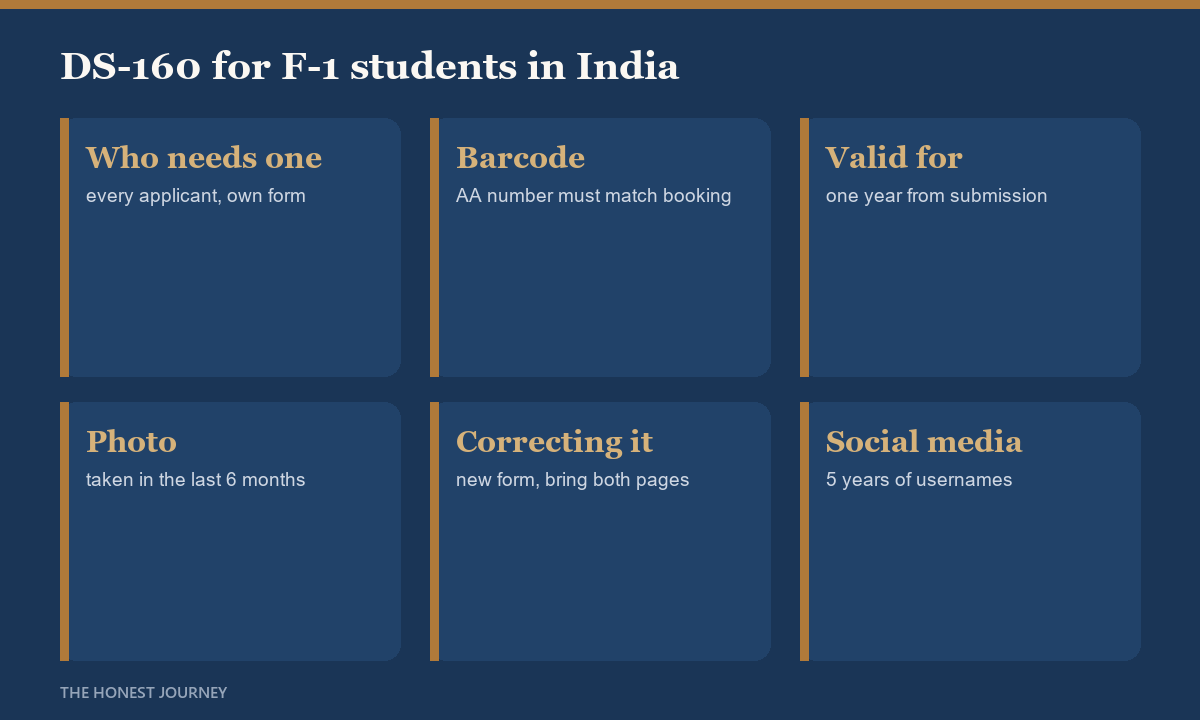
With the I-20 in hand you start the F-1 student visa process. The sequence is fixed and the official authority is the US Department of State at travel.state.gov. First you pay the SEVIS I-901 fee, the record-keeping fee for international students. Then you complete the DS-160 online application and pay the visa fee. Then you book and attend the visa interview at the US consulate.
The interview is short and the officer is checking three things, broadly: that you are a genuine student, that you can fund the program, and that you intend to comply with your status. You prove the funding with your I-20 and your financial documents, which is where proof of funds matters. Our proof of funds guide covers exactly what to carry, including how a sanctioned education loan counts as evidence of funds.
One timing point that trips families up: the SEVIS fee, the DS-160 fee and the first flight are all out-of-pocket costs that fall due before any education loan tranche is disbursed, because the bank releases tuition only after the visa is granted. Budget a clean family buffer for these pre-visa costs separately from the loan.
Stage three: the real all-in cost in INR
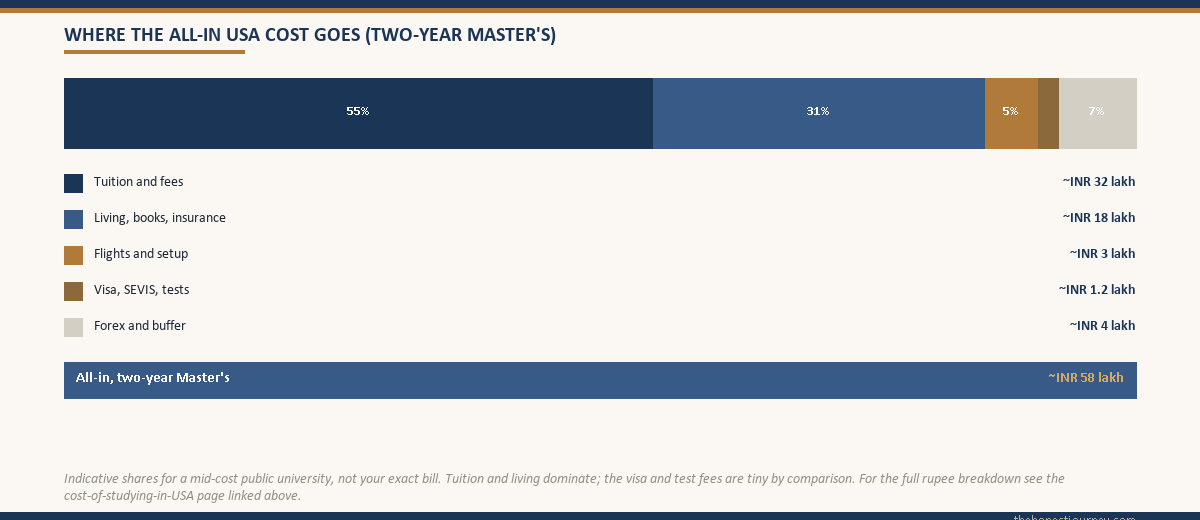
Here is the summarised cost picture for a two-year US Master’s at a mid-cost public university. This is the overview; the full line-by-line breakdown, including how living costs vary by city, is in our cost of studying in the USA guide, which you should read for the detail.
| Component | Indicative INR (two years) | Notes |
|---|---|---|
| Tuition and fees | ~₹32 lakh | Varies hugely by school |
| Living, books, insurance | ~₹18 lakh | Higher in big cities |
| Flights and US setup | ~₹3 lakh | Initial deposits, basics |
| Visa, SEVIS, tests | ~₹1.2 lakh | Mostly pre-departure |
| Forex and buffer | ~₹4 lakh | Rate moves, contingency |
| All-in, two years | ~₹58 lakh | Mid-cost estimate |
Tuition and living dominate; the visa and test fees are small by comparison. The forex line is real, though: if the rupee weakens against the dollar during your two years, your effective cost rises, since tuition is billed in dollars. The mechanics of moving money abroad under the LRS limit are in our wider funding coverage.
Stage four: funding the journey
Most Indian families fund a US degree with a mix of savings, scholarships and an education loan. On scholarships, the honest picture is that full rides are rare and competitive, but partial funding, teaching and research assistantships, and tuition waivers are achievable, especially for strong STEM applicants. Our scholarships guide covers how to find and win them. For US-specific funding, the Fulbright program through usief.org.in is the marquee scholarship route worth knowing even if few win it.
On loans, a two-year US Master’s almost always lands above the ₹7.5 lakh unsecured PSU ceiling, so you are choosing between a secured PSU loan at a lower rate and an unsecured NBFC loan at a higher rate. The full decision sits in our education loan for USA guide, and it is worth reading carefully because the funding choice shapes how repayable the whole degree is.
Faz's ruleTreat the SEVIS fee, visa fee and first flight as out-of-pocket money the loan will not cover. Build a family buffer for the pre-visa costs separately, because the bank disburses tuition only after the visa is granted.
Every year families plan to the rupee on the loan and forget the pre-visa cash. The SEVIS and visa fees plus a flight and first rent deposit need a clean buffer in spring, well before the first tuition tranche lands in August. Plan for it early, not in a panic the week before the interview.
Stage five: the OPT runway and the H-1B reality
This is the stage that decides whether the whole investment pays back, and it is the most misunderstood. After graduation, an F-1 student gets 12 months of Optional Practical Training (OPT), which is work authorisation in the field of study. If the degree is a designated STEM field, the graduate can apply for a 24-month STEM OPT extension, for a total of 36 months of work authorisation. The official rules sit on studyinthestates.dhs.gov and the wider federal education context on ed.gov.
That 36-month window is the repayment engine for a US loan. A STEM graduate earning a US salary across three years can service, and often substantially prepay, a ₹50 lakh loan in a way a one-year work window elsewhere cannot match. This is the honest case for the US ticket being worth its larger loan.
But the runway has a hard limit, and it is the H-1B lottery. Staying and working beyond OPT generally needs an H-1B visa, which is selected by lottery, not by merit. Capable graduates routinely go unpicked across multiple years and have to leave. So the only safe way to model your repayment is on the OPT income you can reasonably count on, not on a long-term US career you are assuming will continue. If the loan only repays comfortably on the assumption that you win the H-1B, the math is too tight and you should shrink the loan or pick a cheaper program.
The honest take on studying in the USA
The US works as a destination when the program quality, the STEM runway and the funding position all line up. A STEM Master’s at a solid school, funded with a manageable loan, repaid across a 36-month OPT window, is a genuinely strong investment, and the OPT-then-H-1B path has lifted countless Indian families into a different bracket.
What does not work is the default version: applying to the US because everyone does, taking a mid-ranked non-STEM program, funding it fully at NBFC rates without collateral, and counting on an H-1B you have not won. That is the combination where the math breaks, and no amount of optimism fixes it. Run your own numbers against the I-20 cost of attendance, the realistic OPT runway and your funding mix before you commit. If they line up, the US is one of the best bets in global education. If they do not, a cheaper one-year Master’s elsewhere may serve you better, and there is no shame in that math. If you are weighing the US against another destination, our USA vs UK comparison for Indian students and our USA vs Canada breakdown put the costs and work runways side by side.
Sorting the visa is the step most people underestimate. The full process, fees and funds proof for the USA sit in the USA student visa guide.
Before you commit, weigh the payback: read is studying in the USA worth it for the honest ROI and years-to-repay math.
FAQ
How much does it cost an Indian student to study in the USA?
An all-in two-year Master’s at a mid-cost US public university runs roughly ₹50 to 60 lakh, covering tuition, living, insurance, flights, visa fees and a forex buffer. Tuition and living dominate the bill, while visa and test fees are small by comparison. Costs vary widely by school and city, with big-city living and private universities pushing the total much higher. For the full line-by-line rupee breakdown, see our dedicated cost of studying in the USA guide rather than relying on this summary alone.
What is the I-20 and why does it matter so much?
The Form I-20 is the Certificate of Eligibility for F-1 student status, issued by your university once you accept admission and submit financial documents. It carries a certified estimated cost of attendance for the full program. That single number sets your visa funding requirement, your education loan sanction ceiling, and how the visa officer assesses your case. Because it follows you through every later step, get the cost-of-attendance figure right at the source the moment you accept, before you apply for a visa or a loan.
How do I get an F-1 student visa for the USA?
After receiving your I-20, you pay the SEVIS I-901 fee, complete the DS-160 application and pay the visa fee, then book and attend an interview at the US consulate. The officer checks that you are a genuine student, that you can fund the program, and that you intend to comply with your status. You prove funding with the I-20 and financial documents, including any sanctioned education loan. The official authority is the US Department of State, and these pre-visa fees are out-of-pocket costs your loan will not cover.
What is OPT and how long does it last?
Optional Practical Training is work authorisation that lets an F-1 graduate work in their field of study after graduation. The standard window is 12 months. If your degree is a designated STEM field, you can apply for a 24-month STEM OPT extension, giving 36 months of total work authorisation. That three-year runway is the main reason a STEM US Master’s can repay a large loan, since a US salary across 36 months can service or even prepay it, unlike a single 12-month window.
Is an H-1B visa guaranteed after OPT?
No. Working in the US beyond your OPT window generally requires an H-1B visa, which is selected by lottery rather than by merit or qualification. Many capable graduates go unpicked across several attempts and have to leave when their OPT ends. For that reason you should model your loan repayment on the OPT income you can reasonably count on, treating the H-1B as upside rather than the base case. If your repayment plan depends on winning the H-1B, it is too risky.
Are scholarships available for Indian students in the USA?
Yes, though full rides are rare and competitive. More achievable are partial scholarships, tuition waivers, and teaching or research assistantships, which are especially common for strong STEM graduate applicants and can substantially cut the net cost. The Fulbright program is the marquee fully-funded route, administered for India through USIEF, but it is highly selective. Start scholarship applications early, since deadlines often precede admission decisions, and treat funding as part of your school choice rather than an afterthought.
Is studying in the USA worth it for Indian students?
It depends on the program and the work runway. A STEM Master’s at a solid school, funded with a manageable loan and repaid across the 36-month OPT window, is usually a strong investment. A mid-ranked non-STEM program, fully loan-funded at high rates with only 12 months of OPT and a reliance on winning the H-1B, is where the math tends to break. Run your own numbers against the I-20 cost, the realistic OPT runway and your funding mix before committing.
Should I take a loan or use savings for a US degree?
Most families use a mix. Savings and scholarships reduce how much you borrow, which directly lowers your interest burden and your repayment risk. For the borrowed portion, a two-year US Master’s almost always exceeds the ₹7.5 lakh unsecured PSU ceiling, so you choose between a cheaper secured PSU loan and a costlier unsecured NBFC loan. The right mix keeps your repayment comfortably serviceable on the OPT runway alone. See our education loan for USA guide for the full funding decision.
Faz · The Honest Journey · 2026