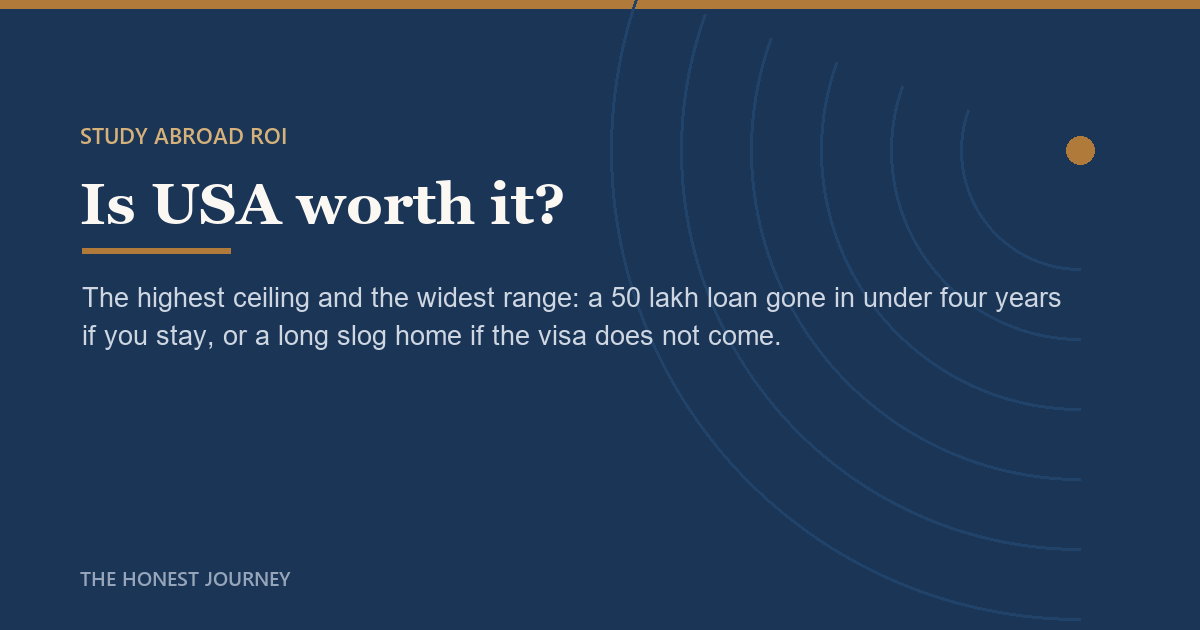
Short answer. The honest answer on whether studying in the USA is worth it for Indian students: on pure earning power, yes, the USA pays more than anywhere else on earth, ₹67 to 100 lakh gross for a STEM graduate, and a good outcome clears a ₹50 lakh loan in three to four years.
But it is also the most expensive ticket, ₹42 to 67 lakh all-in, and staying long term runs through the H-1B lottery and a green-card queue that for Indians stretches for decades. The USA is worth it if your field is STEM, you can carry a large loan, and you treat staying as a bonus rather than a certainty. It is a bad bet if your program is non-STEM, your loan is unsecured at a high rate, and your whole plan depends on a work visa you may never win.
The payback maths depends on your work window. See OPT and the duration of status rule.
A student I spoke to last year did the maths only after she had signed. Master’s in computer science at a solid US university, ₹58 lakh all-in, funded by a ₹52 lakh unsecured loan at 11 percent. On paper terrifying. Then she landed a job at USD 98,000, and inside four years the loan was gone and she was saving hard. Her cousin, same intake, took a non-STEM Master’s at a similar cost, did not win the H-1B lottery in three tries, came home, and is now servicing a ₹50 lakh loan on a ₹22 lakh Indian salary. Same country, same price, two completely different returns. The difference was never the USA. It was the field, the loan, and the odds.
This post is the return-on-investment question the brochures skip. Not how much the USA costs, that lives on the cost of studying in the USA post, but whether the money comes back. I will walk through the all-in cost in rupees, what you actually earn after tax, how many years the loan really takes to clear in the two scenarios that matter, and the specific risks that turn a great investment into a trap. For the math I use ₹84 per US dollar throughout; rates move, so treat it as the planning frame.
If you are still choosing the country, the wider view sits in is studying abroad worth it and the USA vs Canada comparison.
The intake you choose sets the clock on scholarships and the internship cycle, which feeds directly into whether the degree pays back. See US intakes explained.
The ROI question in one paragraph
The USA is the highest-ceiling, highest-variance education investment an Indian student can make. Nowhere else pays a fresh graduate ₹67 to 100 lakh, and nowhere else lets a large loan disappear in three or four years the way a US STEM salary can. That is the ceiling, and it is real. But the same degree can also leave you with a ₹50 lakh loan and an Indian salary if the job, the visa, or the field does not break your way. The return is not a single number; it is a wide range, and where you land inside it depends far more on your field and your visa outcome than on the university name. Treat the USA as an investment with a spectacular best case and a genuinely painful worst case, and plan for both.
Total all-in cost in INR
The USA is the most expensive destination in this whole set, and the number matters because it sets the size of the loan you must earn back. A two-year Master’s at a public university runs roughly USD 25,000 to 40,000 per year in tuition, about ₹21 to 33.6 lakh a year, with private universities higher. Living adds USD 12,000 to 18,000 a year, around ₹10 to 15 lakh depending on the city. All-in, a two-year US Master’s commonly lands between ₹42 and 67 lakh, and metro programs in New York, Boston or the Bay Area push the top of that.
Most Indian students fund this with a large loan, and the loan is where the real cost hides. An unsecured education loan of ₹45 to 55 lakh at 10.5 to 12 percent, with interest accruing through a two-year moratorium, quietly grows before you have earned a rupee. That accrued interest is the part families forget, and it is exactly why the payback maths later matters more than the sticker price.
| Cost item | Two-year US Master’s |
|---|---|
| Tuition (full program) | ~₹30 to 50 lakh |
| Living (full program) | ~₹12 to 20 lakh |
| Rough all-in study cost | ~₹42 to 67 lakh |
| Typical loan shape | Large, often unsecured at 10.5 to 12 percent |
| Interest during moratorium | Accrues and compounds before you earn |
The full breakdown and the loan-product side sit on the cost of studying in the USA post and the education loan for USA post. The point here is only that you are earning back a number closer to ₹55 lakh once moratorium interest is counted, not the ₹50 lakh you borrowed.
Faz's ruleThe number you must earn back is not the loan you signed for. It is that loan plus two years of moratorium interest quietly compounding while you study. Count that number, not the sticker.
A ₹50 lakh loan at 11 percent with a two-year study moratorium is closer to ₹60 lakh by the time your first EMI is due, because the interest accrues the whole time. Every honest payback calculation for the USA starts from the post-moratorium figure, not the amount you borrowed. Students who plan against the sticker price are always surprised by the real balance.
What you actually earn
This is where the USA justifies its price, and it genuinely does for the right field. A STEM Master’s graduate in software, data or engineering commonly starts at USD 80,000 to 120,000, roughly ₹67 to 100 lakh gross at ₹84. That is not a top-of-market figure; it is a normal starting band for a competent STEM graduate at a mid-tier US employer. No other destination in this set comes close on gross pay.
But gross is not what pays the loan. US federal tax, state tax and payroll deductions take a real bite, so take-home on a USD 95,000 salary is often around USD 62,000 to 68,000, about ₹52 to 57 lakh a year in hand. High-cost cities then eat into that with rent. The honest earning figure for loan maths is the money left after tax and rent, and for a disciplined STEM graduate that is still a large surplus, enough to throw ₹12 to 18 lakh a year at the loan.
The non-STEM picture is different and rarely stated. A non-STEM Master’s, in many management, humanities or general business fields, more often starts at USD 55,000 to 75,000, around ₹46 to 63 lakh gross, and, crucially, gets only 12 months of OPT rather than the 36 months STEM graduates receive. Lower pay and a shorter runway to win a work visa is the combination that turns the US bet sour, and it is the single most important thing a non-STEM applicant should price in.
The payback period, said plainly
Two scenarios decide the entire return, and they could not be further apart.
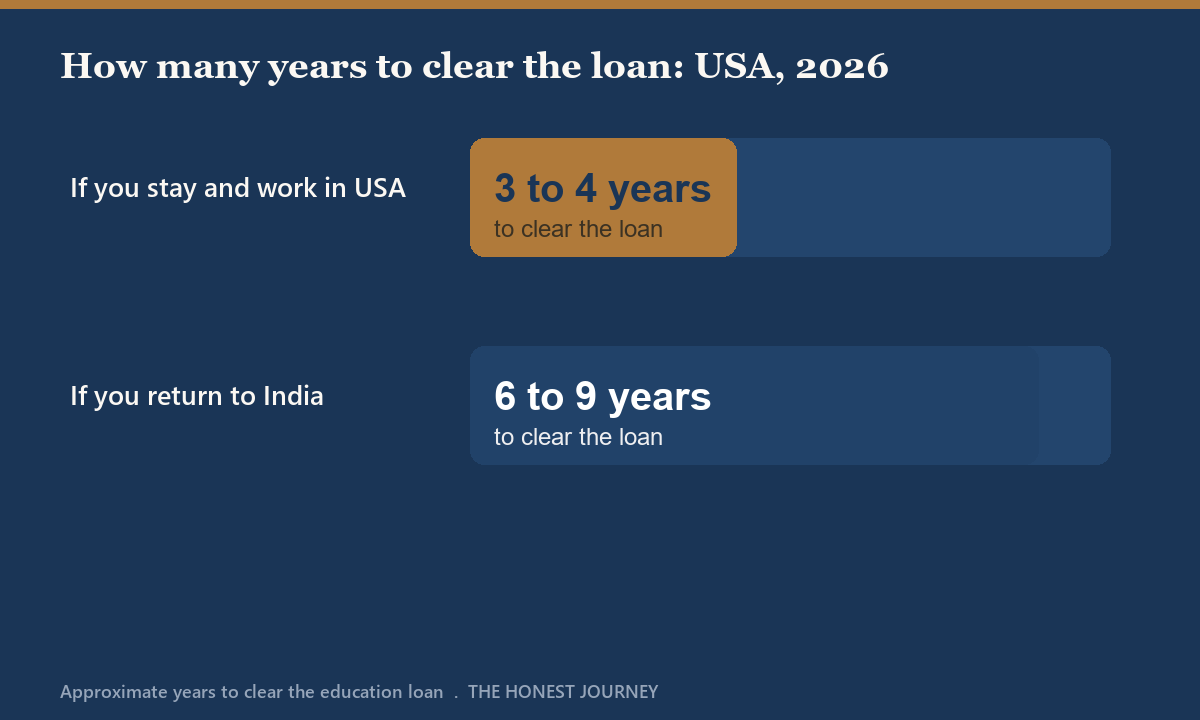
Scenario one, you stay and work in the USA. A STEM graduate on USD 95,000, with about ₹55 lakh in hand after tax and living moderately, can realistically direct ₹14 to 18 lakh a year at a post-moratorium balance near ₹60 lakh. That clears the loan in roughly three to four years, after which the same salary becomes savings. This is the case that makes the USA the best financial bet in the world for an Indian student. It only exists if you win enough time to work, which means OPT plus an H-1B or equivalent.
Scenario two, you return to India. A US Master’s plus some US experience commands a strong Indian salary, often ₹18 to 30 lakh a year for a good STEM profile, but that is a fraction of the US number, and the same ₹60 lakh balance now takes six to nine years to clear on Indian take-home. The degree still helped your career, but the financial return is ordinary, not spectacular, and the years of EMI are heavy. If you return without US experience, having not won a work visa, the return is worse still.
| Payback factor | Stay in the USA (STEM) | Return to India |
|---|---|---|
| Typical salary | USD 80k to 120k (~₹67 to 100L) | ~₹18 to 30 lakh |
| Annual take-home in hand | ~₹50 to 57 lakh | ~₹14 to 22 lakh |
| Realistic yearly loan repayment | ~₹14 to 18 lakh | ~₹5 to 9 lakh |
| Years to clear ~₹60 lakh | ~3 to 4 years | ~6 to 9 years |
| What decides it | Winning OPT plus H-1B time | The visa did not come through |
The gap between those two columns is the real risk you are underwriting, and the thing that moves you between them is not effort or talent. It is the visa lottery.
Faz's ruleThe USA has the best payback in the world and the widest payback range in the world. Which column you land in is decided partly by a lottery, so borrow an amount you could still survive in the return-to-India column.
The three-to-four-year payback is real and glorious, but it assumes you win the time to work. If you would be financially crushed by the six-to-nine-year return-to-India outcome, your loan is too big for the risk you are taking. Size the loan so that even the worse column is survivable, because you do not fully control which one you get.
The risks that break the ROI
Three specific risks turn the US investment from brilliant to painful, and all three are foreseeable.
The first is the H-1B lottery. After OPT ends, most graduates need an H-1B work visa to keep working, and it is awarded by random selection because demand far exceeds the annual cap. Recent years have run selection odds in the region of one in four to one in three per attempt. STEM graduates get three cracks at it across their 36-month OPT; non-STEM graduates, with only 12 months, often get one. Your ability to stay, and therefore your payback column, partly comes down to that draw.
The second is the green-card queue for Indians. Even after H-1B, permanent residence through the employment-based categories has a country cap that leaves Indian applicants in a backlog measured in many years, in some categories decades. You can build a full career in the USA on H-1B, but calling permanent settlement a certainty is not honest for an Indian national. Plan for a long temporary-visa stretch, not a quick green card.
The third is field and loan structure. A non-STEM degree funded by a large unsecured loan at 12 percent is the worst-case setup: lower pay, only 12 months of OPT, higher interest, and the same big balance. If that is your profile, the USA is the hardest place to make the maths work, and a cheaper English-language destination often gives a better honest return. The secured-versus-unsecured choice is covered in the secured vs unsecured education loan post.
A worked payback example
Take one student, a computer-science Master’s graduate, ₹52 lakh loan at 11 percent, two-year moratorium.
| Step | Figure |
|---|---|
| Loan borrowed | ₹52 lakh at 11 percent |
| Balance after 2-year moratorium | ~₹60 to 62 lakh (interest accrued) |
| US STEM starting salary | USD 95,000 = ~₹79.8 lakh gross |
| Take-home after US tax | ~USD 64,000 = ~₹53.8 lakh |
| Yearly amount toward loan | ~₹16 lakh |
| Payback if staying (STEM job) | ~3.5 to 4 years |
| Payback if returned to India | ~7 to 9 years |
The staying column is one of the best returns available anywhere: a large loan gone in under four years, then a high salary that is all upside. The returning column is a long, heavy slog on an ordinary Indian salary. Same student, same loan, and the fork between them is mostly the visa. That is the USA in one table, and whether it is worth it for you depends on how confident you are of the STEM-and-stay path and how survivable the other one is.
When the USA is worth it, when it is not
It comes down to field, loan size, and how you treat the visa.
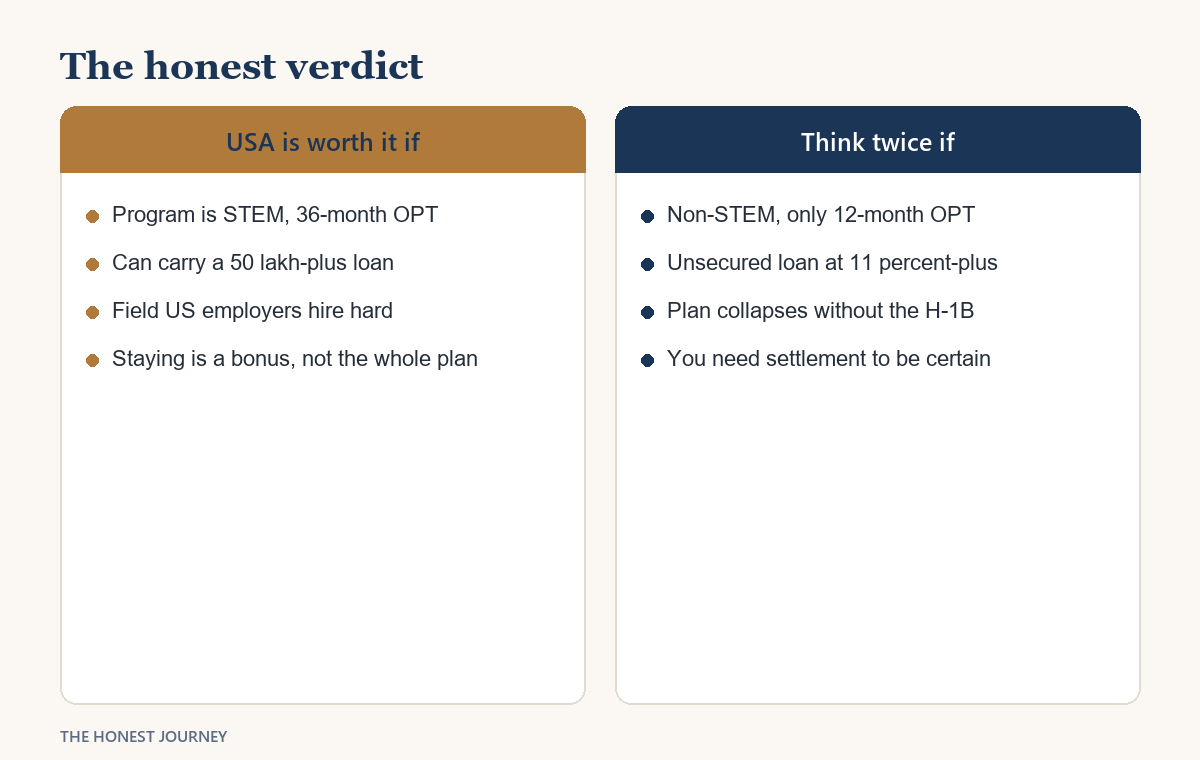
The USA is worth it if your program is STEM with 36 months of OPT, your field is one US employers hire hard for, you can carry a loan of ₹50 lakh or more, and you treat staying as a strong possibility rather than a guarantee you have priced your whole life around. For that profile, the USA is the single best financial bet in international education: the payback is fast and the ceiling is enormous.
Think twice if your program is non-STEM with only 12 months of OPT, your loan is unsecured at 11 percent or more, and your plan collapses if you do not win the H-1B. For that profile the downside is severe and the odds are not in your hands, and a lower-cost English-language destination like Canada, Ireland or Australia often delivers a better honest return with far less risk.
One note that applies to everyone: a US degree plus even two years of US work experience is a genuinely strong asset back in the Indian market too. Returning is not failure, and for many students a planned return after clearing the loan is the smartest version of the whole plan. Do not let the visa lottery convince you that staying is the only good outcome.
The honest take
The student who cleared her loan in four years still calls the USA the best decision she ever made, and for her profile, STEM, a strong job, a stay, she is right. Her cousin, non-STEM and unlucky in the lottery, would not use the same word, and he is not wrong either. The USA did not fail him; the field, the loan and the odds did, and all three were visible before he signed.
So reduce it to the honest test. Is your field STEM, can you carry the loan even if you end up in the return-to-India column, and are you at peace treating permanent settlement as a maybe? If you can answer yes to all three, the USA offers a return nothing else can match. If any answer is no, price the risk carefully and read the USA vs Australia comparison before you commit a rupee, because a lower-ceiling, lower-variance destination may hand you a better real outcome. Decide against the worst case, not the brochure.
Funding the move with a loan? Start with the complete education loan guide, then apply through the PM Vidyalakshmi portal, the government route most Indian students use.
The US number swings most for engineers. See the honest math for engineering graduates, and if you are not in STEM, why the non-STEM version is harder.
FAQ
Is a US Master’s degree worth it for Indian students in 2026?
For a STEM graduate who can carry the loan and lands a US job, yes, clearly. A ₹67 to 100 lakh starting salary clears a ₹50 lakh loan in three to four years, a return no other destination matches. For a non-STEM graduate funded by a large unsecured loan whose plan depends on winning the H-1B lottery, it is a much weaker bet, because the pay is lower, the OPT window is only 12 months, and the visa is not in your control. The answer depends far more on your field and loan than on the university.
How long does it take to repay a US education loan?
If you stay and work in a US STEM job, roughly three to four years on a normal graduate salary, because US take-home pay is large relative to the loan. If you return to India, the same loan takes six to nine years to clear on an Indian salary, since the pay is a fraction of the US figure. Remember the balance you repay is the loan plus the interest that accrued during your two-year study moratorium, often around ₹60 lakh on a ₹50 lakh loan.
What salary can an Indian student expect after studying in the USA?
A STEM Master’s graduate commonly starts at USD 80,000 to 120,000, about ₹67 to 100 lakh gross, though US tax and payroll deductions bring take-home to roughly ₹52 to 57 lakh in hand. A non-STEM graduate more often starts at USD 55,000 to 75,000, around ₹46 to 63 lakh gross. City cost of living then matters: the same salary goes much further outside New York or the Bay Area.
What is the biggest financial risk of studying in the USA?
The gap between staying and returning, decided partly by the H-1B visa lottery. If you win the time to work, a large loan clears in under four years. If you do not and return to India, the same loan takes far longer on a much smaller salary. Because the visa is awarded by random selection, you do not fully control which outcome you get, so the honest rule is to borrow an amount you could still survive if you end up back in India.
Is studying in the USA worth it for a non-STEM degree?
It is the hardest case to justify. Non-STEM programs get only 12 months of OPT rather than the 36 that STEM graduates receive, start at lower salaries, and still cost the same ₹42 to 67 lakh. That combination, one shot at the H-1B, lower pay, and a big loan, is where the US investment most often turns sour. If your field is non-STEM, look hard at lower-cost English-language destinations like Canada, Ireland or Australia, which frequently give a better honest return.
Can Indian students settle permanently in the USA after studying?
You can build a long career on an H-1B work visa, but permanent residence is not quick. The employment-based green-card categories carry a per-country cap that leaves Indian applicants in a backlog measured in many years, and in some categories decades. It is honest to plan for a long stretch on temporary work visas rather than a fast green card. Treat US settlement as a possible long-term outcome, not a certainty you price your whole decision around.
Should I take a large loan to study in the USA?
Only if the maths survives the worst case. A large loan is easy to repay from a US STEM salary but heavy on an Indian one, so the safe test is whether you could still service it if you returned to India without winning the visa. If that scenario would financially break you, the loan is too big for the risk. Prefer a secured loan at a lower rate where possible, and read the secured versus unsecured comparison before signing.
Is the USA or Canada a better return for Indian students?
The USA has the higher ceiling and Canada the safer floor. A US STEM graduate who stays earns more and repays faster than almost anywhere, but the path to staying runs through a lottery and a long green-card queue. Canada costs less, pays less, and offers a clearer, English-based route to permanent residence you can plan toward. For a confident STEM candidate the USA can pay off harder; for someone who values a controllable settlement path, Canada often gives the better risk-adjusted return. The full split is in the USA vs Canada comparison.
Faz · The Honest Journey · 2026