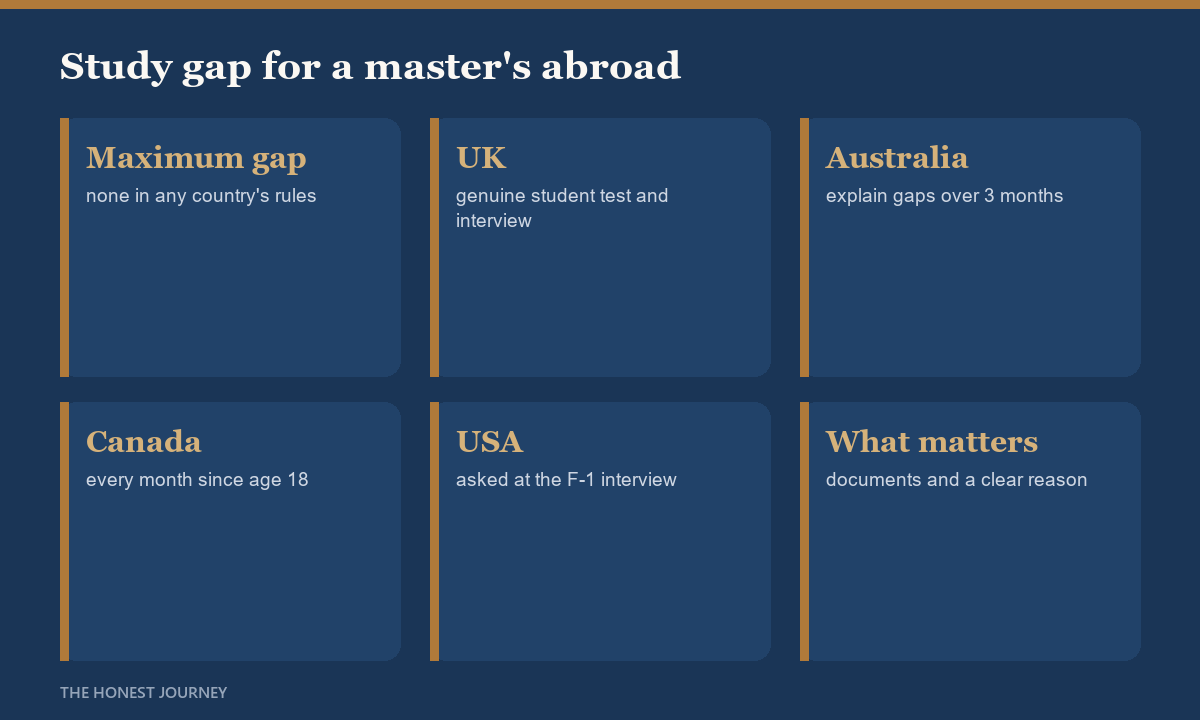
Short answer. No major study destination sets a maximum study gap for a master’s. The “two years for the UK, five for Australia” limits come from agents, not visa rules. The UK, Australia, Canada, the USA, New Zealand and Germany all test one thing: is study your real reason for coming? A gap you can document and explain rarely sinks an application.
Search “study gap accepted in UK” and you will find a confident number. Search the same question on a different site and you will find a different confident number. One says the UK accepts two years for a master’s, another says five, a third says it depends on the university. They cannot all be right, and in fact none of them is quoting a rule, because no rule of that kind exists in the immigration law or official guidance of any of the six countries on this page.
What does exist is more useful to know. Each country asks its visa officers to judge whether you are a genuine student, and each one names the time since you last studied as something to weigh. So the question is never “is my gap under the limit?” It is “does my gap make sense, and can I prove what I did with it?” This page shows exactly where the gap is checked in each country, which gaps read well and which do not, and how to explain yours in the SOP and the visa forms.
Where the “accepted gap” numbers come from
The numbers you see online are rules of thumb that agents built from the cases they handled. A counsellor who saw many UK refusals among applicants with long, unexplained gaps starts telling students the UK “only accepts two years”. That advice is not useless, since it reflects a real pattern, but it gets repeated until it sounds like a regulation. Then it hurts two groups of people. Students with a four-year gap spent in solid work are told not to bother, and students with an 18-month gap spent doing nothing are told they are safe.
The official documents tell a different story. The UK’s caseworker guidance, the document UK visa staff actually work from, lists “the amount of time that has elapsed since the applicant last studied” as a credibility factor and asks whether the applicant has “sound reasons” for returning to study, “particularly after any significant gap”. It never defines “significant” in years. Australia, Canada, the USA and New Zealand work the same way. The gap is a question the officer asks, not a limit your application is checked against.
What each country actually checks
| Country | Maximum gap in the rules? | What is assessed | Where your gap gets looked at |
|---|---|---|---|
| UK | No | The Genuine Student rule. Caseworkers weigh the time since you last studied and your reasons for returning, especially after a significant gap. | University pre-CAS checks, then the UK visa credibility interview |
| Australia | No | The Genuine Student requirement, which applies to applications lodged since 23 March 2024. Four written answers of up to 150 words each. | The university’s own GS check before your offer, then the visa application |
| Canada | No | Whether you will leave Canada when your permit ends, and whether the programme fits your background and plans. | The education and work history form, which for applicants in India asks for every month since age 18 |
| USA | No | The presumption that you intend to immigrate, which you have to overcome at the F-1 interview. | The visa interview and your DS-160 history |
| New Zealand | No | Whether your intention to study is genuine, judged on everything you submit and everything Immigration New Zealand knows about you. | The visa application and supporting evidence |
| Germany | No | Admission first, then a visa file with your CV and a signed motivation letter. | University admission, and the CV the embassy reads |
Two things stand out. First, the “No” column is uniform, which is the honest answer to “which country accepts a study gap for masters”. Second, the gap is looked at more than once, and often by the university before the government. In Australia and the UK especially, the university screens you first because it has its own visa refusal rates to protect. That is where many students with gaps actually get stopped, and it is why your explanation has to be ready before you apply, not after the offer.
Country by country, in more detail
UK
The UK Student route requires you to be a genuine student, and the caseworker guidance (version 14.0, published 3 August 2026) lists the factors. Under education history, it names the time since you last studied, whether you have sound reasons for returning “particularly after any significant gap”, whether the course is academic progression, and how the course fits your plans after study. The same guidance says a caseworker generally must not refuse you on genuineness grounds without interviewing you first, with narrow exceptions. So a gap on its own should not produce a paper refusal. It produces questions, and you get to answer them.
In practice, the universities you apply to will also run a credibility check before issuing your CAS, because refusals count against them. Expect a short interview or questionnaire asking what you did during the gap and why this course now. For the full visa process, costs and documents, see our UK student visa guide for Indian students.
Australia
Australia replaced the old Genuine Temporary Entrant test with the Genuine Student requirement for applications lodged on or after 23 March 2024. The visa form asks you to explain your current circumstances, including ties to family, community, employment and your economic situation; why you want this course with this provider in Australia; how the course will benefit you; and any other relevant information. Each answer is limited to 150 words, and the Department of Home Affairs says it gives more weight to statements backed by evidence. For current employment it asks for your employer’s details, your period of employment, your position and someone who can confirm it.
The government page mentions study gaps specifically only for study already done in Australia, where gaps of more than two months during an academic year need explaining. For an applicant from India, the check that bites first is the university’s. The University of Western Australia’s Genuine Student form asks you to “explain all gaps” in your studies longer than three months. Adelaide University lists gaps in study, including work experience, alongside changes in field and the relevance of the programme to your past or future employment. So in Australia a three-month threshold is real, but it is a threshold for explaining, not a limit on what is accepted. Our Australia student visa guide covers the rest of the file.
Canada
Canada’s regulations require the officer to be satisfied that you will leave by the end of your authorised stay. The gap question lives in the paperwork. The New Delhi visa office’s additional document checklist for study permits (IMM 5818, version dated February 2026) asks for your education and work history since the age of 18, month by month, and says in capitals: “DO NOT leave any gaps.” If you were not working or studying, you are told to write what you were doing, for example unemployed or travelling.
The same checklist asks for an employment letter dated within two months of the application, showing your position, salary and years of employment, plus payslips for the last three months, and income tax returns for you and your parents for the past two years. It also says consolidated mark sheets are not acceptable. So a Canadian file from India shows your gap in detail whether you mention it or not. The only question is whether the months are filled with something you can document. More on the full application is in our Canada student visa guide.
USA
US law presumes every visa applicant is an intending immigrant until they satisfy the consular officer otherwise. That is section 214(b), and it is the reason behind most F-1 refusals. There is no gap rule anywhere in it. What a gap changes is the conversation at the window. An applicant who graduated three years ago will be asked what they have been doing, and “working as a software engineer at a firm in Pune, and this MS moves me into machine learning” is a strong answer. “Preparing” is a weak one if there is nothing to show for it.
US admissions committees rarely care about gaps as such. They care about what you did, and relevant work often strengthens an MS application. Our F-1 visa interview questions guide covers how to answer the “what have you been doing” question without sounding rehearsed.
New Zealand
Immigration New Zealand requires you to have “a genuine reason for coming to New Zealand” and to genuinely intend to study. It says it considers all the information you provide and the information it holds about your personal circumstances. No gap limit appears. Treat it the way you would Australia: explain the gap, attach evidence, and connect it to the course. See our New Zealand student visa guide.
Germany
Germany is the least gap-sensitive of the six at the visa stage. The German Embassy’s student visa checklist for India asks for a curriculum vitae and a signed motivation letter explaining your choice of subject, of Germany and of the university, plus an APS certificate in most cases. There is no credibility interview of the UK kind and no gap threshold. The gap matters more at admission, where some programmes weigh recent academic performance or relevant experience, and in your CV, which should have no unexplained blank years. Our Germany student visa guide has the full checklist.
How a gap actually hurts an application
Since length alone is not the problem, it helps to be precise about what is. Across the six countries, a gap causes trouble in three ways.
- Months you cannot account for. The Canadian form asks for every month since you turned 18. Australian universities ask about anything over three months. An 18-month gap with an employment letter covering all of it is safer than a 9-month gap with nothing to show.
- A gap that does not lead to the course. UK caseworkers are told to check whether the course is academic progression and fits your plans. Adelaide lists “change in area of study” right next to gaps. Three years in sales followed by an MS in data science is fine if you can explain the turn. It fails if you cannot.
- A money story that does not add up. A long gap often means the funding story changes: savings from work, a loan, parents’ income. The officer checks that these match. If you worked for three years, where did the salary go? If you did not work, who supported you, and how does that fit with the funds you are showing?
Notice that none of these is about the number of years. A long, well-documented gap that leads naturally to the course is a strong application. A short, blank gap followed by an unrelated course is a weak one.
Gaps that read well, and gaps that need work
| What you did during the gap | How it usually reads | Evidence to keep ready |
|---|---|---|
| Full-time work in a related field | Strong. It often helps both admission and the visa. | Offer and relieving letters, current employment letter, payslips, Form 16 or ITR |
| Work in an unrelated field | Fine if you can explain why you are changing direction now | The same employment documents, plus a clear line in the SOP on the switch |
| Preparing for GATE, CAT, UPSC or a similar exam | Acceptable for about a year, weaker beyond that unless there is a result | Admit cards, scorecards, coaching receipts |
| Illness or recovery | Acceptable. Officers see this often. | Medical certificate or discharge summary covering the period |
| Family business or caregiving | Acceptable if documented | A letter from the business with GST or registration details, or a medical record for the family member |
| Freelancing or a startup | Good if it is real, weak if it is only a claim | Invoices, client letters, company registration, bank credits |
| Nothing in particular | The hardest to present. Say so plainly and show what changed. | Whatever you can document from recent months, even short courses or part-time work |
The last row deserves a direct word. Do not invent work to fill a blank year. Employment letters are exactly what officers verify, often with a phone call, and in countries such as the UK and Australia a finding of false documents can bring a ban lasting years, which does far more damage than any gap. An honest “I took time to decide, and here is what I did about it” is better than a story that falls apart on a phone call to the employer.
How long is too long?
There is no official answer, so what follows is judgement, not rule. In our experience, applicants see roughly this pattern:
- Under a year. Rarely questioned. A line in your CV is usually enough, though Australian universities and Canada will still want the months accounted for.
- One to three years. Normal for a master’s applicant. Most of these gaps are work, and work is an asset. Explain it in one short paragraph and attach the documents.
- Three to seven years. Still common, especially for MBA and professional master’s applicants. The question shifts from “what did you do?” to “why go back to study now?” Your answer has to be about your career, not about wanting to live abroad.
- Beyond seven years. Very workable with a strong career story, and many students in their thirties go abroad every year. Check that a taught master’s is the right route rather than a professional programme, and expect closer questions about ties to India and your plans afterwards. Our guide to studying abroad in your 30s goes through this in detail, and the MBA abroad for working professionals page covers the programmes built for longer careers.
How to explain a study gap in your SOP and visa forms
Every document you submit tells part of the same story, and officers compare them. Your SOP, CV, visa form, employment letters and, if you are borrowing, the gap affidavit your bank asks for must all show the same dates. A gap described as “work” in the SOP and “unemployed” in the Canadian history form is worse than either on its own.
In the SOP, keep it short and move on. One paragraph is enough for most gaps. State what you did, what you learned from it and how it leads to this course. Do not apologise and do not over-explain. A workable pattern:
After graduating in 2023 I joined a logistics firm in Chennai as an operations analyst. Over two years I built the forecasting sheets our warehouse team still uses, and learned that the limit on my work was statistics I had not been taught. That is why I am applying for an MS in Business Analytics now rather than straight after my degree.
Write your own version. Admissions teams and visa officers see the same template paragraphs many times a season, and a copied one reads worse than a plain honest sentence. Our statement of purpose guide covers structure, and a recommender from your workplace can confirm the story from the outside, which is where a letter of recommendation from a manager earns its place.
In the visa forms, answer the question asked and nothing more. For Australia that means four answers of 150 words or fewer, backed by documents. For Canada it means a complete month-by-month history. For the US it means a DS-160 that matches your SOP, and a spoken answer at the interview that matches both.
Faz's ruleNobody rejects a gap. They reject an unexplained gap, or one that does not lead to the course.
The families I speak to usually ask the wrong question. They ask how many years the country allows, pick a destination to match, and then write the SOP. Do it the other way round. Write down, month by month, what you did since your last degree and what proves it. If every month is covered and the course follows from the work, your gap is an asset in every country on this page. If there are blank months, fix the story and the documents before you choose where to apply.
The education loan side of a study gap
If you are funding the degree with a loan, your gap is checked once more, by the lender. Most Indian banks and NBFCs ask for a gap certificate, usually a notarised affidavit on stamp paper, explaining any break in education. That document must match the dates in your SOP and visa file. The format, stamp paper values by state and the reasons banks accept are in our gap certificate for education loan guide. If you worked during the gap, your savings and ITRs also strengthen your proof of funds, so the gap can help the money side as well.
The honest closing take
The question “which country accepts a study gap?” has a short answer: all of them, in the sense that none sets a limit, and none of them, in the sense that every one of them will ask about it. Choosing a destination because an agent said its gap limit is higher is choosing on a rule that does not exist. Choose on the course, the cost and the outcome, the way you would without a gap, and then build a file where every month is accounted for and the course follows from what you did. Our guide to shortlisting universities covers that first step, and if a previous refusal is part of your history, read student visa rejection reasons before you reapply.
FAQ
Which country accepts the longest study gap for a master’s?
None of the main destinations sets a maximum. The UK, Australia, Canada, the USA, New Zealand and Germany all assess whether you are a genuine student instead. Germany is the least gap-sensitive at the visa stage because it has no credibility interview. In every country, a long gap filled with documented, relevant work is accepted far more readily than a short blank one.
Is a 2-year study gap acceptable for the UK?
Yes, if you can explain it. UK caseworker guidance asks officers to weigh the time since you last studied and your reasons for returning, but it sets no limit in years. Two years of work, exam preparation with results, or documented illness is routine. Expect your university to ask about it in a pre-CAS interview.
How much study gap is accepted in Australia for a master’s?
Australia sets no maximum. Under the Genuine Student requirement you explain your circumstances in answers of up to 150 words, backed by evidence. Universities screen first. The University of Western Australia, for example, asks you to explain every gap in study longer than three months. A multi-year gap is accepted when the explanation and documents are solid.
Does Canada accept a study gap?
Yes. Canada has no gap limit, but the New Delhi visa office checklist asks for your education and work history month by month since age 18 and tells you not to leave any gaps. Unexplained months are the risk, not the length. Employment letters, payslips and ITRs are the evidence officers expect.
Is a study gap a problem for a US F-1 visa?
Not by itself. US law has no gap rule. The officer must be satisfied that you are a genuine student who will not stay on unlawfully, and a gap simply prompts the question of what you have been doing. A clear, specific answer that links your work to the MS is usually enough.
How do I explain a study gap in my SOP?
In one short paragraph: what you did, what it taught you, and why it leads to this course now. Do not apologise or pad it. Make sure the dates match your CV, visa forms and any gap affidavit for your loan, because officers compare documents.
Can I study abroad after a 5-year gap?
Yes. Many Indian students go abroad for a master’s after five or more years of work. The questions shift to why you want to study now and what you will do afterwards. A career-driven reason, relevant work documents and funding that matches your history make a five-year gap a strength rather than a weakness.
Where these figures come from
- UK Visas and Immigration, Student and Child Student caseworker guidance, version 14.0, 3 August 2026
- UK Immigration Rules, Appendix Student, Genuine Student requirement ST 5.1
- Australian Department of Home Affairs, Genuine Student requirement
- University of Western Australia, Genuine Student Assessment Form v2.0
- Adelaide University, meeting the conditions of your offer
- Immigration and Refugee Protection Regulations, section 216, study permits
- IRCC, New Delhi visa office additional document checklist, study permit, IMM 5818 (02-2026)
- 8 U.S. Code 1184(b), presumption of immigrant status
- Immigration New Zealand, Fee Paying Student Visa
- German Embassy New Delhi, checklist for a German national visa for students
Checked against the sources above in September 2026. Visa guidance and university forms are revised often, so confirm the current version on the official page before you apply.