Short answer. An MBA abroad for an Indian professional with four to six years of experience is a real career unlock, but the brochure maths and the actual maths differ. A one-year European or two-year US programme costs a forgone salary as well as fees, so payback depends on post-study work rights and the salary you can realistically clear.
You are 28, maybe 30. You have four to six years behind you, a salary that finally feels like a real salary, and a quiet sense that you have plateaued. The MBA abroad shows up as the obvious unlock. A one-year program at a European school, or a two-year one in the US, and you come out the other side as a different kind of professional with a different kind of paycheck. The brochure math is seductive. The actual math, for a working professional specifically, is the hardest calculation in this entire space, because you have the most to give up.
This is the version for people already in the workforce. Not the fresh graduate version. If you are quitting a job to do this, your decision is fundamentally different from a 22-year-old’s, and pretending otherwise is how people torch two years of earnings and a crore of capital.
An MBA statement is judged on trajectory and measurable impact rather than technical fit, which is a different document from an MS statement. the statement of purpose covers the difference.
Why the working professional’s MBA math is the hardest of all
A fresh graduate doing a master’s gives up a small salary and a seniority clock that had barely started. You give up neither of those small things. You give up a ₹20 to 30 lakh salary, two years of it, plus the promotions you would have earned, plus the compounding of a career that was already moving. That is the opportunity cost, and for a working professional it is enormous.
Add the direct cost. A top US MBA runs $150,000 to $250,000 all in, which is ₹1.25 to 2 crore. A one-year MBA at a strong European school like London Business School, INSEAD, or IESE runs €90,000 to €130,000, roughly ₹80 lakh to ₹1.2 crore. So the full bill for a working professional is not the tuition. It is the tuition plus two years of a senior salary forgone plus the loan interest. For a ₹25 lakh earner doing a two-year US MBA, the true cost approaches ₹2.5 crore once you count the ₹50 lakh of forgone earnings.
The MBA has to clear that entire number, not just the tuition. That is why the same degree that is a brilliant decision for one professional is a wealth-destroying one for another. The variable is not the school. It is what you were already earning and where you were already headed.
Faz's ruleYour MBA does not have to beat your current salary. It has to beat the salary you would have reached anyway in the two years you spend not working.
A 25 lakh earner who would have hit 40 lakh in three years is not comparing the MBA to 25 lakh. They are comparing a 1.5 crore bet to a career that was already climbing. The bar is much higher than the brochure admits.
The basic numbers, laid out honestly
There are three real options and they are genuinely different bets, not variations of one.
The two-year US MBA. Highest cost, highest ceiling. A graduate of a top-tier US program moves into consulting, tech, or finance roles at $150,000 to $175,000 base plus a signing bonus. The two years also buy OPT work authorization and an H-1B attempt, so the US stay-back path exists but runs through the same lottery every other route does. This bet pays off spectacularly if you get into a top-15 school and clear the visa. It is brutal if you pay top-tier prices for a mid-tier school.
The one-year European MBA. INSEAD, LBS, IESE, and peers. Lower total cost because you lose one year of salary instead of two, and post-MBA salaries in London or Amsterdam land around €95,000 to €120,000. The stay-back rules are cleaner than the US in several countries. The catch is that a one-year program is a sprint with almost no time to recruit, so it rewards people who arrive with a very clear post-MBA target, not those hoping to figure it out during the course.
The honest domestic alternative: ISB or an IIM executive program. Around ₹40 lakh, one year, no forgone foreign salary, and a strong Indian recruiting outcome at ₹25 to 40 lakh post-MBA. For a professional who wants to stay in India anyway, this often beats a foreign MBA on pure ROI, because it skips the two biggest costs: the crore of tuition and the visa lottery. Any honest version of this decision has to put the domestic option on the table, not just assume abroad is better.
The three options on one page
Put the real bets side by side, forgone salary included, and the trade stops being abstract. These are typical figures for a professional earning around ₹22 lakh before the MBA.
| Factor | US 2-year MBA | Europe 1-year MBA | ISB / IIM executive |
|---|---|---|---|
| Tuition and living | ₹1.25 cr to ₹2 cr | ₹80 lakh to ₹1.2 cr | ₹40 lakh |
| Salary given up | ~₹44 lakh (2 years) | ~₹22 lakh (1 year) | ~₹22 lakh (1 year) |
| True all-in cost | ₹1.7 cr to ₹2.5 cr | ₹1 cr to ₹1.4 cr | ~₹60 lakh |
| Post-MBA salary | $150k to $175k (₹1.25 cr+) | €95k to €120k (₹85 lakh+) | ₹25 lakh to ₹40 lakh |
| Stay-back | OPT then H-1B lottery | Cleaner in several countries | India, no visa question |
| Return-to-India EMI risk | High (₹1.6 lakh/month on ₹1.5 cr) | High on a large loan | Low |
Read the ISB column honestly before you dismiss it. If your goal is an Indian career, it delivers a strong outcome at a third of the true cost and with no visa lottery. The foreign MBA earns its premium when you specifically need the global network, the international recruiting, or a market you cannot enter from India. When you do not need those, the crore of extra cost is buying prestige, not return.
Faz's ruleIf you want to work in India anyway, put ISB in the comparison before you spend a crore abroad. Sometimes the honest winner is the option nobody bragged about.
The foreign MBA is the right answer often, but not automatically. For an India-bound career it frequently loses to a domestic program on pure ROI. The only way to know is to cost all three columns, forgone salary included, and let the numbers argue.
Success scenario: what it looks like when this works
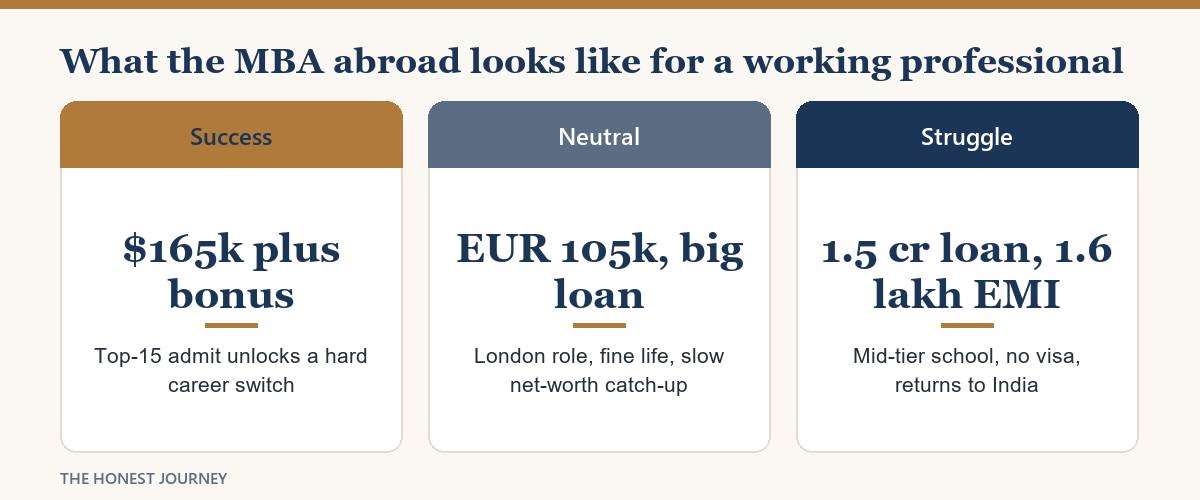
The professional this works for has a clear reason to go. Say a 28-year-old with five years in operations, earning ₹22 lakh, who wants to break into strategy consulting, a move that is genuinely hard to make in India without the MBA credential. They get into a top-15 US program, spend the summer in a consulting internship that converts, and graduate into a role at $165,000 base plus a $30,000 signing bonus. They clear the H-1B lottery on the second OPT year. Five years out they are a manager earning north of $220,000, the ₹1.6 crore loan is closing fast in dollar terms, and the career pivot that was nearly impossible from India is done.
Notice what made it work. A specific, hard-to-make-otherwise career transition. A top-tier admit. An internship that converted. And the visa luck. The MBA was not a general upgrade. It was the key to a specific locked door, and the person knew exactly which door before they applied.
Neutral scenario: the outcome nobody plans for but many get
Now the professional who did a one-year European MBA, funded largely by loan, and took a role in London at €105,000. Objectively a fine outcome. But London is expensive, the post-tax surplus is modest, and the ₹90 lakh loan EMI runs alongside it. In net-worth terms, five years later, they are not dramatically ahead of where a sharp professional who did ISB and stayed in India would be, because the Indian person avoided the crore of cost entirely and compounded savings on a good Indian salary with a low cost of living.
The European MBA bought a London life, an international network, and mobility. Those are real and worth something. But if the person went in expecting a transformed bank balance, the reality is more muted. They traded money for optionality and experience. If that was the conscious trade, it worked. If they expected the money too, there is a gap.
Struggle scenario: what it looks like when it does not work
The one the rankings-obsessed forums under-discuss. A professional takes a ₹1.5 crore loan for a two-year MBA at a school ranked outside the top tier, chosen because it admitted them, not because top employers recruit there heavily. The recruiting outcome is soft, the internship does not convert, and the US visa does not come through. They return to India, where a non-top-tier foreign MBA does not command the premium a top-tier one does, and land a role at ₹32 lakh, which is good, except the EMI on a ₹1.5 crore loan is around ₹1.6 lakh a month. On a ₹32 lakh package that is more than half of take-home before rent.
They are now further behind than if they had never gone: two years of a senior salary lost, a crore of debt added, and a resume that reads as a lateral move rather than a leap. The degree did not fail because MBAs are worthless. It failed because a top-tier price was paid for a mid-tier outcome, and the loan was sized to a transformation that a school outside the top tier could not reliably deliver.
Faz's rulePay top-tier MBA prices only for a top-tier admit. A crore of loan for a mid-ranked school is the single most expensive mistake in this space.
The MBA premium is concentrated at the top. A top-15 school opens doors a mid-ranked one does not, at nearly the same cost. If your only admit is mid-tier, the honest options are to reapply for a better school, choose ISB, or not go, not to pay a crore for it anyway.
The decision framework: questions a working professional should answer
What specific door am I unlocking? The MBA works best for a defined, hard-to-make-otherwise transition: into consulting, into product from a non-tech background, into a new geography. If your honest answer is “general career growth,” that is not a strong enough reason to spend a crore and two years, because general growth was available by staying and getting promoted.
What is my real all-in cost, forgone salary included? Add tuition, living, loan interest, and two years of the salary you are giving up. For a senior earner that total is often ₹2 crore or more. Write it down. That is the number the MBA must return, not the sticker price.
Is my admit top-tier, and does the tier justify the price? The premium lives at the top. If your admit is outside the strongly-recruited tier, the honest move is usually to reapply, choose the domestic option, or walk away, not to pay top prices for it.
Have I honestly compared the domestic option? If you want to stay in India, ISB or an IIM executive MBA at ₹40 lakh with no forgone foreign salary may beat a ₹1.5 crore foreign MBA on ROI. Abroad is not automatically better. Put both columns on the page.
Can I survive the downside? If the visa does not come and you return to India, is the EMI survivable on an Indian post-MBA salary? If not, the loan is too big for the bet.
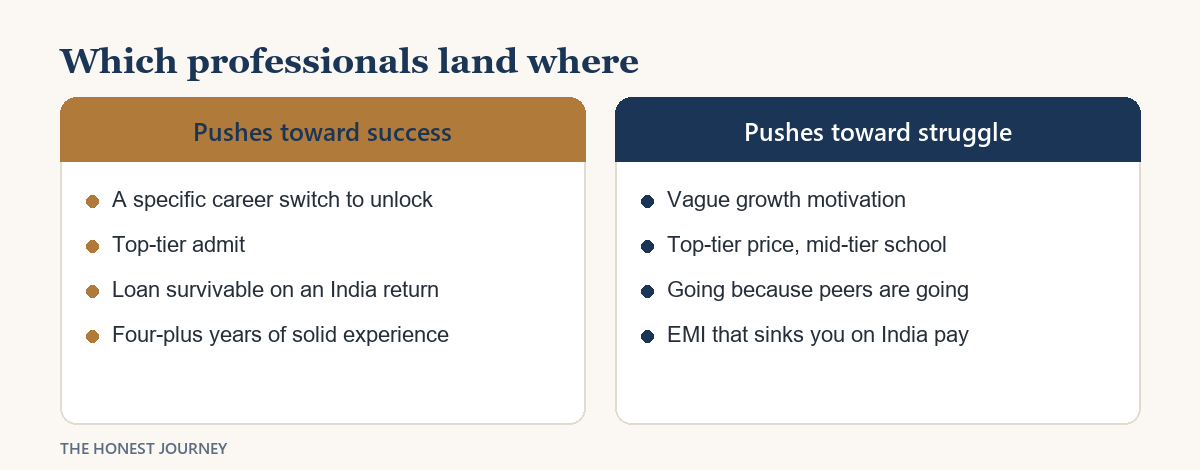
Profile factors: which professionals land in which scenario
Pushes you toward success: a clear, specific career transition that the MBA genuinely enables; a top-tier admit; four or more years of solid experience with a recognisable employer brand; a loan sized so the EMI is survivable even on an Indian return salary; and, for the US route, clear-eyed acceptance of the visa lottery.
Pushes you toward struggle: a vague “growth” motivation; a mid-ranked admit paid for at top-tier cost; going mainly because peers are going; and a loan whose EMI would sink you on an Indian salary. Three or more of these and the honest answer is to reapply, go domestic, or stay.
The age factor: past 32, the two-year US MBA gets harder to justify, because you have fewer working years left to earn back the cost and the seniority reset stings more. The one-year European option, or the domestic executive route, tends to fit later-career pivots better than the full two-year US program.
The honest closing take
The MBA abroad is a genuinely powerful tool for a specific person: one making a defined, hard-to-make-otherwise career pivot, admitted to a top-tier school, with the experience to make the outcome likely and a loan sized to survive the downside. For that person, the crore is an investment that pays back many times over.
For the professional going because they feel stuck, admitted to a mid-tier school, paying top-tier prices, hoping the degree itself will do the work, it is the most expensive way to end up roughly where they started, minus a crore and two years. The gap between those two is not luck. It is whether you had a specific door to unlock and a top-tier key to unlock it with.
Cost the decision fully, forgone salary included. Compare it honestly to ISB and to simply staying and pushing for the next promotion. If a specific, valuable door still needs a top-tier key, go. If not, keeping the ₹25 lakh salary and the crore is not settling. It is the smarter bet. If you are weighing whether the whole abroad move clears the bar in the first place, the is studying abroad worth it breakdown and the education loan for MBA guide cover the mechanics from here.
Same decision, different starting point
The honest answer changes with who is asking. If one of these fits you better, start there instead.
- engineering graduates
- tier-2 college students
- students with an average academic record
- parents funding the whole thing
- applicants in their 30s
- non-STEM and commerce graduates
If you are married, the destination decides whether your partner can earn while you study. That single fact moves the MBA maths more than tuition does. See which countries allow a working spouse.
FAQ
Is an MBA abroad worth it for a working professional from India?
It depends entirely on what you earn now and what door the MBA unlocks. For a senior earner (20 lakh-plus) the true cost includes two years of forgone salary on top of a 1 to 2 crore bill, so the degree has to clear a very high bar. It works well for a specific, hard-to-make-otherwise career pivot with a top-tier admit. It works poorly as a general growth move funded by a large loan at a mid-ranked school.
One-year European MBA or two-year US MBA?
The US MBA is higher cost and higher ceiling with a visa lottery for stay-back. The one-year European MBA (INSEAD, LBS, IESE) costs less because you lose one year of salary instead of two and has cleaner stay-back rules in several countries, but its short duration rewards candidates who arrive with a very clear post-MBA target. Choose based on your goal clarity, your tolerance for the US lottery, and your age.
Is ISB better than a foreign MBA for Indians?
If you intend to work in India, ISB or an IIM executive MBA at around 40 lakh often beats a 1 to 1.5 crore foreign MBA on pure ROI, because it avoids both the crore of tuition and the visa lottery while delivering strong Indian recruiting outcomes. A foreign MBA is the better bet mainly when you want to work abroad or need a global network a domestic program cannot provide.
How much does an MBA abroad really cost including opportunity cost?
For a working professional the true cost is tuition plus living plus loan interest plus the salary you give up while studying. A senior professional doing a two-year US MBA can face a true all-in cost near 2 to 2.5 crore once forgone earnings are counted, even though the sticker cost is 1.25 to 2 crore. Always cost the decision with forgone salary included, not just tuition.