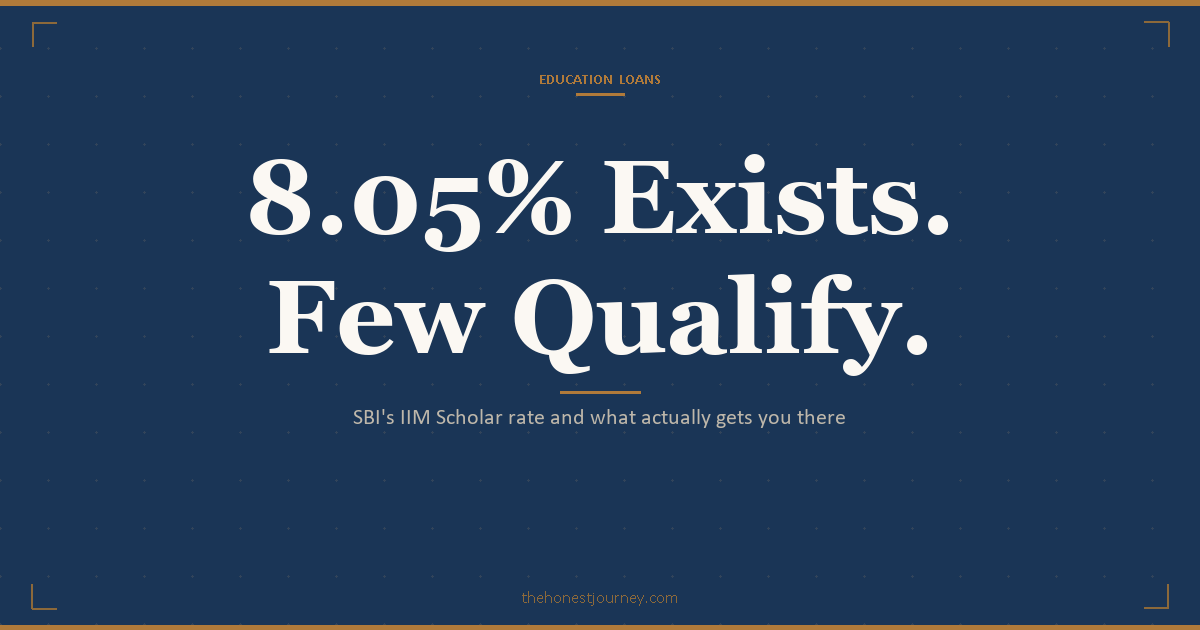
Short answer. MBA loan interest rates are tiered by B-school, not a generic band. SBI Scholar Loan offers 8.05 to 9.05 percent with no collateral up to ₹40 lakh for IIM A, B, C, L, I and K, FMS, XLRI and ISB, 9 to 11 percent for other top IIMs, and 11 to 14 percent below that tier.
MBA loan interest rates in India are tiered by B-school, not a generic 9 to 14% band: SBI Scholar Loan offers 8.05 to 9.05% with no collateral up to 40 lakh for IIM A/B/C/L/I/K, FMS, XLRI, and ISB, 9 to 11% for other top IIMs and private schools, and 11 to 14% below that tier. Run the EMI math against your expected post-MBA CTC, not the brochure CTC.
A 26-year-old engineer with five years at an IT services firm gets his IIM-Calcutta call. Total cost over two years, including the hostel and the mandatory laptop, will be roughly ₹31 lakh. His parents pull out a calculator and start panicking about 14% interest rates they read about in some aggregator article. They have no idea that SBI’s Scholar Loan scheme will offer him 8.05% because of the institution he got into. That single fact, which almost every “education loan for MBA” article buries under a generic 9-14% range, changes the entire arithmetic of his decision. This post is about the rate cards that actually exist, the tier of B-school that determines which one you get, and the ROI math nobody runs honestly.

For the full guide, read Education Loan in India: The Complete 2026 Guide.
The headline answer in one paragraph
MBA loan interest rates in India are not a single 9-14% band. They are tiered by B-school. If you crack IIM Ahmedabad, Bangalore, Calcutta, Lucknow, Indore, Kozhikode, FMS Delhi, XLRI, or ISB, SBI Scholar Loan gives you 8.05-9.05% with no collateral up to ₹40 lakh. For other IIMs and top private B-schools, you are looking at 9-11%. Below that, rates climb to 11-14% and collateral becomes mandatory. The tier of school you get into is, mathematically, the single biggest variable in your loan cost, not your CIBIL score or co-applicant income.
The basic math: what an MBA actually costs
Two-year fees at IIM-A, B, or C now sit at roughly ₹25-27 lakh. Hostel, mess, books, laptop, networking trips, and incidental case-comp travel add another ₹4-6 lakh. So total programme cost is ₹30-33 lakh. ISB’s one-year programme is around ₹40 lakh tuition with another ₹4-5 lakh living. Top private programmes (SPJIMR, MDI, IIFT, NMIMS Mumbai) range from ₹20-30 lakh. Tier-3 private institutes cost ₹10-20 lakh.
Faz's rule
A ₹40L MBA loan at 11% over 10 years is ₹26L of interest, a 65% premium over the program cost.
The headline assumption of ‘I’ll repay it in 4 years from the salary bump’ assumes everything goes right. Plan against the 10-year base case. If the 4-year case happens, you save the interest. If it doesn’t, the math still works.
Faz's rule
The headline tuition number on an Indian MBA brochure is roughly half the real bill. Add forfeited salary, opportunity cost, and EMI years and the true cost lands around two times tuition.
MBA ROI is calculated against the salary you gave up to attend, not against your pre-MBA salary in isolation. The discount-rate math is brutal in years two and three.
The standard MBA loan tenure is 10-15 years with a moratorium covering course duration plus 6-12 months. EMI starts the month after moratorium ends. On a ₹25 lakh loan at 9% over 10 years, the EMI is roughly ₹31,700. On the same loan at 12%, it is ₹35,900. That ₹4,200/month gap is ₹5 lakh over the tenure. Rate matters, and our bank vs NBFC rate comparison shows how wide the spread really gets.
Section 80E lets you deduct the entire interest paid (no cap) from taxable income for eight assessment years, but only under the Old Tax Regime. I have written a full breakdown on the 80E regime trap here.
The bank rate card by B-school tier
Here is the matrix as it actually stands in 2026, sourced from the public product pages of SBI, HDFC Credila, Avanse, Auxilo, and Axis Bank, cross-checked against placement-cell circulars from IIM Ahmedabad, IIM Bangalore, IIM Calcutta, and ISB.
Faz's rule
SBI Scholar Loan at 8.05-8.15% is unmatched, but it's IIM-A/B/C only.
Outside the top 3 IIMs, expect 10-13% from PSU banks and 10.5-13% from NBFCs. The rate difference between a Tier-1 IIM and a mid-tier MBA program is roughly ₹5-7L over the loan tenure.
Tier 1: IIM-A/B/C/L/I/K, FMS Delhi, XLRI, ISB
- SBI Scholar Loan: 8.05-9.05%, no collateral up to ₹40 lakh, processing fee waived
- HDFC Credila: 10.5-11.5%, no collateral up to ₹40 lakh
- Axis Bank: 10.5-12%, no collateral up to ₹40 lakh
- Special treatment: SBI directly disburses to the institute, often without a personal interview at the branch level
Tier 2: other IIMs (Rohtak, Raipur, Ranchi, Trichy, Udaipur, etc.), SPJIMR, IIFT, MDI Gurgaon, IMT Ghaziabad
- SBI: 9-10%
- HDFC Credila: 10-11%
- Avanse / Auxilo: 11-12%
- No collateral up to ₹25-30 lakh, beyond that collateral kicks in
Tier 3: NMIMS, SIBM Pune, Symbiosis (SCMHRD), Christ, Great Lakes, TAPMI
- SBI: 10-11%
- HDFC Credila: 11-12%
- Avanse / Auxilo: 11.5-13%
- Collateral often required above ₹20 lakh
Tier 4: lower-ranked private B-schools (most names you have not heard of)
- All banks: 11-14%
- Collateral mandatory for almost any meaningful loan amount (above ₹7.5 lakh)
- Co-applicant income scrutiny is heavy
You can verify the tier of your target school against the NIRF 2024 MBA ranking. Banks have their own internal “premier institute” lists, but they track NIRF top-30 reasonably closely.

Success scenario: IIM-Bangalore admit, ₹25L loan at 8.15%
A 27-year-old analytics professional, four years at a Bengaluru consultancy, ₹14 LPA in-hand. Cracked IIM-B 2024 batch. CAT 99.4 percentile, GEM. Co-applicant: father, retired BSNL employee with pension of ₹42K/month. CIBIL: 782.
He took ₹25 lakh through SBI Scholar Loan at 8.15%. No collateral. SBI disbursed directly to the institute in two tranches. Moratorium: 2 years (programme) plus 6 months grace. Post-MBA placement: a strategy role at a Bengaluru-based tech firm, ₹34 lakh fixed plus ₹6 lakh joining bonus.
His EMI from month seven after graduation: ₹30,600 over 10 years. On a post-tax monthly take-home of roughly ₹1.9 lakh, EMI is 16% of take-home. He prepaid ₹3 lakh in year two from his bonus. Loan will close in 8.5 years. Total interest paid: roughly ₹9.2 lakh, of which the Section 80E deduction in the Old Regime saved him about ₹2.3 lakh in tax over eight years. Net cost of borrowing: ₹6.9 lakh on a ₹25 lakh loan. Excellent outcome.
Neutral scenario: ISB admit, ₹30L loan, mid-career switch that broke even
A 30-year-old product manager from a Tier-2 IT firm, six years’ experience, ₹22 LPA. ISB 2024 batch (Co’25). Took ₹30 lakh from HDFC Credila at 10.75% because his SBI branch dragged its feet for nine weeks and ISB’s fee deadlines do not wait. The lender-by-lender gap on this is laid out in our guide to education loan approval time. No collateral.
ISB placement: ₹32 lakh fixed at an internet major in product management. His pre-MBA total comp was already ₹28 lakh including stock. So real delta is ₹4 lakh fixed (some upside on RSUs depending on stock performance).
EMI: ₹40,800 over 10 years. He services it comfortably but the financial case is thin: he forewent ₹28L of one-year salary plus ₹40L total cost (loan + co-paid). The ₹4 lakh annual delta means simple payback on the incremental jump is 17 years, which is longer than the loan. He says the MBA was worth it for the network and a function shift, not for the salary jump. Honest call from him. The loan is serviceable. The MBA was not, strictly, an ROI play.
Struggle scenario: Tier-3 private B-school, ₹18L loan, ₹7.5L placement
A 24-year-old engineering graduate from a Tier-2 college, two years at an EdTech firm earning ₹5.5 LPA. Got rejected from all IIMs and top private programmes. Took admission at a private Tier-3 institute in Pune. Total fees: ₹16 lakh. Loan taken: ₹18 lakh from a private NBFC at 12.5%. Mother (housewife) as primary co-applicant, father (small-business owner with ₹6 lakh declared income) as secondary. Collateral: an LIC policy worth ₹4 lakh and a personal guarantee.
Faz's rule
A Tier-3 B-school MBA on an 18-lakh loan with a 7.5-lakh placement is mathematical violence dressed as ambition. Reject the brochure before you accept the seat.
Placement reports are averages of the offers made, not the offers accepted. Ask for the bottom-quartile placement, then plan around it.
Placement was thin. He got an offer at ₹7.5 LPA in sales for a SaaS company in Pune. In-hand take-home: roughly ₹52,000/month.
EMI on ₹18 lakh at 12.5% over 10 years: ₹26,400/month. That is 50% of his take-home. After rent (₹12K, shared 1BHK), mess (₹6K), commute (₹3K), and parents’ household contribution (₹8K), he has ₹2-3K left. No savings, no medical buffer, no career-change runway. He missed two EMIs in year three of repayment when he switched jobs and his salary cycle slipped. The penalty pushed his outstanding up. He is now considering moving back to his hometown to cut rent.
This is the failure mode the lender-led “MBA loan” content never shows you. The loan worked perfectly as a loan. The MBA did not.
ISB ₹40L vs US Top-10 MBA ₹80L: the real ROI math
Most “MBA abroad vs India” comparisons are emotional, not arithmetic. Run it cold.
ISB (one year, Hyderabad/Mohali)
- Tuition + living: ~₹40 lakh
- Opportunity cost (one year of salary forgone at, say, ₹22L): ~₹15 lakh (after tax, conservative)
- Total investment: ~₹55 lakh
- Median post-ISB salary (Class of 2024 placement report, cross-checked against ISB’s official disclosures): roughly ₹35 lakh
- Pre-MBA average comp for the same cohort: roughly ₹22 lakh
- Annual delta: ~₹13 lakh
- Simple payback on incremental jump: ~4-5 years if you stay in India and service the loan from delta alone
US Top-10 MBA (two years)
- Tuition + living: ~₹1.2-1.5 crore (at current INR/USD)
- Opportunity cost (two years forgone at ₹22L): ~₹35 lakh
- Total investment: ~₹1.55-1.85 crore
- Median post-MBA US base: roughly $175,000 plus bonus, but this assumes you get and keep H-1B
- H-1B selection probability: ~25-30% per attempt currently; OPT gives you up to three attempts for STEM-designated MBAs (most US Top-10s have STEM tracks now)
- Indian PR/citizenship backlog through employment-based green card: 50+ years for India-born applicants in the EB-2 queue per USCIS visa bulletin data, summarised here
- If you stay: payback in 3-4 years on the USD salary, before currency
- If you do not get H-1B and return: payback at INR salary stretches to 8-12 years, often longer
The honest call: ISB is the lower-variance bet. US Top-10 MBA has higher upside but the entire ROI is gated by an immigration lottery you do not control. Your loan is INR-denominated either way (or USD if you used Prodigy Finance, in which case INR depreciation makes the real cost worse).
Decision framework: answer these before you sign
- Is my admit at a Tier 1 or Tier 2 B-school per the NIRF 2024 list, or is it not?
- Will my EMI after moratorium exceed 30% of my expected starting take-home pay?
- Is my pre-MBA salary high enough that the incremental delta justifies the loan over 10 years, or is the MBA mainly a function-switch / network play?
- Do I have a co-applicant with verifiable income who is willing to sign? (Even “no collateral” loans require this.)
- If I am going abroad, am I comfortable with the H-1B / PR uncertainty, or am I assuming I will definitely stay?
- Am I filing under the Old Tax Regime so I can actually claim Section 80E?
- If my admission is rescinded between sanction and disbursal, do I understand the PPO clause in my sanction letter?
If you cannot answer yes to questions 1-4, the loan is probably worse than the offer looks.
Profile factors that correlate with each scenario
Tier-1 admits with 4-8 years’ work experience and pre-MBA comp of ₹15-25 LPA tend to land in the success bucket: the salary jump post-MBA is large enough that the loan EMI is comfortable.
Mid-career professionals (8+ years, pre-MBA comp ₹25L+) going to ISB or a one-year programme often land in the neutral bucket: the network and function shift justify the cost, but ROI on a pure-salary basis is thin.
Fresh graduates or 1-2 year experienced candidates going to Tier-3 / Tier-4 B-schools are the highest-risk cohort. Median placements at non-NIRF-top-30 institutes hover at ₹6-9 LPA, against loan EMIs of ₹20-26K/month on ₹15-18 lakh loans. Debt-to-take-home ratios above 40% are common.
The co-applicant matters more than people realise. A salaried parent with steady ITRs gets you better rates and lower processing fees. A self-employed or housewife co-applicant often pushes you to NBFCs at 11-13% even for a Tier-2 admit. I broke down the co-applicant income proof gap in the documents required for education loan post.

Don’t take this loan if
- Your admit is at a Tier-4 private B-school with no NIRF ranking and median placements you cannot verify. The math almost never works.
- You cannot service the projected EMI from 30% of a realistic post-MBA salary based on the actual placement report (not the highest package). Highest-package quotes are the most misleading number in B-school marketing.
- Your co-applicant is on the edge of retirement and has no second income source. If the loan goes sideways, the recovery falls on them.
- You are stretching to ₹50L+ for a US MBA without a clear plan for either H-1B-or-return. Currency depreciation alone adds 25-40% to the real cost over 10 years.
- You are taking the loan on a conditional admission and have not read the PPO (Pre-Placement Offer) and admission-rescission clauses in the sanction letter. Most banks will recall the disbursed amount if admission is cancelled, with interest from disbursal date.
What you do with all of this
If you have a Tier-1 admit and an SBI branch that knows the Scholar Loan product, you are looking at the cheapest education debt available to any Indian student today. Take it, file under the Old Regime, claim 80E, and prepay from bonuses. If you have a Tier-2 admit, run the EMI-vs-expected-salary check honestly using the institute’s official placement report, not the LinkedIn flex of the top 5% of the class. If you are below that, the loan is a question, not an answer. You decide. And if you are weighing the MBA against another professional qualification, the loan math for the education loan for CA students runs very differently, because the course fees are a fraction of an MBA and the borrowing need is far smaller.
Faz's rule
If your post-MBA placement projection at your target school is below 1.5x your pre-MBA salary, the MBA is not financing growth. It is financing a lateral move with extra debt.
Lateral moves do not need an MBA. They need a network and three years of patience. The loan is the expensive shortcut, not the lever.
FAQ
Which bank gives the best education loan for MBA?
For IIM-A/B/C/L/I/K, FMS Delhi, XLRI, and ISB admits, SBI’s Scholar Loan scheme at 8.05-9.05% is the cheapest option available, with no collateral up to ₹40 lakh. For other Tier-2 programmes, HDFC Credila and Axis Bank are competitive at 10-12%. NBFCs like Avanse and Auxilo are usually 1-2% more expensive than banks but disburse faster, which matters when ISB or IIM fee deadlines are tight.
What is SBI MBA loan interest rate?
SBI’s Scholar Loan rate ranges from 8.05% (IIM-A/B/C) to about 9.05% (other top institutes on its premier list). For non-Scholar Loan MBA borrowing, standard SBI education loan rates are 9.5-11.5% depending on collateral and co-applicant profile. Rates are linked to the External Benchmark Lending Rate (EBLR) plus a spread, so they fluctuate with RBI policy rate moves. Always check the SBI Scholar Loan page for the current rate before applying.
Can I get a full loan for IIM?
Yes. SBI Scholar Loan covers up to ₹40 lakh without collateral for IIM-A/B/C admits, which is more than the ₹30-33 lakh total programme cost. For other IIMs, the no-collateral cap is typically ₹25-30 lakh, and many students top up with a ₹3-5 lakh personal loan or family contribution for the difference. Full programme financing is achievable for most IIM admits if the co-applicant profile holds.
How much loan can I get for MBA abroad?
For Indian banks (SBI, HDFC, Axis), unsecured caps for a US MBA at a top-25 programme are typically ₹40-50 lakh. Beyond that you need collateral, usually residential property. For a ₹1.2-1.5 crore total cost, the structure is often: ₹40-50 lakh unsecured from an Indian bank, plus a USD-denominated top-up from Prodigy Finance or MPOWER, plus family contribution. The USD top-up carries currency risk over a 10-year tenure.
Is collateral required for MBA loan?
For Tier-1 and Tier-2 B-school admits, no, up to the institute-specific cap (₹25-40 lakh). For Tier-3 admits above ₹20 lakh, yes. For Tier-4, collateral is required for almost any loan above ₹7.5 lakh. Acceptable collateral includes residential property, fixed deposits, LIC policies with surrender value, and government securities. Banks discount the collateral value by 25-40% before computing eligibility.
What is the EMI for a 20 lakh MBA loan?
On a ₹20 lakh loan at 9% over 10 years, the EMI is approximately ₹25,330. At 11%, it rises to ₹27,560. At 13%, it is ₹29,860. These numbers assume EMI starts after a 24-month moratorium plus 6 months grace, during which simple interest accrues and is either paid or capitalised. If you capitalise the moratorium interest, your effective principal at EMI start is roughly ₹23-24 lakh, pushing the actual EMI 15-20% higher than the headline figure. Our walk-through of how to repay an education loan covers this EMI mechanic in detail.
What happens if my admission is rescinded after loan sanction?
This is the PPO clause people miss. Most sanction letters specify that if your admission is cancelled (institute revokes it, you fail to enroll, or you defer), the bank recalls the disbursed amount along with interest from the date of disbursal. If the institute has already received the tranche, you negotiate refund with the institute, then return the funds to the bank. Failure to do so converts the educational loan into a regular personal loan at higher rates. Always read clauses 8-12 of your sanction letter before signing.
Can I claim Section 80E for an MBA loan?
Yes, if you file under the Old Tax Regime. Section 80E allows full deduction of interest paid (no upper cap) for up to eight consecutive assessment years, starting from the year you begin repayment. The loan must be from a scheduled bank or an approved financial institution. NBFC loans qualify if the NBFC is notified. The New Tax Regime, default since 2023-24, does not allow 80E. Most MBA borrowers should explicitly opt for the Old Regime in their first eight return-filings post-graduation. See income tax department guidance for the legal text.
Faz · The Honest Journey · 2026