Short answer. If you did engineering, an MS abroad is not a dream you discovered. It is a default you inherited. Half your batch is taking the GRE, a WhatsApp group is comparing university shortlists, and the assumption underneath all of it is that a master’s in the US or Germany is simply the next correct step.
Nobody in that group is asking the one question that actually decides the outcome: for an engineer specifically, when does this math work, and when are you borrowing ₹40 lakh to end up where you already were.
Deciding between the GRE and a GATE score? Read is the GRE required for an MS abroad.
For choosing where to apply, see our guide to shortlisting universities for an MS abroad.
This is the version for engineers. Not the generic “should you study abroad” version. Engineers start from a different place than everyone else considering this decision, and that starting point changes the whole calculation.
For an MS the statement is judged on technical readiness and fit with specific labs. the statement of purpose covers what that means in practice.
Why the engineer’s math is different from everyone else’s
Most people considering study abroad are trying to escape a weak job market. An engineer with a CS or IT degree and two years at a product company is not. That is the part that makes this decision harder for you, not easier.
You already have a career in progress. A 2019-2021 graduate at a decent product firm is looking at ₹15 to 30 lakh a year by their third or fourth year. A senior engineer at a well-known India office of a global tech company can cross ₹40 lakh without leaving the country. So when you take a two-year MS abroad, you are not just spending the tuition. You are also giving up the Indian salary you would have earned in those two years, and you are resetting your seniority clock to zero in a new country.
That is the real cost of the decision, and it is much higher for a mid-career engineer than for a fresh graduate from a service company earning ₹4.5 lakh. The engineer who leaves a ₹22 lakh job to do an MS is making a far riskier bet than the one who leaves a ₹5 lakh job, because the second person has much less to lose and much more to gain. The abroad decision is not one decision. It is a different decision at every salary level, and your salary level is probably higher than the people writing the generic guides assume.
The basic numbers, laid out honestly
There are two very different engineer paths abroad, and lumping them together is how people make bad decisions. Keep them separate.
The US path. A two-year MS in computer science or a related field costs roughly $50,000 to $110,000 all in, tuition plus living, which is about ₹42 lakh to ₹92 lakh depending on the university and city. Most students fund this with a loan of ₹35 to 50 lakh. The upside is real: a new-grad software role at a mid-to-large US company pays $110,000 to $160,000 base. The catch is the immigration lottery. After your degree you get up to three years of work authorization on STEM OPT, during which your employer has to win you an H-1B visa in a lottery where the odds have recently sat near one in four per year. Clear it and stay, and the math is excellent. Miss it across all your attempts, and you come home with the loan and a US resume that resets to Indian pay.
The Germany and Europe path. A master’s in Germany at a public university is close to tuition-free, so your cost is mostly living: the blocked account requirement is around €11,900 for the year, and a two-year stay runs roughly ₹18 to 28 lakh all in. That is a fraction of the US number. The salary is lower too: an engineer starting in Germany earns around €48,000 to €62,000, and after tax that is a comfortable European life but not a wealth-building American one. The trade is lower risk and lower ceiling. There is no lottery. An 18-month job-seeker window and a clear path to the EU Blue Card mean that if you can work in the language-light tech corridors, you stay.
Faz's ruleDo not compare an MS abroad to your life today. Compare it to where you would be in India in the same two years if you kept working.
The engineer who already earns 20 lakh at a product company is not choosing between abroad and nothing. They are choosing between abroad and a 35 lakh Indian salary three years from now. That is the real bar the degree has to clear.
The two paths in hard numbers
Put the two bets side by side and the trade becomes obvious. These are typical 2025-26 figures for a Indian engineer with a decent profile, not best-case brochure numbers.
| Factor | US MS (CS or allied) | Germany MS (public university) |
|---|---|---|
| All-in two-year cost | ₹42 lakh to ₹92 lakh | ₹18 lakh to ₹28 lakh |
| Typical loan | ₹35 lakh to ₹50 lakh | ₹0 to ₹15 lakh |
| Starting salary after degree | $110,000 to $160,000 (₹92 lakh to ₹1.3 cr) | €48,000 to €62,000 (₹43 lakh to ₹56 lakh) |
| Stay-back gate | 3-year STEM OPT, then H-1B lottery (~1 in 4) | 18-month job-seeker visa, EU Blue Card, no lottery |
| Return-to-India EMI risk | High: ₹50 lakh loan means ~₹70,000/month EMI | Low: small or zero loan |
| The bet in one line | High cost, high ceiling, lottery-gated | Low cost, lower ceiling, more certain |
Neither column is the right answer. The right answer is the column that matches your profile and your tolerance for the lottery. An engineer with a strong profile and an appetite for the immigration gamble is leaving money on the table in Germany. An engineer with an average profile and a family that cannot absorb a ₹50 lakh loss is gambling their downside in the US. The mistake is taking one column’s loan while being suited to the other column’s bet.
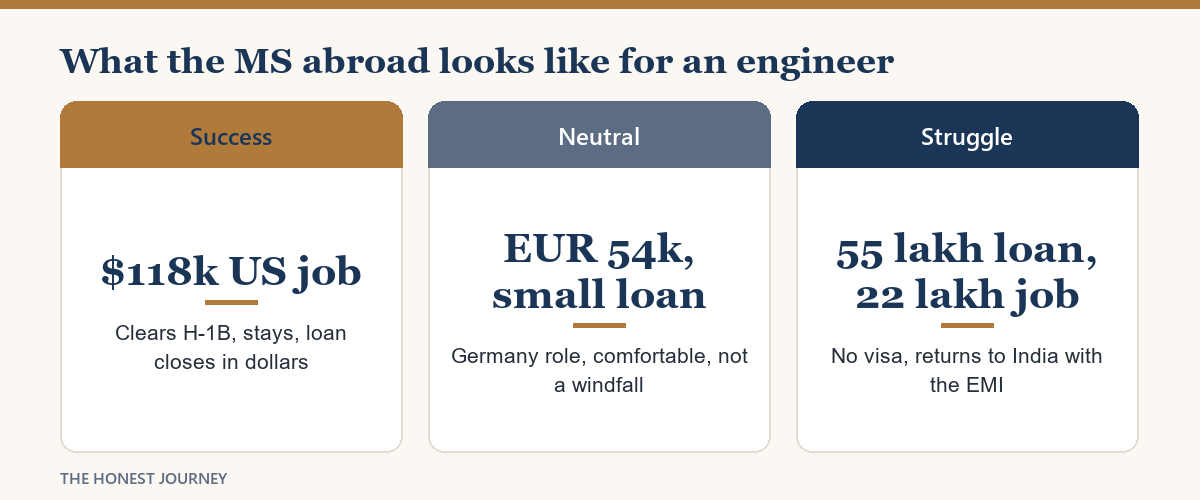
Success scenario: what it looks like when this works
Picture the engineer this works for. Strong fundamentals, a real GitHub, comfortable grinding data-structure interviews for six months. Admit from a university that US recruiters actually pipeline from. Loan of ₹40 lakh at 11 percent.
They finish the MS, spend the summer on interview prep, and land a new-grad software role at $118,000 base. On OPT they are already earning, so the loan starts getting serviced from a US salary, not an Indian one. In year two of OPT they clear the H-1B lottery. Five years out they are on a green-card track, earning north of $180,000 with stock, and the ₹40 lakh loan that felt terrifying at sanction is closed. In dollar terms the debt was never large relative to the income it unlocked.
This is the outcome the WhatsApp group imagines for everyone. It is real, and it happens, but notice what made it work: a strong technical profile, a target-school admit, and clearing an immigration lottery that was outside their control. Two of those three were earned. One was luck. Hold that thought.
Neutral scenario: the outcome nobody plans for but many get
Now the engineer who went to Germany. Near-zero tuition, ₹22 lakh of living costs, a small loan or family funding. They finish the master’s, spend four months job-hunting on the post-study visa, and land a role at €54,000 in a mid-size firm.
Life is good in the ordinary sense. They have a stable job, a European address, PR on the horizon, and no crushing debt. But they are not getting rich. After German tax and rent, the monthly surplus is modest. In pure money terms they are not obviously ahead of where a strong engineer would be in Bengaluru by year five. What they bought was not a higher number. It was optionality, a European life, and a hedge against the Indian job market. If that is what they wanted, it worked. If they went expecting the US-style windfall, they will feel a quiet gap between the story they were sold and the balance in their account.
This is the most common honest outcome for the Europe path, and it is a perfectly good one, as long as you chose it on purpose.
Struggle scenario: what it looks like when it does not work
The one the guides skip. An engineer with an average profile takes a ₹55 lakh loan for an MS at a lower-ranked US university, chosen because it gave an admit, not because recruiters pipeline from it. The technical prep is thin. Over three years of OPT the H-1B lottery does not come through, and the job market for that tier of school is soft. Work authorization runs out.
They come home. The US degree, without US work experience that converted, gets read in India as a two-year gap plus a foreign master’s, which is worth something but not what was paid for it. They restart in Bengaluru at ₹18 to 22 lakh, which is a fine salary except that the loan EMI on ₹55 lakh capitalized after the study-period moratorium is around ₹75,000 a month. On a ₹22 lakh package, that EMI plus rent eats the paycheck. The degree did not fail because the person was not smart. It failed because the loan was sized to a US outcome that never arrived, and the profile was not strong enough to make that outcome likely.
The difference between the success scenario and this one was not intelligence or effort. It was the honesty of the profile assessment before signing, and the size of the loan relative to the downside. If you take the smaller-loan, stronger-profile version of the bet, the struggle scenario is survivable. If you take the big-loan, weak-profile version, it is not, and the moratorium math makes the damage visible the month your grace period ends. That mechanism is worth understanding in full before you sign anything, and it is covered in the education loan moratorium trap post.
The decision framework: questions an engineer should answer before signing
Not “is studying abroad worth it.” That question is too generic to be useful. These are the ones that actually separate the success path from the struggle path for an engineer.
What am I actually giving up? Write down your realistic India salary trajectory for the next three years if you stayed and kept working. That number is the bar. If you already earn ₹20 lakh, the degree has to clear a much higher return than it does for someone at ₹5 lakh.
Is my profile strong enough for the outcome I am borrowing against? Be brutal. If you are borrowing ₹50 lakh on the assumption of a US six-figure job, do you have the fundamentals and the target-school admit that make that job likely, or are you hoping the degree alone carries you? The loan is sized to the good outcome. Your profile determines whether you get it.
Am I choosing the US bet or the Europe bet, and do the numbers match? The US path is high cost, high ceiling, lottery-gated. The Europe path is low cost, lower ceiling, more certain. Taking a US-sized loan for a US-sized dream while having a Europe-sized risk appetite is how people end up in the struggle scenario. Pick the bet that matches both your profile and your tolerance for the lottery.
Can I survive the downside? If the immigration lottery does not come through and you return to India, is the EMI survivable on an Indian salary? If the honest answer is no, the loan is too big, regardless of how good the upside looks. Run the return-to-India EMI before you run the dream.
Faz's ruleSize the loan to the outcome you can survive, not the outcome you are hoping for. The lottery is not in your control. The loan amount is.
The engineer who borrows 55 lakh on a weak profile and the one who borrows 40 lakh on a strong one are not taking the same bet with different luck. They are taking different bets. One is recoverable if it fails. The other is not.
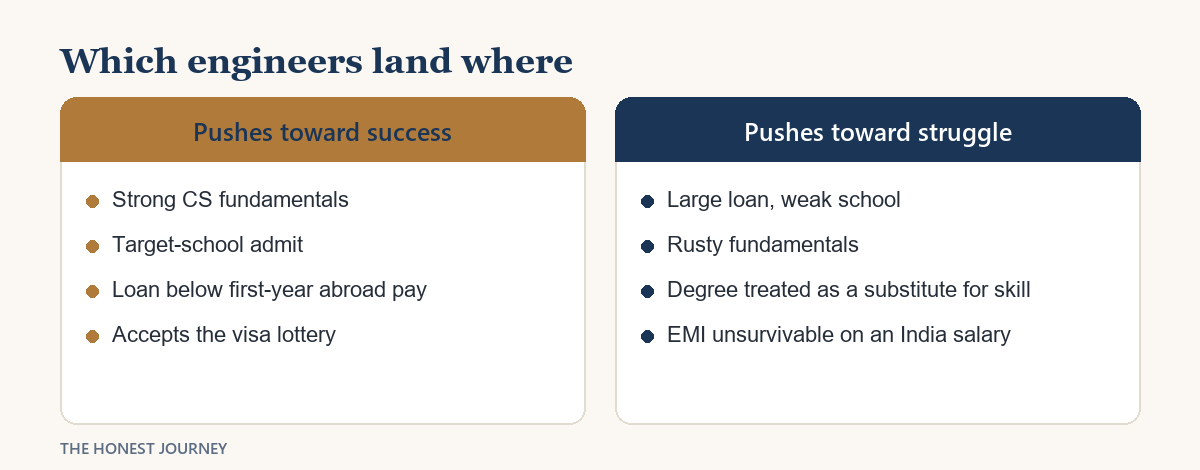
Profile factors: which engineers land in which scenario
The scenario you end up in is not random. Certain traits correlate strongly with each outcome, and you can assess yours honestly before you commit.
Pushes you toward the success scenario: genuine strength in computer-science fundamentals, an admit from a school with a real recruiting pipeline, willingness to prepare seriously for technical interviews, a loan sized well below your projected first-year abroad income, and clear-eyed acceptance that the US path includes a lottery you cannot control.
Pushes you toward the struggle scenario: a large loan chosen to fund an admit from a low-ranked school, weak or rusty fundamentals, an assumption that the degree substitutes for interview skill, and a loan EMI that would not be survivable on an Indian salary if you had to return. If three or more of these describe you, the honest move is not a different university. It is either a stronger profile first, a smaller loan, or the lower-risk Europe path.
The mid-career engineer’s special case: if you already earn ₹20 lakh or more at a product company, the bar is highest of all. You are giving up the most, and a foreign master’s adds the least to an already strong resume. For you, the question is often not “MS abroad or not” but “would a direct move on a work visa, or an internal transfer, get me the same outcome without the loan and the reset.” Sometimes the honest answer is that you do not need the degree at all.
The honest closing take
For an engineer, an MS abroad is one of the few study-abroad decisions where the upside is genuinely enormous. A US software career changes your family’s financial trajectory in a way almost nothing else does. That is true and I am not going to pretend otherwise.
But the same decision, taken with a weak profile and an oversized loan, is also one of the few that can set you back a decade. The gap between those two outcomes is not the university brochure. It is the honesty of your profile assessment and the size of the loan relative to the downside you can survive. The engineers who win this bet are not the ones who wanted it most. They are the ones who sized it correctly and had the fundamentals to make the good outcome likely.
Run your own India trajectory. Assess your profile without flattering yourself. Size the loan to the outcome you could survive if the lottery went against you. If all three still point abroad, go, and go with clear eyes. If they do not, that is not a failure. That is the decision working exactly as it should. For the broader country-by-country return math once you have decided the profile fits, the is studying in the USA worth it and studying in Germany breakdowns take it from here.
Same decision, different starting point
The honest answer changes with who is asking. If one of these fits you better, start there instead.
- working professionals doing an MBA
- tier-2 college students
- students with an average academic record
- parents funding the whole thing
- applicants in their 30s
- non-STEM and commerce graduates
FAQ
Is an MS abroad worth it for Indian engineers who already have a job?
It depends heavily on your current salary. If you already earn 20 lakh or more at a product company, the bar is high because you are giving up a strong Indian trajectory and resetting your seniority abroad. For engineers earning 4 to 8 lakh at service companies, the upside is larger and the opportunity cost is lower. Always compare the abroad path to your realistic three-year India salary, not to your life today.
US MS or Germany MS for an Indian engineer?
The US path is high cost (roughly 42 to 92 lakh), high ceiling (110k to 160k dollar salaries), and gated by the H-1B lottery. The Germany path is low cost (roughly 18 to 28 lakh, near-zero tuition), lower ceiling (around 48k to 62k euro salaries), and has no lottery with a clearer stay-back route. Choose the US bet if your profile is strong and you accept the lottery risk. Choose Germany if you want lower risk and lower debt.
How much education loan is safe for an MS abroad?
Size the loan to an amount whose EMI you could still service on an Indian salary if you had to return, because the immigration outcome is not in your control. Borrowing 50 to 55 lakh against a US six-figure job that may not materialise is the single most common way engineers end up in financial trouble. A loan well below your projected first-year abroad income is the safer structure.
What happens to Indian engineers who do not clear the H-1B lottery?
They get up to three years of STEM OPT work authorization to keep trying. If it does not come through across those years and the US job did not convert, most return to India, where the degree is read as valuable but not transformative, and salaries reset to Indian levels. If the loan was sized to the US outcome, the EMI becomes very hard to service on an Indian salary. This is why the downside must be survivable before you sign.