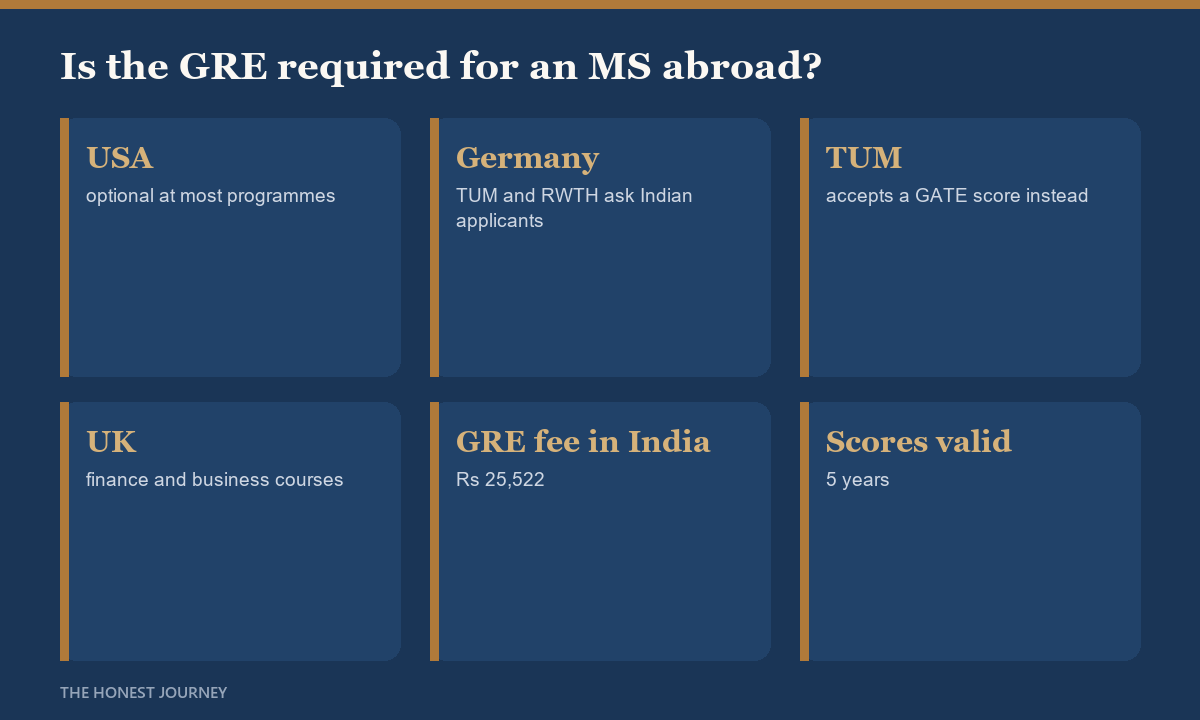
Short answer. For most US MS programmes the GRE is now optional. Germany is the surprise: TUM and RWTH require it from Indian applicants for many engineering and computer science master’s, and TUM accepts GATE instead. UK finance programmes such as LSE’s ask for the GMAT or GRE. The test costs ₹25,522 in India, so check your shortlist before booking.
Five years ago the GRE was close to compulsory for an MS in the USA and irrelevant almost everywhere else. Both halves of that have changed. Many US departments dropped the requirement during the pandemic and never brought it back, while some of Germany’s best technical universities now demand it specifically from applicants with Indian degrees. Advice written for the old pattern will send you the wrong way in both countries.
For TUM and RWTH, your converted grade matters as much as the GRE. Check it with the German grade calculator.
The other test-season decision: IELTS vs TOEFL vs PTE vs Duolingo, fees and acceptance.
The other test-season expense to check school by school: WES evaluation for Indian students.
This page answers the question the way you actually need it answered: country by country, with named programmes, the minimum scores where they exist, what the test costs in rupees, and how to decide whether to take it when it is optional.
The short version, country by country
| Country | Is the GRE required for an MS? | Examples |
|---|---|---|
| USA | Usually optional now, but set programme by programme. A minority of departments still require it, especially from applicants with non-US degrees. | Georgia Tech MS Computer Science: not required. UC San Diego CSE: not required for Fall 2027. UCLA Computer Science: not required for 2025 to 2026. |
| Germany | Required by some top technical universities for applicants with Indian degrees, in many engineering, computer science and data programmes. | TUM Informatics: GRE or GATE for degrees from India. RWTH Aachen: GRE with published minimums for most engineering and computing master’s. |
| UK | Not required for most taught master’s. Finance, economics and business programmes are the main exception, usually asking for the GMAT or GRE. | LSE MSc Finance: GMAT or GRE required for all applicants without a UK undergraduate degree. |
| Canada, Australia, Ireland, New Zealand | Rarely listed for taught master’s. Some business and research programmes ask for it. | Check the programme page, not the university’s general page. |
The pattern to take from the table is simple. The GRE is no longer a country rule. It is a programme rule, and the same university can require it for one master’s and ignore it for another. The only reliable answer is the admissions page of the exact programme you are applying to.
USA: optional at most programmes, and what optional really means
Most US master’s programmes in computer science and engineering now list the GRE as optional or not required. Georgia Tech states plainly that a GRE score is not required for its MS in Computer Science. UC San Diego’s computer science department does not require it for MS applications for Fall 2027. UCLA’s computer science department did not require it for the 2025 to 2026 cycle.
Optional does not mean the same thing at every university, and this is where Indian applicants go wrong. There are three different policies hiding behind the word:
- Considered if submitted. Georgia Tech says that if you provide GRE scores, they will be considered, and it recommends submitting them if your degree is not in a related field, you have been out of education for over ten years, or you are concerned about the strength of your application.
- Accepted but given no extra weight. UCLA’s computer science department reviews scores that are submitted, but says applications with scores are not given greater weight than those without.
- Not required, still accepted. UC San Diego lets applicants submit valid scores they already have.
The same programme by programme logic applies to English tests, which we cover in US universities without IELTS. Read the exact wording. Under the first policy, a strong Quant score can help an applicant whose transcript is the weak point. Under the second, it is money spent for nothing.
When a US applicant should take it anyway
Georgia Tech’s own advice maps closely onto the situations Indian applicants are most often in. Take the GRE even where it is optional if one of these is true:
- You are switching fields, for example from a BCom or BSc in a non-computing subject into an MS in computer science or data science.
- Your CGPA or percentage sits below the typical admitted student, or you have backlogs.
- Your college is little known outside India, so the admissions committee has less to calibrate your grades against.
- You have been working for several years and your academic record is old.
In each case, a high Quant score gives the committee a recent, standardised number to set against a transcript it cannot easily read. If none of these apply, and your shortlist is made up of programmes that say scores are not required, you can usually skip it. If you are switching fields, your statement of purpose has to make the same case in words that the score makes in numbers.
Germany: where the GRE is required for Indian applicants
This is the part most GRE advice misses. Germany’s public universities charge little or no tuition (see our guide to the cost of studying in Germany), which makes them popular with Indian MS applicants, and several of the most competitive ones have responded to the volume of applications by asking applicants with degrees from certain countries, including India, for a GRE.
TUM: GRE or GATE
The Technical University of Munich requires a GRE or GATE for certain master’s programmes. For its master’s in Informatics, applicants with a degree from India must submit a GRE General Test with at least 164 in Quantitative Reasoning and 4.0 in Analytical Writing, or a GATE scorecard in computer science with the minimum qualifying score for that year. TUM also notes that graduates of an Indian Institute of Technology do not need a separate GATE.
That GATE option matters for your budget. GATE costs roughly ₹2,000 per paper against ₹25,522 for the GRE, and many engineering students sit it anyway. If TUM is on your list and you have a qualifying GATE score, check whether your programme accepts it before you book a GRE.
RWTH Aachen: GRE with published minimums
RWTH Aachen publishes a list of programmes that require the GRE General Test from international applicants, with minimum scores for each. The figures below come from RWTH’s own list, dated March 2025. Some are scaled scores and some are percentile ranks.
| RWTH master’s programme | Verbal | Quant | Writing |
|---|---|---|---|
| Mechanical engineering, automotive, robotic systems and most production programmes | 145 | 160 | 3.0 |
| Computer Science (Informatik), Data Science, Software Systems Engineering | 15th percentile | 75th percentile | 3.5 |
| Computer Engineering, Electrical Engineering and Information Technology | 15th percentile | 85th percentile | No minimum |
| Biomedical Engineering | No minimum | 160, and the test must be under two years old | No minimum |
Two things stand out. The Verbal bar is low, so the test is really about Quant. And the Biomedical Engineering programme wants a test taken in the last two years, not the five that ETS allows, so an old score may not count.
Germany’s other gates still apply on top of the GRE: APS verification, and from the summer semester of 2027 the new dMAT test for engineering, commerce, economics and business graduates. Our guide to shortlisting universities for an MS abroad explains both, and German universities without IELTS covers the language requirement.
Faz's ruleIn the USA you now take the GRE to strengthen a weak spot. In Germany's top technical universities you may have to take it just to be considered.
Most families I speak to have this backwards. They budget for the GRE because the US MS is the expensive, prestigious option, and skip it for Germany because the tuition is free. In 2026 it is closer to the opposite. Check each programme on your shortlist, and if TUM is on it, check whether a GATE score you already have does the job for free.
UK and other countries: mostly no, except for finance and business
UK taught master’s programmes judge you mainly on your degree class and your college, so most do not ask for the GRE. The exception is finance, economics and business. LSE’s MSc Finance, for example, requires the GMAT or GRE from every applicant without a UK undergraduate degree, and states a strong preference for the GMAT. Other finance-heavy programmes at competitive UK universities follow similar rules.
Canada, Australia, Ireland and New Zealand follow much the same pattern for taught master’s: the GRE is uncommon, and where a test is asked for it is usually for business or finance. Research master’s and PhDs are more likely to want it. As with every country, the programme page is the only reliable source.
What the GRE costs from India
| Item | Cost in India |
|---|---|
| GRE General Test | ₹25,522 ($249) |
| Rescheduling | ₹5,650 ($55) |
| Score reports sent on test day | Four free |
| Each additional score report | ₹4,150 ($40) |
| Score validity | Five years from the test date |
The four free score reports are sent on test day, so decide your recipients before you sit the test. Every university you add later costs ₹4,150. An applicant with eight universities on the list who picks four on test day and adds four later pays about ₹16,600 in extra reports on top of the test fee.
Add preparation costs, and the GRE comfortably reaches ₹35,000 to ₹50,000 for many applicants. That is worth paying when a programme on your shortlist requires it or when your profile has a weak spot that a strong score would cover. It is not worth paying as insurance for a list of programmes that do not need it.
The test itself, briefly
Since September 2023 the GRE General Test has been a shorter test of about 1 hour 58 minutes, with Verbal Reasoning, Quantitative Reasoning and one Analytical Writing task. Scores run from 130 to 170 for Verbal and Quant and from 0 to 6 for Writing. For the programmes that set minimums, Quant is what matters: TUM’s Informatics bar of 164 and RWTH’s 160 for engineering programmes both sit well above the average test taker.
For a Fall intake, aim to sit the GRE by October of the year before, so there is time for a retake and for official scores to reach universities before December to February deadlines. Our US intakes guide and German intakes guide set out the deadlines.
GRE waivers
A GRE waiver is a programme agreeing to consider your application without a score at a programme that normally requires one. Where a programme already lists the GRE as optional or not required, there is nothing to waive. Where it is required, some programmes will consider a waiver request based on strong grades, a relevant degree from a recognised university, or several years of relevant work, and many will not. The German requirements above are written into the programmes’ admission rules, so do not expect a waiver there. RWTH does offer some applicants an alternative route through a subject interview run with the APS centres, which is worth asking about if you are aiming for an RWTH programme.
GRE or GMAT
For engineering, computer science and data science, the GRE is the standard test. For finance, management and MBA programmes, many universities accept either, and some state a preference. LSE’s MSc Finance, for example, prefers the GMAT. If your shortlist mixes an MS in data science with a master’s in finance, check which test each one prefers before you book either, because preparing for both is rarely a good use of time.
The honest closing take
The question is no longer whether you need the GRE for an MS abroad. It is whether you need it for the specific programmes on your list, and the answer has moved in opposite directions in the USA and Germany. Most US programmes will admit you without it, although a strong Quant score still helps an applicant with a weak or unfamiliar transcript. Several of Germany’s best technical universities will not consider you without it, or without a GATE score. For the wider trade-off, see whether studying in Germany is worth it.
So build the shortlist first and let it decide. If a required programme is on it, book the test early, choose your four free score recipients carefully, and aim for Quant, not Verbal. If nothing on the list requires it and your profile has no weak spot for a score to cover, keep the ₹25,000 for the application fees.
FAQ
Is the GRE required for an MS in the USA in 2026?
Not at most programmes. Georgia Tech’s MS in Computer Science, UC San Diego CSE and UCLA Computer Science do not require it, although each treats submitted scores differently. A minority of US programmes still require it, so check each programme’s admissions page.
Is the GRE required for an MS in Germany?
At some top universities, yes, for applicants with Indian degrees. TUM asks for a GRE or GATE for programmes such as Informatics, and RWTH Aachen publishes GRE minimums for most of its engineering and computing master’s. Many other German universities do not require it.
Can I use GATE instead of the GRE for Germany?
At TUM, for several programmes, yes. TUM Informatics accepts a GATE computer science scorecard with the minimum qualifying score for that year instead of the GRE. Check each programme, because not every German university or programme accepts GATE.
Is the GRE required for a master’s in the UK?
Not for most taught master’s. The main exceptions are finance, economics and business programmes. LSE’s MSc Finance requires the GMAT or GRE from applicants without a UK undergraduate degree.
How much does the GRE cost in India?
The GRE General Test costs ₹25,522. Rescheduling costs ₹5,650, and each score report beyond the four free ones sent on test day costs ₹4,150. Scores are valid for five years.
What is a good GRE score for an MS?
It depends on the programme, and Quant matters most. TUM Informatics asks for at least 164 in Quant and 4.0 in Writing, and RWTH’s engineering programmes ask for 160 in Quant. Where the GRE is optional, a score is only useful if it is strong enough to lift a weaker part of your application.
Should I take the GRE if it is optional?
Take it if you are switching fields, your grades are below the typical admit, your college is little known abroad, or your degree is several years old. Otherwise, check whether your programmes give submitted scores any extra weight. Some, like UCLA Computer Science, say they do not.
Where these figures come from
- ETS India, GRE General Test fees in rupees
- ETS, sending GRE scores and the four free score reports
- Georgia Tech College of Computing, MS Computer Science admission requirements
- UC San Diego Computer Science and Engineering, graduate admissions
- UCLA Computer Science, graduate admission FAQ
- Technical University of Munich, Master Informatics admission requirements
- Technical University of Munich, special conditions for certain countries
- RWTH Aachen University, GRE requirements by programme, March 2025
- London School of Economics, MSc Finance entry requirements
Checked against the sources above in September 2026. Test requirements are set programme by programme and change between admission cycles, so confirm the current rule on your programme’s own page before you book the test.