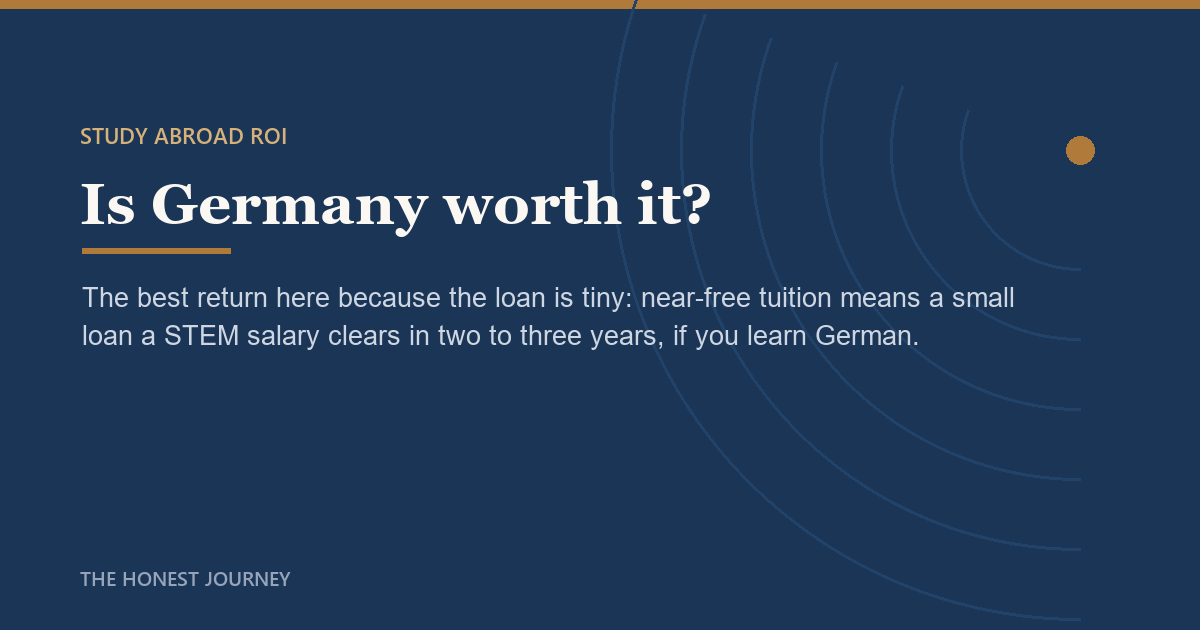
Short answer. The honest answer on whether studying in Germany is worth it for Indian students: on pure return-on-investment, Germany is the best bet in this whole set, because the loan is tiny.
Near-zero public tuition means a two-year Master’s costs ₹20 to 26 lakh all-in, mostly living, so you can often self-fund or take a small ₹15 to 20 lakh loan, and a STEM salary of ₹40 to 54 lakh clears that in two to three years. But the entire return is gated by one thing, German. Most qualifying jobs, the higher salaries and the fast permanent-residence route all effectively need working German, and without it the cheap degree can stay stuck as a cheap degree. Germany is worth it, spectacularly, if your field is engineering or STEM and you will genuinely learn the language. It is a weak bet if you will not.
For how Germany’s 18 month job seeking permit compares, see post study work visas by country.
An engineering student I know funded his German Master’s almost entirely from family savings, a small top-up loan of about ₹12 lakh, because the tuition was essentially free. Two years later he was on an EU Blue Card earning EUR 58,000, the loan was long gone, and he was saving more than his cousins in pricier countries who were still deep in EMIs. The catch he will admit freely: the first year was brutal, evenings of German classes on top of the degree, because without B1 the good jobs simply did not open. He paid Germany’s real price, which was never money. It was language.
This post is the return question, not the cost question; the price detail lives on the cost of studying in Germany post. I will walk the all-in cost in rupees, what you actually earn, why the payback is the fastest here, and the one risk, the language wall, that decides everything. For the math I use ₹90 per euro throughout; treat it as the planning frame.
If you are still choosing the country, the wider view is in is studying abroad worth it and the Germany vs Canada comparison.
The ROI question in one paragraph
Germany is the low-cost, high-return, high-friction option, and the return is the best on paper precisely because the investment is so small. When your loan is ₹15 lakh instead of ₹50 lakh, even a moderate salary clears it fast, and Germany pays engineering and STEM graduates well. That is why the pure ROI beats the USA, the UK, Canada and Australia: the numerator is decent and the denominator is tiny. But the whole thing is conditional on a single input you must supply yourself, German. The salary, the qualifying job and the fast settlement route all assume it. Germany does not risk your money; it risks your degree becoming unusable if you never clear the language bar. Get the language, and it is the best value in international education. Skip it, and the cheap ticket buys you very little.
Total all-in cost in INR
Germany is structurally the cheapest serious destination, and the reason is tuition. Public universities charge international students almost nothing, only a nominal semester contribution of EUR 100 to 350, so tuition across a two-year Master’s is often under ₹1.5 lakh in total. The real cost is living, and the student visa requires a blocked account of around EUR 11,904 a year, about ₹10.7 lakh, as proof of funds. All-in, a two-year German public Master’s commonly lands between ₹20 and 26 lakh, almost entirely living and fees.
That small ticket changes the entire risk profile. Because the number is low, many families self-fund it or take only a modest loan of ₹15 to 20 lakh, sometimes a secured loan at a lower rate. The moratorium interest that dominates the US and Australian maths is almost a non-issue here, because there is so little principal. You are earning back a small number, and that is the whole reason Germany’s payback is the fastest in this set.
| Cost item | Two-year German public Master’s |
|---|---|
| Tuition (full program) | ~₹0 to 1.5 lakh |
| Living (full program) | ~₹20 to 24 lakh |
| Rough all-in study cost | ~₹20 to 26 lakh |
| Typical loan shape | Small, ₹15 to 20 lakh or self-funded |
| Proof of funds at visa | Blocked account ~EUR 11,904 (~₹10.7L) |
The breakdown and loan detail sit on the cost of studying in Germany post and the education loan for Germany post, including the blocked account detail. The ROI point is simple: the amount you must earn back is small, which is Germany’s structural advantage over every pricier country here.
Faz's ruleGermany wins on return for one boring reason: the loan is tiny. A small loan against a decent STEM salary clears in two to three years, faster than anywhere. The catch is not the money. It is whether you will learn German to unlock the salary at all.
The German ROI is the best in this set purely because the investment is so low. Near-free tuition means a small loan or none, so even a moderate salary repays it quickly. But that salary and the Blue Card both assume working German, so the real question is never affordability. It is whether you will do the language work that turns the cheap degree into a paying career.
What you actually earn
German pay for engineering and STEM graduates is genuinely strong, and it is the other half of why the return is so good. A STEM or engineering graduate commonly starts around EUR 45,000 to 60,000, roughly ₹40.5 to 54 lakh gross at ₹90, in a country where a small loan means most of your surplus is yours to keep or save.
Two honest caveats sit on that number. First, German taxes and social contributions are high, so take-home is a smaller share of gross than in some countries, often around 60 to 65 percent. Second, and more important, that salary band assumes you can work in German-speaking teams for most qualifying roles. English-only jobs exist, especially in large tech and research settings, but they are a minority, and the higher-paying, more secure roles skew German-speaking. The gross figure is real; it is conditional on the language.
The non-STEM picture is weaker and rarely stated. Germany’s hunger is specifically for engineers, technical and STEM graduates. If your field is non-technical, both the job market and the salaries are less favourable, and the language requirement bites harder. Germany’s return case is strongest for STEM and thinner outside it.
The payback period, said plainly
Two scenarios frame the return, and the fork here is the language, not a visa lottery.
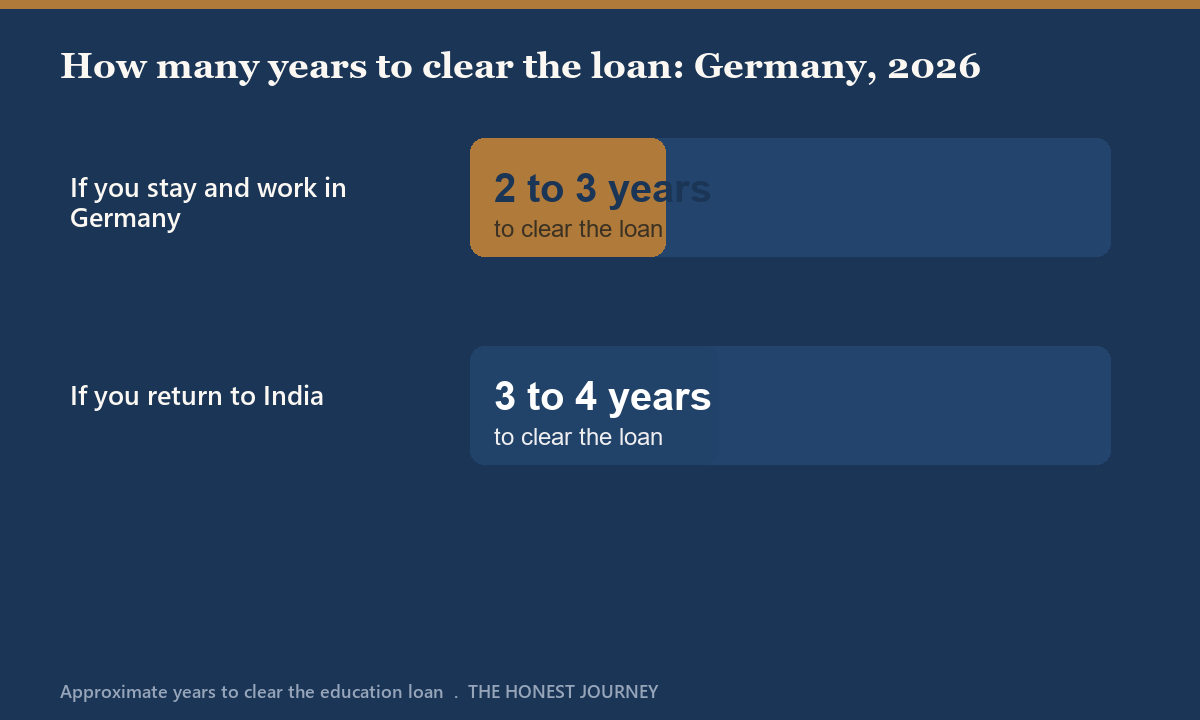
Scenario one, you learn German and stay. A STEM graduate on EUR 50,000, with only a ₹15 to 20 lakh loan, can clear it in about two to three years, the fastest payback in this entire set, and then bank a strong salary with a fast route to permanent residence through the EU Blue Card. This is the case that makes Germany the best value in international education, and it exists whenever you clear the language bar in a technical field.
Scenario two, you do not learn German. The degree is still real and respected, but the good jobs and the Blue Card route stay largely closed, and you may struggle to find qualifying work inside the 18-month post-study window. Some return to India, where a German engineering Master’s does carry weight, ₹12 to 22 lakh a year, and because the loan was small, the financial damage is limited. The return is not painful the way a failed US bet is, because you never risked much money. But the great outcome, the fast Blue Card and the strong salary, quietly passes you by.
| Payback factor | Learn German and stay | No German |
|---|---|---|
| Typical salary | EUR 45k to 60k (~₹40 to 54L) | Limited roles, or return to India |
| Loan size | Small (~₹15 to 20L) | Small (~₹15 to 20L) |
| Realistic yearly repayment | ~₹6 to 9 lakh | ~₹4 to 6 lakh |
| Years to clear the loan | ~2 to 3 years | ~3 to 4 years, if returned |
| What decides it | Reaching working German | The language bar not cleared |
Notice the crucial difference from the USA: because the loan is small, even the worse column is survivable. Germany’s downside is a missed opportunity, not a financial trap. That is what makes it the lowest-risk high-return bet here, so long as you are honest about the language.
Faz's ruleGermany has the best upside and the softest downside on this list, because the loan is small either way. The worst case is a missed opportunity, not a debt trap. That is the safest high-return bet in this whole set, if you commit to the language.
Unlike the USA, where a failed bet leaves a crushing loan, Germany’s small ticket means even the no-German outcome does not financially break you. You simply miss the great result rather than land in a trap. That soft downside plus a top-tier upside is why Germany is the most rational choice for a STEM student willing to do the language work.
The risk that breaks the ROI
Germany has essentially one risk that matters, and it is not financial. It is the language, and it deserves brutal honesty because students consistently underweight it.
Most good German jobs, most daily life, and the faster settlement routes assume working German, usually B1 or above. You can study many Master’s programs entirely in English, which lulls students into thinking the language is optional. It is not. The 18-month post-study job-seeker window is generous, but finding a qualifying role inside it without German is genuinely hard in most fields, and the students who struggle are almost always the ones who treated German as a nice-to-have.
The honest planning rule is to start German before you arrive and treat reaching B1 as part of the degree itself, not an optional extra. If you are certain you will do that, Germany is superb. If you are honest that you will not sustain the effort, an English-language destination like Canada or Ireland will convert your degree into a job far more reliably, even at a higher cost. The trade is language effort now for a small loan and a fast payback; only take it if you will actually pay in language.
A worked payback example
Take one student, a mechanical or computer-science Master’s graduate, ₹18 lakh loan at 10 percent.
| Step | Figure |
|---|---|
| Loan borrowed | ₹18 lakh at 10 percent |
| Balance after moratorium | ~₹20 to 21 lakh |
| German STEM starting salary | EUR 50,000 = ~₹45 lakh gross |
| Take-home after German tax | ~EUR 31,000 = ~₹27.9 lakh |
| Yearly amount toward loan | ~₹8 lakh |
| Payback if you learn German and stay | ~2.5 to 3 years |
| Payback if you return to India | ~3 to 4 years |
Both columns are gentle, because the loan is small. The German-speaking column clears a tiny loan in under three years and then opens a strong salary and a fast Blue Card, the best outcome on this whole list. Even the return column is manageable. Same student, and the fork is entirely whether the language gets learned. There is no lottery here, only effort you control.
When Germany is worth it, when it is not
It comes down to field and language, not money.
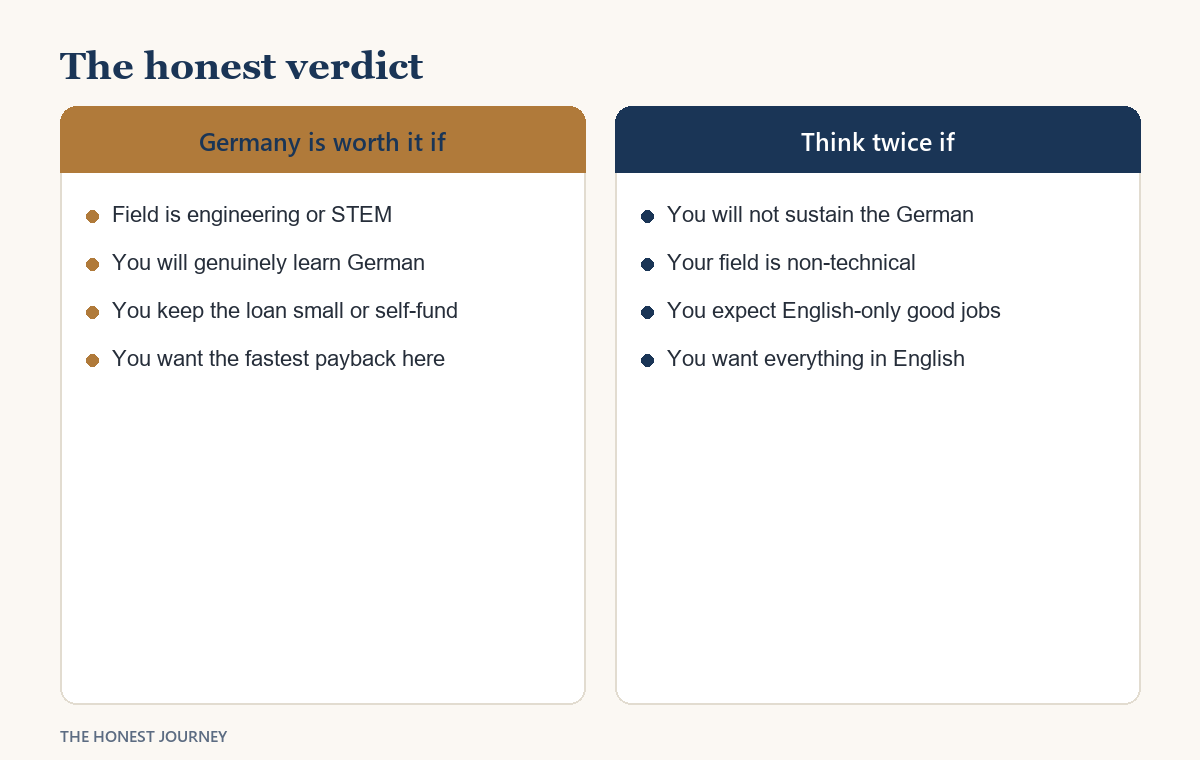
Germany is worth it if your field is engineering, STEM or research where German industry hires hard, you can keep the loan small or self-fund, and above all you will genuinely commit to reaching working German. For that profile Germany offers the best return in international education: a near-free degree, a strong salary, a fast route to permanent residence, and a downside that never financially breaks you. Nothing else on this list combines a high upside with such a soft floor.
Think twice if you will not sustain the language effort, or your field is non-technical where German’s job market and salaries are weaker. For those cases the cheap degree can stall, and an English-language destination will convert into a career more reliably despite the higher cost. Be brutally honest about the language, because self-deception here is the one way to waste Germany’s otherwise unbeatable maths.
One note for everyone: a German engineering Master’s plus experience is a strong asset back in India too, and because the loan was small, a planned return is a genuinely good, low-stress outcome. Germany is one destination where returning home does not mean years of heavy EMIs.
The honest take
The engineer who cleared his small loan in under three years is unequivocal that Germany was the smartest financial decision available to him, and the numbers back him completely. But he is equally clear that the version of him who skipped the German classes would be telling a very different story, stuck with a cheap degree he could not fully use. The maths was never the risk. The language was.
So reduce it to the honest test. Is your field STEM or engineering, can you keep the loan small, and will you truly do the language work? If yes, Germany is the best-value, lowest-risk high-return bet on this entire list, cheap to enter, strong to earn, fast to settle. If you cannot honestly promise the language, price that in clearly and read the study in Germany page and the Germany vs UK comparison before you commit. Decide on the language question first, because in Germany it decides everything.
Funding the move with a loan? Start with the complete education loan guide, then apply through the PM Vidyalakshmi portal, the government route most Indian students use.
Germany is the classic engineering bet. See the honest math for engineering graduates.
FAQ
Is a German Master’s degree worth it for Indian students in 2026?
For a STEM or engineering student willing to learn German, it is the best return in international education. Near-free public tuition means a two-year Master’s costs only ₹20 to 26 lakh all-in, mostly living, so a small loan clears in two to three years on a strong STEM salary. The whole case is conditional on the language: most qualifying jobs and the fast Blue Card route need working German. Learn it and Germany is unbeatable value; skip it and the cheap degree can stall.
How long does it take to repay a German education loan?
Faster than anywhere else here, because the loan is small. Public tuition is nearly free, so many students borrow only ₹15 to 20 lakh, which a STEM salary of ₹40 to 54 lakh clears in about two to three years. Even if you return to India, the small loan means a manageable three to four years, not the long slog a large US or Australian loan creates. Low principal is the entire reason Germany’s payback leads this list.
Do I really need German to make the degree worth it?
For most students, yes. You can study many Master’s programs in English, but most qualifying jobs, the higher salaries and the fast settlement route effectively need working German, usually B1 or above. Finding a role inside the 18-month post-study window without it is genuinely hard in most fields. Treat reaching B1 as part of the degree, starting before you arrive. If you will not commit to the language, an English-language destination converts to a job more reliably.
What salary can an Indian student expect after studying in Germany?
A STEM or engineering graduate commonly starts around EUR 45,000 to 60,000, about ₹40.5 to 54 lakh gross at ₹90, though high German taxes and social contributions bring take-home to roughly 60 to 65 percent of gross. The strong figures assume you can work in German-speaking teams for most qualifying roles. Non-technical fields see weaker demand and pay, so Germany’s salary case is strongest for engineering and STEM graduates specifically.
Is studying in Germany worth it for non-STEM students?
It is a weaker case. German industry hires hardest for engineers and technical and STEM graduates, so non-technical fields face a thinner job market and lower salaries, and the language requirement bites harder. The near-free tuition still limits your financial downside, so the risk is low, but the great upside, a strong salary and fast Blue Card, is less accessible. Non-STEM students should weigh English-language destinations that hire more broadly in their field.
Can Indian students settle permanently in Germany after studying?
Yes, and relatively fast, but through the language. On an EU Blue Card, granted for a qualifying job above a salary threshold, you can reach a settlement permit in about 21 months with B1 German or about 33 months with basic German. Every step needs a qualifying, usually German-speaking, job. So permanent residence is genuinely quick by international standards, but it is gated by the language and a skilled role, not handed out automatically.
Why is Germany considered the best value for Indian students?
Because the return-on-investment maths is dominated by a tiny loan. Near-free tuition means a small or no loan, and a decent STEM salary clears it in two to three years, faster than the USA, UK, Canada or Australia. Just as important, the downside is soft: if things do not work out, you never risked a large sum, so the worst case is a missed opportunity rather than a debt trap. High upside with a soft floor is a rare combination.
Is Germany or Canada a better return for Indian students?
Germany has the better pure return but the harder condition. Its near-free tuition makes the payback the fastest here, but the salary and settlement route need German. Canada costs far more and pays in English with a clearer, points-based permanent-residence path you can plan without a language barrier. For a STEM student certain about learning German, Germany wins on maths; for someone who wants everything in English, Canada is the safer route despite the cost. The full split is in the Germany vs Canada comparison.
Faz · The Honest Journey · 2026