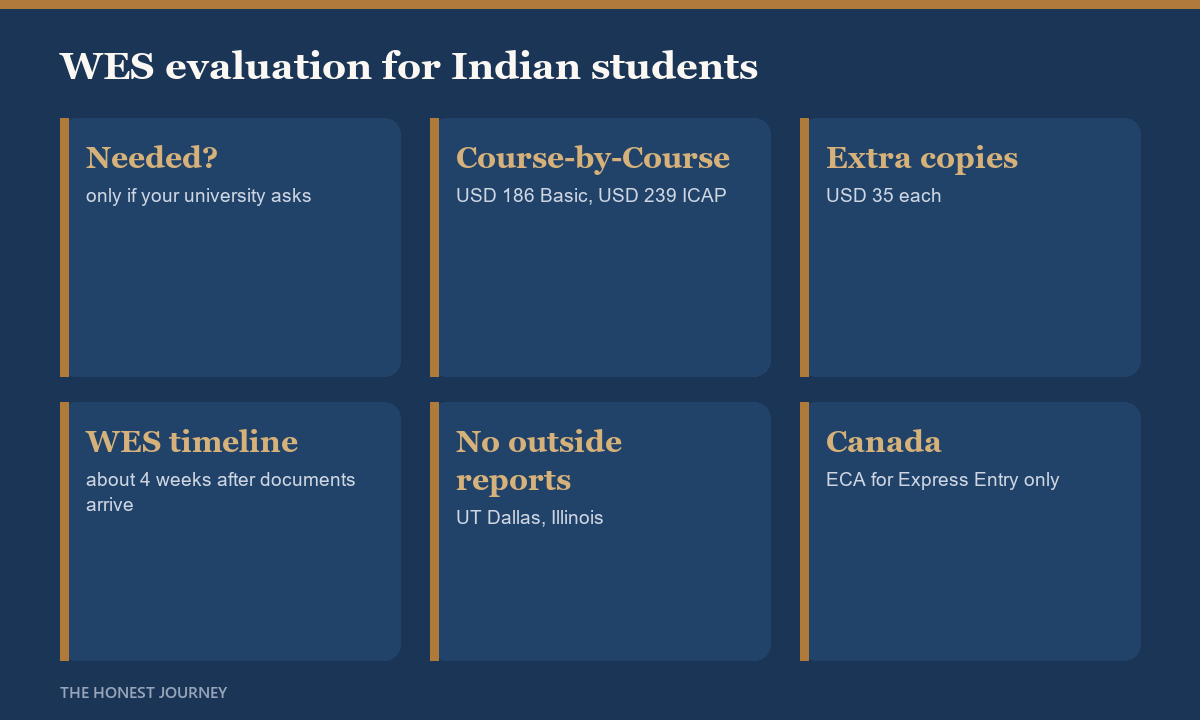
Short answer. A WES evaluation converts your Indian degree and marks into US or Canadian terms, but you need one only when a university or agency asks for it. Many US universities evaluate Indian transcripts themselves, and some refuse WES reports. A Course-by-Course report costs USD 186. Canada needs a WES ECA for Express Entry, not for a study permit.
Every year thousands of Indian students pay for a WES evaluation in the first week of their application season, because a senior, a consultant or a blog told them it was step one. For some of them it is. For a large share it is money spent on a report their universities will never open, and for a few it is worse than useless, because the university they most want does not accept outside evaluations at all.
Need a percentage for an Indian form? Use your university’s own rule in the CGPA to percentage calculator.
This page sorts out which group you are in before you pay. It covers what WES actually produces, which US and Canadian institutions ask for it, what it costs at today’s prices (most guides still quote last year’s), how Indian transcripts reach WES, how long it takes, how your percentage becomes a GPA, and when ECE or another evaluator is the better choice.
What a WES evaluation actually is
World Education Services is a non-profit that compares qualifications earned outside the US and Canada with the education systems of those two countries. It is a member of NACES, the US association of credential evaluation services, and has been since March 1987. For Canada it is one of the organisations Immigration, Refugees and Citizenship Canada designates to issue Educational Credential Assessments.
WES sells three report types that matter to an Indian student:
| Report | What it tells the reader | Who asks for it |
|---|---|---|
| Document-by-Document (DxD) | The US equivalent of each credential, for example “bachelor’s degree”, with no grades or GPA | Some employers and licensing boards; rarely enough for graduate admission |
| Course-by-Course (CxC) | Every course, converted into US semester credits and a US letter grade, plus a GPA on the 4.0 scale | US graduate schools that want an outside evaluation, and application services such as SOPHAS |
| Educational Credential Assessment (ECA) | The Canadian equivalent of your degree, for immigration | IRCC, for Express Entry and some provincial nominee programmes |
Each report comes in a Basic version or an ICAP version (International Credential Advantage Package). ICAP means WES also stores your verified transcripts and can send them, with the report, to later recipients. Some application systems accept only ICAP, so check the wording before choosing Basic to save money.
Do you even need WES? Check this first
US universities set their own rules for international transcripts, and they fall into three groups. You can only find out which group a school is in by reading its graduate admissions page, so do this for every school on your list before you pay anyone.
Group 1: the school requires WES, sometimes a specific WES package
Boston University’s School of Public Health is a clear example. For international transcripts not verified by SOPHAS, the public health application service, it requires a Course-by-Course ICAP evaluation from WES, submitted to SOPHAS, and SOPHAS “will only accept WES ICAP evaluations”. A Basic report or an ECE report would not do. Application services for other health professions often work the same way.
Group 2: the school wants an outside evaluation, but not necessarily from WES
Georgia Tech’s graduate admissions office “highly recommends” three evaluators for applicants educated outside the US: International Education Evaluations, Educational Perspectives and The Evaluation Company. WES is not on that list. Georgia Tech also offers an in-house evaluation as an alternative. Other schools simply ask for an evaluation from “a NACES member”, in which case WES, ECE and the other members all qualify.
Group 3: the school does its own evaluation and will not take yours
The University of Texas at Dallas states that “outside credential evaluations are not required or accepted for admission”. Its admissions office evaluates your mark sheets and degree certificate itself. The Graduate College at the University of Illinois says it does “not accept credentials or evaluations provided by third-party evaluation companies such as WES and ECE”. An applicant to either school who buys a WES report has spent the money for nothing.
Plenty of universities popular with Indian applicants sit in group 3 or accept either route, which is why the default advice “get WES done first” is wrong for so many Indian applicants. The right order is: shortlist, read each school’s international transcript page, then buy the one evaluation that covers the schools that need it. Our guide on how to shortlist universities for an MS abroad builds this check into the shortlisting pass.
Canada is a different question
For a Canadian study permit, WES is not on the document list at all. IRCC’s study permit checklist asks for your letter of acceptance, proof of funds, identity documents and, in most cases, a provincial attestation letter. Canadian universities and colleges then set their own transcript rules for admission, so check each school’s page as you would for the US. Our Canada student visa guide covers the permit side.
The ECA matters later, if you apply for permanent residence through Express Entry. IRCC’s rule is that “if you completed your education outside Canada, you need an Educational credential assessment” to qualify for the Federal Skilled Worker Program or to earn points for that education, and “you don’t need an assessment for a Canadian degree, diploma or certificate”. So a student who completes a Canadian master’s can claim it without any ECA. The Indian bachelor’s needs an ECA only if you want points for two or more credentials, because IRCC requires “an assessment for each one” of them.
An ECA must be less than five years old when you create your Express Entry profile and when you submit your application. That timing is why buying one at the admission stage is usually a mistake. A student who orders an ECA in 2026, studies for two years and then works on a post-graduation work permit can easily find it has expired just as they become eligible. Order it when your PR timeline is real, not when you apply for college. The PGWP guide explains that timeline.
UK, Australia, Germany and elsewhere
WES reports are built for the US and Canadian systems. If you are applying to universities in the UK, Australia, Germany or anywhere outside North America, follow each university’s own document instructions and do not buy a WES report unless one of them names it.
WES fees in 2026, and what you will really pay
These are the prices on WES’s graduate admissions page as of September 2026. Several popular guides still show the older USD 168 Course-by-Course price, so do not budget from them. Rupee figures use about ₹96 to the dollar and are rounded.
| WES report (US) | Price | Approx. in rupees |
|---|---|---|
| Course-by-Course, ICAP (WES’s recommended package) | USD 239 | ₹22,900 |
| Course-by-Course, Basic | USD 186 | ₹17,900 |
| Document-by-Document, ICAP | USD 171 | ₹16,400 |
| Document-by-Document, Basic | USD 118 | ₹11,300 |
| ECA for Canadian immigration | CAD 264, plus delivery and 13% HST | Priced in Canadian dollars |
The report price is not the full bill. WES lists these extras separately:
- Delivery: standard delivery without tracking is USD 14, international courier is USD 86 per address.
- Extra copies ordered with the application: USD 35 each. This is how you send the same report to several universities.
- Copies ordered after the evaluation is complete: USD 58 for the first one on a Basic report, USD 35 on ICAP, then USD 35 each.
- Upgrades: Basic to ICAP costs USD 53 while the evaluation is still in progress, and USD 92 after it is complete. Upgrading a DxD to a CxC, or adding a degree later, also costs USD 92.
A realistic example: a Course-by-Course Basic report sent to five universities, with four extra copies ordered at the start, comes to USD 186 plus 4 × USD 35, which is USD 326 or about ₹31,300 before delivery. Order those four copies after the evaluation is finished and the first costs USD 58, so the total rises to USD 349. On ICAP, copies cost USD 35 whether you order them early or late, which is why ICAP suits students who expect to add schools later.
Your Indian university adds its own charges for issuing transcripts and sending them, and some add a separate verification fee. These vary widely between universities, so ask your registrar or examination branch for the exact figure before you start.
Documents WES needs from an Indian university
WES’s page on Indian credentials (updated May 2026) sets out the rules:
- Mark sheets: WES accepts either a consolidated transcript or the yearly or semester mark sheets, as long as the degree-granting institution issues them and sends them in a sealed envelope, or electronically through a WES digital partnership.
- Degree certificate: include a copy of the degree certificate or the provisional certificate. Some documents of this kind can be uploaded to your WES account yourself; your account lists exactly which.
- All years: WES asks for all years of mark sheets, so a missing semester, including the one where you cleared a backlog, holds up the whole file.
- Master’s holders: if your Indian master’s is an MEd, ME, MPhil, MTech, MNursing or MPharm, WES does not need your bachelor’s documents. For every other Indian master’s, including an MSc, MA, MCom or MBA, WES “cannot evaluate your master’s degree without the bachelor’s degree”, so the bachelor’s records must come too.
WES also warns that it cannot currently evaluate qualifications from Indian institutes of Ayurveda, Unani and Siddha medicine. Check eligibility before paying if that is your field.
If you had backlogs, they will appear on the mark sheets and in the course list, and a Course-by-Course report converts each attempt as the university recorded it. Our page on backlogs covers how that plays out with lenders as well as universities.
How to send your transcripts to WES from India
This is the step that takes longest for most Indian students, and it is almost entirely outside WES’s control.
- Apply and pay first. Create your WES account, choose the report, pay, and note your WES reference number. Your university needs that number to match the documents to your file.
- Check whether your university is a WES digital partner. Digital partners send records electronically, which WES describes as the more secure option. If yours is not, an authorised official can ask WES to set up a partnership, though you cannot rely on that happening in time for one application season.
- Use a verification route if one fits. WES accepts records verified through the National Skill Development Corporation. You upload your documents to your NSDC digital wallet, NSDC verifies them with the issuing body and transmits them to WES. WES also names Qualification Check as a route once you have your reference number.
- Otherwise, request sealed envelopes. If your institution will not send documents directly, WES may accept them from you “in sealed envelopes provided by your institution”. Do not open the envelope, and follow the instructions in your WES account for how the envelope must be sealed and signed.
- Track acceptance, not dispatch. WES starts the clock only once it has received and accepted every required document. Watch your WES account for the “documents accepted” status rather than assuming the job is done when your college posts the envelope.
Can you send your own transcripts to WES? Only in the sealed-envelope form above, where the institution prepares and seals them. Photocopies you attest yourself are not official records, and uploads you make yourself are limited to the specific items your WES account asks for.
How long WES takes
WES splits its timeline into two stages and publishes typical times for each:
| Report | Document review and acceptance | Evaluation after acceptance |
|---|---|---|
| Document-by-Document | Typically 2 weeks | Typically 1 week, up to 2 for complex cases |
| Course-by-Course | Typically 2 weeks | Typically 2 weeks, up to 4 for complex cases |
| ECA for IRCC | Typically 2 weeks | Typically 1 week, up to 2 for complex cases |
Both stages start only after all your documents have arrived. The unpublished part is how long your Indian university takes to issue and send them, which ranges from a few days at a digitally connected institution to many weeks at a large affiliating university. In our view, the safe plan for a Course-by-Course report is to start about three months before your first deadline. The US intakes guide gives those deadlines.
How WES turns your percentage into a GPA
A Course-by-Course report converts each course’s mark into a US letter grade, weights it by credit, and calculates a GPA on the 4.0 scale. WES’s own training material shows the common scale it applies to Indian university marks:
| Marks | Indian classification | WES grade |
|---|---|---|
| 70 to 100 | First Class with Distinction | A |
| 60 to 69 | First Class | B |
| 50 to 59 | Second Class | B |
| 35 to 49 | Third or Pass Class | C |
| 0 to 34 | Fail | F |
Two things follow from that scale, and both surprise students. First, the top is compressed: a course scored at 72 and one scored at 94 both become an A. A student who clears 70 in most subjects can end up with a WES GPA in the high 3s even though a 72 percent aggregate feels ordinary in India. Second, the 50 to 69 band is flat, so a student averaging 61 and one averaging 67 can come out close together, around a B.
Treat any estimate as a guide only. The scale above comes from WES training material, and WES adjusts for individual institutions. To estimate your own number, use the WES iGPA Calculator on the WES site. Our guide for average academic records explains what a 3.0 to 3.3 GPA can realistically get you.
Three-year Indian degrees
Most US master’s programmes expect four years of undergraduate study. WES’s policy, in place since 2006, is that a three-year Indian bachelor’s counts as equivalent to a US bachelor’s only when both conditions are met: the degree was earned in Division I, and the awarding institution is accredited by NAAC with a grade of A or better. Other three-year degrees are treated as three years of undergraduate study.
That makes WES a real advantage for one group: BSc, BCom and BA graduates from NAAC A-grade institutions with first-division results, applying to schools that accept WES. WES itself names Carnegie Mellon, Columbia, Northwestern, Syracuse and the University of Virginia among universities more likely to consider three-year degrees. Even so, a positive equivalency does not bind the school, so confirm with the department. If you are in this group, a WES report may be the one worth buying before you finish shortlisting.
ECE vs WES: which one should you pick?
Educational Credential Evaluators (ECE) is the other large NACES member, also a member since March 1987. For US admissions they do the same job:
| WES | ECE | |
|---|---|---|
| Course-by-Course report | USD 186 Basic, USD 239 ICAP | USD 199, or USD 244 with ECE Insignia |
| Cheaper report | Document-by-Document, USD 118 | General, USD 110; General with GPA, USD 135 |
| Faster option | No paid rush listed for graduate admissions | Guaranteed 5 business days for USD 90, after documents are approved |
| Extra copies | USD 35 each | USD 30 each, USD 20 with Insignia |
| Canadian ECA for Express Entry | Yes, IRCC designated | Not on IRCC’s list of designated organisations |
The decision is simpler than the forums make it. If a school or application service names one evaluator, use that one; price does not matter when the other report will be rejected. If schools accept any NACES member, pick the one that covers the most schools on your list with a single report. If Canadian PR is a real possibility later, remember that only the WES side of this comparison gives you an ECA, but also remember the five-year expiry, which usually means ordering it later anyway.
Faz's rulePay for the evaluation your universities ask for. Nothing more, and not before you know.
Most students I talk to bought WES in the same week they booked the GRE, because a senior told them it was step one. Then half their shortlist turned out to be schools that evaluate Indian transcripts themselves, and one of them refused outside reports completely. Do the shortlist first, open every school’s international transcript page, and write down what each one wants. Buy one report that covers the schools that need it, with the copies ordered up front. That is often ₹20,000 you never needed to spend.
The honest closing take
WES is a legitimate, useful service, and for some applicants it is essential: health programmes that go through SOPHAS, schools that name WES, three-year degree holders who meet its equivalency conditions, and later on, anyone heading for Canadian PR. For many Indian master’s applicants to the US, though, it is a cost they can skip, because the universities they apply to read Indian mark sheets themselves. Decide school by school, from the school’s own page, and not from what a consultant or a friend says. When you do need a report, the real bottleneck is your Indian university’s transcript office, so start that part early and budget for extra copies at the start. For the rest of the application, see our guides on whether you need the GRE, the statement of purpose and the full cost of studying in the USA.
FAQ
Is WES evaluation mandatory for Indian students applying for an MS in the USA?
No. Each university decides. Some require a WES Course-by-Course report, some accept any NACES evaluator, and some, such as UT Dallas and the University of Illinois Graduate College, do not accept outside evaluations at all and evaluate Indian transcripts themselves. Check each school’s international transcript page before paying for one.
How much does a WES evaluation cost for Indian students?
As of September 2026, a Course-by-Course report costs USD 186 Basic or USD 239 ICAP, and a Document-by-Document report USD 118 or USD 171. That is roughly ₹11,300 to ₹22,900 at about ₹96 to the dollar. Delivery and extra copies (USD 35 each) are charged on top, as are your Indian university’s own transcript fees.
How long does WES take for Indian transcripts?
WES says document review typically takes 2 weeks once all documents arrive, and a Course-by-Course evaluation typically takes another 2 weeks, up to 4 for complex cases. The longest part is usually your Indian university issuing and sending the transcripts, so start about three months before your first deadline.
Is WES required for a Canada student visa?
No. IRCC’s study permit document list does not include a WES evaluation or an ECA. You need an ECA later if you apply for permanent residence through Express Entry with education earned outside Canada. A Canadian degree or diploma needs no ECA.
Can I send my transcripts to WES myself?
Only in sealed envelopes prepared by your institution, if the institution will not send them directly. Photocopies you attest yourself are not official records. You can upload a few items, such as a degree certificate, to your WES account when your account asks for them.
What GPA will WES give for 70 percent in India?
On the common scale WES applies to Indian university marks, 70 and above converts to an A, 50 to 69 to a B, and 35 to 49 to a C. Because WES converts each course and weights it by credits, a student with most subjects above 70 can reach a GPA in the high 3s. Use the WES iGPA Calculator for an estimate.
Which is better, ECE or WES?
Neither is better in general. Use the one your university or application service names. If any NACES member is accepted, compare price and speed: ECE’s Course-by-Course report is USD 199 with a paid 5-day rush, and WES’s is USD 186 Basic. Only WES issues ECAs for Canadian immigration.
Where these figures come from
- WES, graduate admissions evaluations and fees
- WES Canada, Educational Credential Assessment fees and validity
- WES, current processing times
- WES, credential evaluation and document requirements for India, May 2026
- WES, how to get your Indian degree evaluated
- WES, understanding the three-year Indian bachelor’s degree in the US
- WES, a guide to WES grade conversion (training presentation, common Indian university scale)
- ECE, services and fees for applicants to US institutions
- NACES, current members
- Boston University School of Public Health, transcripts
- Georgia Tech Graduate Education, evaluation services FAQ
- UT Dallas Graduate Admissions, international students
- University of Illinois Graduate College, information for admitted students
- IRCC, Express Entry educational credential assessment
- IRCC, study permit documents
Checked against the sources above in September 2026. Fees and university transcript policies change, so confirm the current figure on the official page before you pay.