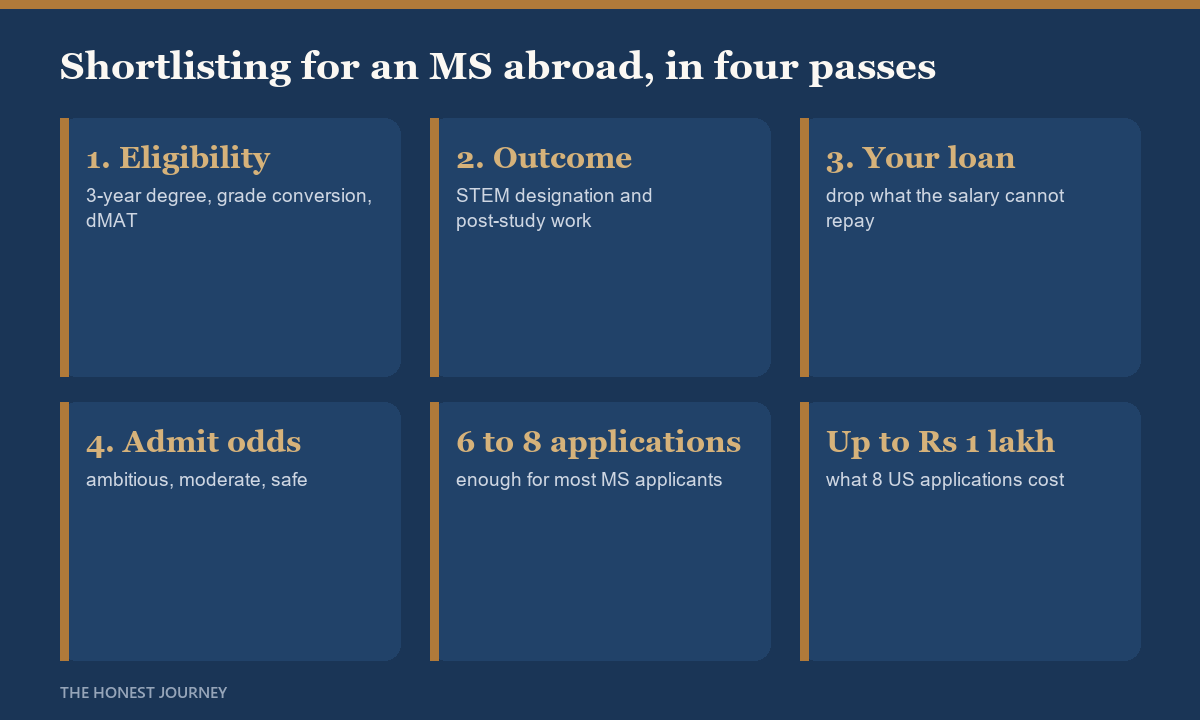
Short answer. Shortlist in four passes: first cut universities that will not accept your degree or grades, then keep programmes with the job outcome you need, then drop anything your loan cannot carry, and only then sort by admit odds. Six to eight applications, split across ambitious, moderate and safe, is enough for most Indian MS applicants.
Most shortlisting advice starts with rankings and ends with a list of fifteen universities. That order is backwards for an Indian applicant. Before a ranking matters, three gates decide whether your application is even read: whether the university accepts a three-year degree, how it converts your percentage or CGPA, and whether the programme leads to the work rights you are counting on. A top-50 name that fails any of these is not ambitious. It is an application fee you will not get back.
Applying to Germany? Convert your CGPA with the German grade calculator before you shortlist.
Shortlist first, then book your test, because universities and visa offices accept different English tests.
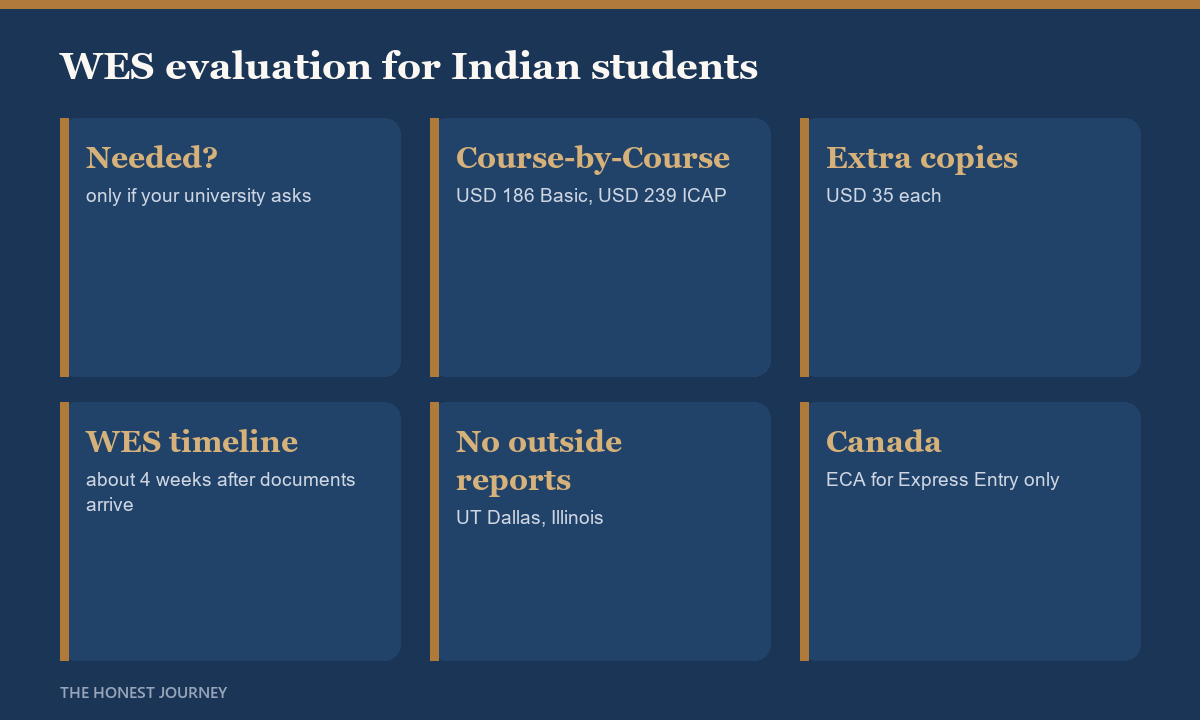
Before paying for a credential evaluation, check whether your universities need WES at all.
Before you book any test, check which programmes on your list need it. See is the GRE required for an MS abroad.
This page walks through the four passes in the order that saves the most money, with the country rules that trip Indian applicants up most often, and the real cost of applying in rupees.
Why rankings are the wrong first filter
Rankings measure research output, reputation surveys and citations. They say very little about the three things that decide whether an MS abroad pays off for you: whether you get in, whether the course gives you the right to work afterwards, and whether the fees leave you with a loan you can repay. A university ranked 40th with a non-STEM programme can leave you with one year of work rights in the US, while a university ranked 150th with a STEM-designated version of the same subject gives you three.
Rankings also disagree with each other. The same university can sit twenty places apart in two tables, because each table weighs different things. Use a ranking to break a tie between two programmes that already pass every other test, not to build the list.
Pass 1: the eligibility gates
This pass removes universities where your application would fail on paper, however good the rest of it is. It is the pass most applicants skip, because the rules sit in an international admissions page rather than on the programme page.
The three-year degree problem
If you hold a three-year BSc, BCom or BA, this is the gate that matters most. Four-year degrees such as the BTech and BE clear it almost everywhere. Three-year degrees are treated very differently by country and by university.
| Country | How a three-year Indian degree is usually treated | What to check |
|---|---|---|
| USA | Varies by university. WES treats a three-year degree as equivalent to a US bachelor’s only when it was earned in Division I from an institution with a NAAC grade of A or better. Some universities, such as San Jose State, do not accept most three-year Indian degrees at all. | The graduate school’s international requirements page, and whether it relies on a WES evaluation. |
| Canada | Often strict. The University of Toronto’s graduate school requires a four-year bachelor’s degree, or a three-year degree followed by a master’s. | The university’s credential equivalency tool for India. |
| UK | Generally accepted, because UK bachelor’s degrees are also three years. The real test is your percentage and your university’s standing. | The university’s India entry requirements page. |
| Germany | Judged in ECTS credits. Many master’s programmes accept 180 ECTS, which a three-year degree can meet, but some ask for 210 or 240. | The eligibility section of the specific programme, not the university’s general page. |
The practical rule for the USA is to treat a three-year degree as a filter to apply before anything else. Open each university’s international graduate admissions page and search it for “three-year” or “3-year”. If it asks for a four-year degree or a master’s on top, it comes off the list, however well it fits otherwise.
How your grades are converted
Your 7.5 CGPA does not mean the same thing to every university. Each country converts it differently, and some adjust it for the standing of your college.
UK. UK universities map Indian percentages to their own degree classes, and many use a sliding scale by institution. The University of Surrey, for example, asks for an overall 60% or 65% for a course that needs a UK 2:1, depending on which Indian institution you studied at. The University of Bristol asks for at least 60% or a 6 out of 10 from an Indian university on its accepted list. The same 62% can clear one university’s bar and miss another’s.
Germany. German public universities convert foreign grades with the modified Bavarian formula: German grade equals 1 plus 3 times (best possible grade minus your grade) divided by (best possible grade minus the pass mark). German grades run from 1.0, the best, to 4.0, a bare pass, so lower is better.
| Your Indian result | Scale and pass mark used | Converted German grade |
|---|---|---|
| 80% | 100, pass at 40 | 2.0 |
| 70% | 100, pass at 40 | 2.5 |
| 60% | 100, pass at 40 | 3.0 |
| 8.0 CGPA | 10, pass at 4 | 2.0 |
| 7.0 CGPA | 10, pass at 4 | 2.5 |
Use your own university’s pass mark in the formula, not an assumed one. A college with a pass mark of 50 instead of 40 gives a noticeably worse converted grade for the same percentage. Competitive programmes often want 2.5 or better. A 72% converts to about 2.4 at a college that passes at 40, which clears that bar, but to about 2.7 at a college that passes at 50, which does not.
USA and Canada. Most US graduate schools read your transcript themselves or ask for a WES course-by-course evaluation, which reports a GPA on the US 4.0 scale. There is no single conversion, and a stated minimum such as 3.0 is a floor, not a target. If your grades are well below the numbers your target programmes quote, read our guide on studying abroad with an average academic record or backlogs before you build the rest of the list.
Germany’s new gate for 2027: the dMAT
If Germany is on your list, there is a new requirement most older shortlisting guides do not mention. Indian applicants whose bachelor’s degree is in engineering, commerce, accounting, finance, economics, or business and management must now take the dMAT, a digital test run as part of the APS verification, before APS will issue the certificate. It applies to graduate programmes starting in the summer semester of 2027 or later.
The degree title on your certificate decides it, not the master’s you are applying for. A BTech in computer science and engineering is covered, because it is an engineering degree. A BSc in computer science, a BCA, or a standalone data science or IT degree is not automatically covered. BCom, BBA and economics degrees are.
The first sitting had registration close on 15 September 2026, with the test on 26 September and certificates from 12 October. The dMAT fee is €150, on top of the APS fee of ₹18,000. If your degree is in one of the affected fields and you are aiming for 2027, check the next test window on the APS India site before you plan your German applications around a deadline.
Pass 2: the outcome you need
Once the list holds only universities that can admit you, check what each programme leads to. The question is not whether it is a good course. It is whether it gives you the right to work long enough to repay what it costs.
For the USA, check STEM designation programme by programme
An F-1 student gets 12 months of Optional Practical Training after the degree. If the degree is in a field on the DHS STEM Designated Degree Program List, you can apply for a 24-month STEM OPT extension on top, which makes three years of work rights in total and up to three chances at the H-1B lottery. That difference changes the whole repayment plan.
STEM status is set by the programme’s CIP code, not by the subject name. Two business analytics degrees at two universities can sit under different codes, one STEM and one not. Ask the admissions office for the CIP code of the exact programme, or check the I-20 once you have an admit, and match it against the DHS list. Our page on OPT, the H-1B and the duration of status rule explains what those three years are worth.
Do not count on internships during the course
Many shortlists favour programmes that advertise internships through Curricular Practical Training. In August 2026, guidance from SEVP told schools that CPT is allowed only where practical training is required of every student in the programme. An internship through an optional elective does not qualify. If paid work during the degree is part of how you plan to cover living costs, ask each university whether the internship is a compulsory part of the curriculum. If it is optional, leave it out of your numbers.
For the UK, Canada and Germany, check the post-study route
Outside the USA, work rights come from the country’s post-study route rather than the programme. The UK Graduate Route drops from two years to 18 months for applications made from 1 January 2027. Canada’s post-graduation work permit has its own field and language rules. Germany gives graduates 18 months to find a job. Our post-study work visa guide compares them country by country, and it should shape which countries stay on your list at all.
Pass 3: what your loan can carry
This is the pass that protects you from a good admit to a programme you cannot pay for. Before you look at admit odds, write down the total cost of each programme, tuition plus living costs for the full length of the course, and the loan that total implies.
Then compare it with what the job at the end is likely to pay. A useful rule of thumb is to keep the total loan below the first year’s salary you can realistically expect after graduating, in the country where you expect to work. A programme that costs twice that is not ambitious, it is a repayment risk. Our guides on the cost of studying in the USA and on whether studying in the USA is worth it give the numbers to plug in.
Cost also cuts across countries in a way rankings hide. A public German university with no tuition and a US private university with a similar subject can differ by ₹40 lakh or more over the course. Neither choice is right for everyone, but you should make it on purpose, at this stage, rather than discover it at the admit stage.
Faz's ruleA university you cannot afford is not an ambitious choice. It is an expensive way to be rejected, or an admit you will end up declining.
The shortlists I have seen go wrong were not too cautious. They were built top down from a ranking, and the money was checked last. By then the family had paid ten application fees and the student was emotionally attached to the two admits that needed a ₹70 lakh loan. Do the loan maths before you pay a single application fee, and only apply to places you would actually go to if they said yes.
Pass 4: ambitious, moderate and safe
Only now does the familiar sorting come in. Every university left on your list is one you are eligible for, that leads to the outcome you need, and that you can afford. Sort them by how your profile compares with the students they admit.
| Tier | Where your profile sits | How many to apply to |
|---|---|---|
| Ambitious | Below the typical admitted student on grades, test scores or experience | 2 |
| Moderate | Close to the typical admitted student | 3 or 4 |
| Safe | Clearly above the typical admitted student | 2 |
To place a university in a tier, look at what it publishes about its admitted class: average GPA, test score ranges, and how many students it takes from India. Where the university publishes nothing, ask current Indian students on the course what profiles they see around them. Admit predictors built from self-reported results are a rough guide at best, because the people who report are not a random sample.
Two rules keep the tiers honest. A safe university must still pass all three earlier passes. If you would not go there, or cannot afford it, it is not a safety, it is a wasted fee. And an ambitious university should be ambitious on admit odds only, not on cost. If it is both a stretch to get into and a stretch to pay for, drop it.
How many universities to apply to, and what it costs
Six to eight well-chosen applications cover most Indian MS applicants. Going past ten rarely improves the result, because the extra applications are usually to universities that failed one of the earlier passes and were added to feel safer. What it does increase is the bill.
| Item | Typical cost | In rupees at ₹96 per dollar |
|---|---|---|
| US graduate application fee, per university | $75 to $125 (Arizona State lists $75 to $120 depending on your status) | ₹7,200 to ₹12,000 |
| Eight US applications | About $600 to $1,000 | ₹58,000 to ₹96,000 |
| WES course-by-course evaluation, if asked for | $186, or $239 with ICAP, plus delivery | ₹18,000 to ₹23,000 |
| uni-assist, Germany | €75 for the first programme, €30 for each further one in the same semester | Depends on the euro rate at the time |
| APS certificate, Germany | ₹18,000, plus €150 for the dMAT if your field requires it | ₹18,000 plus the dMAT fee |
Add score reports for tests such as the GRE, TOEFL or IELTS beyond the free ones, and courier costs for any documents sent by post. A full US round of eight applications realistically costs ₹70,000 to ₹1 lakh before you have a single admit. That is one more reason to do the earlier passes properly: every university you cut before applying saves around ₹10,000.
Some universities waive the fee for early applicants, for specific programmes, or on request. It is worth asking, especially for the moderate and safe tiers, but never keep a university on the list only because it is free to apply to.
Timing the shortlist
For a Fall intake in the USA, most master’s deadlines fall between December and February, and many universities review in rounds, so earlier applications see more seats and more funding. Build the shortlist by September or October of the year before, so there is time to order transcripts, arrange a WES evaluation if one is needed, and write a different statement of purpose for each programme. Our guide to US intakes and the wider intakes guide set out the calendar by country.
Recommendation letters take longer than applicants expect, because your referees write them around their own work. Ask for them as soon as the shortlist is fixed. Our guide to the letter of recommendation covers what to give your referees.
A worked example
Take a BSc Computer Science graduate from a three-year programme, 72% overall, two years of work as a developer, aiming for an MS in data science with a loan ceiling of about ₹45 lakh.
Pass 1 removes every US university that insists on a four-year degree, and most of Canada’s research universities. The UK stays in, because 72% clears a 2:1 at most universities. Germany stays in if the programme accepts 180 ECTS, and the grade converts to about 2.4, which is competitive. A BSc in computer science is not automatically a dMAT field, so the APS check should go ahead without the new test.
Pass 2 keeps only US programmes whose CIP code is on the STEM list, because three years of work rights is the difference between repaying the loan comfortably and struggling. In the UK, the 18-month Graduate Route is factored in.
Pass 3 removes the private US universities where tuition alone would exhaust the ₹45 lakh ceiling, leaving public US universities that accept three-year degrees, a handful of UK universities, and the German options.
Pass 4 sorts what is left: two ambitious US public universities, three moderate options split between the US and the UK, and two safe choices, one of them in Germany. Seven applications, every one of them a place the student would actually attend.
The honest closing take
A good shortlist is short because it was built in the right order. Cut on eligibility first, because no essay rescues a degree the university will not accept. Cut on outcome next, because the work rights at the end are what repay the loan. Cut on cost third, because an admit you cannot afford is not a win. Only then sort by admit odds.
Done this way, six to eight applications are enough, and every one of them is a real option. The applicants who apply to fifteen universities usually have not done the first three passes, and they pay for it twice: once in application fees, and again when the admits that arrive are the ones they cannot take.
FAQ
How many universities should I apply to for an MS abroad?
Six to eight is enough for most Indian applicants: two ambitious, three or four moderate and two safe. More than ten rarely improves the outcome and adds ₹10,000 or so in fees for every extra US application.
What does ambitious, moderate and safe mean when shortlisting universities?
Ambitious universities admit students with profiles above yours, moderate ones admit students like you, and safe ones admit students below you. A safe university must still accept your degree, lead to the work rights you need and fit your loan, or it is not really safe.
Do US universities accept a three-year Indian bachelor’s degree?
Some do and some do not. WES treats a three-year degree as equivalent only when it was earned in Division I from a NAAC A or better institution, and universities such as San Jose State do not accept most three-year Indian degrees. Check each university’s international graduate admissions page before applying.
Is 7 CGPA good enough for an MS abroad?
It is enough for many universities, but not for the most competitive programmes. In Germany a 7.0 on a 10-point scale with a pass mark of 4 converts to about 2.5, which is borderline for competitive courses. In the UK it depends on your college and the university’s sliding scale.
How do I check whether a US master’s programme is STEM designated?
Ask the university for the programme’s CIP code, or check it on your I-20, and match it against the DHS STEM Designated Degree Program List. STEM status depends on the code, not the name of the degree.
What is the dMAT for Germany?
The dMAT is a digital test that Indian graduates in engineering, commerce, accounting, finance, economics, or business and management must take as part of APS verification for master’s programmes starting in summer 2027 or later. The fee is €150, on top of the ₹18,000 APS fee.
Should I shortlist universities by QS ranking?
Use rankings only to break a tie between programmes that already pass on eligibility, outcome and cost. Rankings measure research and reputation, and they say little about admit odds, work rights or whether the fees fit your loan.
Where these figures come from
- WES, on the three-year Indian bachelor’s degree, Division I and NAAC A conditions
- San Jose State University, graduate admissions policy on three-year bachelor’s degrees
- University of Toronto School of Graduate Studies, international credential equivalencies
- University of Surrey, entry requirements for students from India
- University of Bristol, requirements for students from India
- Technical University of Munich, the modified Bavarian formula for grades earned outside Germany
- dMAT, requirements and 2026 test dates for Indian graduates
- APS India, list of degree fields affected by the dMAT, version of 29 June 2026
- APS India, on the dMAT and the APS fee
- uni-assist, handling fees
- WES, course-by-course evaluation fees for graduate admissions
- Arizona State University, graduate application fees
- Study in the States (DHS), eligible CIP codes for the STEM OPT extension
- ICE, SEVP Broadcast Message 2608-02 on CPT, 24 August 2026
Checked against the sources above in September 2026. Admission rules are set by each university and change every cycle, so confirm the current requirement on the programme’s own page before you apply.