Short answer. Here is the thing nobody tells Indian applicants about letters of recommendation: in most cases, you are going to write them yourself.
Not because that is the rule. Because your professor has forty students asking, a teaching load, and no particular experience with how a foreign admissions committee reads. So they say the thing almost every Indian recommender says: “draft something and I will sign it.”
Ask for letters once your list is fixed. Here is how to build a university shortlist.
That moment is where most LORs go wrong, and it is not for the reason you think. The problem is not ethics. The problem is that applicants write flattering, generic letters about themselves because that feels like what a recommendation should sound like, and generic praise from a recommender is worth close to nothing.
This page covers what a reader is actually extracting from an LOR, who to ask and in what order, how to handle the draft-it-yourself situation properly, and the specific patterns that make Indian LORs weaker than they should be.
What an LOR is actually for
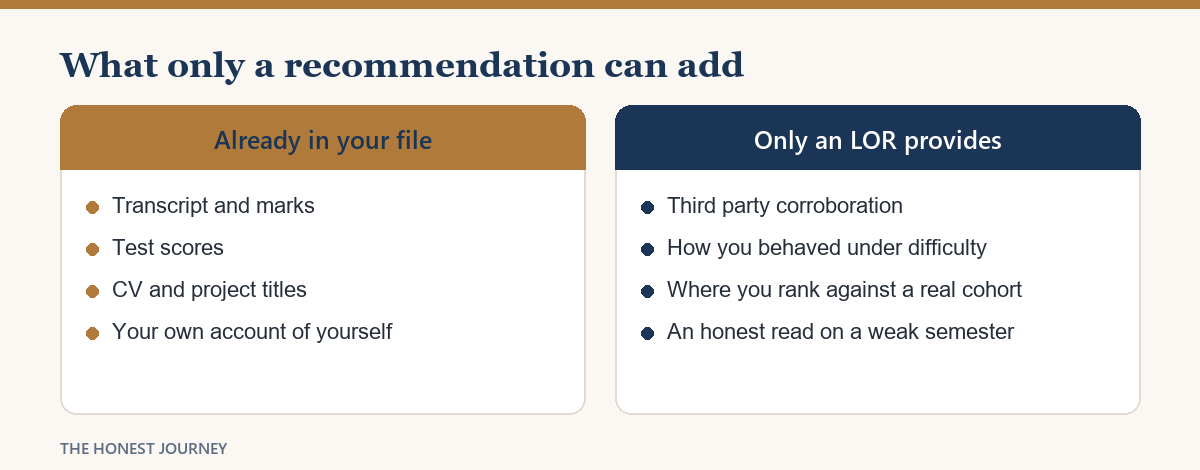
An admissions committee already has your transcript, your test scores, your CV and your statement of purpose. All of those are things you assert about yourself.
The letter of recommendation exists to do one thing those cannot: provide third party evidence, from someone who watched you work, about qualities that do not appear on a transcript.
Specifically, the reader is looking for:
- Corroboration. Does an independent person confirm what your application claims?
- Behaviour under difficulty. How did you handle a hard problem, a failure, a deadline?
- Comparison. Where do you sit relative to others this person has taught or managed?
- Anything the file hides. A weak semester with a real explanation, a project whose difficulty is not obvious from the title.
Notice that none of these are “is this person hardworking and sincere.” That sentence appears in a very large share of Indian LORs and it carries no information, because it is what every letter says.
Faz's ruleA recommendation that only praises you is not a recommendation. It is a character reference, and admissions committees discount those almost entirely.
The value is in the specific, checkable detail that only someone who supervised you could know. Everything else is padding, and experienced readers skim straight past it.
Who to ask, in order of usefulness
Applicants routinely optimise for the wrong thing here, chasing seniority when the reader wants proximity.
Best: someone who supervised your actual work closely. A project guide, a thesis supervisor, a manager who reviewed your output weekly. They can describe how you think, which is the whole point.
Good: a professor whose course you did demonstrably well in, where there was real interaction. A lab component, a term project, office hours. They can compare you to a cohort.
Weak: a very senior person who barely knows you. A head of department or a company director who met you twice will write something warm and empty. Seniority does not compensate for lack of specifics, and readers can tell instantly.
Usually a mistake: family friends, employers of relatives, or anyone whose relationship to you is not academic or professional. Several universities explicitly disallow these.
How many, and what mix
Most master’s programmes want two or three. The useful default for a recent graduate is two academic and one professional if you have work experience. For an applicant with several years of work behind them, flip it: two professional and one academic, since recent evidence matters more than a lecturer who taught you six years ago.
For a PhD, academic letters dominate, and a letter from someone active in the field you are entering carries disproportionate weight because the reader may actually know them.
The write-it-yourself problem
This is the situation most Indian applicants land in, so it deserves proper treatment rather than moral hand wringing.
First, the honest framing. A recommender who asks you to draft something and then reads, edits and signs it is making a judgement and taking responsibility for the content. That is different from a letter you write and submit without them meaningfully seeing it, which is misrepresentation and is treated as such if discovered.
The practical risk sits with the second version, and it is not hypothetical. Universities do contact recommenders. Letters submitted from personal email addresses rather than institutional ones attract scrutiny. Two letters from different people that share sentence structure are noticed, and that happens constantly when one applicant drafts all three.
How to do it properly if you are drafting
Do not write a letter. Write a brief, and let them turn it into a letter.
Give your recommender a page containing: the programme and why you are applying, two or three specific incidents from working with them including what went wrong, your actual output on that work, and the one or two qualities you hope the letter will evidence. Then ask them to write it in their own words, or to edit heavily.
If they insist on a full draft, write it in their voice and their register, not yours. A professor who has taught for twenty years does not write like a twenty two year old applicant. Vary the structure across your three letters deliberately, because three letters with identical architecture is the single clearest signal that one person wrote all of them.
Faz's ruleThree letters that share a sentence structure tell the reader one person wrote all three. That is the most common and most avoidable LOR failure in Indian applications.
If you are drafting more than one, change the shape as well as the words. Different opening, different order, different length. Same voice across three recommenders is what gets noticed.
What makes a letter strong
Four things, in rough order of how much they move a reader.
1. A specific incident, told properly
“He is a dedicated student” is worth nothing. “When the sensor calibration failed two weeks before his project deadline, he rebuilt the acquisition pipeline in Python rather than extending the deadline, and the resulting dataset was clean enough that a second student used it the following term” is worth a great deal.
One such paragraph outperforms a page of adjectives. If the letter contains no incident that could only have been observed by this recommender, the letter is not doing its job.
2. An explicit comparison
Readers want calibration. “Among the roughly two hundred students I have supervised on final year projects, I would place her in the top five” is concrete and checkable in a way that “an excellent student” is not.
This is also where Indian LORs tend to be weakest, because the convention here is warm generality rather than ranking. A recommender who is uncomfortable ranking can still say “the strongest student in a cohort of sixty this year”, which is the same information in softer language.
3. Honest limits
Counterintuitively, a letter that acknowledges a genuine weakness reads as more credible, not less. “Her written English needed work at the start of the project, and she took it seriously enough that her final report was among the clearest I received” is a stronger sentence than uniform praise, because it demonstrates the recommender was actually paying attention.
Uniformly glowing letters from every recommender are, paradoxically, discounted.
4. Coverage of what the file hides
If you have a gap year, a weak semester, or a switched field, one recommender addressing it directly is worth more than you explaining it yourself. Third party corroboration is the entire currency here. Our page on studying abroad with an average academic record covers how much a weak marksheet actually costs.
The practical mechanics
| Question | The practical answer |
|---|---|
| How long | 400 to 600 words, or roughly one page. Longer is not better. |
| Letterhead | Institutional letterhead where possible, signed and dated. |
| Email address | Institutional, not Gmail. Personal addresses invite verification. |
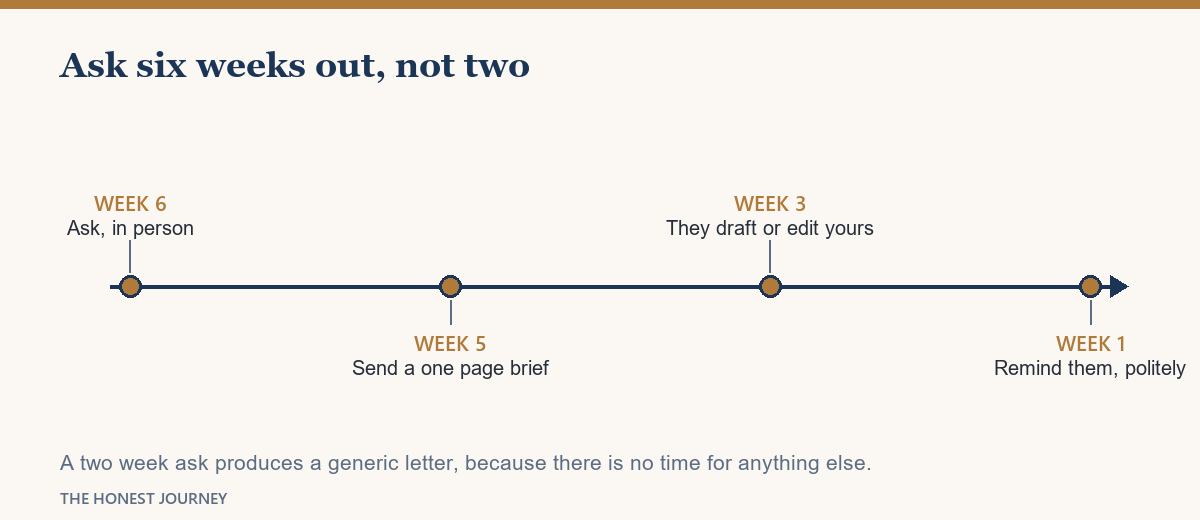
| How far ahead to ask | Four to six weeks. Two weeks is rushed and produces a generic letter. |
| Waiving your right to view | Yes, waive it. Unwaived letters are read as less candid. |
| Same letter for every university | Mostly fine. The programme name and any programme specific line should change. |
| Following up | Politely, at two weeks and one week before the deadline. Recommenders miss deadlines constantly. |
Patterns that weaken Indian LORs specifically
These recur often enough to be worth naming directly.
Formal register mistaken for strong content. “It gives me immense pleasure to recommend” is a common opening and it spends your first sentence on nothing. Foreign readers register it as filler.
Marks recited back. The transcript is already in the file. A letter listing your percentage in each subject is wasting the one document that could say something else.
Superlatives without a denominator. “One of the best students I have ever taught” means little without knowing how many that is or where the others went.
All three letters from the same institution and the same register. Where you have work experience, mixing in a professional letter adds a genuinely different perspective, which is more valuable than a third academic voice saying the same thing.
Signed but unread. The riskiest version, and the most common. If your recommender has not actually read the letter going out under their name, you are exposed if the university calls them.
Why this is a money question
Same logic as the rest of the application, and worth stating plainly.
Weak recommendations do not usually cause an outright rejection on their own. What they do is fail to lift a borderline file. For most Indian applicants competing for funded places or for admits at schools worth the loan, borderline is exactly where the file sits, and the LOR is one of the few components you can still improve for free at that stage.
A rejection cycle costs a year of forgone salary plus another round of application fees at roughly ₹8,000 to 15,000 per university. Asking six weeks early and writing a proper brief costs you an afternoon. If the degree is going to be funded by a loan, our education loan guide covers the sanction side, and the whole point of a strong application is to make that borrowing buy an admit worth having.
Frequently asked questions
What is a letter of recommendation for students?
A letter of roughly 400 to 600 words from a professor or manager who supervised your work, submitted with a university application. Its purpose is to provide independent evidence about how you work, which your transcript, CV and statement of purpose cannot supply because those are your own claims.
What is the correct LOR format?
Institutional letterhead, dated, addressed to the admissions committee, roughly one page. Opening line stating who the recommender is and how they know you and for how long, then one or two specific incidents, then a comparison against other students or colleagues, then a clear recommendation and contact details.
How many letters of recommendation do I need?
Most master’s programmes ask for two or three. Recent graduates should lean academic. Applicants with several years of work experience should lean professional, since recent evidence matters more than a lecturer who taught you years ago. PhD applications are academic dominated.
My professor asked me to write it myself. Is that allowed?
It is extremely common in India. If your recommender genuinely reads, edits and signs it, they are taking responsibility for the content. Submitting a letter they have not meaningfully reviewed is misrepresentation. The safer approach is to give them a one page brief with specific incidents rather than a finished letter.
Can universities tell if I wrote my own LOR?
Often, yes. Three letters sharing a sentence structure is the clearest giveaway, and it happens whenever one applicant drafts all of them. Personal email addresses instead of institutional ones invite verification, and universities do contact recommenders.
Should I ask a senior professor who barely knows me?
No. Proximity beats seniority every time. A head of department who met you twice writes a warm, empty letter. A project guide who supervised you weekly can describe how you think, which is the only thing the reader actually wants.
Should I waive my right to see the letter?
Yes. Waived letters are read as more candid and therefore carry more weight. Retaining access signals that the recommender may have written knowing you would read it.
The honest closing
The letter of recommendation is the component applicants think about last and the one where a small amount of effort changes the most, because almost everyone submits something generic.
The whole task is getting a specific, checkable observation from someone who actually watched you work. That means asking the right person rather than the most senior one, asking six weeks early rather than two, and giving them the raw material to write something only they could have written.
And if you end up drafting it, which you probably will, write a brief rather than a letter, make sure they genuinely read what goes out under their name, and vary the three so they do not read as one voice. For the other half of this, see the honest guide to the statement of purpose, and for the visa document, which is a different thing entirely, the SOP for a student visa.